Pompey’s Pillar: Discover The Beauty of Alexandria
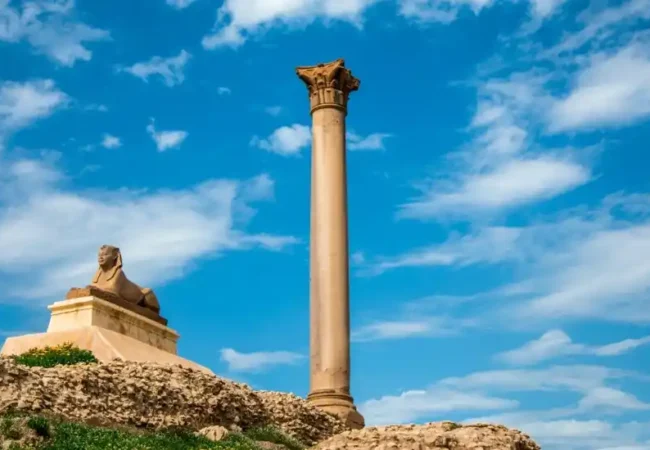
Alexandria is a city with a rich history, and Pompey’s Pillar in...



Imagine descending deep into the earth, into a dark and mysterious world where the only light comes from your lantern. This is what awaits visitors to the Catacombs of Kom El Shoqafa in Alexandria, Egypt.
Discovered in 1900, the Catacombs are a series of tunnels and caves that contain some of the most fascinating ancient Egyptian art ever discovered. This artwork includes carved sarcophagi, colorful murals, and even a replica of the ancient city of Alexandria itself.
If you’re visiting Alexandria, be sure to add the Catacombs of Kom El Shoqafa to your list of must-see attractions. You won’t be disappointed!
Overview of the Catacombs of Kom El Shoqafa

Overview-of-the-Catacombs-of-Kom-El-Shoqafa-EgyptaTours
Your journey into the Catacombs of Kom El Shoqafa begins in a small room, where your guide provides you with a short history of the site. You then descend a set of steep, narrow stairs, winding down into the darkness.
As your eyes start to adjust to the darkness, you begin to make out the features of the catacombs before you. The ceilings are low and the air is thick and musty, as if it has been trapped down here for centuries. You can’t help but feel a sense of excitement as you explore these hidden treasures.
one of Alexandria’s most popular tourist attractions, and for good reason. These labyrinthine tunnels were used to bury the dead from the late Roman period to the early Islamic period, and they offer an insight into Egypt’s ancient history. With its carved columns and intricate reliefs, the catacombs are a sight to behold.
it holds a fascinating historical significance, blending the influences of Alexander the Great, Egyptian, Greek, and Roman cultures. Dating back to the 4th century, these burial chambers offer a unique glimpse into ancient funerary practices.
Legend has it that in 1900 when a donkey accidentally fell into a shaft leading to the catacombs, its discovery led to the unearthing of this remarkable underground complex. The catacombs feature intricate carvings and artwork that showcase both Egyptian and Greek styles.
One notable funerary scene depicts Anubis, the Egyptian god of embalming and mummification, in an Egyptian-style top section. Below it is a portrayal of the mythological abduction of Persephone in Greek style. This fusion of artistic traditions reflects the cultural exchange that occurred during this era.
The catacombs also demonstrate influences from early imperial Roman architecture. The use of arches and columns showcases Roman engineering techniques while maintaining elements from both Egyptian and Greek architectural styles.
Today, these catacombs stand as a testament to the rich history and cultural diversity that existed during ancient times. Exploring their depths allows us to appreciate how different civilizations merged their beliefs and artistic expressions in this unique burial site.
The Ancient Marvels of the Catacombs of Kom El Shoqafa
The Catacombs of Kom El Shoqafa in Alexandria are an amazing example of ancient funerary architecture. The tombs were carefully carved directly into Alexandria’s bedrock, showing the skill of ancient builders and their understanding of what was needed for such a large structure. The lowest level is currently closed due to water infiltration so only the top two levels are open for visitors.
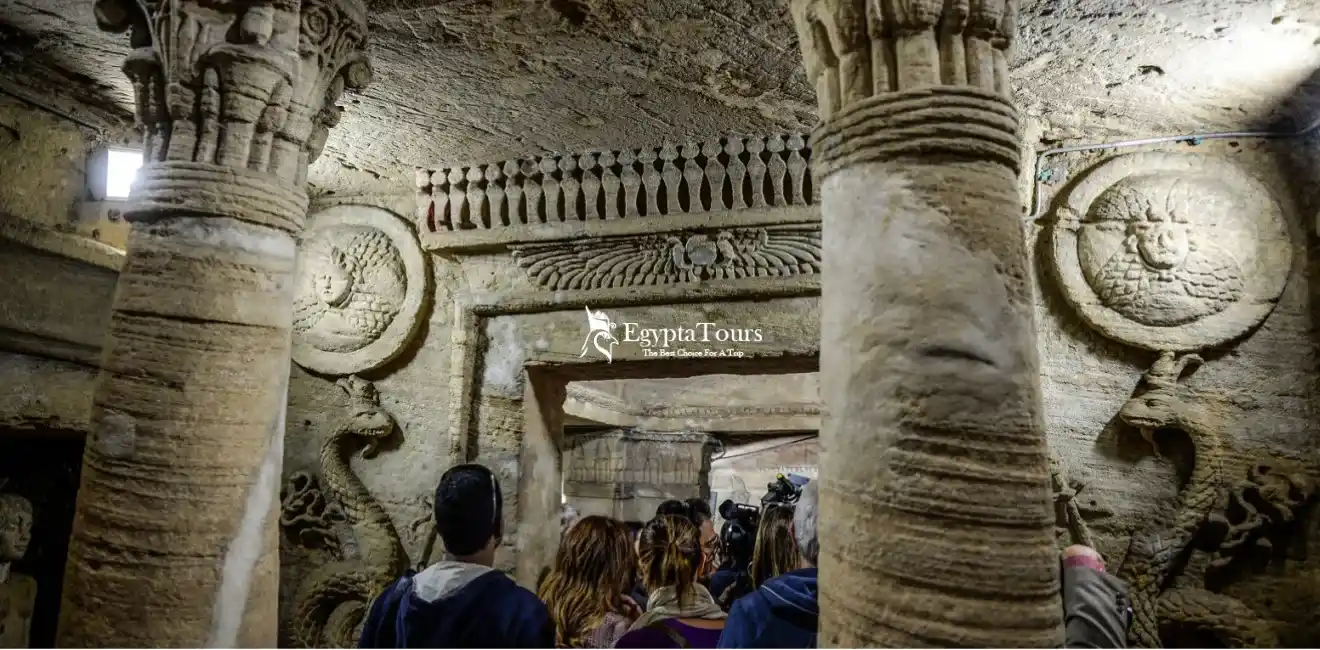
Visitors enter the catacombs through a spiral staircase that wraps around a central shaft. This shaft was used to lower bodies and offerings into the tombs using ropes, keeping the remains intact. Rectangular openings in the walls let natural light in, giving the descent a mystical feeling.
At the bottom, visitors reach the Rotunda, a round hall with a domed ceiling supported by six tall pillars. This hall helps visitors orient themselves and shows the mix of Egyptian and Greco-Roman architecture. Next to the Rotunda is the Triclinium, a Roman-style dining area where family and friends could hold funeral banquets or commemorations. The U-shaped stone benches show the respect given to the deceased and the importance of ritual feasts.
Beyond these main areas, the catacombs have many chambers, corridors and Luculi (burial niches) decorated with carvings, frescoes and symbolic images combining Egyptian, Greek and Roman elements. The care in these decorations shows how important the afterlife was in Alexandrian society and how much people wanted to honor the dead.
Before entering the main burial chamber, visitors pass through two corridors, one on the east and one on the west. After walking through the hall past the Rotunda, they reach a small vestibule. On the east side is a statue of a man in a niche and on the west side a statue of a woman. Both are made in the Egyptian style but include some Greek details, showing the cultural mix in Alexandria.
The burial area is surrounded by a low wall called the parapet with a dome supported by six pillars. Between the pillars were statues of human heads, some of which were later moved to the Greco-Roman Museum.
The walls are decorated with floral designs and the deceased were laid in the niches. After burial, the niches were sealed with stones and decorated with Medusa heads, Dionysus and other mythological figures. On the front wall above the sarcophagus, a mummy lies on a funerary bed as the main focus.
The main burial chamber has two large composite columns decorated with Egyptian and Greco-Roman motifs, including winged sun disks, Medusa heads and depictions of Anubis in Roman armor. There are three stone sarcophagi with fixed lids, carved with mythological scenes, floral garlands and gods from both Greek and Egyptian traditions, showing the wealth and beliefs of Alexandria’s Greco-Roman elite.
Nearby, the Tomb of Tigrane has wall paintings mixing Pharaonic symbols with Hellenistic styles, showing Alexandrian art. The Tomb of Wardian has a small painted chapel that once held a statue of Isis, giving visitors a view of Alexandria’s artistic and cultural heritage.
The god Anubis is shown waiting for the dead, holding a jar with liquids for mummification in his left hand while his right hand touches the mummy. He wears Roman clothing with a sun disk and cobras on his head.
Next to him is the Egyptian god of knowledge and wisdom, wearing the double crown, holding a scepter in one hand and a jar in the other. A lion-shaped table shows the god Horus standing, wearing the double crown of Upper and Lower Egypt. Nearby is a lady with a sun disk above her head, hands raised in prayer. In front of her, a priest wearing a long garment offers a lotus flower and a jar.
An emperor or ruler wearing a short kilt is placing the double crown on his head while offering a necklace to the sacred bull Serapis. Behind Serapis, a goddess stretches her wings, likely Isis. The right side of the chamber mirrors this design with a sarcophagus decorated the same way.
At the end of the second floor, a staircase leads to the third floor with a platform inclined along the stairs. This level is currently underwater.
The catacombs contain 502 rare artifacts, including 39 coffins, 17 Sphinx statues, 156 bases and column capitals, seven gutters and nearly 300 other artifacts.
Even with all these details, seeing the Catacombs of Kom El Shoqafa in person is an experience beyond words with many secrets and wonders waiting to be discovered.
Visitors can descend the spiral staircase of 99 steps, connecting all three floors. The staircase is made of square stones with round windows that let in natural light. It was once lit with oil and used for incense with steps designed higher at the beginning and gradually lower for visitor comfort.
The staircase leads to the first floor, starting with a corridor that opens into a round hall. At the center is a deep well 8.5 meters in diameter with a domed ceiling supported by six pillars and walls decorated in red. Beyond this is a second large square hall, 9 meters long and 8.5 meters wide, showing the scale and sophistication of the catacombs.
History of the Catacombs of Kom El Shoqafa

History-of-the-Catacombs-of-Kom-El -Shoqafa- EgyptaTours
The Catacombs were discovered in 1900 when a group of locals were digging a well. What they found was a series of caves, corridors and tombs that had been carved out of the limestone rock.
The catacombs date back to the 2nd century AD, and are thought to have been used as a burial place for the wealthy residents of Alexandria. The caves and tombs are intricately carved, and decorated with scenes from Egyptian mythology and the Bible.
The catacombs were closed to the public for many years, but they were reopened in 2005 and are now a popular tourist attraction.
What to See and Do at the Catacombs of Kom El Shoqafa

What-to-See-and-Do-at-the-Catacombs-of-Kom-El-Shoqafa-EgyptaTours
Kom El Shoqafa catacombs are one of Alexandria’s most popular tourist attractions for a good reason: they’re absolutely fascinating. This labyrinth of underground tombs and tunnels was carved out of the rock in the late 1800s, and it’s a true wonder to behold.
The Catacombs of Kom El Shoqafa, meaning “Mound of Shards,” is a historical archaeological site in Alexandria, Egypt, dating back to the 2nd to 4th centuries AD. These catacombs were built during the Roman period and reflect a blend of Roman, Greek, and Egyptian cultural influences.
A circular staircase leads down into the complex, where visitors can explore its many chambers, including a large banquet hall believed to have been used for commemorative feasts in honor of the dead.
The catacombs, likely created during the reign of a Roman emperor, stand as a fascinating testament to ancient burial customs and the fusion of different traditions.
Tips for Visiting the Catacombs of Kom El Shoqafa
Tips-for-Visiting-the-Catacombs-of-Kom-El-Shoqafa-EgyptaTours
When you go to explore the Kom El Shoqafa Catacombs , make sure you plan enough time to get through it all. After all, there’s a lot to see and experience! Here are some tips for getting the most out of your visit:
Getting to and Around the Catacombs

Getting-to-and-Around-the-Catacombs-EgyptaTours
You can reach the Catacombs of Kom El shoqafa by taking a cab from the airport, or traveling by train. The nearest metro station to the Catacombs is Ramses. Once you’ve reached the Catacombs, a tour guide is recommended to help you maneuver around the area; there are several pathways and staircases throughout, so it’s easy to get lost.
When you tour the Catacombs, you will be taken down several flights of stairs leading into an underground world of brightly painted frescoes and three distinctive levels that offer stunning views of ancient architecture. A major highlight is undoubtedly the central chamber that houses a grandiose spiral staircase, which showcases finely crafted pillars and decorations. From here, visitors can view some incredible artwork that dates back to Roman, Greek and Egyptian times.
The Catacombs are an excellent example of the intricate details that have been incorporated into early Egyptian culture, making it a must-visit destination for anyone interested in exploring Egypt’s rich history.
Best Tours To Catacombs of Kom El Shoqafa
| Tour Name | Duration |
|---|---|
| Egypt 12 Days : The Ultimate Itinerary | 12 Days – 11 Nights |
| 10 Days Cairo & Nile Cruise and Hurghada Trip | 10 Days – 9 Nights |
| 4 Days Cairo and Aswan Tour Package | 4 Days – 3 Nights |
| 5 Days Cairo, Aswan and Abu Simbel Tour Package | 5 Days – 4 Nights |
| Alexandria 1 Day Tour | 1 Day – 10 Hours |
The Catacombs of Kom El Shoqafa stand as one of Alexandria’s most remarkable archaeological treasures, offering a rare glimpse into a time when Egyptian, Greek, and Roman cultures merged underground. From its spiral stairway to its richly decorated burial chambers, the site reflects both the artistry and beliefs of a multicultural ancient society.
Visiting the catacombs is more than a walk through tombs—it’s a journey into the layered history of Alexandria and a must-see experience for anyone interested in ancient civilizations and hidden wonders beneath the city.
Exploring the Catacombs of Kom El Shoqafa: Frequently Asked Questions
The Catacombs of Kom El Shoqafa are an ancient burial site in Alexandria, Egypt. They’re renowned for their unique blend of Egyptian, Greek, and Roman architectural styles.
These catacombs were constructed in the 2nd century AD. They served as a family tomb for the first two centuries of their use.
They were accidentally discovered in 1900 when a donkey fell into the access shaft, revealing the entrance to the underground complex.
The catacombs showcase a fusion of Egyptian, Greek, and Roman styles, reflecting the diverse cultural influences in Alexandria during that era.
Visitors can explore various chambers and passageways, including the Hall of Caracalla, rotunda, and an antechamber. There are intricate carvings, sculptures, and frescoes throughout.
Yes, they are open to the public. Visitors should check local guidelines and opening hours before planning their trip to ensure access.
They are located in the Carmous district of Alexandria. Tourists can reach them via public transportation, taxi, or guided tours.
Photography policies may vary, and it’s best to confirm with the site management. Flash photography might not be permitted to preserve the paintings and sculptures.
Yes, guided tours are often available. They offer valuable insights into the history and significance of the catacombs.
The cooler months from October to April are ideal for visiting, as temperatures are more comfortable for exploring the site.
The catacombs contain narrow passageways and stairs, which may be challenging for visitors with mobility limitations. It’s advisable to inquire about accessibility before visiting.
Yes, Alexandria has many attractions, such as the Alexandria National Museum, the Bibliotheca Alexandrina, and the Roman Amphitheater, all worth exploring alongside the catacombs.




Explore our top-rated Egypt travel packages and embark on an unforgettable journey. From the Pyramids of Cairo to the magical temples of Luxor, Aswan, and Abu Simbel, discover expertly curated tours designed for your perfect Egyptian adventure