Giza Necropolis Tickets: Official Visitor Guide & Prices
Giza Necropolis is one of the most visited tourist sites in Egypt...



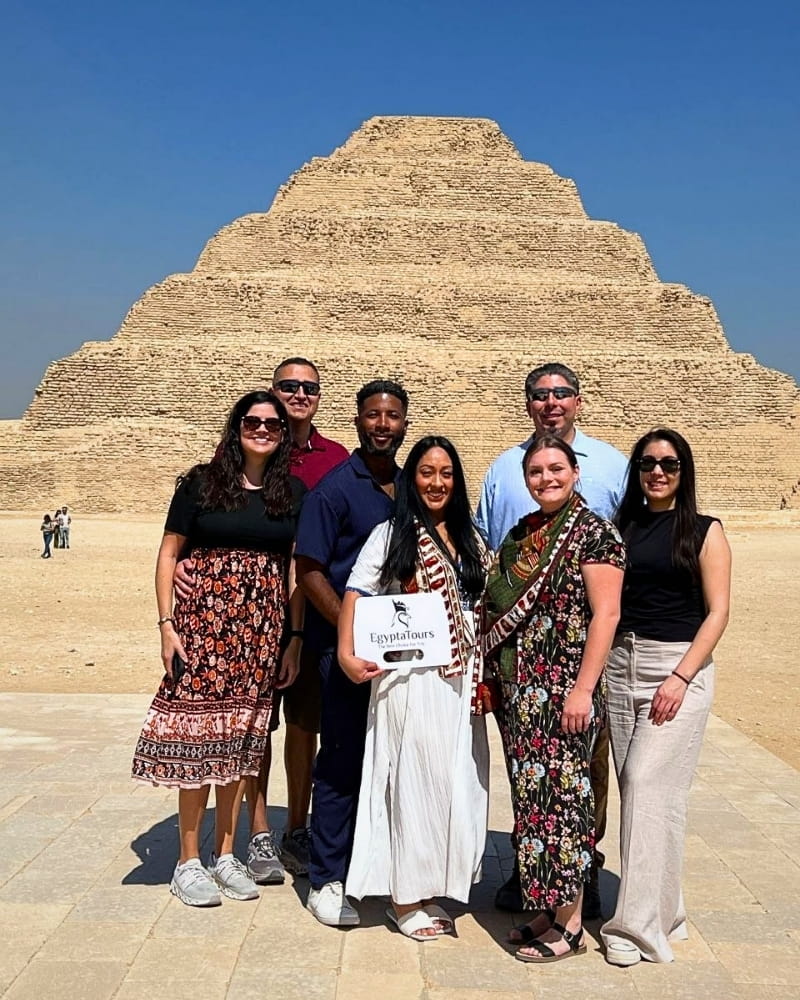
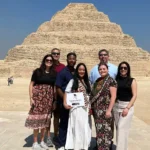
The Step Pyramid of Djoser, located in the ancient Saqqara necropolis and built during Egypt’s Third Dynasty (c. 27th century BCE) for Pharaoh Djoser, stands as the world’s oldest monumental stone building. Designed by the visionary architect and vizier Imhotep, this revolutionary structure broke away from traditional mud-brick mastabas by stacking rectangular tiers into a striking six-tiered, 62-meter-tall monument. Enclosed within a sprawling 40-acre mortuary complex complete with a massive stone wall, a colonnaded entrance, a Heb Sed court, and a 3.5-mile subterranean maze of tunnels containing over 40,000 ancient stone vessels, Djoser’s pyramid marked a pivotal architectural milestone that forever changed Egyptian burial traditions and paved the way for future pyramid builders.
Key Takeaways
World’s Oldest Stone Monument: Constructed approximately 4,700 years ago, the Step Pyramid is humanity’s earliest colossal stone building, moving beyond traditional mud-brick architecture into permanent limestone.
Visionary Architect Imhotep: Designed by Djoser’s renowned vizier Imhotep—who later became revered in Egyptian history as a master builder and a god of medicine—the structure introduced groundbreaking engineering concepts.
Stepped Architectural Innovation: Rather than a traditional smooth-sided or single-level design, the pyramid consists of six mastabas stacked progressively smaller on top of one another, reaching an original height of 204 feet (62 meters).
Expansive Mortuary Complex: The 40-acre surrounding enclosure features a 30-foot-high defensive wall, a magnificent limestone Colonnaded Hall, the Heb Sed Court for royal renewal rituals, and the Serdab containing the earliest known life-sized Egyptian royal statue.
Vast Subterranean Labyrinth: Beneath the pyramid lies a 3.5-mile network of tunnels and a granite burial chamber surrounded by descending shafts housing over 40,000 carved stone jars bearing the names of earlier First and Second Dynasty rulers.
Recent Restoration and Reopening: Following extensive conservation work by skilled engineers using modern techniques to stabilize ancient cracks, the historic landmark was successfully restored and reopened to the public in 2020.
Saqqara, located in southern Cairo between Giza and Dahshur, is dotted with several fascinating monuments, including a number of tombs and a few crumbling pyramids, but the Djoser’s step pyramid is a must-see.
The 4,700-year-old step pyramid, built for the third dynasty pharaoh Djoser in the 27th century B.C., is the world’s oldest stone monument of its size. Djoser’s Pyramid, which was originally intended as a tomb, has fascinated tourists for centuries, as demonstrated by the graffiti on its walls.
In this blog post, you’ll get to know all about the Pyramid of Djoser-the world’s oldest still-standing stone building.

The-Step-Pyramid-Of-Djoser-Must-See-Landmark-In-Saqqara-Egypt-EgyptaTours
Djoser (also known as Netjerikhet, Tosorthos, and Sesorthos; c. 2670 BCE) was the first pharaoh of Egypt’s Third Dynasty. Little is known about Djoser’s childhood or family life.
He succeeded his father, the last king of the Second Dynasty, Khasekhemwy, and his mother, Queen Nimaathap. Hetephernebti, his wife, was most likely his half-sister.
Although it was customary for the pharaoh to have a queen and lesser wives, Djoser had no other wives other than Hetephernebti.
Reigning for over twenty years, Djoser is most known for his Step Pyramid, the first pyramid ever built in Egypt, but he also initiated a number of other construction projects; so many, in fact, that experts have estimated a reign of over thirty years to account for the number of tombs, temples, and monuments he ordered.
The famous Djoser’s step pyramid, which, like all of Egypt’s pyramids and monuments, was built by skilled Egyptian craftsmen and workers rather than slaves.
Originally planned as a simple mastaba tomb, Imhotep’s Step Pyramid developed to become the highest monument of its day and a tourist attraction that drew visitors from all over the country.
Djoser’s step pyramid is an iconic landmark that Egypt has never attempted before. Previously, kings were buried in mastabas, rectangular tombs built over underground chambers that rose no higher than 20 feet (6 meters).
Djoser’s step pyramid is a series of mastabas placed on top of each other, each level a little smaller than the one beneath, to create a pyramid shape.
Earlier mastaba constructions were made of clay brick, but the Djoser’s step pyramid was made of limestone blocks with carved symbols of trees (holy to Egyptian gods) and reeds, presumably representing The Field of Reeds, the Egyptian afterlife.
The pyramid was formed out of over 11.6 million cubic feet of limestone and clay (330,400 cubic meters).
The tunnels underneath the pyramid form a 3.5-mile (5.5-kilometre) labyrinth.

Why-Was-the-Saqqara-Step-Pyramid-Built-EgyptaTours
Prior to Djoser’s reign (c. 2670 BCE), the first pharaoh of Egypt’s Third Dynasty, mastaba tombs were the standard style of burial: typically rectangular monuments made of dried clay brick that covered underground pathways where the corpse was entombed.
By simply digging in from the top, thieves could easily reach the smaller mastaba tombs, where pharaohs were buried.
For safety reasons, Imhotep (c. 2667 BCE), Djoser’s vizier, constructed a more magnificent tomb for his king by stacking mastabas on top of one another, gradually shrinking them to make the design known today as the Step Pyramid.
Djoser’s step pyramid would have made it very hard for a thief to dig his way into the burial chamber from the top.
Unfortunately, despite the fact that this pyramid afforded enhanced security, it was ultimately broken into, and most of the burial items, including Djoser’s mummy, were looted.
Apparently, not every mummy has been removed from the tomb. Recent investigations showed that three mummies from the late period (approximately 712–332 B.C.) were buried inside Djoser’s burial chamber.
This suggests that during this era, people had not only broken into the king’s burial chamber but were also burying more mummies within it.

Djosers-Step-Pyramid-Construction-Ancient-Stone-Architecture-In-Saqqara-Egypt-EgyptaTours
Over the last century, Djoser’s step pyramid has been thoroughly studied and analyzed, and it is now known that the construction process went through several multiple phases, including a few false attempts.
Imhotep appears to have started with a basic mastaba tomb. He planned to go higher than the highest mastaba, which was 20 feet (6 meters).
According to studies, the pyramid began as a square mastaba rather than the customary rectangular design, and was later modified to a rectangular shape.
It is unknown why Imhotep opted to abandon the conventional rectangular mastaba design, although it is likely that Imhotep had a square-based pyramid in mind from the start.
Imhotep intended to carry on the tradition of early mastaba decoration with writings and carvings of reeds.
His great, towering mastaba pyramid would contain the same subtle touches and powerful symbolism as the more modest tombs that had come before it, and even better, they would all be made of stone rather than dried mud.
When finished, the Djoser’s step pyramid was 204 feet (62 meters) tall, making it the highest structure of its day.
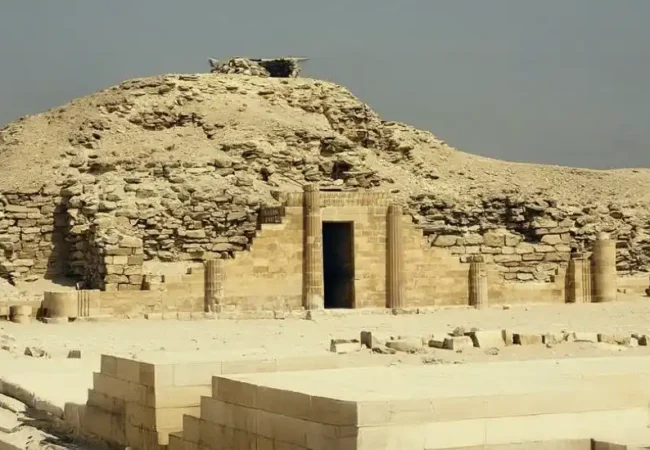
The surrounding complex, which covered an area of 40 acres (16 hectares) and was enclosed by a wall 30 feet (10.5 meters) high, comprised a temple, courtyards, shrines, and residential rooms for the priests.
The wall had 13 fake entrances carved into it, with just one actual entry cut in the south-east corner; the entire wall was then surrounded by a 2,460-foot-long (750-meter-wide) trench.
The fake doors and trench were built within the compound to prevent unwelcome visitors.
To explore the inner courtyard and temples, one would have required to be shown how to enter.
The engineer Imhotep designed the pyramid of Saqqara, which made him one of the greatest engineers in the era of King Djoser. Over time, the engineer Imhotep acquired great knowledge in the field of medicine and became one of the most famous wise physicians in ancient Egypt. People would flock to him seeking treatment.
Some scholars discovered the Blue Chambers under the Pyramid of Djoser. The chambers were named this because they contain blue faience tiles. These tiles were distinguished by shimmering with the color of the sky and giving the place more beauty. These chambers were part of the tombs built by the engineer Imhotep, who paid great attention to their design with high precision. Scholars believed that the blue color in these tiles symbolized the sky.

The-Colonnaded-Hall-First-Massive-Stone-Entrance-In-Ancient-Egypt-EgyptaTours
The Step Pyramid complex is considered one of the first stone entrances in ancient Egypt. It was built by the engineer Imhotep, and this complex is one of the most famous archaeological landmarks, reaching a height of about 200 feet. It is characterized by columns carved from limestone. This stage is one of the important stages in the life of the ancient Egyptians, as royal tombs evolved and took the shape of a pyramid. Its construction dates back to the era of the Third Dynasty in Egypt.
The Pyramid of Djoser is one of the oldest pyramids in the world. The Egyptian government was keen to restore it because many cracks had appeared on it due to natural factors. The restoration process was carried out by the most skilled engineers specialized in restoring antiquities. They used many modern techniques that helped them restore the pyramid with accuracy and efficiency while preserving its original shape. It was reopened in 2020 in a grand celebratory scene before the public.
There are many landmarks that can be visited in the Saqqara necropolis, the most prominent of which are:
The ancient Egyptians believed that the Djoser complex emulated the pharaoh’s palace, believing that kings, after their death, continue their lives in the other world. Therefore, the complex was built with many rooms and courtyards designated for kings only. Many massive walls were also designed, believing that they would protect the pharaoh on his eternal journey.
The prices for the Saqqara entrance ticket are 450 EGP for foreign visitors and 230 EGP for students. The visiting hours for Saqqara are from 8:00 AM to 5:00 PM. It is preferable to start your visit in the early morning to avoid severe crowding so you can explore the place without rush.
The pyramid and its surrounding complex were created to be visually stunning and to amaze visitors.
Djoser was so pleased with his achievement that he violated the custom of just having his own name carved on a monument and also had Imhotep’s name carved.
Djoser’s step pyramid, House of the North, House of the South, Serdab, Heb Sed Court, South Tomb, Temple T, and Northern Mortuary Temple are all part of the complex.
All of these, together with the surrounding wall, formed a complex the size of an ancient Egyptian metropolis.
Actually, Djoser’s complex was really greater than Hierkanpolis at the time.
The House of the North and the House of the South had no purpose, but it has been suggested that they represented Upper and Lower Egypt.
The Serdab (‘cellar’) is a stone box near the pyramid’s northern entrance where a life-sized sculpture of Djoser was discovered.
This sculpture would have been extremely valuable to the king’s soul in the afterlife.
The soul was supposed to have nine aspects, one of which, the ba (the bird-shaped symbol commonly seen on tomb carvings), could fly from earth to heaven at will.
However, it would have required a recognized landmark on Earth, which would have been the pyramid with the face of the king in front of it. Once the ba spotted its owner’s home from above, it could swoop down, enter, and return to the terrestrial world.
The significance of Pharaoh’s names and pictures comes into play here because the soul must be able to remember its previous home (physical body) on earth in order to be at ease in the afterlife.
The statue of Djoser, built in the complex, is the earliest known life-sized Egyptian sculpture still in existence and would have been built for this reason, as well as to remind tourists of the heritage of the great king.
The Heb Sed Court was associated with the Heb Sed Festival, during which the king established his right to reign.
The celebration was performed in the 30th year of the king’s reign, and then every three years after that to re-enact his coronation and renew his authority. This courtyard, which contains the Houses of the North and South, also boasts thirteen tiny chapels.
Three carved panels in the South Tomb represent Djoser executing the Heb Sed ceremony.
This mastaba-shaped tomb is said to have been constructed to accommodate another statue of the pharaoh.
Temple T is one of the complex’s most interesting and mysterious monuments.
The building’s front is basic with minimal decoration, but the interior is elegantly built with Djed pillars (indicating stability) throughout.
Inside, there are beautiful carvings as well, including one of a half-opened door that appears to be a real gateway.
The significance of this door sculpture is unknown, but it might have symbolized a symbolic doorway to the afterlife.
The Northern Mortuary Temple, located nearby on the north side of the pyramid, was used to enter the pyramid’s underground corridors that went down to the burial chamber.
Regarding the Djoser’s step pyramid, to prevent robbers and secure the king’s body and burial goods, the real chamber of the tomb, where the king’s body was laid to rest, were dug beneath the foundation of the pyramid as a maze of tunnels with rooms off the hallways.
Djoser’s burial chamber was made of granite, and getting there required navigating halls filled with thousands of stone containers engraved with the names of previous kings.
The underground complex’s additional rooms were for ceremonial reasons.
The underground corridors are enormous, and the stone containers are one of the most fascinating findings within. Over 40,000 of these jars, in different forms and shapes, were discovered in two of the pyramid’s descending shafts (the 6th and 7th shafts).
These vases are engraved with the names of Egyptian rulers from the First and Second Dynasties and are composed of various stones, including diorite, limestone, alabaster, siltstone, and slate.
These vessels have the names of the kings Narmer, Djer, Den, Adjib, Semerkhet, Ka, Heterpsekhemwy, Ninetjer, Sekhemib, and Khasekhemwy, as well as non-royal names of minor figures in history.

Step-Pyramid-Vs-The-Giza-Pyramids-Key-Differences-EgyptaTours
Saqqara often feels calmer than the Giza Plateau. It’s still a major site, but the space is wide, and the monuments spread out across the desert. Expect sun, wind, and a lot of walking on uneven ground. Bring water, sun protection, and shoes with grip. Respect barriers, they exist to protect fragile areas and to keep visitors safe.
A few myths follow the Step Pyramid around. The most common is that it’s “just a smaller pyramid.” It’s not. It’s a different type, built earlier, and it belongs to a much larger complex than many first-time visitors expect. Another misconception is that pyramids were built by enslaved people. Evidence from other pyramid sites points toward organized labor forces, with skilled workers and support systems. The details vary by period and site, but the old stereotype doesn’t hold up well.
Restoration is also part of what you’re seeing. Ancient stone has weathered for thousands of years, and conservation work can stabilize weak areas without turning the site into something new.
Access can shift from one visit to the next. Conservation work sometimes limits entry to underground areas, interior chambers, or tight passages. That isn’t a bad sign, it often means specialists are strengthening parts of the monument or managing visitor impact.
Before you go, check current site rules through a trusted tour operator or official guidance, and be ready to adjust your plan on arrival. If a space is closed, focus on what remains visible above ground, the complex was meant to be read from its courtyards and walls as much as from its hidden rooms.
Few monuments in human history are as significant as the Djoser’s step pyramid.
Without exaggeration, his pyramid complex represents a watershed moment in the growth of monumental stone construction in Egypt and across the world.
Djoser’s step pyramid was a groundbreaking architectural achievement, but it also served as the model for all subsequent great Egyptian pyramid builders.
Make sure to book an amazing vacation with Egyptatours to enjoy such an important landmark.
If You Would Like To Enjoy The Beauty And The Magic Of Theses Cities In Egypt, You Can Choose One Of Our Egypt Classic Tours Packages, Nile Cruises, Day Tours Or At Least You Can Customize Your Own Tour.
The Step Pyramid of Djoser, located in the ancient Egyptian necropolis of Saqqara, is one of the most important early architectural achievements in Egypt.
Built during the Third Dynasty by Pharaoh Djoser, it is the first monumental stone structure of its kind, constructed using over 40,000 stone blocks.
The pyramid is part of a larger complex that includes temples, courtyards, and funerary complexes, designed to honor the pharaoh in the afterlife. Beneath the pyramid lies a vast underground network of tunnels and chambers, further emphasizing its role as a grand burial site.
The Step Pyramid influenced later pyramids, including the Great Pyramid of Giza, marking a pivotal point in Egypt’s architectural evolution.
The Step Pyramid of Djoser, located at Saqqara, is part of a larger step pyramid complex and is considered the earliest large-scale building in stone.
Constructed during the 27th century BC for Pharaoh Djoser by his architect Imhotep, this revolutionary structure marked a turning point in ancient Egyptian architecture.
On the east side of the complex, chapels and ceremonial structures were built to support royal rituals, emphasizing the pyramid’s religious and political significance.
The Pyramid of Djoser, located in Saqqara, is one of Egypt’s most remarkable ancient structures and marks a major leap in architectural design.
Built for King Djoser during the 27th century BCE, it is considered the earliest colossal stone building in Egypt.
The pyramid was originally clad in white limestone, which would have gleamed brilliantly under the sun, symbolizing purity and eternity.
Designed by the architect Imhotep, this step pyramid served as a grand tomb and set the stage for the later smooth-sided pyramids of Giza.
The Step Pyramid is the world’s oldest monumental stone building. It’s the first pyramid the Egyptians built, setting the stage for future pyramids.
Imhotep, a renowned architect and priest, designed the Step Pyramid during Pharaoh Djoser’s reign. His innovative design broke new ground in ancient Egyptian architecture.
The pyramid is located in the Saqqara necropolis in Egypt, part of a larger mortuary complex.
Unlike later smooth-sided pyramids, Djoser’s Pyramid consists of six mastabas stacked atop each other, forming a step-like structure.
Yes, visitors can go inside the pyramid. It has recently reopened after extensive renovations, offering a glimpse into its ancient interior.
The pyramid was constructed during the Third Dynasty, around 4,700 years ago.
The pyramid originally stood about 62 meters (203 feet) tall, making it a significant achievement for its time.
The primary purpose was as a tomb for Pharaoh Djoser, ensuring his journey to the afterlife and highlighting his power and divine status.
The site is open daily. It’s best to check current visiting hours and consider a guided tour to enhance the experience.

Explore our top-rated Egypt travel packages and embark on an unforgettable journey. From the Pyramids of Cairo to the magical temples of Luxor, Aswan, and Abu Simbel, discover expertly curated tours designed for your perfect Egyptian adventure