What Was Horus The God of? The Sky, Kingship, and Protection
Horus was one of the most important gods in ancient Egyptian religion....



Primeval God of Air: Shu was one of ancient Egypt’s earliest creator deities, representing the air, wind, light, and the life-giving breath essential for all living creatures.
The Great Separator: His most famous mythological act was lifting his daughter, the sky goddess Nut, away from his son, the earth god Geb, creating the physical space for life to exist.
Guardian of Cosmic Order: Shu was not just a physical force; he embodied the principles of Ma’at (balance and harmony), acting as the eternal pillar that prevented the universe from collapsing back into chaos.
Member of the Ennead: As the son of the creator god Atum and the twin brother of Tefnut (goddess of moisture), Shu was a founding member of the Heliopolitan Ennead—Egypt’s nine most important deities.
Classic Iconography: In ancient art and temple reliefs, Shu is most commonly depicted as a man wearing an ostrich feather on his head, standing with his arms raised to support the heavens.
The Egyptian Shu God is considered one of the oldest and most important gods in ancient Egyptian religion, closely connected to the ideas of creation and cosmic order. Shu (in ancient Egyptian: šw, meaning “emptiness” or “the one who rises” and in Coptic: Ϣⲱⲓ) was one of the primeval gods in ancient Egypt. He represented the invisible force that fills the space between the sky and the earth and maintains balance in the universe.
Shu was the brother and partner of the goddess Tefnut and he was one of the gods of the Heliopolitan Ennead, the most significant group of deities in ancient Egyptian belief.
In most mythological traditions, Shu is described as the son of the sun god Ra who sent Shu and Tefnut to begin the first stages of creation.
He was known as the god of air, wind, light, peace and emptiness, all of which were essential elements for life as understood by the ancient Egyptians.
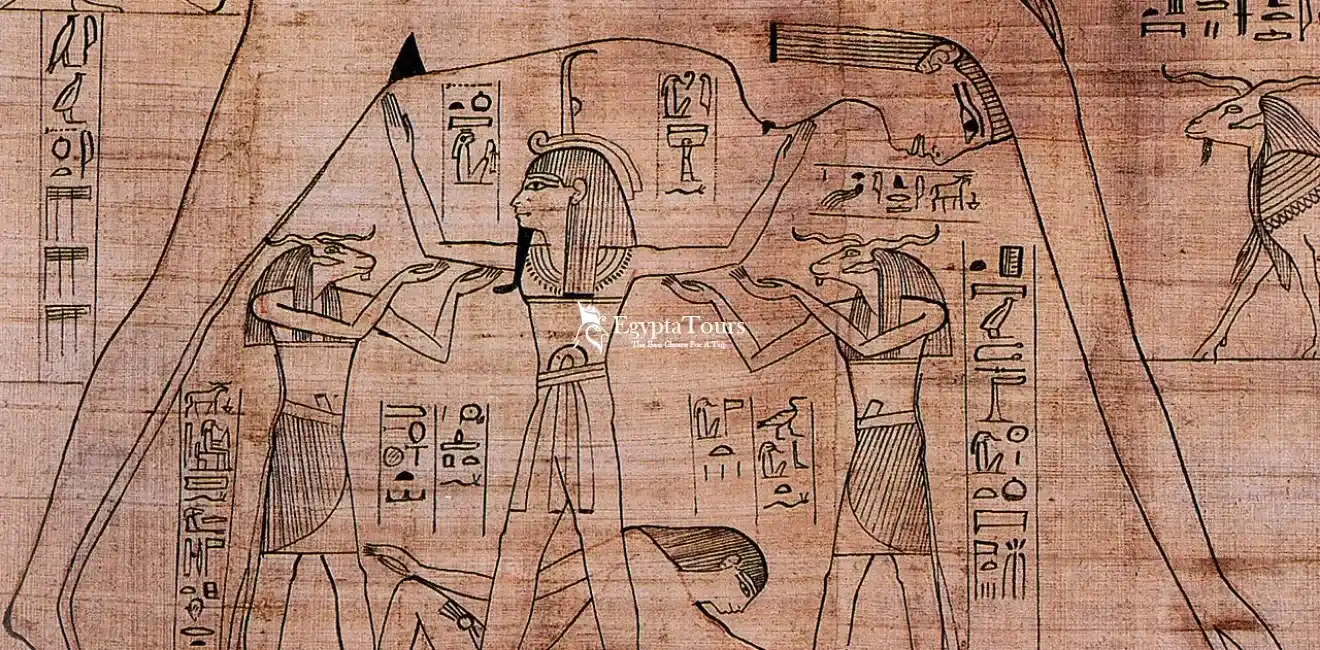
According to Egyptian mythology, Shu’s most important role was separating the sky from the earth. He lifted the goddess Nut (the sky) away from the god Geb (the earth), creating the space in which humans and all living beings could exist.
This act was not only a mythological event but also a symbol of cosmic balance and order, a core concept in ancient Egyptian thought. For this reason, He remained a symbol of calm strength and stability and continued to appear in religious texts, temples and ancient Egyptian reliefs up to the present day.
The-Origins-and-Family-of-Shu-God-EgyptaTours
According to Heliopolitan mythology, Shu God was the first deity to appear as the god of air. These myths explain that Shu took his place at the very beginning of creation, when the self-created god Atum began bringing the first beings out of the unformed state of chaos known as Nun, through the first act of emergence and creation.
Ancient Egyptian texts describe the origin of Shu in two main ways. In the first version, Atum is said to have spat or sneezed Shu, a symbolic image representing the breath of life that the god gives to creation.
In the second version, Shu is described as emerging or awakening from Atum’s breath itself, which clearly emphasizes Shu’s identity as the god of air and as a personification of the life-giving breath that the ancient Egyptians believed was essential for existence.
Shu had a divine twin, the goddess Tefnut, the goddess of moisture who represented his other half. Shu and Tefnut played an important role together in the process of creation and they were seen as cosmic twins, since air and moisture were both necessary for life to begin. From their union came two of the most important figures in the Egyptian pantheon: Geb, the god of the earth and Nut, the goddess of the sky.
Within the framework of divine genealogy, Shu held a central position as a member of the Heliopolitan Ennead, the group of nine creator gods.
His family relationships reflect his responsibility for organizing the world and maintaining balance among the forces of nature, a role that remained closely linked to the character of God Shu throughout ancient Egyptian religious thought.
Being one of the primeval gods, the Egyptian God Shu possesses immense power. He is stronger than any of his children and has the ability to keep them separated for millions of years.
Shu was the god of air and wind. The ancient Egyptians believed he represented the cool, calm air that exists between the earth and the sky. He was thought to bring peace and order, like a gentle breeze.
As the god of air, Shu has absolute control over the air. He can manipulate air currents, fly, generate winds and control their strength and direction.
Shu also possessed warrior-like qualities such as strength, speed, and endurance, and he was closely associated with the pharaoh.
He was often depicted in human form, wearing a feather (the hieroglyphic symbol of his name) on his head, with his arms raised to support the goddess Nut, separating her from her husband Geb. Shu was described as dwelling inside the sun disk, and he often appears as a bearded man carrying the sky and protecting the earth.
Sometimes Shu was shown as a lion cub or as a man with a lion’s head. On other occasions, he wore four ostrich feathers, symbolizing the four pillars that hold up the sky when Shu is absent. In his role as the god of light, he is often depicted holding the sun disk.
One of Shu’s most important tasks was to separate the sky from the earth. In Egyptian mythology, the sky goddess Nut and the earth god Geb were once joined together. Shu lifted Nut into the sky, creating the space necessary for life to exist on earth, The ancient Egyptians believed that without Shu, there would have been no place for humans or animals to live.
There is a famous hymn dedicated to the Egyptian God Shu that says: “That is my daughter, the living one, Tefnut who will be with her brother Shu. Life is his name and Order is hers. In the beginning, I lived with my two children, one before me and the other behind me. Life settled with my daughter Order, one inside me and the other outside. I rose above them but their arms were around me.”
This hymn was an important part of Shu’s daily worship. The ancient Egyptians prayed to him asking for a good life and sought light and guidance. He was worshiped in prayers, hymns and shrines and offerings were made to honor him. Shu also appeared in tombs and temples and he was well-known among the people with his ability to grant peace, order and life being central to his worship.
The responsibility of the deity of Air went beyond holding up the heavens. He was the eternal pillar of Ma’at. By keeping the Earth and Sky separated, he created the necessary space for light. He made it possible for the sun god, Ra, to sail safely across the sky each day.
The breath of Shu gave life to the mortal world. The dead depended on him as well. Shu acted as a divine guide for lost spirits. He steered them safely through the dark and hidden perils of the underworld.
His enduring strength was a direct model for the Pharaoh. The king served as the physical protector of order on Earth. He drew his power from the cosmic balance maintained by God of Air. The eternal nature of Shu represented the unbreakable foundation of the Egyptian state.
The-Myths-of-the-Egyptian-god-of-Air-EgyptaTours
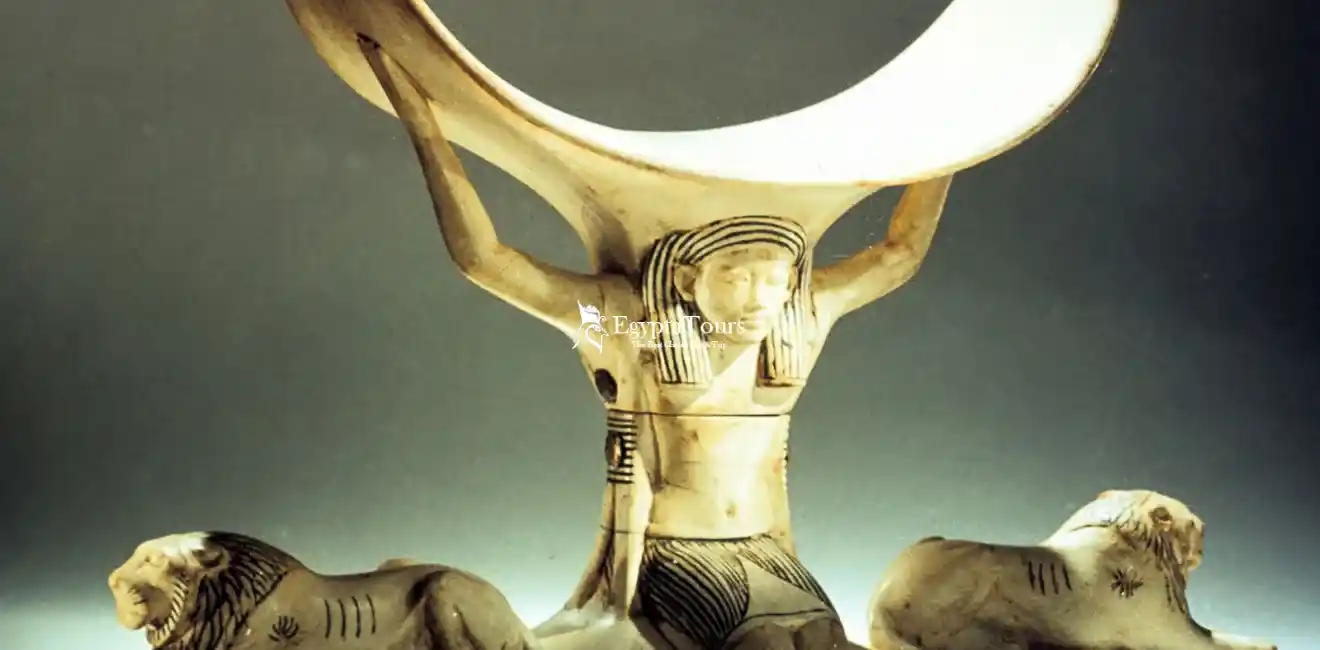
There is a well-known statue of this primeval god shown kneeling while holding a curved platform above his head which is often interpreted as representing the sky. In some cases, this form was also used as a headrest where the user would place their head upon what symbolized the sky. Two lions appear beside Shu, one on each side, emphasizing his strength and protective role.
As the god of air, Shu was seen as a source of cooling and calmness, which made him a symbol of peace, tranquility and reconciliation. Because of his association with dry air and stillness, Shu was also connected to the concept of Ma’at which represents truth, justice, order and balance. Shu embodied the dry atmosphere that exists between the earth and the sky, separating the two realms after the first act of creation, known as the First Occasion.
He was often depicted wearing an ostrich feather, sometimes one and sometimes up to four feathers as the ostrich feather symbolized lightness and emptiness. Shu was also associated with mist and clouds which were sometimes referred to as his “bones.” Due to his position between heaven and earth, Shu was also known as the wind.
In a later myth that reflects a great climatic disaster believed to have occurred at the end of the Old Kingdom, it is said that Shu and Tefnut once quarreled and Tefnut left Egypt and traveled south to the more temperate region of Nubia.
Shu quickly realized that he missed her, but Tefnut had transformed into a fierce cat that destroyed any man or god who approached her. Eventually, the god Thoth, using disguise, wisdom and persuasion, succeeded in convincing her to return.
The Greeks later associated Shu with Atlas, the primeval giant who holds up the heavens as both figures are shown bearing the sky above them, reflecting a clear similarity in role and symbolism.
According to Heliopolitan cosmology, Shu and Tefnut as the first pair of cosmic elements, gave birth to Nut, the goddess of the sky and Geb, the god of the earth. During an act of love between Nut and Geb, Shu separated them, creating the duality of the visible world such as above and below, light and darkness and good and evil. Before this separation, Nut had already given birth to the gods Isis, Osiris, Nephthys, Horus and Seth.
The ancient Egyptians believed that without Shu separating the sky from the earth, material life could not have existed.
He is most often depicted as a man, but in his role as a protector, warrior and solar deity, he was sometimes shown with the head of a lion. He commonly holds the ankh, the symbol of life, emphasizing his role as a life-giving and sustaining force.
The God of Air played a central role in shaping the universe according to Heliopolitan mythology. Before the world was ordered, Nut, the goddess of the sky and Geb, the god of the earth, were intertwined, leaving no space for air, light or life to exist. Following the orders of his father, Atum, Shu intervened and separated the two, lifting Nut away from Geb, creating the essential space between the sky and the earth that allowed humans, animals and plants to live.
This separation was not just a physical act; it symbolized the principles of Ma’at, the Egyptian concept of control, order and cosmic harmony. By doing this, Shu prevented the universe from collapsing under the weight of the sky pressing down on the earth. Once Nut was raised, Shu maintained the cosmic order, ensuring the existence of day and night and allowing life to thrive in the space he created.
In this way, Shu was not only considered a god of the sky but also the majestic guardian of cosmic order, ensuring balance in the world and the continuation of life.
The-Relationships-between-Shu -God-and-others-EgyptaTours
In the story of The Shadow of the Snake, after Leonid met the Kan family, he discovered that they were not evil as Sarah Jacobi had described. He secretly began learning the path of Shu to be able to control air powers, being naturally skilled as an air elemental. Leonid succeeded in learning the way on his own. After witnessing Jacobi and her assistant Kuai interacting with multiple monsters including Abyss himself, Leonid fled Saint Petersburg and contacted Shu, convincing him to transfer him to Sadi Kan in Brooklyn.
Shu acts as a mentor and guardian to Anubis, treating him like a child and he feels strong disdain for Anubis’s relationship with Sadi.
When Sadi points out that he treats Anubis as a child despite being over 5,000 years old, Shu explains that this is still young by divine standards. Shu separates Anubis from Sadi, forbidding him from seeing her again and keeps him away.
However, he did not intervene when Anubis entered Sadi’s presence to take Walt as a host, nor did he prevent him from staying there for several minutes without a host.
The reason may be that Anubis was about to take a host and in that case, his presence was acceptable despite Shu’s usual refusal. After Anubis merged with Walt and wished to dance with Sadi again, Sadi asked if Shu would intervene as before. Anubis explained that he is now human so Shu will not interfere, though he believes Shu will continue to watch him, a point they sometimes joke about.
As the god of wind and sun, He embodied the essential forces of life. He gave humans and gods the “breath of life” and made him a gentle and protective guardian.
Shu became a symbol of physical strength and cosmic harmony, he was always maintaining space between the sky and the earth, represented by air and balance.
In ancient Egyptian statues and drawings, Shu was often depicted as a man wearing a large feather on his head, symbolizing the light elements of air and light and connected to Ma’at, the goddess of order. Sometimes Shu appears with his arms raised, holding the goddess Nut above Geb, reminding everyone of his ongoing duty as a creator who maintains balance.
Shu was also thought to be connected to the sun and wind, elements associated with light, renewal and harmony. He was not seen merely as a god of air but as a force that ensures cosmic order in the heavens.
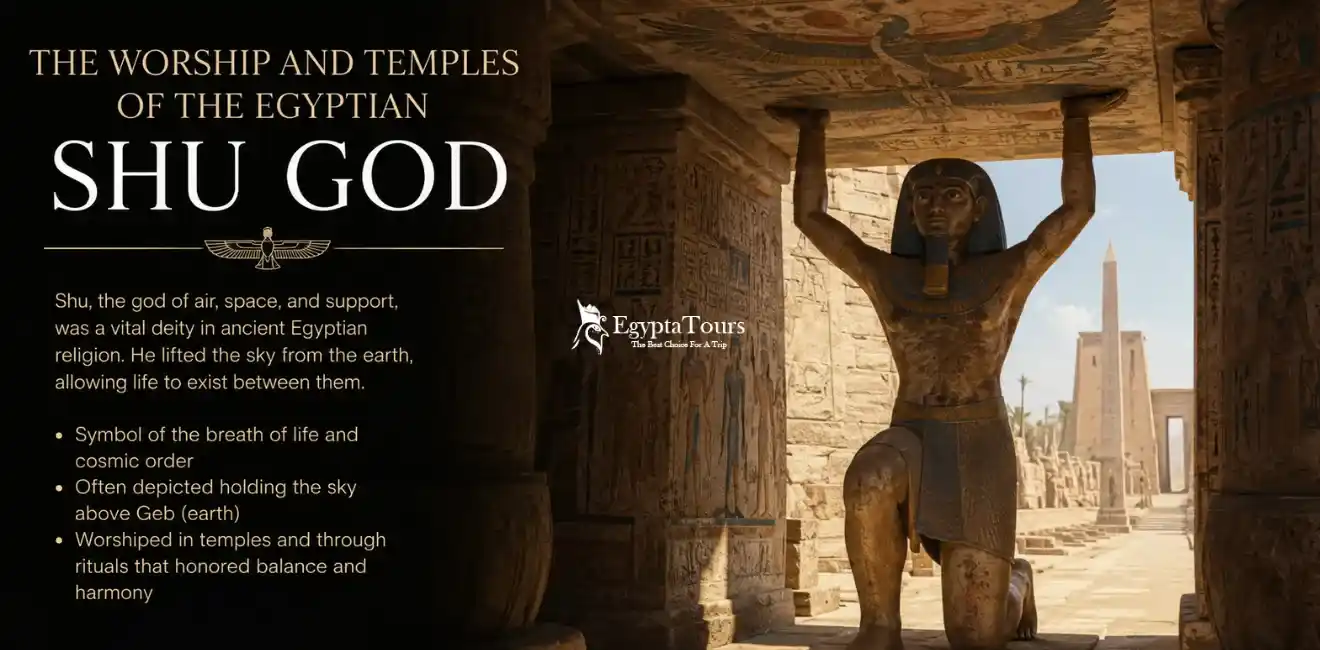
The-Worship-and-Temples-of-the-Egyptian-Shu -God-EgyptaTours
Shu was not considered as popular as Ra, Osiris or Isis so few temples were dedicated to him. His main temple was located in Heliopolis, the primary worship center of the Ennead, the nine creator gods. He was worshiped as the guardian of the sky, the organizer of cosmic order and the protector of the world between the eternal sky and the earth.
Shu is often mentioned in spells, hymns and funerary rituals where he is asked to grant the breath of life and protect cosmic order. In pyramid texts and coffin texts, he is praised more than any other god for providing air to the deceased in the afterlife.
Despite having few temples, his religious influence was important because he was central to the Egyptian worldview and his role as the provider of the cosmic breath enabled a complex network of gods, humans and nature.
Ancient texts highlight Shu’s role in enabling Ma’at, the principle of justice and balance. These writings convey a profound spirit reflecting the harmony of life on earth, even in the life after death.
Shu is often depicted separating Nut from Geb, lifting the sky above the earth as a symbol of his cosmic role. He appears above other beings with his arms raised to support the sky, reinforcing his image as the guardian of world balance.
He is usually shown as a man carrying a feather on his head, representing air and lightness. Occasionally, statues and amulets depict him, though they were rare compared to gods like Osiris or Horus. His image remained consistent from the Old Kingdom through the Greek and Roman periods as he was always seen as the supreme god between sky and earth.
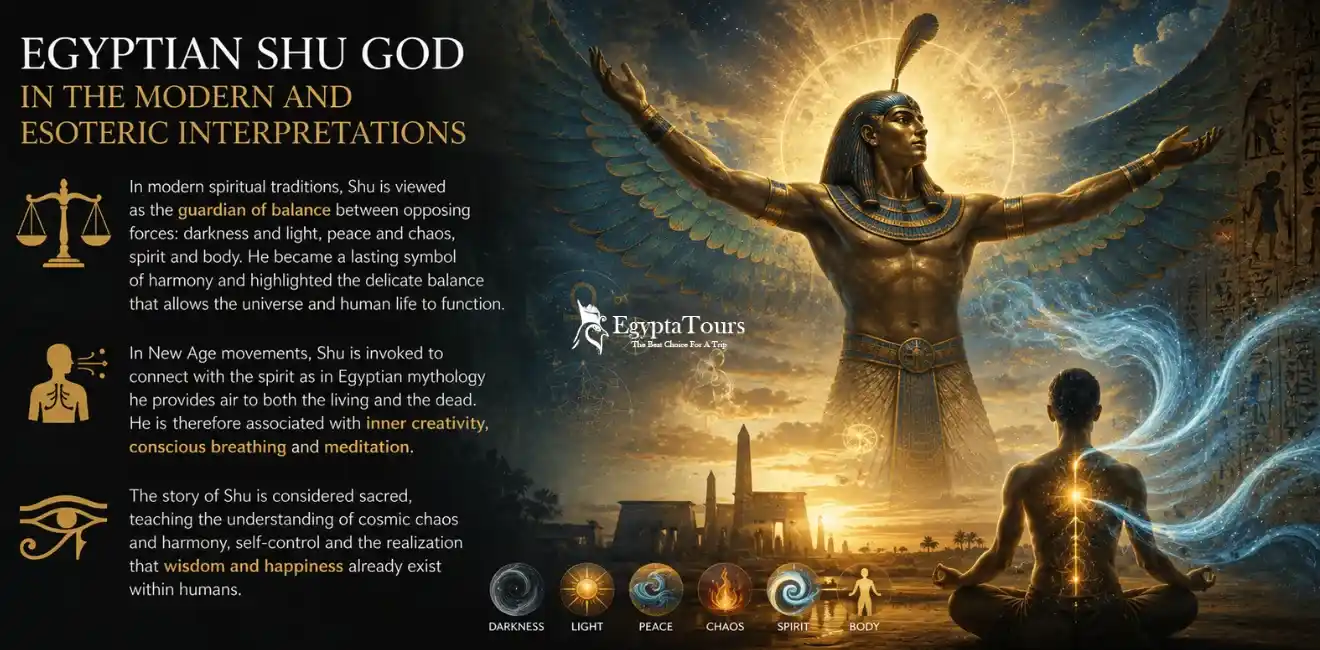
In modern spiritual traditions, Shu is viewed as the guardian of balance between opposing forces: darkness and light, peace and chaos, spirit and body. He became a lasting symbol of harmony and highlighted the delicate balance that allows the universe and human life to function.
In New Age movements, Shu is invoked to connect with the spirit as in Egyptian mythology he provides air to both the living and the dead. He is therefore associated with inner creativity, conscious breathing and meditation.
The story of Shu is considered sacred, teaching the understanding of cosmic chaos and harmony, self-control and the realization that wisdom and happiness already exist within humans.
Are you ready to stand in the presence of the primeval gods? Our curated journeys take you to the heart of the Heliopolitan Ennead, where the self-created god Atum first brought life out of chaos. Experience the calming strength of the god of wind and light in the sacred spaces where he was once honored with hymns and offerings. Book your expedition today and breathe in the history of the one who sustains the cosmic order!
This primeval god is one of the oldest and most important gods in ancient Egyptian religion, representing air, wind, light, peace and emptiness. He is a member of the Heliopolitan Ennead and the brother and partner of the goddess Tefnut.
Shu’s most important role was separating the sky goddess Nut from the earth god Geb, creating the space necessary for humans, animals and plants to exist. This act symbolized cosmic balance and order, reflecting the Egyptian principle of Ma’at.
Shu is the child of the self-created god Atum. His twin sister and partner is Tefnut, goddess of moisture. Shu and Tefnut are the parents of Geb, god of the earth and Nut, goddess of the sky.
Shu has immense power as one of the primeval gods. He is the god of air and wind, with absolute control over air, able to manipulate air currents, fly, generate winds and maintain cosmic balance. He is also a protector and warrior, sometimes depicted with the sun disk or as a lion-headed deity.
Shu is often shown as a man with a large feather on his head, representing air and lightness. He is sometimes depicted raising the goddess Nut above Geb, separating the sky from the earth and in some cases he appears as a lion cub or a man with a lion’s head.
Shu was worshiped mainly in Heliopolis, the primary center of the Ennead. He was honored as the guardian of the sky, organizer of cosmic order and protector of the world between the sky and the earth.
Shu embodies Ma’at, the principle of truth, justice, order and balance. By separating Nut and Geb and maintaining the space between the sky and earth, Shu ensured cosmic harmony and allowed life to exist.
Shu is mentioned in pyramid texts, coffin texts, prayers and hymns. He is praised as the giver of air and life in the afterlife and ancient Egyptians prayed to him for guidance, light and peace.
In modern spiritual and New Age traditions, Shu is seen as a guardian of balance between opposing forces such as darkness and light, peace and chaos and spirit and body. He is also associated with inner creativity, conscious breathing and meditation.
The Greeks associated Shu with Atlas, the giant who holds up the heavens. Both are depicted bearing the sky, reflecting a similarity in role and symbolism.

Confidently choose your perfect Egyptian adventure from our selection of trusted, expert-curated tours.



Unlock the true wonders of Egypt with confidence. We combine expert local knowledge, seamless logistics, and round-the-clock support to deliver flawless, responsible, and unforgettable travel experiences.