Attracting hundreds of thousands of tourists each year, The Hanging Church of Cairo is one of Egypt’s most famous basilica-style churches. There are several churches in Egypt, but none can compete with The Hanging Church. It is a holy place that served as a shelter for God’s messenger. Because of its magnificent beauty and rich history, many visitors see it as the most significant Coptic destination in all of Cairo.
The Hanging Church in Cairo, known as Saint Mark’s Coptic Orthodox Church, is a significant religious site. It is associated with Pope Tawadros II and features a notable painting representing the seat of the Coptic Orthodox Pope, referred to as the seat of the Coptic Orthodox Pope.
Read this post if you’re looking for a comprehensive travel guide to this breathtaking Coptic sight.
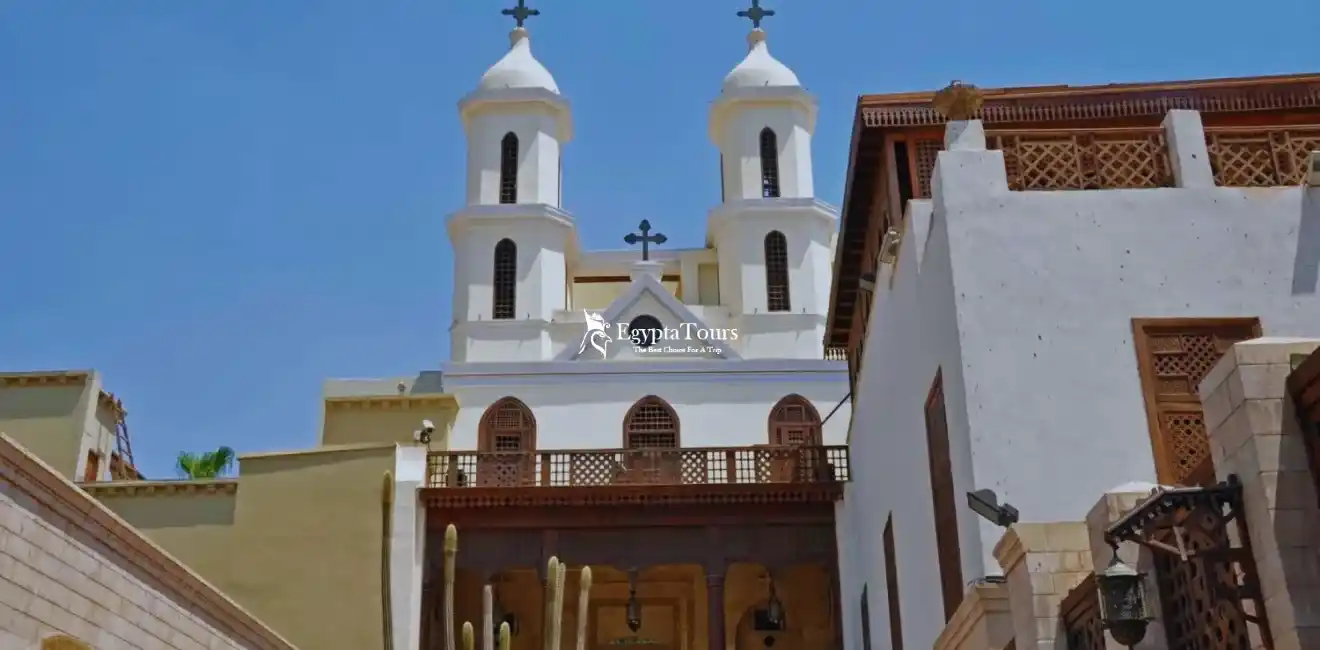
The most iconic site in Coptic Cairo is the Church of the Saint Virgin Mary, better known by its nickname, the “Hanging Church”. The church dates back to the 9th century, but the site is claimed to have first been occupied by the church as early as the 3rd century AD, making it Egypt’s oldest Christian religious site.
The “Hanging Church” is not actually hanged from anything, as its name would lead one to believe. It gets its unique name from the fact that it is built on top of the gates of an ancient Roman fortress known as the “Babylon Fortress.” This church, which stands on 2nd-century Roman remains, is one of the oldest and most famous in Old Cairo. Over the ruins of the Roman fortress, a foundation was built using logs from palm trees and several layers of stones. The unique Hanging Church features a wooden roof designed after Noah’s Ark.
The Hanging Church was the Coptic Patriarch’s residence from the 7th through the 13th centuries, and it has been the site of significant political and religious events. The Coptic Pope’s formal title is “Coptic Pope of Alexandria,” reflecting the historical fact that Alexandria, Egypt, has served as his residence; but, after the Arab invasion of Egypt, it was deemed that Cairo would be a more suitable location.
Cairo thereafter became the official seat of the Coptic Pope, also known as the Holy Seat of St. Mark due to the Pope’s belief that he is St. Mark’s successor.
Around 1047, Pope Christodolos sparked controversy and infighting within the Coptic Church by choosing to be inaugurated at the Hanging Church rather than the Church of Saints Sergius and Bacchus, where consecrations had usually taken place. Following Pope Christodolos’ decision, many subsequent patriarchs decided to be appointed, crowned, and even buried at the Hanging Church.
Although both Cairo and Alexandria are acknowledged as the seat of the Coptic Orthodox Pope, the Hanging Church in Cairo currently serves as his official residence.
The Interior Design of the Hanging Church
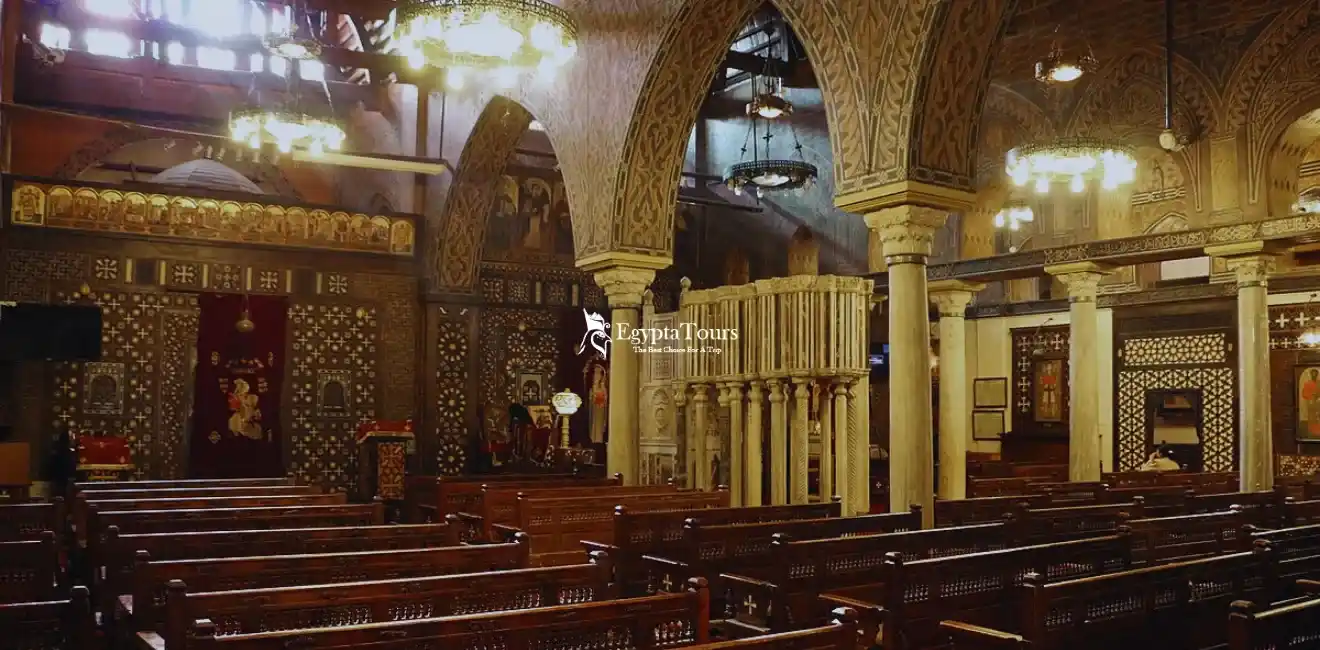
The eastern side of the church has three sanctuaries: one in the center is devoted to the Virgin Mary, one to the left is named after St. George, and one to the right is dedicated to John the Baptist. Painted baldachins are placed just above altars inside the sanctuaries.
The entrance in the church’s southeast corner leads to the oldest part of the church. On its eastern side, there are three sanctuaries. The one in the middle is dedicated to St. Dimiana, the one on the left to St. Takla Hymanot (an Ethiopian saint), and the one on the right is devoted to St. Andrew. The baptistery is located next to these sanctuaries.
The wooden ceiling is a one-of-a-kind work of art, beautifully decorated in ebony and ivory with geometric patterns and crosses.
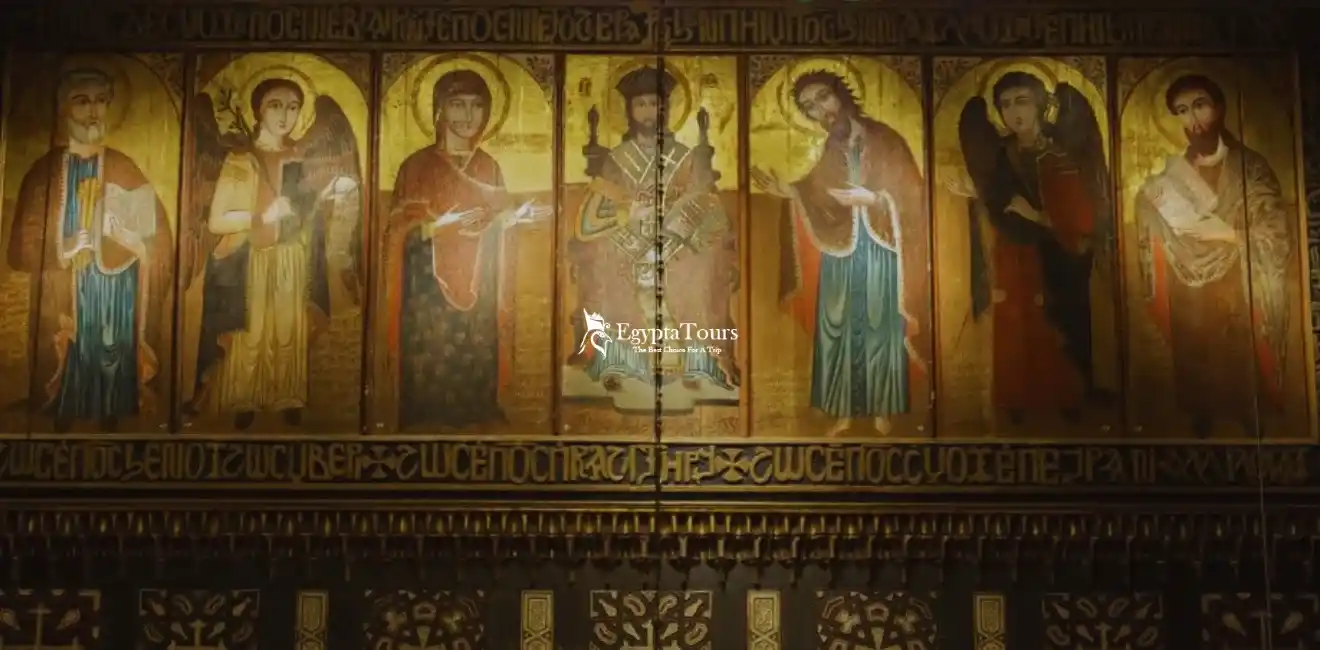
The wooden ceiling is also crowned with magnificent icons, with the enthroned Jesus in the middle, the Virgin Mary, Archangel Gabriel, and St. Peter on the left, and John the Baptist, Archangel Michael, and St. Paul on the right.
15 icons depict the life and torture of St. George, while the remaining 7 depict the life of John the Baptist. An icon of St. Mark may be found on the main church’s southern wall. (St. Mark was the first Patriarch of the Coptic Orthodox Church).
The Hanging Church’s majestic pulpit originates from the 5th century and is supported by 15 great columns. A cross is portrayed above three steps on each side of the pulpit, representing the three days Jesus Christ was in his tomb and his resurrection.
On the eastern side of the chapel, there is a fresco depicting the Nativity (the birth of Christ) and the midwife Salome, as well as a second fresco depicting the Apocalypse. There is also a church devoted to St. Mark on the first floor.
The Hanging Church of Cairo has 110 magnificent icons, the majority of which date from the 18th century, though some are even older. One of the icons, in particular, has been proven to date back to the 8th century.
A large number of the icons discovered in Cairo‘s Hanging Church are made of ebony, and many are inlaid with ivory. Jesus, the Virgin Mary, Archangel Michael, Archangel Gabriel, St. Peter, St. John the Baptist, and St. Paul are among the most significant icons featured in this church. In addition to these icons, there are several more that depict other types of Coptic crosses.
The church’s massive wooden domed roof or ceiling is another fascinating feature. Aside from being a magnificent example of age-old craftsmanship, it was also built to mimic Noah’s ark.
Furthermore, the oldest and holiest icon in Cairo’s Hanging Church comes from the 8th century and depicts the Coptic Mona Lisa with baby Jesus on her lap, with John the Baptist standing in front of them. Not only is this the oldest icon in the church, but it is also the most cherished one.
The Miracle of the Moving Mountain
The Cairo Hanging Church, also known as the Suspended Church or Al-Moallaqa in Arabic, is significantly linked with a famous miracle involving the movement of Moqattam Mountain. Around 976 AD, the Fatimid caliph, Al-Mu’izz, challenged the Coptic Pope, Patriarch Abraham, to move Moqattam Mountain in order to prove a Bible verse that claims if you have faith, you can move a mountain.
‘’And Jesus sais to them, Because of your unbelief: for truly I say to you, if you have faith as a grain of mustard seed, you shall say to this mountain, Remove hence to yonder place; and it shall remove; and nothing shall be impossible to you’’ Matthew 17-20
For three days, the Patriarch fasted and knelt before a painting of the Virgin Mary, and on the third day, she came to him in a vision and told him what to do. That painting of the Virgin Mary can still be found in the church today. The Fatimid Caliph was persuaded of the validity of the Christian faith and granted the church exceptional privileges as a result.
The Hanging Church isn’t the only ancient landmark worth seeing in the area. Coptic Cairo is a unique part of Old Cairo that has a good number of Christian churches and other structures dating from the years between the collapse of the pharaonic religion and the emergence of Islam, when Egypt was dominated by Christians. Coptic Cairo is primarily built around the ruins of Babylon’s fort.
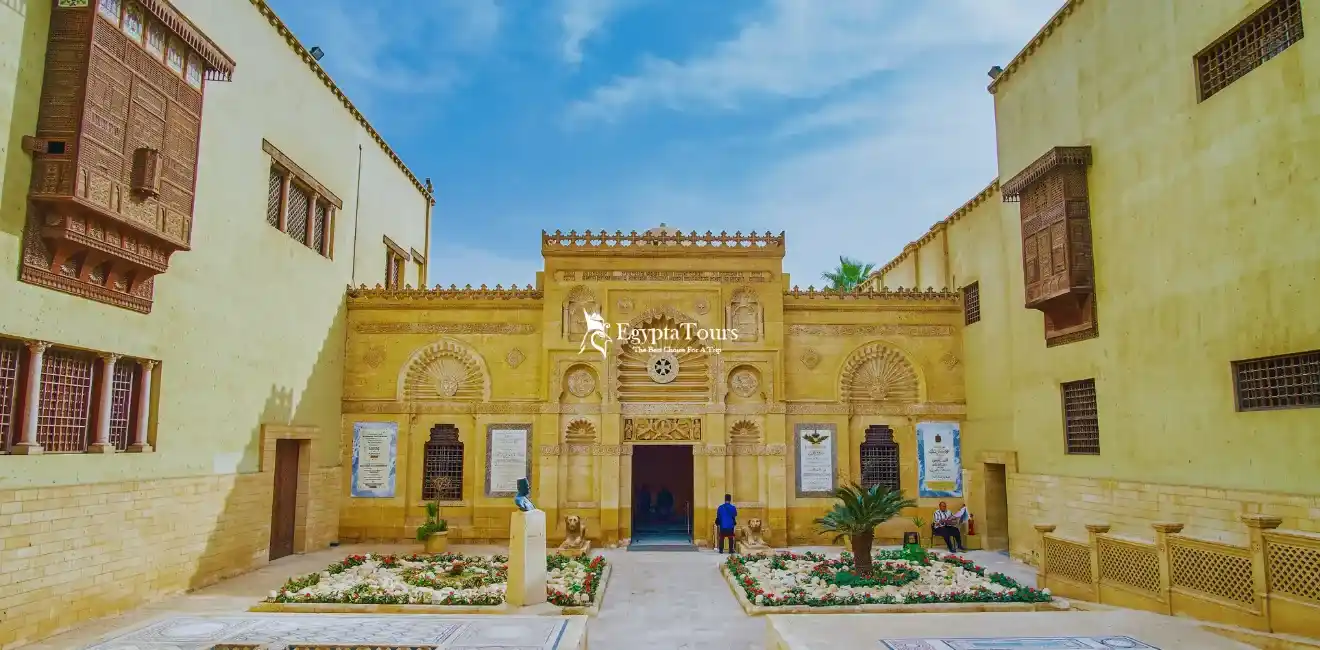
The Coptic Museum, located close to the hanging church, houses the world’s biggest collection of Coptic Christian works of art and artifacts. The museum, which opened in 1910, covers Coptic history from the arrival of Christianity to Egypt up through the Ottoman Empire, showing artworks influenced by Egyptian, Greek, Roman, Byzantine, and Ottoman traditions.
Additionally, this location contains six churches from the early Christian era. The most prominent is the Hanging Church, also known as the Church of the Virgin Mary, which was established in the 9th century to “hang” high above Babylon’s walls. Further inside Coptic Cairo, there are numerous additional ancient churches, including the Church of St. Sergius, which was presumably constructed on the location of a crypt where the Holy Family (Jesus, Mary, and Joseph) sought refuge during their time in Egypt.
Also, Ben-Ezra Synagogue dates much further back. This is Cairo’s oldest synagogue, built in the 9th century on what is either the Temple of Jeremiah or the place where the pharaoh’s daughter discovered Moses among the reeds.
You Can Check Our Tour Categories to Discover The Hanging Church:
The church is in Coptic Cairo and is easily accessible via the Mar Girgis Metro. The Hanging Church may be reached by walking a few steps from there. Visits should be combined with a visit to the Coptic Museum, which is conveniently located two minutes away from the church.
There is no entry fee. The church is open from 9 a.m. to 5 p.m. every day. Coptic Mass is held on Wednesdays and Fridays from 8 to 11 a.m., and on Sundays from 9 to 11 a.m. Visitors are welcome to come and watch. There is no particular dress code; however, it is preferable to wear clothes that reach at least to your knees and to avoid exposing tops.
Conclusion
The hanging church is an enthralling destination that never fails to leave tourists with lifetime memories of its breathtaking beauty and rich history. It is practically impossible for the casual traveler to see everything; nevertheless, the Hanging Church in Cairo and the prominent buildings in the vicinity should not be missed.
Discovering the Hanging Church of Cairo: Your Top FAQs
What is the Hanging Church of Cairo?
The Hanging Church, also known as Al-Muallaqa, is one of Cairo’s oldest and most famous Coptic Christian churches. It dates back to the 3rd century AD and is renowned for being built on the southern gate of the Roman fortress of Babylon.
Why is it called the “Hanging” Church?
It’s called the “Hanging” Church because it was constructed over the gatehouse of the ancient Roman fortress, creating the appearance that it is suspended.
Where is the Hanging Church located?
The Hanging Church is located in Old Cairo, a historic area that’s home to a concentration of ancient religious sites, just a short walk from the Mar Girgis metro station.
What architectural features make the Hangامتing Church unique?
The church’s distinctive architecture includes wooden screens, marble columns, and a beautiful collection of icons. Its nave is suspended over the passage, giving it its unique characteristic.
Can visitors tour the Hanging Church?
Yes, visitors are welcome to tour the church. It’s open most days, but it’s best to check ahead for specific hours. Dress modestly, respecting the religious nature of the site.
Does the Hanging Church have any religious artifacts or art?
The church houses many significant artifacts, including a collection of over 100 ancient icons and intricate woodwork panels depicting biblical scenes.
How do I get to the Hanging Church from central Cairo?
You can reach the Hanging Church by taking a taxi or using the Cairo Metro to the Mar Girgis station. It’s a short walk from there.
Is there an entrance fee for visiting the Hanging Church?
No, there is no entrance fee to visit the Hanging Church, but donations are appreciated to help with its maintenance and preservation.
What are the visiting hours?
Generally open to visitors during the day; exact hours can vary, especially for services—verify locally or with your tour operator.
Are there guided tours available at the Hanging Church?
Guided tours are available, and they can provide more insight into the church’s history and significance. Check with local tour operators or at the site for availability.
What should I know before visiting the Hanging Church?
Dress respectfully, as it’s a religious site. Photography is allowed, but be mindful of services and other visitors. Plan for additional time to explore nearby attractions in Old Cairo.
Is the church accessible to all visitors?
It is a historic site with limited accessibility features; expect stairs and narrow spaces inside.
Any practical tips for visitors?
Dress modestly (shoulders and knees covered), be respectful during services, consider hiring a guide for context, and plan for a visit that includes nearby Coptic Cairo sites.
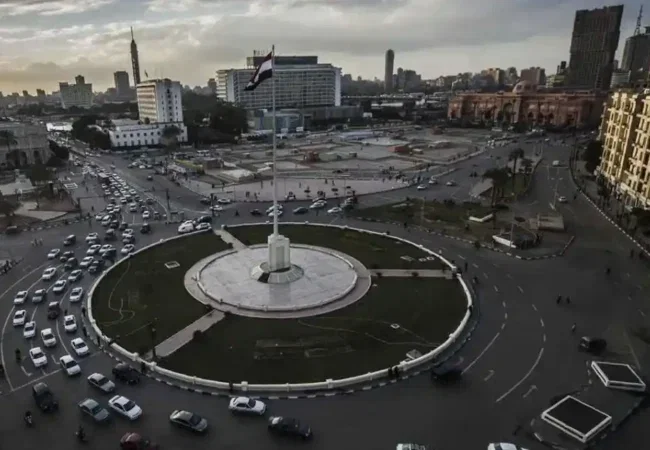
Tahrir Square, also known as Martyrs’ Square, is a public square located in the heart of Cairo, Egypt’s capital. It was first established in 1867 and has historically been a central place for political demonstrations. The Egyptian Revolution of 1919 and the 2011 Egyptian Revolution both partly took place in Tahrir Square. Tahrir Square is […]
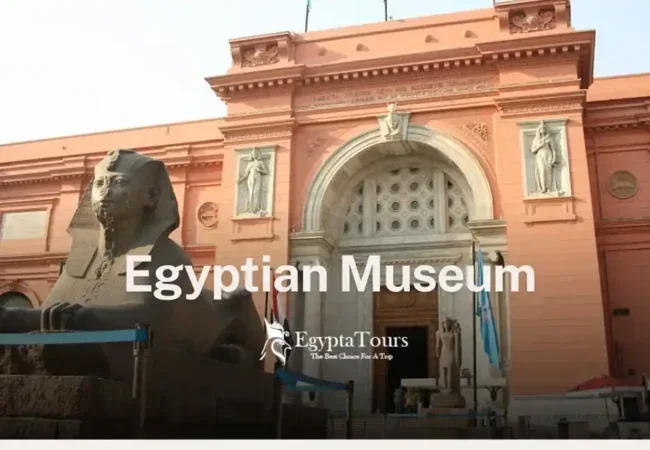
The Egyptian Museum in Cairo is one of the world’s most famous and prestigious Egyptian Museums. Featuring over 120,000 artifacts, including mummies, statues, and jewelry, it is an essential part of any visit to Cairo. On a tour of the museum, visitors can explore the ancient history of Egypt and gain a better understanding of […]
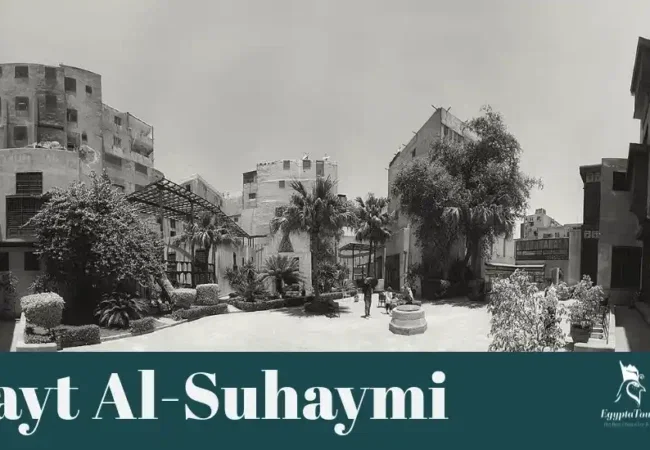
Bayt Al-Suhaymi is a living piece of wonder and happiness displayed as the finest Islamic architecture from the Ottoman era dating back some 370 years. It is one of the most stunning and vibrant medieval Islamic buildings in Cairo, the finest non-monumental architecture found in the golden capital of Cairo that functions as a magical […]
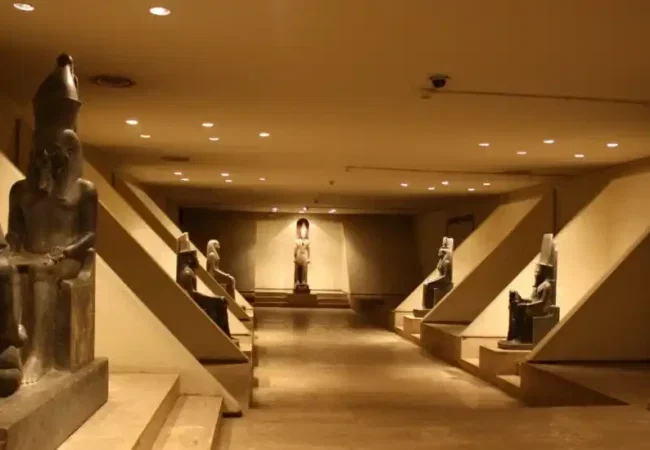
Grand Egyptian Museum is one of the largest museums in the world and is considered a symbol of Egyptian cultural and historical heritage It aims to display many Egyptian treasures related to ancient Egyptian civilization in an innovative way. This museum was opened in 2021 and combines modern technologies with the culture of the ancient […]
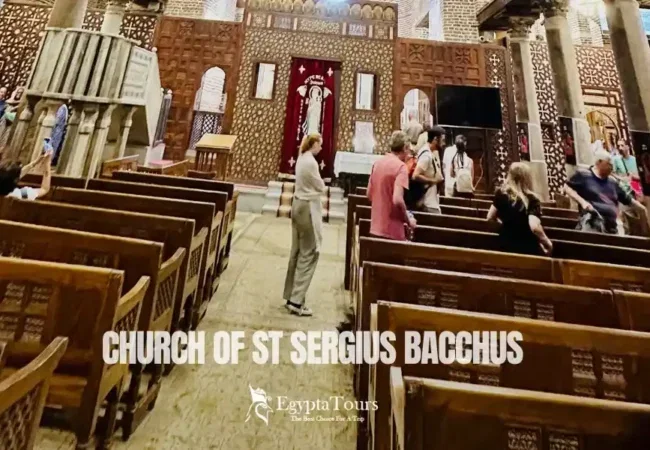
The Church of St Sergius Bacchus is one of the oldest and most ancient churches in Egypt also known as the ancient Church of Saint Abu Serga. It has great significance for Copts especially because of its long history since its construction until today. It is also an ideal destination for tourists and visitors from […]
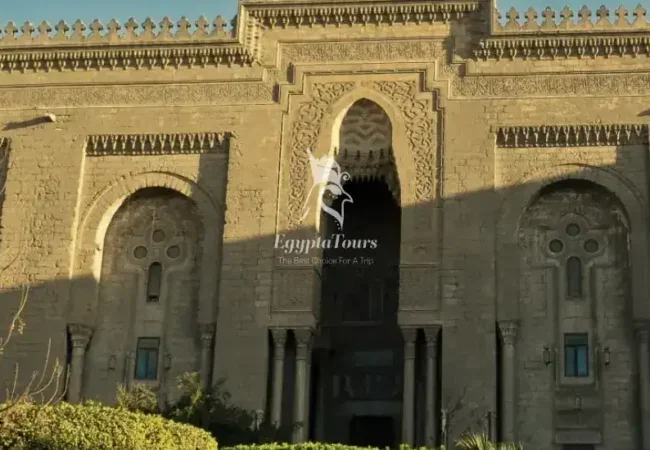
Consider it a story of his loneliness? Islamic architecture is like a beehive, a chain that will not separate from each other and has no end. Let us delve into knowing some of them, including architecture, design, locations, and naming. Let us enjoy the beauty of Al-Rifai Mosque, the most important elements of architecture in […]
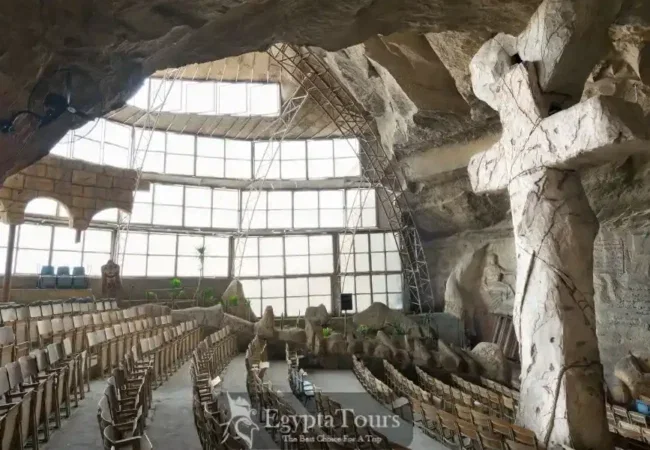
Located in eastern Cairo, specifically in the Mokattam Mountain, the Cave Church is considered one of the prominent landmarks in the area, comprising a group of Orthodox churches carved into the rock. The construction of this site dates back to the 20th century, starting as an idea and evolving into a notable location visited by […]
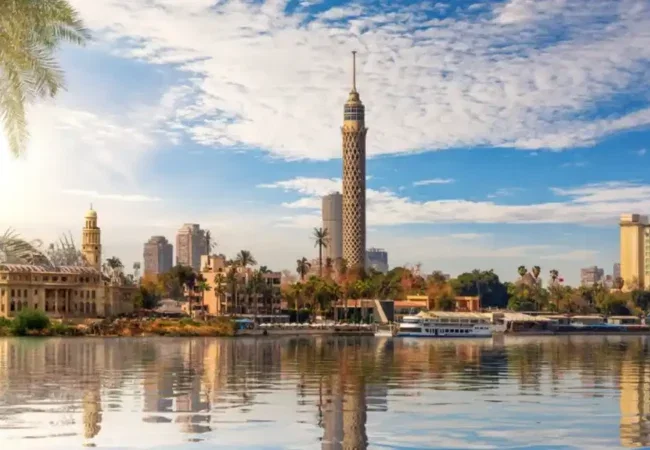
In the heart of Cairo, on the banks of the Nile River, stands the Cairo Tower, from which you can see Cairo as you have never seen it before with a magical panoramic view, giving you moments of tranquility away from the city’s hustle. If you are looking for a special experience, the Cairo Tower […]