


Christian Monuments and Monasteries in Egypt
Christianity in Egypt is the second most widespread religion after Islam. The Egyptians have accepted this religion with open arms due to its similarity with their beliefs and morals. Even the symbol of Christianity resembles the symbol of the Ankh of the Pharaohs.
Since then, the establishment of a new religion in Egypt has begun in private places of worship, and many Christian Monuments and Monasteries in Egypt have been built along the route of the Holy Family. Egypt was a hub and center of Coptic culture, and it spread more after the fall of the Roman occupation, and Christianity became the official religion of the country.
The history of Christianity in Egypt begins with the flight of the Holy Family to Egypt to escape the persecution of Herod the Great, King of Judea, according to the Gospel accounts. It is said that after that, Christianity spread widely in Egypt through the efforts of Saint Mark, who later established the Coptic Church or the Markosian Church.
He was one of the seventy chosen by Jesus to spread the Gospel, and he is mentioned in the Book of Acts of the Apostles. He is also the author of the second Gospel in the New Testament.
Since that time, Christian Monuments and Monasteries in Egypt have spread everywhere.
The Most Famous Christian Monuments and Monasteries in Egypt.
Since Egypt is a meeting point of religions and has many Christian, Islamic, and Pharaonic monuments, we will discuss in detail each Christian monument and Monasteries in Egypt.
-
Hanging Church.
-
Hanging Church
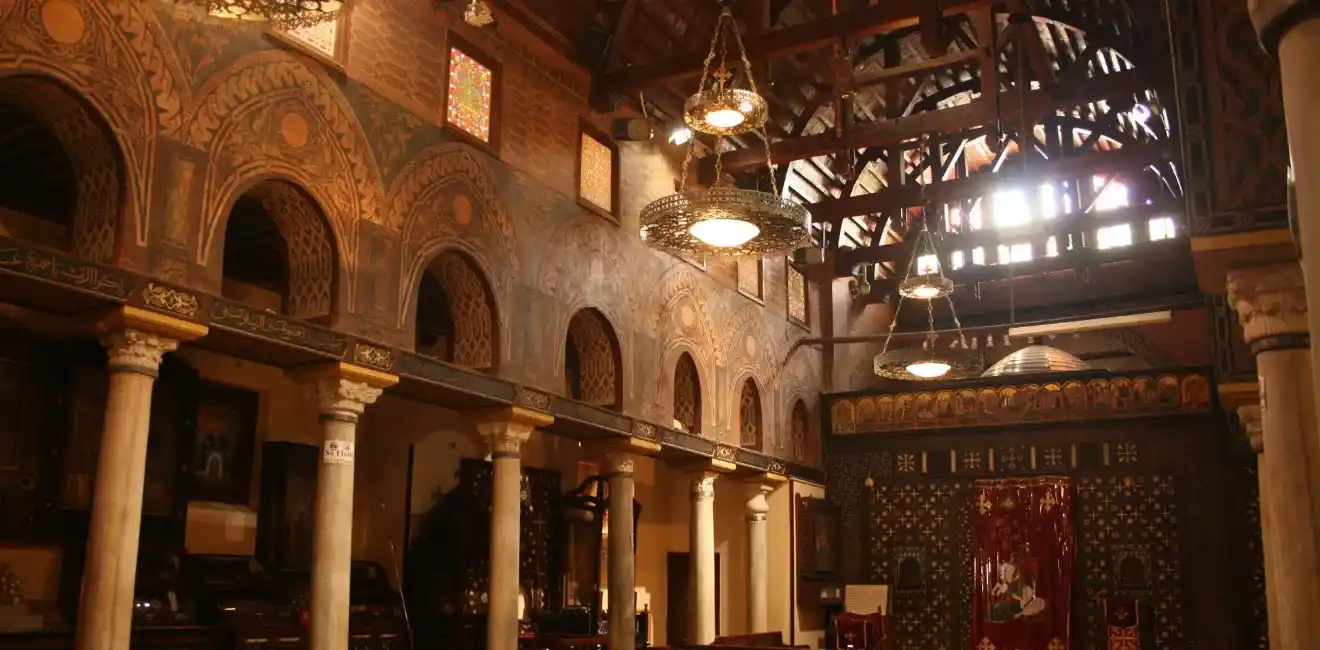
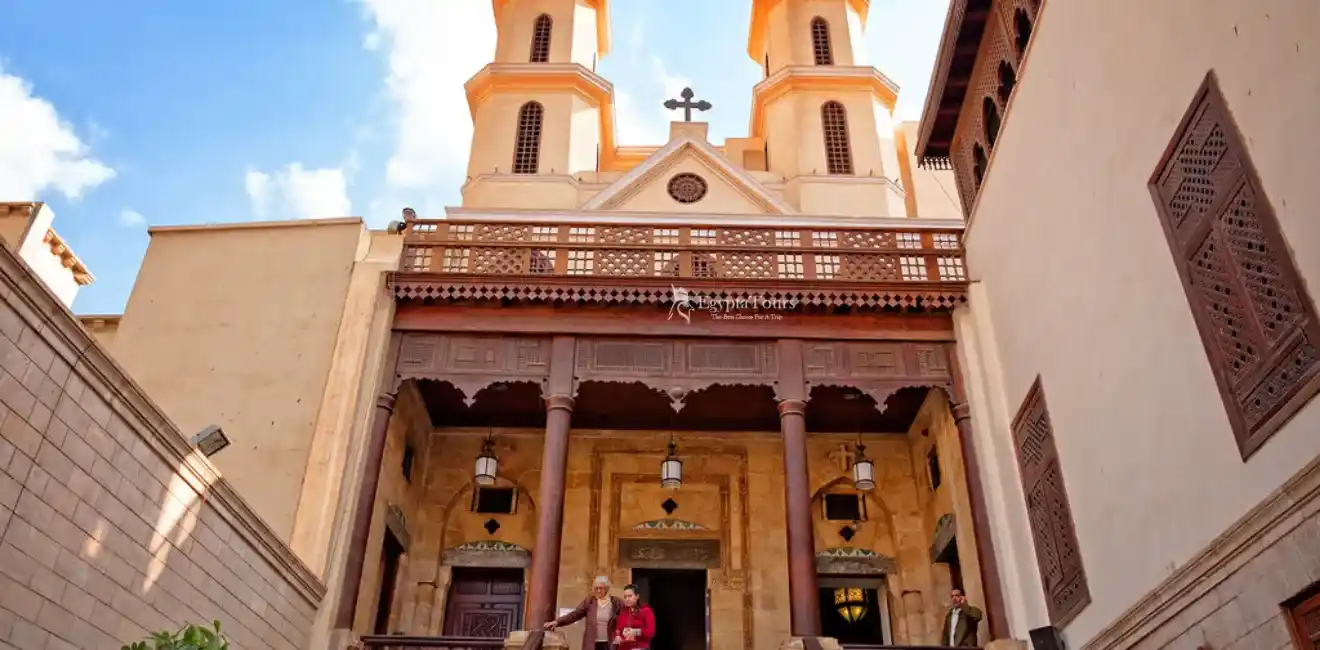
The hanging church is considered one of the oldest Christian Monuments and Monasteries in Egypt and most important religious symbols known in Cairo, and it has many historical features and a unique architectural style. For this reason, it is always included in the tourism plan in Egypt.
It was built in the Basilica style in the 4th century BC and is named as such because it was built on top of the old Roman gate of Babylon, giving the impression that it is built in the air. The church contains many beautiful and eye-catching murals and sculptures.
Location:
The church is located in the Kom Ghurab area of Old Cairo.
Importance of Hanging Church.
It was designed to serve as the official home of the Coptic Orthodox Pope in 1047 and the operating center of the Coptic patriarch, and it was the center for main elections and religious ceremonies across the years.
The Architectural Style of The Hanging Church.
The architectural style of the magnificent Hanging church is a beautiful blend of Coptic, Byzantine, and early Islamic influences, showing elaborately sculpted wooden panels, marble columns, and stunning religious artwork.
Inside the Hanging Church is an amazing collection of ancient icons, elaborate frescoes, and ornate decorations that depict biblical scenes and Coptic Christian symbolism. The church is a popular destination for pilgrims and tourists alike who seek to explore its historical and spiritual significance.
-
The S.T George Church.
The ST George church is one of the most important Christian Monuments and Monasteries in Egypt that is still standing, dating back to the early Christian era, and houses one of the most important religious museums. It has been recently developed by the Ministry of Antiquities.
The church is famous for being the only round church in Egypt. It is a Greek Orthodox church built inside the Babylon Fortress in Coptic Cairo. The church is part of the Holy Patriarchal Monastery of St. George, under the Greek Orthodox Patriarchate of Alexandria, and serves as the seat of the Pope and Patriarch of the Orthodox Church in Alexandria.
Location.
The church was built on top of the Roman tower of Fort Napoleon’s three towers in the area of the Religious Complex in Old Cairo.
The Description Of St George Church.
The church, situated on one of Fort Napoleon’s three towers, the only round church in Egypt. Unlike the traditional Noah’s Ark shape, its design takes a unique form, emblematic of salvation in Christianity, and is instead reminiscent of Ravenna’s Basilica of San Vitale.
-
Abu Serga church.
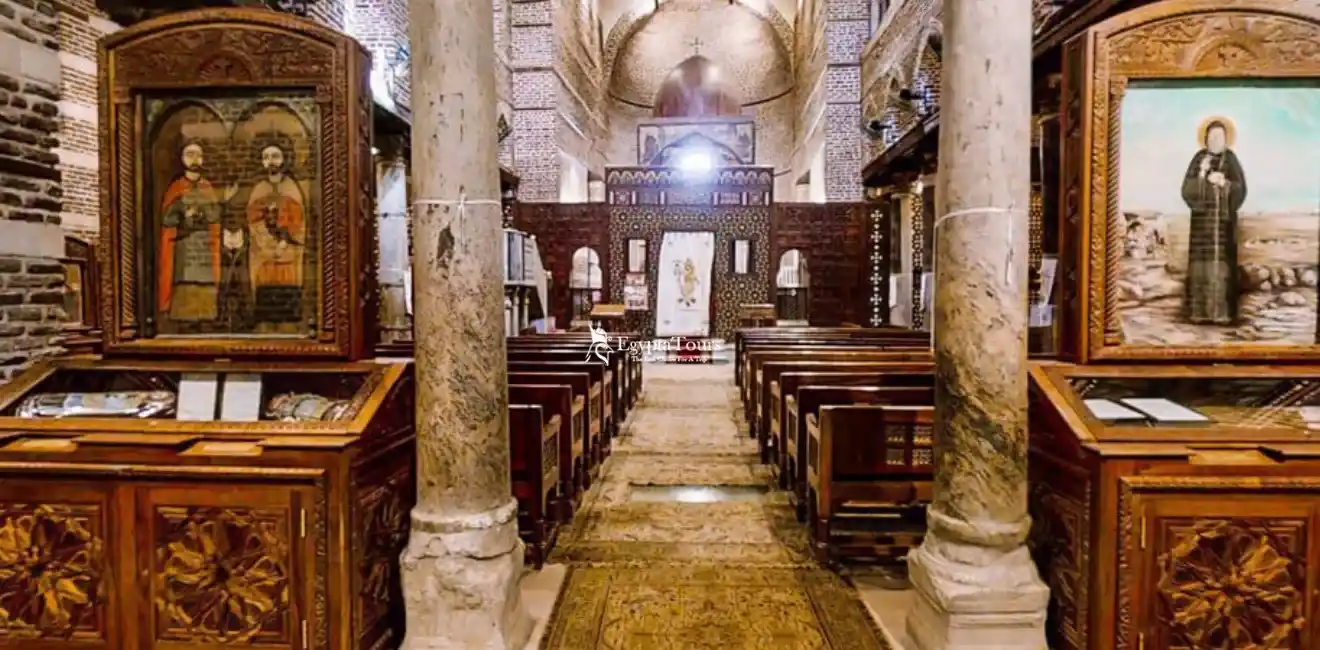
Abu-Serga-church-hristian-Monuments-and-Monasteries-in-Egypt-EgptaTours
The Church of Abu Serga was built on the spot where the Holy Family stayed during their flight from the tyrant king. It contains the Cave of the Escape next to the altar. It was built in the 4th century and was burned during the fire of Fustat, then rebuilt during the reign of Marwan II, and was also restored afterwards. It contains the most valuable and oldest icons on the southern wall.
Location:
The church was built on top of the ruins of an old Roman fortress in Cairo, specifically in the old Harat Mar Girgis (St. George’s Lane).
Description:
The church is built in the usual Basilican style, rectangular in shape, 27 meters long and 17 meters wide, with a height of 15 meters. The main nave is a single level, with the southern aisle consisting of two levels. The main entrance is located in the northwest, and the secondary entrances are not used. The entrance that is used is a door at the end of the western wall.
-
St. Catherine’s Monastery.
It is an Eastern Orthodox Christian Monuments and Monasteries in Egypt named after Catherine of Alexandria. It is the oldest continuously inhabited Christian monastery in the world, attracting tourists from all over the globe. It is a secluded monastery with strong ties to the Patriarchate of Jerusalem. For long periods, the monastery was under the guardianship of the Russian Orthodox Church, and the monks and priests were Greek.
Location:
It is located on the Sinai Peninsula, at the foot of Mount Sinai, below Mount Catherine, the highest mountain in Egypt, near the city of Saint Catherine, Egypt.
The Monastery’s Historical Value.
The monastery contains a historic church with valuable gifts from kings and princes, including silver chandeliers, and a well believed to be Moses’ Well. It was built around a tree said to be the Burning Bush where Moses spoke to God. The monastery is a piece of historical art, featuring Arabic mosaics, Russian and Greek icons, oil wall paintings, and wax engravings.
It has a manuscript library said to be the second-largest after the Vatican, a guesthouse, and a distinctive bell tower. The monastery is served by some Bedouin staff. It contains an ossuary holding the relics of the monks who lived there, including St. Catherine’s relics.
-
Monastery of Saint Anthony.
The Monastery of St. Anthony is a Coptic Orthodox monastery founded by the followers of St. Anthony the Great, an early Christian monk. It’s one of Egypt’s most prominent monasteries, influencing Coptic institutions and promoting monasticism. Several patriarchs have come from the monastery, and it’s visited daily by hundreds of pilgrims. In 2002, the Egyptian government started an 8-year, $14.5 million restoration project. Today, the monastery is a self-contained village with gardens, a mill, a bakery, and five churches, making it a popular destination for Egyptians, offering spiritual retreats and family trips.
Location:
The Monastery of St. Anthony is located on the slopes of Gebel Galala, in the Eastern Desert of Egypt. It can be accessed via Suez, then to Ras Gharib, and westward into the desert at Ain Sukhna, or from Beni Suef eastward via the desert road (unpaved). Alternatively, it can be reached from Cairo via Helwan to Al-Kreimat, then to Zafrana, with the monastery located about 48 km before Zafrana, and the access road (Dair Road) is approximately 17 km long.
-
The Monastery of St. Paul.
It is a Coptic Orthodox monastery and one of the oldest Egyptian monasteries. It’s named after St. Paul and also known as the Monastery of the Leopards. The first monks to inhabit it were some of St. Anthony the Great’s disciples. It was briefly inhabited by Melchites, followed by Egyptian monks. The Syrian monks had a sustained presence in the monastery, inhabiting it during the first half of the 15th century before their presence disappeared.
Location.
It is located west of one of the high mountains of Galala, surrounded by high plateaus, and can be accessed via the Suez-Ras Gharib road (the beginning of the Red Sea Riviera), or via an unpaved road from Beni Suef.
The History:
The monastery’s history dates back to the 4th century AD, holding historical significance as it’s built over the cave where St. Paul lived for over 80 years. The earliest account of the monastery comes from Antonius Martyr, a native of Placentia, who visited St. Paul’s tomb between 560 and 570 AD.
-
Wadi Natrun
Wadi Natrun is a city in Egypt, part of Beheira Governorate. It holds great significance since the Pharaonic era for extracting natron salt used in mummification. It also gained sacred status in Christianity due to the Holy Family’s passage through it. The area was known by several names, most notably: Salt Field, Shiheet, Scetis, and Wher-Hoker.
The first Christian monastic gathering in Wadi Natrun dates back to the 4th century AD, led by Macarius the Great, who founded the Monastery of St. Macarius, still thriving today alongside three other monasteries: St. Bishoi, Paromeos, and the Syrians. The area once housed around 700 monasteries in the second half of the 4th century AD, making it a revered site for Coptic Orthodox followers.
Location:
Wadi El-Natrun is located in the southwest of Beheira Governorate, bordered by: North: Badr and Abu El-Matamir centers. East: Sadat City. West: El-Hammam center, Matruh Governorate. South: 6th of October City.
The Importance of Wadi Natrun:
The place holds great significance in several aspects, including the religious aspect, as it is considered a sacred place, and Pharaonic artifacts have been discovered there. The place also carries defensive importance.
It is considered the only remaining Christian Monuments and Monasteries in Egypt
Wadi el-Natroun was full of monasteries that fell victim to the effects of time such as: The Monastery of El-Suryan, The Monastery of Abu Makar, The Monastery of Baramus and The Monastery of Anba Bishoy.
-
Abu Mena Church.
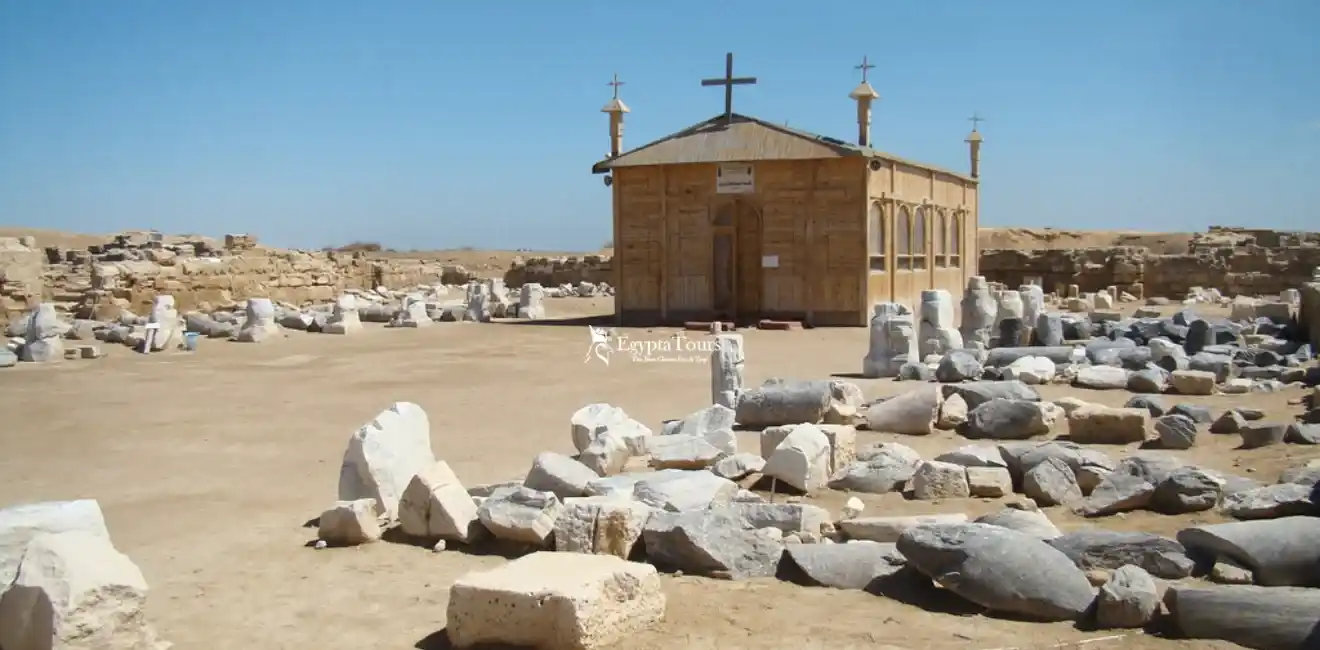
Abu-Mena-Church-Christian-Monuments-and-Monasteries-in-Egypt-EgptaTours
It was formerly a small village where the tomb of Saint Menas was located, and the area was the most important Christian pilgrimage center in Egypt until the early Middle Ages. The site is located in the Second District of Ambaria in Alexandria. This site was discovered in 1905 by the German archaeologist (Kaufmann), who was able to uncover large parts of it in the summer of 1907.
The area contains a collection of Coptic artifacts, churches, and monasteries. Between 312-315 AD, the relics of the martyr “Mar Mina” were transferred to the monastery, and the first church was built in the Mareotis area between 320-325 AD, attributed to Emperor Constantine. Notably, the area was abandoned in the 13th century due to raids by Turks and Persians, and in the 14th century, the relics of Saint Mar Mina were transferred to the Church of Mar Mina in Old Cairo.
Location.
The archaeological site of Abu Mena is located on the northern edge of the Western Desert, which is referred to by the Bedouins
- The Church of St. Simon the Tanner
The Church of St. Simon the Tanner or Simon the Tanner Monastery in Mokattam is an Egyptian Coptic church carved into the Mokattam Mountain in Cairo. It comprises six Orthodox churches: (St. Shenouda Church, St. Paromius the Syrian Church, the Church of the Archangel and Mary and Hanna, St. Paul and St. Anthony Church, St. Mark Church, and the Cathedral of the Virgin and St. Simon, which is the largest church in Egypt, accommodating 20,000 people, and features 76 carved icons.
Location.
The Monastery and Church of St. Simon the Tanner are located in the Mokattam Mountain, southeast of Cairo, amidst a community known as the “Zabbaleen”. This Egyptian Coptic church is carved into the mountain.
-
St. Mark’s Coptic Orthodox Cathedral.
President Gamal Abdel Nasser donated several thousand pounds for the construction of the cathedral and attended its inauguration ceremony accompanied by Emperor Haile Selassie of Abyssinia (Ethiopia). At that time, the Pope of Alexandria and the Patriarch of the See of St. Mark was Anba Kyrillos VI, who was succeeded by Pope Shenouda III. The St. Mark’s Coptic Orthodox Cathedral serves as the seat of the Pope of Alexandria in Cairo.
location.
It’s located in the Abbasiya neighborhood of Cairo.
-
The Heavenly Cathedral of Sharm El-Sheikh.
The Heavenly Cathedral is considered one of the finest and most beautiful churches in the world.
It was built in 2010 to be a modern church known for its incredible beauty all across the world. It took ten years to be constructed as the interior is exaggerated, which took a team of 19 people two years to build. There are frescoes and murals, the walls depict Biblical scenes such as The Creation and Exodus, and on the ceiling, there is St. John’s vision of the Apocalypse.
Location:
It is located in Haj el Nour, a local area situated between Naama Bay and the Old Market.
-
The Red Monastery
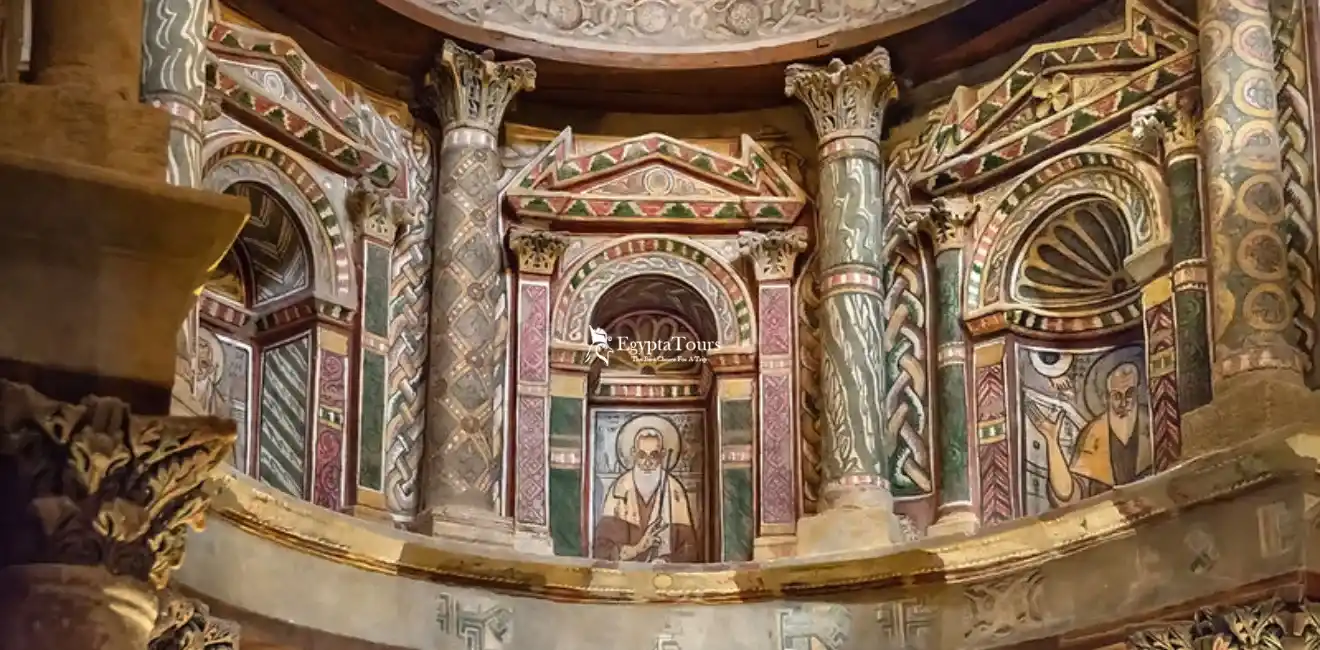
The-Red-Monastery-Christian-Monuments-and-Monasteries-in-Egypt-EgptaTours
The church of the Red Monastery is one of the most important archaeological sites, and it is the first church in Egypt and the Mediterranean basin in terms of the number of icons. It covers 80% of the structure and decorations, which resemble the Church of Hagia Sophia in Istanbul and the Church of St. Vitale in Ravenna, Italy.
The church is considered an open-air museum, and the icons and paintings date back to the 5th, 6th, and 7th centuries, covering almost all the walls and surfaces. They showcase the grandeur of Coptic art and the diversity of themes, which are difficult to enumerate, including themes from the Old and New Testaments, icons depicting biblical stories, dogmatic and theological themes, geometric shapes, plant decorations, and shapes of birds and animals.
Location:
The Red Monastery is located approximately 12 km west of Sohag, and about 3 km away from the famous Monastery of Anba Shenouda, known as the White Monastery.
-
Saint Barbara Church Complex.
It is a beautiful and ancient church with special sanctity and respect. The altar is located behind the screen, and to the right of the altar is a wall 4 feet high, containing a box with the body of St. Barbara, where visitors were allowed to touch her body. It was also managed by the Christians of the Girdle, then by the Greek monks, and in the Middle Ages, it was consecrated to a nun named Barbara.
Location:
The Church of St. Barbara is located north of the Coptic Museum and east of the Church of St. Sergius and Bacchus (Abu Serga) on the eastern side of the Babylon Fortress.
-
Abou Seifain Church.
It is a hidden blessed gem with a long history and a timeless impact on the Coptic culture of Egypt, and has gained the reputation of being one of the regions of Islamic Cairo. The church is celebrated for its rich history and religious importance. It’s a place of pilgrimage for Coptic Christians and attracts visitors interested in exploring Egypt’s Christian heritage.
The site houses ancient relics, icons, and artifacts that hold cultural and religious importance within the Coptic tradition. The architecture of the Church of Saint Mercury reflects a blend of traditional Coptic design elements with influences from different historical periods due to multiple renovations and rebuilds over the centuries.
Location:
It is located in Haret Zweila.
-
The Monastery of Saint Simeon
It is one of the most wonderful Christian Monuments and Monasteries in Egypt which is dedicated to Anba Hedra.
It is named after a local saint (Coptic: ⲁⲡⲁ ϩⲁⲧⲣⲉ / Apa Hatre) who lived in the late of the 4th and the beginning of the 5th century AD—first as a monk, and finally as the Bishop of Syene .
It was constructed with stone at the lower level and mud brick at the upper level, surrounded by high walls.
Its basilica retains faint frescoes, while monastic cells feature mastaba beds and Muslim pilgrim graffiti en route to Mecca. The complex was fortified against Bedouin raids, which appeared more fortress-like than religious.
The church and the grotto are notable for the remains of the colourful wall paintings that still decorate some of their walls and ceilings. Some of the monks’ cells on the upper level, along with parts of the church walls, are notable for the Coptic and Arabic graffiti left by visitors and the monks of the monastery.
Location:
On the west bank of the Nile River in Aswan, across from Elephantine Island.
-
The Monastery of Saint Macarius
It is also known as Dayr Al-anbā Maqār is a Coptic Orthodox monastery.
This monastic community began with a single cell, which was the cell of Macarius the Great himself, a cave covered with reeds and papyrus, located west of the current monastery, at the site of the Baramus Monastery. Then, the disciples and followers gathered around him, and settled after building other cells for themselves at a distance from Macarius’ cell.
As the number of those seeking monasticism increased, he left them and went to the current location of the monastery, thus establishing the Baramus Monastery. Over time, new disciples gathered around him, and a church was built for prayers where the monks gathered, with a well, a bakery, and a kitchen for food preparation. The development continued, and warehouses, a guest house, and a refectory were built for the monks to take their “meal of love”.
The monastery also contains several churches dedicated to worship inside it
Location:
It is located in Wadi El Natrun, Beheira Governorate, about 92 km (57 mi) north-west of Cairo, and off the highway between Cairo and Alexandria.
Conclusion.
Egypt contains many churches, and each church has its own customs, traditions, and distinctive features. Since the entry of the Holy Family into Egypt and until now, Christianity has remained, and churches continue to be built in various and different places throughout Egypt.
FAQs
1-How did the christianity start?
The history of Christianity in Egypt begins with the flight of the Holy Family to Egypt to escape the persecution of Herod the Great, King of Judea, according to the Gospel accounts. It is said that after that, Christianity spread widely in Egypt through the efforts of Saint Mark, who later established the Coptic Church or the Markosian Church.
2-Where is the hanging church?
The church is located in the Kom Ghurab area of Old Cairo.
3-What is the importance of hanging church?
It was designed to serve as the official home of the Coptic Orthodox Pope in 1047 and the operating center of the Coptic patriarch, and it was the center for main elections and religious ceremonies across the years.
4-What is the reason that St George church is so famous?
The church is famous for being the only round church in Egypt. It is a Greek Orthodox church built inside the Babylon Fortress in Coptic Cairo. The church is part of the Holy Patriarchal Monastery of St. George, under the Greek Orthodox Patriarchate of Alexandria, and serves as the seat of the Pope and Patriarch of the Orthodox Church in Alexandria.
5-When was the first Christian monastic gathering in Wadi Natrun?
The first Christian monastic gathering in Wadi Natrun dates back to the 4th century AD, led by Macarius the Great, who founded the Monastery of St. Macarius, still thriving today alongside three other monasteries: St. Bishoi, Paromeos, and the Syrians. The area once housed around 700 monasteries in the second half of the 4th century AD, making it a revered site for Coptic Orthodox followers.
6-Where is the Monastery of Saint Macarius?
It is located in Wadi El Natrun, Beheira Governorate, about 92 km (57 mi) north-west of Cairo, and off the highway between Cairo and Alexandria.
7-What is the Description of The Church of Abu Serga?
The church is built in the usual Basilican style, rectangular in shape, 27 meters long and 17 meters wide, with a height of 15 meters. The main nave is a single level, with the southern aisle consisting of two levels. The main entrance is located in the northwest, and the secondary entrances are not used. The entrance that is used is a door at the end of the western wall.
8-What is the Importance of Wadi Natrun?
The place holds great significance in several aspects, including the religious aspect, as it is considered a sacred place, and Pharaonic artifacts have been discovered there. The place also carries defensive importance.
It is considered the only remaining Christian Monuments and Monasteries in Egypt
Wadi el-Natroun was full of monasteries that fell victim to the effects of time such as: The Monastery of El-Suryan, The Monastery of Abu Makar, The Monastery of Baramus and The Monastery of Anba Bishoy.