






Egyptian God Apophis
Egyptian God Apophis the god of ancient Egypt were a way for the ancient Egyptians to understand nature and life. Not all gods were benevolent; there were gods that represented evil, fear and chaos, because the ancient Egyptians believed the world was based on a balance between order and disorder. Therefore, evil gods appeared to explain the causes of darkness, disasters and dangers that threatened life.
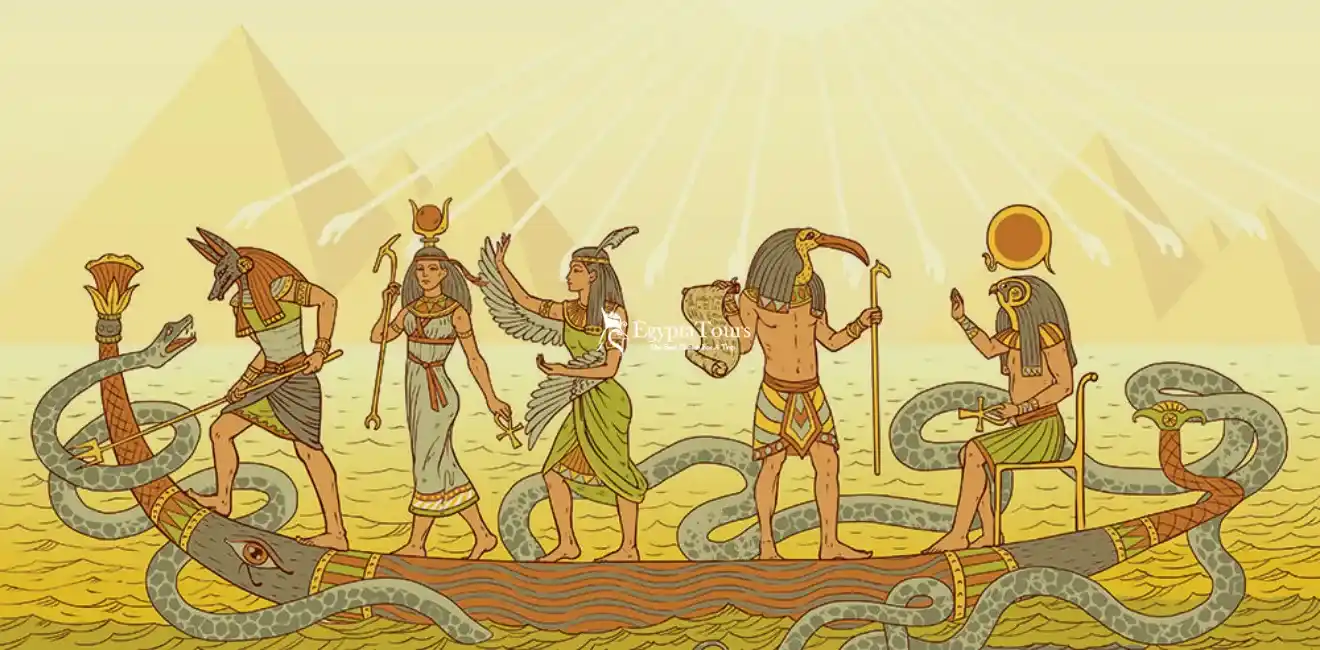
One of the most famous of these evil gods was Apophis who was depicted as a huge serpent. Apophis was a symbol of evil, chaos and darkness and a constant enemy of the sun god Ra. The Egyptians believed that every night, Apophis tried to attack Ra’s boat during his journey through the underworld to prevent the sunrise. But the gods always overcame him so order was restored and the sun rose again.
Apophis was not a god to be worshiped, but a force of evil to be resisted. That’s why the Egyptians performed special rituals to ward off his evil and protect the world from chaos.

The -Attributes- of -the -Egyptian -God -Apophis
Since Ra was the sun god, bringer of light and protector of the cosmic order “Maat,” Apophis was considered his greatest enemy and was therefore given the titles “Enemy of Ra” and “Lord of Chaos.”
The ancient Egyptians imagined the “Lord of Chaos” as a giant serpent or snake, which led to titles like the “Nile Serpent” and the “Evil Dragon.” Some accounts mention that he could reach a length of sixteen yards with a head made of flint.
On a pottery vessel from the Naqada I period (around 4000–3550 BCE), of type C and currently preserved in Cairo, a snake is drawn on the inner rim of the vessel, accompanied by other desert and aquatic animals, depicted as the enemy of a god likely a sun god, stalking him from a large rowing boat. This snake is believed to represent Apophis.
Most myths suggest that Apophis was born after Ra, often said to have emerged from his umbilical cord. Researcher Geraldine Pinch notes that a later creation myth explains that Apophis originated from the saliva of the goddess Neith while she was still in the primordial waters, which transformed into a colossal serpent 120 yards long. Nevertheless, the prevailing belief was that Apophis existed since the beginning of time, in the waters of “Nun,” representing the chaos of primordial creation.
the Egyptian God Apophis’ Battles with Ra
the -Egyptian- God- Apophis’ -Battles -with- Ra
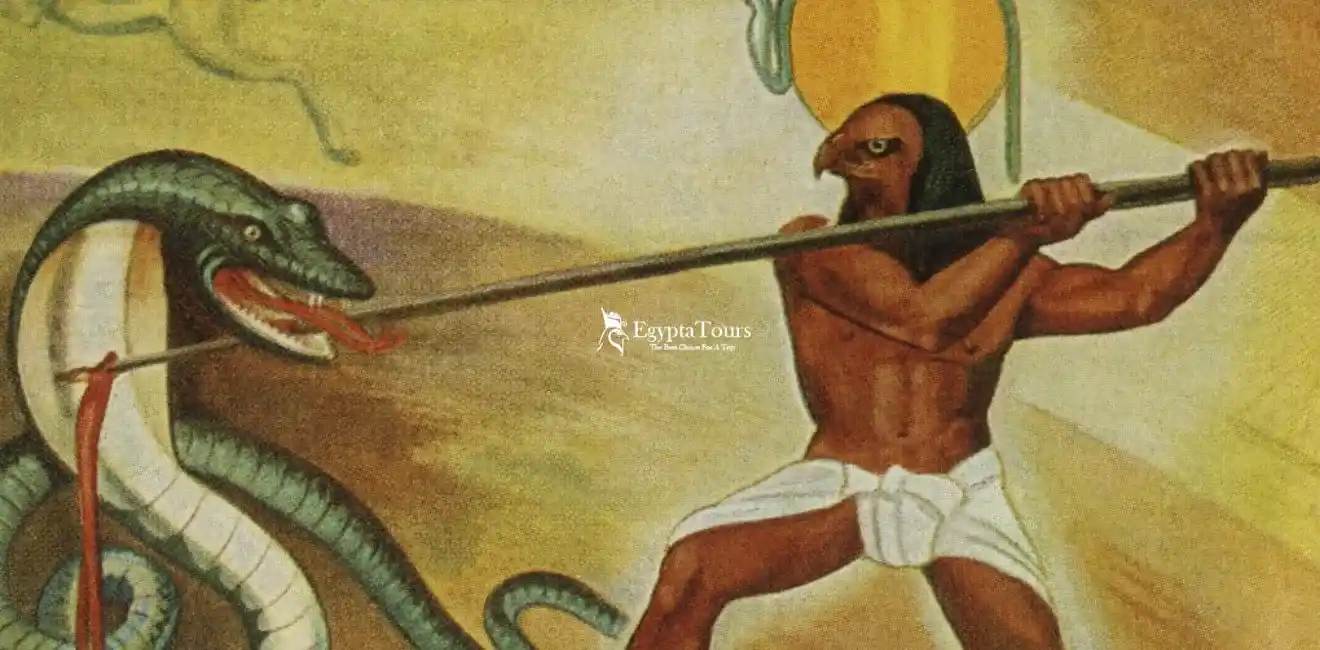
Some depictions show the god Set stabbing the serpent Apophis, while Ra sometimes appears in the form of a great cat defeating Apophis.
The myths about the conflict between Apophis and Ra developed significantly during the New Kingdom. It was believed that Apophis must always remain below the horizon and was not allowed in the human world, which is why he was associated with the underworld. In some stories, he awaited Ra at the western mountain “Manu,” where the sun sets while in others he lurked just before dawn in the tenth division of the night. This variety in his locations earned him the title
“Encircler of the World.” His terrifying roar was believed to shake the underworld. Some myths also suggest that he was imprisoned there, either because he was a former supreme deity overthrown by Ra or because of his inherently evil nature.
The Pyramid Texts indicate that Apophis used magical stares to confuse Ra and his followers. Ra was assisted by a group of guardians accompanying him on his journey, including Set and possibly the “Eye of Ra.” Apophis’ movements were believed to cause earthquakes and his battles with Set explained thunderstorms. In one account, Ra himself defeats Apophis while taking the form of a cat.
Religious Practices of The Egyptian God Apophis
The Egyptians believed that Ra’s nightly victory was ensured by the prayers of priests and worshippers in temples. They practiced various rituals and folk beliefs aimed at repelling Apophis and helping Ra complete his daily journey across the sky.
One major ritual was the annual “Banishing of Apophis,” in which priests created a symbolic statue of him, believed to contain all the evil and darkness of Egypt which was then burned to protect the land for another year.
The priests also possessed a detailed manual for combating Apophis, known as the “Books of Banishing Apophis” (or “Book of Apophis”). These texts outlined step-by-step rituals to humiliate and destroy him, including:
- Spitting on Apophis
- Desecrating him with the left foot
- Stabbing him with a spear
- Binding him
- Striking him with a knife
- Setting him on fire
Additionally, these books included instructions for making wax models or small drawings of the serpent which were spat on, defaced and burned while reciting spells to help Ra destroy Apophis. Due to the fear that any image of him might empower the serpent, any depiction of Apophis always included another god subduing him.
Since Apophis was believed to dwell in the underworld, he was sometimes considered a devourer of souls. Therefore, the dead needed protection from him and were occasionally buried with spells capable of destroying Apophis. The Book of the Dead rarely mentions direct encounters between Ra and Apophis, except in spells 7 and 39.
The Conflict between Set and the Egyptian God Apophis
The universe came into existence when the god pushed aside the forces of chaos and darkness hidden in the primordial waters “Nun,” allowing the forces of order and light, Maat and Ra to act and begin the creation of the cosmos. This is how the creation story was understood by the ancient Egyptians.
Pushing aside the forces of chaos and darkness was the first step in creating the universe but it was not destruction, it was temporary displacement. These chaotic forces remained hidden under the primordial waters, regenerating their strength from time to time and lying in wait to try to return the cosmos to its original, pre-creation state.
The ancient Egyptians symbolized these eternal chaotic forces with the water serpent “Apophis.” They saw it as the perfect symbol of chaos and darkness, as a water serpent disappears completely from the prey’s view which sees the water as calm and harmless then suddenly strikes. This behavior was seen as analogous to the forces of chaos, lying in wait for Ra’s boat during its journey through the underworld “Duat.”
Ra’s journey in the underworld aimed to renew the universe’s energy, a cyclical renewal ensuring the continuity of the cosmos and preventing it from falling back into the abyss of chaos. This journey is divided into twelve stages or gates with Apophis lurking along the path to attack Ra’s procession at the deepest points in Duat.
Interestingly, it was the god Set who confronted Apophis. Although many scholars view Set as a symbol of evil, his role in Egyptian cosmology was more complex. Both Apophis and Set represented chaos but each had a different function.
Apophis symbolized the primordial chaos that existed before creation, acting as a force that pulled all things back into the waters of Nun. Set, on the other hand, represented the cosmic power responsible for death, an inescapable fate. The myth of Isis and Osiris tells that Set killed his brother Osiris in three ways, establishing the model of death repeated for all humans. Osiris’ death and resurrection prevented the universe from collapsing.
Ra’s visit to Osiris in the depths of the underworld was essential to the renewal of cosmic energy. The universe could not be renewed without Osiris’ death and resurrection and without Ra’s journey to him. Therefore, Set’s actions were not absolute evil but a necessary cosmic event. For this reason, ancient Egyptian artists depicted Set fighting Apophis and pushing him aside, clearing the way for Ra to pass safely and continue the process of cosmic renewal.
Egyptian God Apophis Attacks the Solar Boat
Egyptian -God -Apophis- Attacks -the -Solar -Boat
Although Apophis was believed to exist since primordial times, his name does not appear explicitly until the Middle Kingdom. His emergence is likely linked to the chaos and instability that followed the end of the Old Kingdom. However, some scholars doubt that the First Intermediate Period was truly a “dark age” and they suggest that depictions of giant snakes on Predynastic pottery may be associated with Apophis.
Early texts, such as the Pyramid Texts, mention several serpent gods or demons representing evil or chaos. The myths about Apophis developed more fully during the New Kingdom, especially in funerary texts like the Duat or Amduat. In the Roman period, he was sometimes called “He Who Was Spat Out” and was believed to have been born from the saliva of the goddess Neith.
Egyptian God Apophis and Natural Phenomena
Like Set, Apophis was associated with frightening natural events, such as sudden darkness during a solar eclipse, storms and earthquakes. Both were linked to the northern sky, considered by the Egyptians a cold, dark and dangerous place, and sometimes associated with the demon-goddess Taweret. Unlike Set, however, Apophis was always a force of pure evil and could not be reasoned with.
Egyptian God Apophis depiction
Apophis was often depicted as a huge serpent with tightly coiled rings to emphasize his enormous size. In funerary texts, he is usually shown being dismembered in various ways. In a detailed depiction in the tomb of Ramesses VI, twelve heads are painted above the serpent’s head, representing the souls he swallowed, which are temporarily freed when his body is destroyed, only to be imprisoned again the following night. In alternative depictions in private tombs, Hathor or Ra transforms into a cat to cut the huge serpent with a knife. Apophis was also represented as a circular ball, the “evil eye” of Apophis, struck by the pharaoh in numerous temple scenes.
Apophis in Edfu

Egyptian- God -Apophis in-Edfu
Apophis had many epithets, including “the Evil Lizard,” “Encircler of the World,” “the Enemy,” and “Serpent of Rebirth.” He was not worshiped but feared and was possibly the only god besides Aten during the Amarna period considered omnipotent. He required no nourishment and could never be fully destroyed, only temporarily defeated.
He led an army of demons that preyed on the living and the dead. To defeat this malevolent force, the priests of Ra performed an annual ritual called the “Banishing of Apophis,” where a symbolic effigy imbued with all the evil of the land was beaten, crushed, smeared with mud and burned. Other rituals included creating wax models of the serpent that were ritually dismembered and burning a papyrus bearing its image. The “Book of Apophis” contains a collection of magical spells from the New Kingdom intended to repel or contain the serpent’s evil.
Despite Egyptians’ fear and hatred of Apophis, two Hyksos rulers adopted his name as their coronation title, albeit with slightly different spelling.
Egyptian God Apophis on the Papyrus of Hunefer
According to one myth, Apophis had the magical ability to hypnotize Ra and all his followers, except Set who would confront the serpent by stabbing its side with a great spear. In some texts, Apophis coils around Ra’s solar boat, trapping it or floods the waters of the underworld to drown it.
In other texts, Apophis is associated with Set, the god of chaos, while a host of major and minor gods, including Isis, Neith, Serqet (Selket), Geb, Aker and followers of Horus as well as other unnamed gods taking the form of monkeys, defend Ra. Sometimes the dead, in the form of the god Shu, also fight Apophis to maintain Maat. Apophis swallows Ra but they cut a hole in his belly to allow Ra to escape. If they failed, the world would be plunged into darkness.
FAQs
Who was Apophis in Egyptian mythology?
Apophis was an evil god representing chaos and darkness and was a constant enemy of the sun god Ra.
How was Apophis depicted?
Apophis was depicted as a huge serpent or snake, and was given titles like “Nile Serpent” and “Evil Dragon.”
What was the relationship between Apophis and Ra?
Apophis was believed to try every night to attack Ra’s boat during his journey through the underworld to prevent the sunrise but the gods always overcame him.
Was Apophis worshiped?
Apophis was not a god to be worshiped but a force of evil to be resisted.
What rituals were practiced to ward off Apophis?
The Egyptians performed rituals such as the annual “Banishing of Apophis,” where a symbolic statue containing all evil was burned and they also followed the “Books of Banishing Apophis” outlining step-by-step rituals to combat him.
What specific rituals are mentioned in the “Books of Banishing Apophis”?
The rituals include: spitting on Apophis, desecrating him with the left foot, stabbing him with a spear, binding him, striking him with a knife and setting him on fire.
What natural phenomena were associated with Apophis?
Apophis was associated with frightening natural events such as sudden darkness during a solar eclipse, storms and earthquakes.
What was the role of the god Set in confronting Apophis?
Set confronted Apophis. Although sometimes seen as a symbol of evil, his role was complex, pushing Apophis aside to allow Ra to continue his journey and renew cosmic energy.
What did Apophis symbolize regarding chaos?
Apophis symbolized the primordial chaos that existed before creation, acting as a force that tried to return the cosmos to its pre-creation state.
How were the dead protected from Apophis?
The dead needed protection from him, so they were sometimes buried with spells capable of destroying Apophis. The Book of the Dead rarely mentions direct encounters between Ra and Apophis, except in spells 7 and 39.
What are some of the titles given to Apophis?
Some titles include: “the Evil Lizard,” “Encircler of the World,” “the Enemy” and “Serpent of Rebirth.”
About EgyptaTours

EgyptaTours is a name synonymous with trust, excellence, and unforgettable travel experiences, proudly standing as one of the leading travel agencies in Egypt. Renowned for its deep expertise, personalized service, and carefully crafted itineraries, EgyptaTours serves as the ultimate gateway to discovering Egypt in its most authentic and inspiring form.