





The Ancient Egyptian Moon God, Khonsu
This article is about the ancient Egyptian moon god Khonsu. His name is sometimes written as Khensu, Khens, Khons, Khonsu or Konshu and in Coptic it is written as Shons. His name means “the traveler” and the ancient Egyptians believed this referred to the nightly journey of the moon across the sky. Alongside the god Thoth, Khonsu helped measure the passage of time and was associated with baboon monkeys. He was also important in creating new life for all living beings. In Thebes, he was part of the Theban Triad, together with his mother, the goddess Mut, and his father, the god Amun.
Khonsu, also known as Khons, Chons or Khensu, was the god of the moon and time in ancient Egypt. His main center of worship was in Thebes, where he was part of a triad with Amun and Mut. He was one of the companions of Thoth, who was also associated with the moon and the measurement of time.
It was believed that Khonsu could influence the fertility of humans and livestock. Some myths, recorded on the walls of the Ptolemaic Temple of Khonsu at Karnak, describe him as having a prominent role in creating the universe. He was also honored as a god of healing, for example, in the story of the “Princess of Bekhten,” he is said to have personally healed King Ptolemy IV, who then took the title “Beloved of Khonsu, who protects the king and drives away evil spirits” in gratitude. It was also believed that he provided protection for ordinary people so many Egyptians bore his name.

The- Ancient -Egyptian- Moon- God,- Khonsu
In art, Khonsu was often depicted as a man wrapped like a mummy with a youthful lock of hair on the side of his head and holding a menat necklace along with a scepter and flail. He was associated with other divine children such as Horus and Shu. Sometimes he was shown with a falcon’s head, like Horus, sometimes linked to the baboon and sometimes fully human.
Khonsu is mentioned in the Pyramid Texts and the Coffin Texts, where he appears as a fierce figure but he became more prominent during the New Kingdom, when he was described as “the greatest god of the great gods.” Most of the building of the Khonsu temple complex at Karnak centered around him during the reign of Ramesses. The temple contains depictions of a creation myth, where Khonsu appears as a great serpent fertilizing the cosmic egg to create the world.
His reputation as a healing god spread beyond Egypt; inscriptions on the Bentresh stela recount how the Princess of Bekhten was cured immediately upon the arrival of Khonsu’s statue. King Ptolemy IV, after being cured from illness, took the title “Beloved of Khonsu who protects the king and drives away evil spirits.”
Representation of The Ancient Egyptian Moon God, Khonsu
Khonsu was usually depicted as a small man wrapped like a mummy, wearing the youthful lock of hair and the beard of gods, holding a scepter and a staff. Sometimes he was shown with a falcon head, sometimes linked to the baboon, and sometimes fully human. In the form of “Khonsu recording time,” he wore the sun disk and held a writing tool. He enjoyed games, especially the game of Senet, and was often depicted playing with Thoth.
Khonsu’s temples also existed in Memphis, Hibs and Edfu, besides Karnak.
The Ancient Egyptian Moon God, Khonsu at Karnak

The -Ancient -Egyptian- Moon- God,- Khonsu -at -Karnak
In the early history of Egypt, Khonsu was sometimes seen as a violent and dangerous god. He appears in the “Cannibal Hymn” in the Pyramid Texts as a god who demands blood and helps the deceased king consume other gods. The Coffin Texts describe him as “Khonsu who lives on hearts.” However, by the New Kingdom, he was worshiped mainly as the gentle and merciful son of Amun and Mut.
There is some debate about the meaning of his name. Some believed it represented the royal placenta, but the more widely accepted view today is that it comes from the word “Khens” meaning “to travel” or “to cross,” referring to his journey across the sky. He also had specific names such as “Khonsu Nefer Hotep” in Thebes and he was described as “Lord of Ma’at,” a title he shared with Ptah.
At the new moon, he was known as the “Great Bull,” and during the full moon, he was associated with a slaughtered bull. He did not only rule the month but was believed to have absolute power over evil spirits that attack the earth, sky and sea, causing pain, disease, madness and death. He was also believed to make plants grow, fruits ripen, animals reproduce and was considered a god of love for humans.
Mythology and Role of The Ancient Egyptian Moon God in the Underworld
The meaning of Khonsu’s name, “the traveler,” reflects the movement of the moon across the night sky. He was known by titles such as the Embracer, the Guide, the Protector and the Healer. It was believed that he guarded those who traveled at night, protected them from wild animals and aided in healing. It was thought that when Khonsu appeared as the crescent, women became fertile, livestock became fertile and spirits filled all pathways with fresh air.
The earliest mention of him is in the “Cannibal Hymn” of the Pyramid Texts, where he appears as a fierce god who slaughters other gods and offers their entrails to the deceased king to gain magical powers. This process was intended to help the king achieve immortality and regain vitality.
From the Old Kingdom to the Middle Kingdom, Khonsu was referred to in tomb inscriptions as “Webueti,” meaning the messenger, a title for deities connected with the afterlife and the mission of death. In the Coffin Texts, he is mentioned as the son of the goddess Shesmetet, responsible for burning hearts with his fiery wrath, known as “Khonsu who lives on hearts.” During the New Kingdom, the goddess Ammit took the role of devourer of hearts.
Role of khonsu as God of the Moon
Khonsu has been associated with the moon since ancient times, with the crescent linked to the Egyptian sickle sword, a symbol of justice, hence he was called “Khonsu the Sharp.” In the Coffin Texts, he is shown traveling from Punt, a land representing the East and the place of sunrise for the sun and moon.
During the New Kingdom, the lunar cycle became linked to life stages. The crescent was associated with bull horns and became a symbol of male fertility. Ptolemaic inscriptions from the Temple of Khonsu in Thebes describe Khonsu and the sun god as two bulls crossing the sky, meeting in the East as sources of light. The crescent represents a young bull, while Khonsu turns into an old bull at the full moon then renews himself at the beginning of the next lunar cycle.
Depicting him as a child or young bull symbolizes the start of the lunar cycle and the renewal of the month. Rare depictions of him as a two-faced child represent the period when the moon disappears from the sky. His transformation from child to old man symbolizes the yearly cycle and Khonsu in his youth (Khonsu-pa-Khered) brings spring and fertility.
Role of The Ancient Egyptian Moon God, khonsu as Creator God
In the later period of the New Kingdom, Khonsu was also worshiped as a creator god, depicted as a man with two falcon heads, wings of a vulture, standing on a crocodile, with his heads representing the sun and the moon and the crocodile symbolizing victory over primordial chaos.
In the creation myth at the Temple of Khonsu in Karnak, he is depicted as a primordial serpent and the son of Amun, swallowing Amun’s seed and carrying it then meeting the goddess Hathor-Bennet to create the city of Thebes and give birth to the eight gods of Ogdoad.
Khensu pa khart: The embodiment of crescent light, helps women conceive and livestock reproduce, associated with fresh air and thus with the god Shu.
Khonsu pa khered (Child Khonsu): Described as “the first great son of Amun,” son of the goddess Neith, an aspect of Ra, symbolizing youth in the morning and old age in the evening.
Khonsu pa ir sekher and Khonsu heseb ahau: Associated with life renewal and fertility.
The Forms of Khonsu, The Ancient Egyptian Moon God

The- Forms- of -Khonsu,- The- Ancient -Egyptian- Moon -God
Khonsu-Neferhotep: Prominent during the New Kingdom in Karnak, depicted either as a mummiform youth or as a falcon-headed man behind Amun. He bore titles like “Khonsu-Neferhotep, Horus, Lord of Joy in Karnak” and “Khonsu-Neferhotep, Lord of Ma’at on the Great Throne.”
Khonsu-Thoth: A union between Khonsu and Thoth, worshiped in Edfu, Philae and Thebes. The baboon was considered the living embodiment of Khonsu-Thoth and used in divination rituals.
Relations of The Ancient Egyptian Moon God with Other Gods
He was associated with Thoth in Hermopolis (Khonsu-Djehuti) and with Ra, Shu, Min and Horus in Thebes. Later, he was linked with Osiris as a bull representing the sun and moon. In Kom Ombo, he was considered the son of Hathor and Sobek and in Edfu the son of Osiris.
Khonsu in Popular Culture
In Marvel Comics, Khonsu appears as “Khonshu” and his god is embodied by the character Moon Knight who gains superpowers according to the phases of the moon.
In the Moon Knight series in the MCU, Khonshu is used to exploit Marc Spector’s psychological struggles to make him a fighter in his name. He appears mummified with a crescent on his head and a falcon head, sometimes fighting evil spirits and possessing healing powers, inspired by the more terrifying version in the Pyramid Texts.
In the Night at the Museum movie series, Khonshu is considered the source of Ahkmenrah’s magic tablet which brings the exhibits to life every night.
Conclusion about The Ancient Egyptian Moon God, khonsu
The name “Khonsu” comes from the verb khens, meaning “to cross” or “to pass.” It symbolizes the moon’s passage across the sky and also represents the deceased crossing into the afterlife. His name can mean “the Passing One,” “the Traveler,” “the One Who Moves,” or “the One Who Crosses.”
Khonsu is the Moon God in ancient Egypt. He is mentioned in the Pyramid Texts and Coffin Texts as a powerful deity, sometimes strict or aggressive but also as a protector of the Pharaoh who drives away evil spirits and assists in hunting, while providing food for the gods.
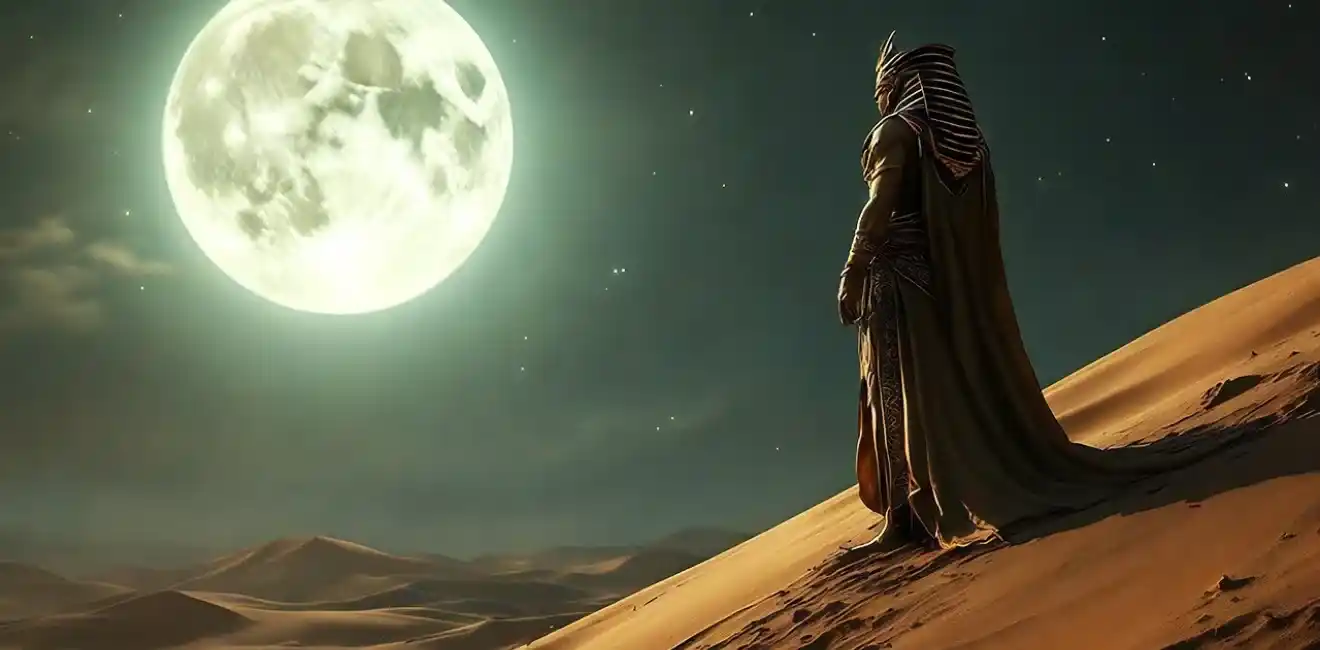
Khonsu is known for traveling across the sky at night in his celestial boat. He is considered the son of the gods Amun and Mut, forming part of the Theban Triad. He is usually depicted as a bearded man walking as a child or sometimes with the head of a falcon and a lunar disk on his head. He often carries a staff shaped like a peg and wears a necklace on his chest or hands and some images show him with a falcon head as a celestial symbol.
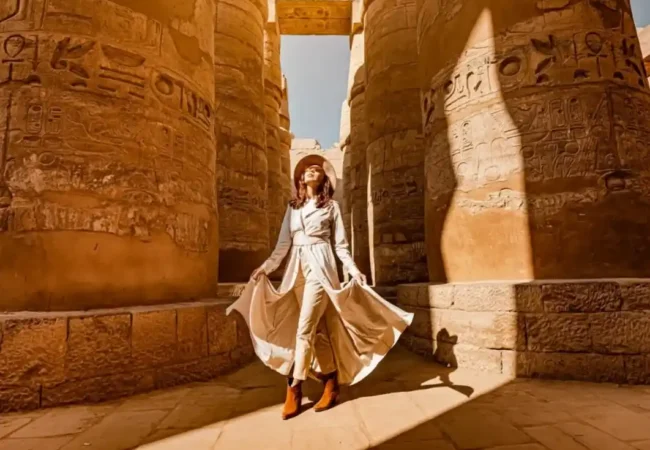
Khonsu’s main temple is located in Karnak, within the temple of Amun. In Kom Ombo, he was worshiped as the son of the god Sobek and the goddess Hathor. The construction of the Karnak temple began during the reign of Ramesses III and was completed in the Ptolemaic period.
FAQs
What does the name Khonsu mean and why was it significant to the ancient Egyptians?
The name Khonsu means “the traveler.” The ancient Egyptians believed it referred to the nightly journey of the moon across the sky, symbolizing both the moon’s movement and the passage of the deceased into the afterlife.
Who were Khonsu’s parents and what triad was he part of in Thebes?
Khonsu was the son of the goddess Mut and the god Amun. In Thebes, he was part of the Theban Triad alongside his parents.
How did Khonsu help in measuring time and what other god was he associated with in this role?
Khonsu helped measure the passage of time alongside the god Thoth, who was also associated with the moon and timekeeping.
What roles did Khonsu play in fertility and healing?
Khonsu was believed to influence the fertility of humans and livestock. He was also honored as a god of healing, with myths describing him curing King Ptolemy IV and assisting ordinary people.
How was Khonsu depicted in ancient Egyptian art?
Khonsu was often depicted as a mummified man with a youthful lock of hair, holding a menat necklace, scepter, and flail. Sometimes he had a falcon head, was linked to baboons, or appeared fully human.
How did Khonsu’s reputation change from the Pyramid Texts to the New Kingdom?
In the Pyramid Texts, Khonsu appeared fierce and demanding, associated with blood and consuming other gods. By the New Kingdom, he was mainly worshiped as a gentle and merciful god, protector, and healer.
What was Khonsu’s association with the lunar cycle and bulls?
During the new moon, Khonsu was known as the “Great Bull,” while during the full moon he was linked with a slaughtered bull. These representations connected him to male fertility and the renewal of life.
What creation role did Khonsu have according to the Temple of Khonsu in Karnak?
Khonsu was depicted as a primordial serpent, swallowing Amun’s seed and meeting Hathor-Bennet to create Thebes and give birth to the eight gods of the Ogdoad, showing his role as a creator god.
What are some of the different forms and titles of Khonsu?
Khonsu-Neferhotep was depicted as a mummiform youth or falcon-headed man. Khonsu-Thoth represented a union with Thoth, linked to baboons in divination. Other forms include Khonsu pa-khered (Child Khonsu) and Khonsu-pa-khart (crescent light).
About EgyptaTours

EgyptaTours is a name synonymous with trust, excellence, and unforgettable travel experiences, proudly standing as one of the leading travel agencies in Egypt. Renowned for its deep expertise, personalized service, and carefully crafted itineraries, EgyptaTours serves as the ultimate gateway to discovering Egypt in its most authentic and inspiring form.