Temple of Esna: The Hidden Temple of Khnum
Welcome to the Majestic temple of Esna! This huge structure was built...



The Temple of Edfu, also known as the Temple of Horus, stands as one of Egypt’s most magnificent and exceptionally preserved ancient monuments. Built during the Ptolemaic dynasty between 237 and 57 BC, this sprawling Nile-side sanctuary in Upper Egypt was dedicated to the falcon-headed god Horus, the goddess Hathor, and their son Harsomtus.
Having spent centuries buried beneath desert sand and Nile silt, the temple emerged remarkably intact, offering modern historians and travelers a pristine window into Hellenistic-era Egyptian religion, mythology, and monumental architecture. Recent joint archaeological restorations have further unveiled its brilliant original colors and traces of gold gilding, cementing its status as an unmissable destination along the Nile.
Key Takeaways
Ptolemaic Construction and Timeline: Built over a span of nearly 180 years between 237 BC (initiated by Ptolemy III) and 57 BC (completed under Ptolemy XII), the complex masterfully blends ancient Egyptian heritage with Greek architectural styles.
Extraordinary Preservation: The monument owes its near-perfection survival to being buried under 40 feet of desert sand and Nile silt for centuries before its rediscovery in 1860 by French Egyptologist Auguste Mariette.
Rich Mythological Legacy: Situated on the legendary site of the epic battle where Horus defeated Seth, the temple served as the focal point for grand religious celebrations, including the sacred marriage festival with Hathor of Dendera and the Festival of the Living Falcon.
Grand Architectural Layout: The vast complex features a towering 37-meter-tall entrance pylon, a expansive forecourt surrounded by columned arcades, inner hypostyle halls, a deeply sacred sanctuary housing the barque of Horus, and a functional Nilometer.
Recent Polychrome Discoveries: A collaborative Egyptian-German archaeological project recently uncovered brilliant original colors, remnants of gold gilding on temple reliefs, and hidden Demotic priestly inscriptions, returning the sanctuary closer to its original splendor.
Prime Nile-Side Accessibility: Strategically located in Upper Egypt halfway between Luxor and Aswan, the Temple of Edfu is easily reached by road or standard Nile cruise itineraries, making it a cornerstone of Egyptian tourism.
Temple of Edfu Facts (also known as The Temple of Horus) is one of the most stunning destinations to visit in Egypt’s incredible history to experience the audacious ambition of Egypt’s temple architects.
Temple of Edfu is recognized as the crown jewel of Aswan’s wonderful city, where the legends of the past are revived in the most astounding way throughout this heavenly, magnificent landmark.
Temple of Edfu depicts a lost art that embodies the true essence of ancient Egyptian civilization as seen through the eyes of the Ptolemaic dynasty.
This temple was built on land thought to have seen the greatest battle in Egyptian mythology between the good and evil forces represented by the ancient Egyptian gods Horus and Set.
It is the best preserved temple in Egypt and one of the last temples to be constructed in ancient Egypt’s history, serving as a last symbol of the ancient Egyptian heritage’s magnificence, majesty, and glory.
By the end of this article, you will learn all about Temple of Edfu history and why this temple still dominates the Nile-side town of Edfu city.

What-is-The-Edfu-Temple-EgyptaTours
As the largest temple dedicated to Horus, one of Egypt’s most important historic gods, statues of the falcon-headed god can be found all through the complex, and its extensive wall carvings have provided historians with valuable information about the Hellenistic period of Egyptian history: the magnificent reliefs provide insight into the religion, mythology, and way of life during the era.
The Temple of Edfu history exemplifies the profound admiration and connection between the Ptolemaic and ancient Egyptian cultures.
The temple was started by Pharaoh Ptolemy Ill on August 23, 237 BC and was completed during the reign of Pharaoh Ptolemy XII in 57 BC.
Edfu was the ancient Egyptian Tbot, or Atbo in Coptic, from which the modern name derives. When the Greeks arrived in the Ptolemaic era, the ancient god of Horus was united with the Greek god Apollo to form Horus-Apollo.
Apollinopolis Magna was given the name of the city as a result, and it became the capital of the second nome (region) of Upper Egypt.
According to Osiris’ legend, the temple was built on the site of a battle for ancient Egypt‘s sovereignty between the falcon-headed god of protection and victory, Horus, and the god of the desert, war, and chaos, Seth. This is most likely why Horus was so well respected in this region.
The Temple of Edfu was dedicated to Horus, Hathor of Dendera, and their son, the young Harsomtus, “Uniter of the Two Lands,” and was built on the site of an older temple.
Long inscriptions on the exterior of the enclosure wall, notably near the north end of the east and west sides, recount the history of its construction and provide a description of the entire complex.
A Temple Built by Successors of Ptolemaic Pharaohs
The temple proper was built in 237 BC during the reign of Ptolemy II Euergetes I and finished in 212 BC by his successor, Philopator.
The decorating of the walls with reliefs and inscriptions, which had been interrupted during Epiphanes’ troubled reign, was resumed in 176 BC by Philometor and completed in 147 BC under the reign of Euergetes II, precisely 90 years after the foundation stone was laid.
Euergetes II additionally constructed and decorated the huge entrance (finished in 122 BC).
The courtyard with its colonnades, enclosure walls, and pylon were constructed during the reigns of Ptolemy IX Soter II and Ptolemy X Alexander I, but the pylon was not decorated with reliefs until the reign of Ptolemy XII Neos Dionysos, who finished building works in 57 BC.
The temple was left alone under the sand for hundreds of years after the arrival of Christianity during the closing days of the Roman Kingdom in 391 AD, when paganism was prohibited, until it was discovered again in 1860 AD by a French Egyptologist, Auguste Mariette.
Edfu is located in Upper Egypt, almost halfway between Luxor to the north and Aswan to the south, about 110 kilometers from each city. It belongs to the Aswan Governorate and is also a gateway to the Nile Valley for many travelers coming from Red Sea resorts, especially those in Marsa Alam and nearby areas.
The city is on a fertile plain that has traditionally been used for growing sugarcane. Today, around 130,000 people live in Edfu and many of them work in tourism because the Temple of Edfu is a very popular site for visitors to southern Egypt.
You can visit Edfu at any time of the year. Winter is especially popular for tourists because the days are warm like in the rest of the Nile Valley with daytime temperatures reaching about 25°C and nighttime temperatures rarely falling below 7°C. During the day, the sun can be very strong with temperatures sometimes rising above 40°C, so it is important to protect yourself from the heat and sun.
Edfu-Temple-Description-EgyptaTours
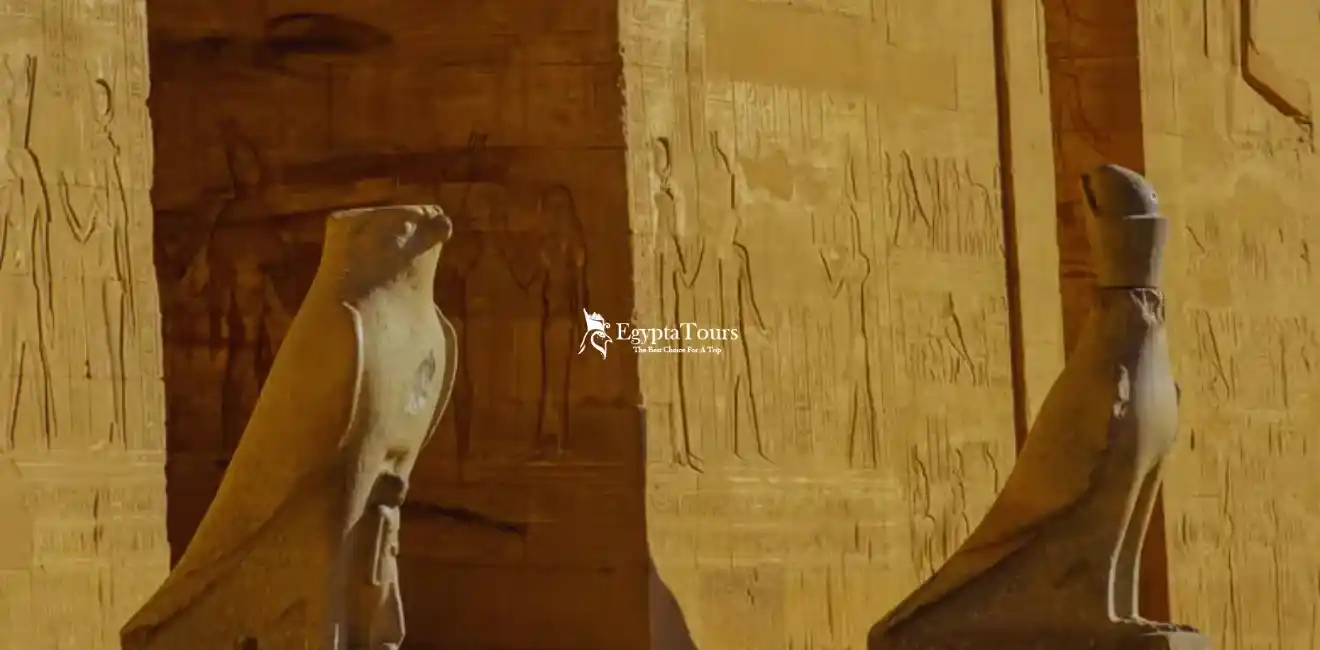
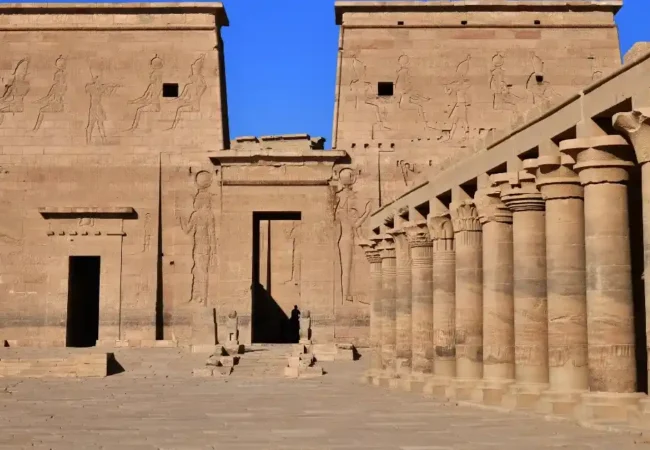
Edfu Temple contains one of the most spectacular pylons of any Egyptian temple, standing 37 meters tall and carved with battle scenes depicting King Ptolemy VIII punishing his enemies in front of the god Horus. In addition, there is an open courtyard with columns with floral capitals.
It is often referred to as the “court of offerings.” There is a hypostyle hall with 12 columns that support the roof.
The sanctuary at the end of this spectacular temple features a niche with a statue of the deity. There are 12 rooms around this sanctuary.
The sanctuary’s walls are covered in religious scenes. Some rooms were designated for religious use.
The most noteworthy features of the temple are a nilometer, which was used to keep track of the level of the Nile River, as well as a chapel devoted to the goddess Nut.
The temple’s tourist appeal stems from the various battle scenes depicted on its walls. The wall on the northern side of the court depicts Horus and Hathor’s marriage, which is celebrated twice a year, once in Temple of Edfu and once in Dendera temple.
It has a pylon built by Cleopatra‘s father in the first century BC. It leads to a peristyle court and, subsequently, to a hypostyle hall, which precedes the Horus sanctuary.

Edfu-Temple-Architectural-Elements-EgyptaTours
There are various aspects that distinguish the Temple of Edfu as an outstanding piece of art that blends the ancient Egyptian and ancient Greek architectural styles to create a magnificent piece of perfection that delivers a great archaeological wonder.
This is the temple’s main entrance, which is constructed of cedarwood.
The entrance of the temple is marked by a huge gate with two tall towers, each about 36 meters high. The original doors, made of Lebanese cedar, were installed in 57 BCE by Ptolemy XII Neos Dionysos. On the front of the pylon, there are four depressions, two on each side of the gate, showing where four wooden flagpoles, each 40 meters tall, would have been placed. Inside the towers, there are four levels of rooms and storage spaces, accessible by staircases that also lead to the temple roof.
The monumental gateway leads to a large paved courtyard surrounded on three sides by 32 columns. On the walls to the right and left, there are carvings depicting the Feast of the Joyous Union, one of the most important festivals at Edfu. This festival celebrated the sacred marriage between Horus of Edfu and Hathor of Dendera. Most of the rituals took place outside the temple so that the people could watch them.
The 15-day festival began with the arrival of Hathor’s statue, which had traveled from Dendera by boat 14 days earlier. The celebrations included feasting, drinking, visits to the ancestors’ burial mounds in the desert and various rituals inside the temples. On the 14th day, Hathor’s statue left Edfu in a grand procession and returned to her temple in Dendera.
On each side, there are two rows of columns. It is 46 meters long and 42 meters wide.
Its purpose was to deliver offerings to the gods.
was dedicated to deity worship.
is made up of 18 columns that are organized into rows of three columns each.
This is a small room with 12 columns that have amazing carvings and ornamentation.
Only the monarch and the priest were allowed to enter, and it is regarded as the most sacred area in Temple of Edfu, which is surrounded by 10 rooms.
At the entrance to the first hypostyle hall, two large statues of Horus, carved from a single block of granite from Aswan, stand guard. The doors of the hall controlled access to the temple’s central area and were usually closed except during special festivals. The hall’s ceiling is decorated with astronomical scenes.
On either side of the hall are rooms used by priests: the House of Morning on the left for ritual purification and the House of Books on the right, which acted as a library containing religious and scientific texts as well as all the papyri needed for daily rituals and festivals. The list of papyri in this room is carved on its walls.
Beyond the outer hall lies the smaller hypostyle hall, marking the start of the naos, the most sacred part of the temple. Here, the floor rises slightly and the ceiling lowers, leading to the sanctuary.
The smaller hall has three side rooms: the Room of the Nile on the left to store water for purification, the Laboratory for making unguents and perfumes used in rituals, and the Treasury on the right which held objects and amulets made of precious metals and stones for adorning the gods’ statues.
This narrow room was used for burning food and oil offerings which nourished the god through their aroma and smoke. The walls are decorated with scenes of offerings and purification to ensure the god’s eternal sustenance.
The vestibule acted as a buffer before entering the most sacred areas, the sanctuary and surrounding chapels. Also called the transversal hall, it has staircases on both sides that lead to the roof which was used for some ceremonies in the past.
The sanctuary is the most sacred and important part of the temple. It housed the sacred barks of Horus and Hathor, used in processions and the permanent shrine for the god’s image, likely a wooden falcon statue. The black granite shrine at the rear is one of the few remains of an older temple of Horus, made by Nectanebo II (360–343 BCE), about a hundred years before the construction of the current temple. Hymns were inscribed on the sanctuary door frame, sung each morning to wake Horus and the other gods in their chapels.
Around the sanctuary are 13 chapels and additional side rooms, each holding statues of other gods who shared the temple with Horus. The doors of each chapel show which deities were housed there.
To the east of the temple, outside the enclosure wall, there is a circular well reached by stairs starting inside the temple and going under the wall to the outside. This well supplied water for daily purification and also served as a Nilometer to measure the annual Nile flood. The wall of the sloped staircase has carved scales to show the water level.
The temple hosted the annual coronation festival as well as the divine birth and victory of Horus.
Temple of Edfu was built in the New Kingdom architectural style (1570–1050 BC) and had a “Mamisi,” a Greek divine birth chamber at the west entrance that was 36 meters tall and held two granite Horus statues.
The Mammisi, which Ptolemy VIII Euergetes II constructed and Ptolemy IX Soter II decorated with reliefs, is located to the west of the entrance of the Temple of Horus.
Various reliefs of Hathor of Dendera may be found in the main chamber on the right-hand wall, including Hathor suckling Horus, Hathor giving birth, and multiple Hathors playing musical instruments.
This festival was held every year to celebrate the crowning of the sacred bird and the renewal of the pharaoh’s power. The ritual began by taking the main statue of Horus of Behdet from the temple sanctuary to the Temple of the Sacred Falcon, an outer temple that no longer exists. Living falcons were raised there and were believed to represent Horus and the pharaoh.
On the festival day, one falcon was chosen by the statue of Horus as its heir through an oracle. The falcon and the statue were then shown to the crowd from the top of the monumental gateway, on the bridge between the pylons. After the ceremony, the falcon returned to the main temple for its coronation and then both the falcon and the statue were returned to their respective temples while the people of Edfu celebrated.
In the forecourt, there are remains of older temples built on the same site. East of the courtyard door, there is a monumental entrance from a New Kingdom temple with inscriptions of Ramesside kings from the 19th and early 20th Dynasties (1295–1069 BCE). Beneath the forecourt pavement, sandstone fragments bear the names of King Djehuty, possibly from the 13th Dynasty (1773–1650 BCE) and Psamtek II of the 26th Dynasty (595–589 BCE). Reliefs also show a Kushite king from the 25th Dynasty (747–656 BCE).
The restoration and development projects at Edfu include improving the temple surroundings such as the temple road and the tourist walkway. The project also involves renovating the temple enclosure wall, external gates, and other facilities to accommodate tourism.
A joint archaeological mission between the Supreme Council of Antiquities and the University of Würzburg in Germany uncovered the original colors of the Temple of Edfu, along with several inscriptions appearing for the first time. This happened during the restoration of the temple’s surface, dedicated to the god Horus. The project began in 2021 and is funded by the Gerda Henkel Foundation in Germany.
During the restoration of the roof and walls of the sanctuary, colorful scenes and Demotic inscriptions by priests were revealed, along with traces of gold used to gild reliefs, royal symbols and the bodies of the gods. Dirt, bird droppings, dust, soot and salt deposits were removed and the original colors are now being examined and restored to return the scenes to their original appearance.
The high quality of the colors in the Temple of Edfu reflects the advancement of Egyptian art. A unique Demotic text hidden under debris was discovered, describing priests entering the sanctuary.
Additionally, Edfu city is developing a 2-kilometer-long tourist corniche and the “Ahl Masr” tourist marina along the Nile, connecting the tourist docks to the temple. The marina receives about 80 floating hotels daily. The first phase cost 12 million Egyptian pounds and further phases are ongoing. The 2-kilometer road to the Temple of Edfu is also being developed with curbs, sidewalks and decorative columns, costing 8 million Egyptian pounds.
The Temple of Horus at Edfu is one of Egypt’s best-preserved temples. Its most notable feature is the large black granite statue of Horus in the form of a falcon, wearing the double crown of Upper and Lower Egypt. The temple contains many inscriptions and paintings that provide important information about the ancient Egyptian language, myths, religious beliefs and worship practices.
Mr. Sherif Fathy, the Minister of Tourism and Antiquities, praised the role of the restorers, especially the Egyptian team, for their efforts to preserve Egypt’s cultural heritage. He highlighted their dedication to uncovering all the inscriptions in Egyptian temples and restoring the original colors that decorated them thousands of years ago.
He described the work as remarkable, explaining that the restorers carefully removed the accumulated dirt and conducted precise treatments to restore the colors to their original state. He also directed that the restoration be completed quickly to prepare for the winter tourist season and to welcome both Egyptian and international visitors.
Dr. Mohamed Ismail Khaled, Secretary-General of the Supreme Council of Antiquities, explained that the temple restoration project is part of the Ministry of Tourism and Antiquities’ strategy to preserve Egypt’s cultural and historical heritage which is considered a legacy for all humanity.
The project aims to clean the temple walls, digitally document and republish the inscriptions and scenes with more accurate translations and studies than previous publications from the last century. It also includes restoring and cleaning the inner walls and chapels of the temple, stabilizing the colors, removing dirt and soot and conducting detailed studies of the inscriptions and scenes on the sanctuary walls and adjacent rooms.
During the restoration of the roof and walls of the sanctuary, the team discovered traces of colorful scenes and inscriptions written by priests in Demotic script, as well as remnants of gold paint that was used to gild reliefs, jewelry, royal emblems and the bodies of deities.
The Secretary-General praised the project’s efforts to reveal the inscriptions and colors, which will greatly help return the temple to its original appearance, preserve the temple and its inscriptions and enhance the visitor experience.
Dr. Ayman Ashmawy, Head of the Egyptian Antiquities Sector, noted that the inscriptions indicate that some parts of the temple were covered with thick metal sheets made of gilded copper, leaving only sets of holes in the walls. This made them difficult to document in previous records. The Egyptian-German team succeeded in uncovering this type of gilding in many upper parts of the walls in the sanctuary housing the sacred barque.
Mr. Ahmed Abdel Nabi, project supervisor, explained that the team removed dirt, bird droppings, dust, soot and salt deposits from the surfaces. This revealed remnants of the original colors that covered the reliefs. The team is currently examining and analyzing the colors to restore the scenes to their original state when the temple was built.
Professor Martin A. Stadler, project head and Chair of Egyptology at Julius Maximilian University of Würzburg, said that the quality of the colors reflects the advanced level of Egyptian art. He also noted the discovery of a Demotic inscription in ink that had been completely hidden under dirt.
This unique text describes the priests entering the sanctuary, which is unusual because personal writings usually appear only in outer areas or entrances, not in the main sanctuary where the sacred barque and god’s statue are located. These inscriptions will provide new insights into the religious practices of priests at that time.
Victoria Altmann Windel, project director and researcher at Julius Maximilian University of Würzburg, added that revealing the original colors of the inscriptions helped uncover more details of the scenes and hieroglyphic texts that were not visible on the reliefs. It also added a unique character to the sanctuary, especially when sunlight enters it.
The Temple of Horus at Edfu, also known as the Edfu Temple, was built in the Ptolemaic Kingdom between 237 and 57 BC, over a span of 180 years. This grand structure is one of the best-preserved temples in Egypt and is dedicated to Horus, the falcon-headed god.
Often referred to as the “Horus of the Temple of Horus at Edfu,” it stands as a remarkable example of ancient Egyptian temple architecture.
The final touches to the temple were completed during the reign of Ptolemy XII, marking the culmination of nearly two centuries of construction and devotion.
The Temple of Horus at Edfu is widely regarded as the most spectacular of all the Nile-side temples between Luxor and Aswan. It is an essential stop for all cruise ships that make the trip.
So, when in Egypt, take a day tour to discover the amazing mysteries of Edfu’s vast and wonderfully preserved temple.
The Temple of Edfu, a Ptolemaic temple dedicated to the falcon god Horus, stands as one of the most impressive and well-preserved ancient structures in Egypt.
Construction began under Ptolemy III Euergetes and was completed by later Ptolemaic rulers.
The temple also honors the goddess Hathor, who, according to myth, would visit Horus at Edfu. Its transverse halls, sanctuaries, and black granite statues of Horus reflect the grandeur of the temple. Even earlier, Nectanebo II made contributions to the site, further enhancing its significance.
The exceptional state of preservation of the Temple of Horus at Edfu offers a remarkable glimpse into ancient religious practices and architectural brilliance.
If You Would Like To Enjoy The Beauty And The Magic of These Cities In Egypt , You Can Choose One Of Our Egypt Classic Tours Packages, Nile Cruises, Day Tours Or At Least You Can Customize Your Own Tour.
The Temple of Edfu is a well-preserved ancient Egyptian temple dedicated to Horus, the falcon-headed god. Built between 237 and 57 BC during the Ptolemaic period, it stands on the west bank of the Nile in Edfu.
The Temple of Edfu is significant because it’s one of the best-preserved shrines in Egypt. It provides crucial insights into the religion, architecture, and daily life of the Ptolemaic era.
Yes, visitors can explore the temple. It’s open to the public and features guided tours that detail its history and significance.
The temple features a massive entrance pylon, intricate carvings, a large courtyard, and numerous hieroglyphic inscriptions. It’s known for the Festival Hall of Horus and sacred sanctuary.
Yes, there’s an entrance fee for visitors. Prices may vary, so it’s best to verify current rates beforehand.
The temple is accessible by road or Nile cruise. Many visitors opt to travel from nearby cities like Luxor or Aswan, often as part of organized tours.
Photography is generally allowed, but it’s advisable to check any restrictions on flash photography or specific areas where photos might be prohibited.
The temple typically opens from early morning until late afternoon. Times can vary with seasons, so checking in advance is a good idea.
Nearby, the Kom Ombo Temple and the city of Aswan offer more historical sites to explore. Many Nile cruises also include these destinations in their itineraries.
The cooler months from October to April are ideal for visiting, as temperatures are more comfortable for exploring the site.




Confidently choose your perfect Egyptian adventure from our selection of trusted, expert-curated tours.



Unlock the true wonders of Egypt with confidence. We combine expert local knowledge, seamless logistics, and round-the-clock support to deliver flawless, responsible, and unforgettable travel experiences.