Grand Egyptian Museum: A New Era of Archaeology
Grand Egyptian Museum is one of the largest museums in the world...



Located on the Nile Corniche between the Luxor and Karnak temples, the Luxor Museum is a cultural institution inaugurated in 1975 that displays a meticulously curated collection of ancient artifacts from the Theban region. Prioritizing clear presentation over sheer volume, the two-story museum guides visitors through 5,000 years of history with approximately 1,200 select pieces. Its climate-controlled galleries house highly significant archaeological discoveries, including the statues of the 1989 Luxor Temple Cachette, the reconstructed talatat wall of Akhenaten, and the royal mummies of Ahmose I and Ramesses I.
Key Takeaways
The Luxor Museum on the Nile Corniche in Luxor is one of the most beautiful museums that includes many rare artifacts discovered in Luxor, such as statues of kings and gods, in addition to many collectibles dating back to various historical eras of Egyptian history. The museum also displays some of King Tutankhamun’s belongings that were preserved. It was discovered in the Valley of the Kings in Luxor in 1922.
Where the most prominent and rare pieces throughout Egyptian history, from Pharaonic, Islamic and Coptic, are gathered inside the corridors of the Luxor Museum on the Nile Corniche in the city center, which was inaugurated on December 12, 1975 during the era of former President Mohamed Anwar Sadat, with his guest, the President of the Republic of France, Valery Gasicard de Stanes. To be a distinctive tourist attraction for Egyptians and foreigners from around the world.

Luxor-Museum-Outside-EgyptaTours
Luxor Museum in Egypt, Egypt hosts a collection of historical miracles that tell the story of its ancient civilization and rich cultural heritage.
Among these cultural miracles, the Luxor Museum in Egypt shines as one of the most prominent landmarks of Egyptian antiquity, as it is considered one of the largest and most important museums in Egypt and the world.
This museum is located in Luxor, a historic city filled with Pharaonic antiquities. Museum is a must-visit destination for anyone looking to experience Egypt’s fascinating history, architecture, and culture.
The museum is located on the eastern bank of the Nile near the ancient city of Luxor, and includes an impressive collection of artifacts and antiquities dating back nearly 5,000 years.
The museum witnessed the first and largest development process in 1984 by holding an internal display in the place of the old display, then former President Hosni Mubarak opened the Cache Hall in 1992.
The most recent development was a second expansion of the museum through the establishment of the “Majd Taiba” Hall in 2004 to include another group of highly distinguished artifacts, including King Muharib Horemheb and his wife Mut Najmat.
It contained 376 pieces of rare collectibles from several Pharaonic dynasties, all of which were displayed with great precision and care in chronological order, and hundreds of new pieces were added to them, as well as a large number of pieces found in its storeroom and the private gift shop at its entrance.
Among the museum’s most wonderful exhibits currently is a collection of antiques that were in the tomb of King Tutankhamun, as well as statues representing the era of the New Kingdom that were found hidden near Luxor Temple in 1989 AD.
You can also find the royal mummies of the Pharaohs Ahmose I and Ramses I, which were added to the museum’s collection in March 2004 AD. As part of renovations to the museum, which included a visitor center.
The Luxor Museum opened in 1975. It was designed by the Egyptian architect Mahmoud El-Hakim during the time of President Anwar Sadat. The museum’s main purpose is to show important discoveries from Thebes, now called Luxor, in a modern building that is easy for visitors to move around and understand.
Unlike the large collection in Cairo, the Luxor Museum focuses on showing the best pieces. It became more important after 1989, when archaeologists found a treasure of statues under Luxor Temple.
This included over 20 important statues of pharaohs, gods, and sacred animals. Later, the Royal Mummies Hall was added, where visitors can see the mummies of Ahmose I and Ramesses I, two famous rulers in Egypt’s history.
Today, the Luxor Museum is considered one of the best cultural places in Egypt. People admire it because it combines important research with a visitor-friendly experience.
The Luxor Museum is on the east side of the Nile River in Luxor city. It is on Corniche El Nil Street, between Luxor Temple and Karnak Temple, two of Egypt’s most famous ancient sites. Its location makes it easy for visitors to reach while exploring the city’s important archaeological attractions.

Luxor-Museum-Outside-artifacts-EgyptaTours
The museum has more than 1,200 carefully chosen artifacts, many of which are some of the best examples of ancient Egyptian art and craft. Here are some important highlights that every visitor should see:
In 1989, archaeologists found the Luxor Temple Cachette, which had more than 20 statues buried under the temple floor. The statues were made of granite, alabaster, and sandstone, and they show pharaohs, gods, and sacred animals.
Some of the most impressive statues are of King Amenhotep III and the goddess Hathor. Even after hundreds of years, their smooth, polished surfaces still show their power.
The museum has a collection of Talatat blocks from the time of Akhenaten, called the “heretic king” because he encouraged people to worship the Aten. These reliefs are special because they are in the Amarna art style, which was different from the usual Egyptian art.
They show pharaohs and their families in a more natural and lively way. Scenes of Akhenaten, Nefertiti, and their daughters give us a rare look at the private life of this famous and controversial king.
One of the museum’s most interesting exhibits is the Royal Mummies Hall. It shows the mummies of Ahmose I, who started the 18th Dynasty, and Ramesses I, its first ruler.
The mummies are kept in special cases with controlled temperature. They are displayed with weapons and other objects that show their military successes. Seeing them is a strong reminder of Egypt’s power and royal history.
Even though the Luxor Museum does not have Tutankhamun’s famous golden mask, it shows several items from his tomb. These include weapons, ceremonial objects, and a beautifully made funerary bed.
The museum shows objects from nearby sites, like items used in burials, jewelry, and ritual objects from the Valley of the Kings and Karnak Temple. These objects reveal the richness of royal tombs and the everyday life of ancient Egyptians. From small amulets to ceremonial weapons, each piece helps tell the story of Thebes.
Unlike many museums that mostly show burial items, the Luxor Museum displays objects used in everyday life like tools, pottery, jewelry and household items giving visitors a clear view of how ancient Egyptians lived.
By focusing on medical history, these tools show that ancient Egyptians had advanced knowledge of health and surgery.
Luxor-Museum-Outside-artifacts-EgyptaToursThe museum consists of two floors, ground and upper, and the ground floor contains a number of artifacts found in the governorate
Including the head of the god “Mahat-Wart” in the form of a cow, its body made of gold-plated wood, with two copper horns, eyes inlaid with the precious lapis lazuli stone, and its base. Coated with black wax
The statue represents one of the forms of the goddess Hathor, the goddess of happiness and love, who receives the setting sun every day and also the souls of the recently deceased.
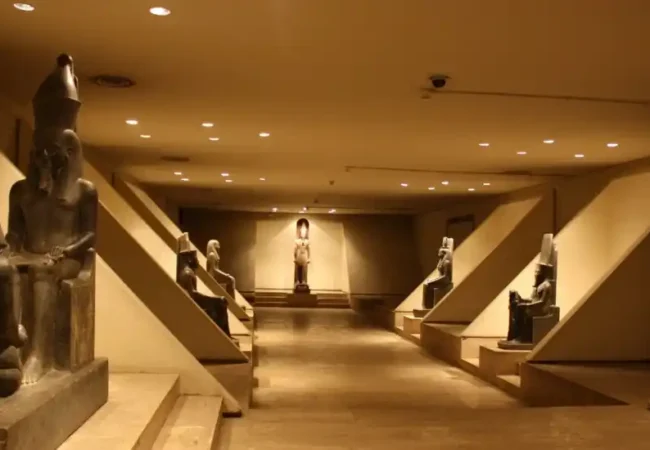
The floor also includes the granite head of the statue of Amenhotep III, the statue of the god Amun, a rare head of King Senusret III, the wonderful statue of King Tuthmosis III made of schist stone, and the most beautiful and largest alabaster statue in Egypt of the god Sobek and Amenhotep III.
The Karnak Stela includes hieroglyphic text relating to the struggle of the rulers of Thebes with the Hyksos
The second floor contains a number of statues, the most important of which are statues of Mek Akhenaten, a number of Coptic funerary stelae, and a number of engraved stones known as talatat.
Which was part of one of Akhenaten’s temples at the eastern end of the Karnak Temple and was collected, where inscriptions were found explaining the daily and religious life in the temple and some of the furniture, jewelry, utensils, and royal amulets.
There are also stone pieces engraved with a picture of King Amenhotep II, who is on a war chariot, and in front of the chariot there is a copper target pierced by four arrows, in addition to other pieces on which Akhenaten and his wife worship the sun god Aten.
Egypt’s museums are one of the most important cultural and historical monuments in the world, and the Luxor Museum in Egypt is no exception.
The museum combines a magnificent architectural aesthetic with a charming surrounding environment to offer a unique cultural experience.
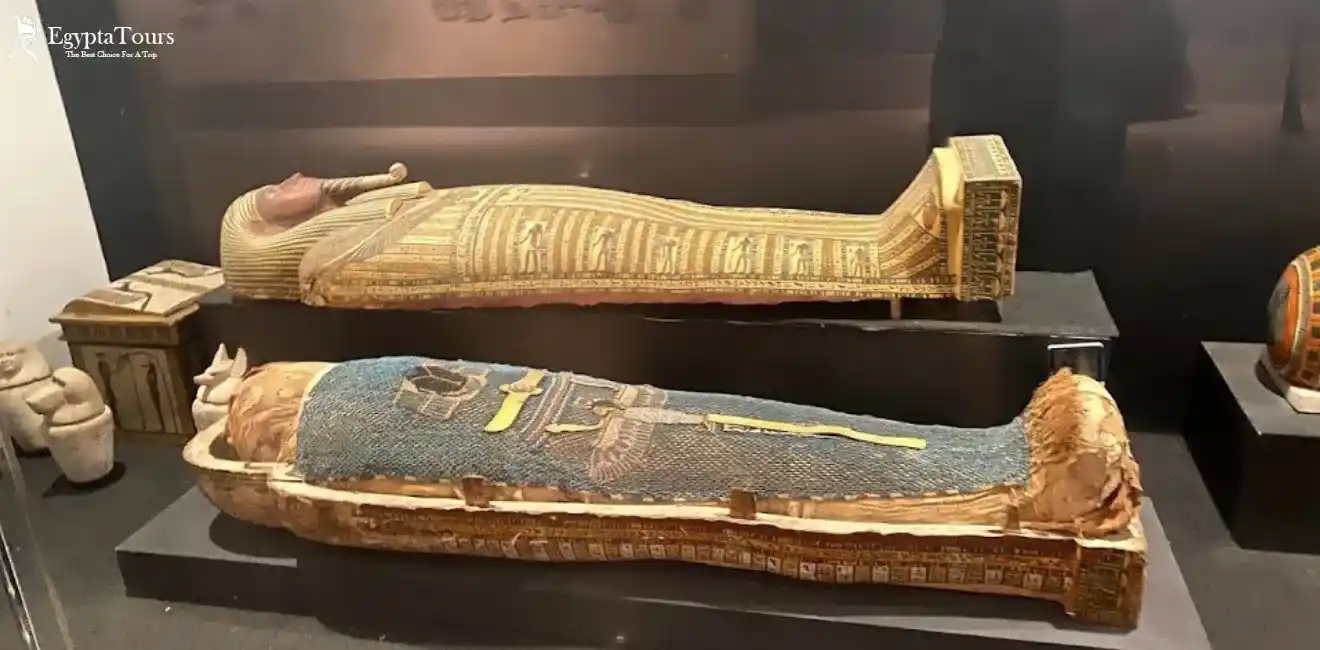
Famous-Royal-Mummies-at-the-Luxor-Museum-EgyptaTours
The Luxor Museum has an impressive collection of royal mummies, including two of the most famous pharaohs from Egypt’s New Kingdom.
Ahmose I: He started the 18th Dynasty and is famous for his military campaigns that drove out the Hyksos and united Egypt. His mummy is one of the museum’s most important exhibits.
Ramses I: He started the 19th Dynasty and was an important pharaoh even though he ruled for a short time. His mummy was once stolen but later recovered and is now at the Luxor Museum.
These mummies are kept in special cases with controlled conditions, letting visitors see the faces of Egypt’s ancient rulers.

Luxor-Museum-artifacts-EgyptaTours
The beauty of the Luxor Museum in Egypt comes from its exceptional architectural design that combines various eras and architectural styles.
The museum is particularly enhanced by its stunning front façade that represents the influence of Pharaonic art and modern style.
Visitors head towards the museum through corridors with massive arches and bright columns that embody the design of antiquity. This architectural design reflects the great attention to detail and the museum’s focus on visual beauty.
The Luxor Museum in Egypt is located in the city of Luxor in southern Egypt, surrounded by Pharaonic antiquities and other historical monuments.
The museum has been carefully designed to blend naturally into and interact beautifully with its surrounding environment.
The museum features stunning views of The Nile River and the region’s impressive geographical landscape.
Natural green gardens surround the Luxor Museum in Egypt, which adds to its aesthetics and makes it an ideal place for visitors looking for an atmosphere of tranquility and beauty.
Visitors can relax in the gardens and enjoy exceptional views of the Nile and its ancient temples.
The Luxor Museum in Egypt is characterized by bright natural lighting that filters through large windows and luxurious arches.
This lighting exceptionally highlights the artifacts, enhancing the visitors’ experience and highlighting their details.
Luxor Museum in Egypt is not just a place to display ancient antiquities and artifacts, but rather it is a comprehensive cultural experience that combines architectural aesthetics and the picturesque surrounding environment.
Visitors can enjoy the beauty of art, history and nature at this exceptional museum in the heart of ancient Egypt.
The Luxor Museum of Ancient Egyptian Art confirmed that the museum receives visitors seven days a week, including holidays and official holidays, during the morning and evening periods
Explaining that visiting hours during the morning period start from 9 am until 2:00 pm, provided that the box office is closed. At 1:30 p.m.
Visiting times for the museum during the evening period start from 5 pm until 9 pm, with the ticket office closing at 8:30 pm.
The price of entry tickets to the museum for a foreign visitor is 100 pounds, and for a foreign student it is 100 pounds, pointing out that payment is made using electronic cards.
The Luxor Museum is open all year, but it is best to visit during Egypt’s cooler months (October to April). Going early in the morning or in the evening is a good way to avoid heat and large crowds.

Luxor-Museum-of-ancient-Egyptian-EgyptaTours
You have many things that you can do during your tourism trip in Luxor, but visiting museums, specifically the Museum, comes at the forefront of these things, as this museum is one of the tourist places worth visiting.
Because it contains various exhibits, each of these displayed pieces is distinguished by its wide importance and in turn depicts an important history that this country has witnessed over many years.
Let walking around be the first activity you will do in this museum. First, you need to explore the museum, its different parts, and its various exhibits.
The Museum in Luxor has many exhibits that will attract your attention and prompt you to take some souvenir photos of such important pieces, and this is something that the museum administration makes available in specific sections.
You will enjoy viewing collectibles dating back to different eras. There are pieces dating back to the prehistoric era, BC, and pieces dating back to the ancient history era.
You will definitely be attracted to one of the halls of the Museum in Luxor, which has been dedicated to displaying a group of artifacts dating back to ancient civilizations, as there are archaeological collectibles dating back to the Pharaonic civilization, including mummies.
Ancient peoples knew many activities in the sea world, which in turn reflects the maritime history of each country and the methods and tools that were used in the past to explore the sea world.
This museum has rare collections about the country’s maritime history, such as ancient ships and boats. You can see various pieces of art, such as ancient architecture, Islamic arts, and paintings.
On the other hand, this museum tells the history and glories of the country and glimpses of former kings through some distinctive exhibits, where you will have the opportunity to see tombs of ancient rulers as well as collectibles belonging to ancient rulers, in addition to models of ancient graves and cemeteries.
Finally, the adjacent roof garden offers sweeping views of Luxor’s old City and allows visitors to take a break and recharge. The adjacent gift and souvenir shop is a great place to buy postcards, Egyptian antiques, and books about ancient Egyptian life.
For those looking for an interactive experience, the museum offers audio and video presentations and workshops. These interactive presentations, performed by museum staff and curators, help explain the various exhibits and artifacts on display.
Luxor Museum is nothing less than a fascinating journey into the past and history of Luxor. From its impressive collection of artifacts and mummies and its interactive displays, the museum is a must-see destination for all visitors to Egypt.
The museum keeps strict control of temperature and humidity and has skilled conservators who use safe restoration methods to protect the artifacts without changing their original look.
With signs in different languages, temporary displays, and programs for students, the museum helps people understand Egypt’s history and encourages young people to value and protect archaeological sites.
Working with museums and universities from other countries helps with research, taking care of artifacts, and sharing culture. These partnerships improve local skills and help protect the region’s treasures for the future.
The Luxor Museum is an important place to see Egypt’s art and culture. It shows carefully chosen artifacts, mostly from the New Kingdom, in a clear and well-organized way. Its most famous exhibits include the royal mummies of Ahmose I and Ramesses I, statues found in the 1989 Luxor Temple Cachette, and the rebuilt wall of Akhenaten. These displays show both artistic skill and strong religious ideas about life, death, and the afterlife.
Along with the nearby Mummification Museum, which focuses on embalming methods, the Luxor Museum gives a full view of ancient Egyptian beliefs by showing both the art of life and the spiritual preparation for death. Besides showing exhibits, the museum also helps with preserving artifacts, educating people, and working with international researchers, making sure Egypt’s ancient history is protected and studied for the future.
Luxor Museum is open daily from 9 AM to 9 PM. Hours may vary during public holidays, so it’s best to check ahead.
You’ll find Luxor Museum on the Corniche El Nil, close to the city center. It overlooks the Nile, making it easy to spot.
Key exhibits include artifacts from Tutankhamun’s tomb and a remarkable collection of statues from the Temple of Luxor cachette.
Yes, there’s a small entry fee. Discounts are available for students and seniors, so bring ID if applicable.
Photography is allowed without flash. Some exhibits may restrict photos, so look for signs or ask a staff member.
Absolutely. Guided tours enhance the experience, providing in-depth insights into the artifacts and history.
Yes, the museum offers accessibility features like ramps and elevators for visitors in wheelchairs.
Luxor Museum occasionally hosts special exhibitions. It’s a good idea to check their website or social media for updates.
There’s a gift shop on-site, offering a range of souvenirs, books, and replicas of the museum’s artifacts.
Plenty of eateries are nearby, offering local and international cuisine. The museum’s location near the Corniche makes it convenient.


Confidently choose your perfect Egyptian adventure from our selection of trusted, expert-curated tours.



Unlock the true wonders of Egypt with confidence. We combine expert local knowledge, seamless logistics, and round-the-clock support to deliver flawless, responsible, and unforgettable travel experiences.