



Ancient Egyptian Government: Structure, Power & Political System
Ancient Egyptian Government depended on two main factors, which are the pharaoh and agriculture, as the pharaoh was an essential part of the Egyptian government and was the one who managed the officials most of the time and most of the officials received orders directly from him, and the Egyptian government contained some stories and novels from the period of the ancient Egyptians, and we will look with you through our article on the most prominent stories, so follow us.
History of Ancient Egypt’s Government
Before the Old Kingdom
scholars have found very few government records from before the Old Kingdom. Evidence shows that Egypt was one united country ruled by one leader. This means the first pharaohs likely created a central government and organized an economic system.
Before the Persian Period, Egypt did not use money. The economy depended on barter. People paid taxes with crops, animals, jewelry, or valuable stones. In return, the government kept order, stored food for times of famine, and built public projects.
The Old Kingdom
Ancient Egypt’s government became more organized during the Old Kingdom. Around 3150 BC, King Narmer united Upper and Lower Egypt and created the first central government, led by the king. To build huge stone pyramids, the pharaoh had to change how the government worked. Pharaohs of the Third and Fourth Dynasties had very strong control and almost complete power.
Early pharaohs built a strong government that helped them gather large numbers of workers. They chose high officials, often from their own families, who were loyal to them. The government helped collect and share food so thousands of workers could be supported. This made it possible to build large stone pyramids. During the Third Dynasty, the first very large group of workers and skilled builders was brought together. Their work led to the Step Pyramid of Djoser, built between about 2667 and 2648 BC.
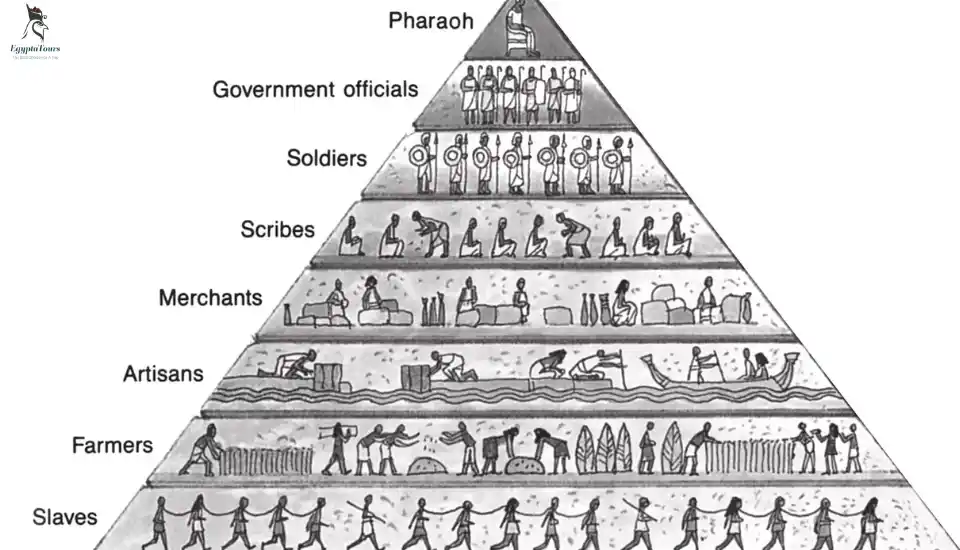
During the Old Kingdom, a social and government system was created and continued through the Old, Middle, and New Kingdoms. At the top of this system was the king, also called the pharaoh. Directly under him was the vizier, who had almost the same power as the king but still had to obey him. Below the vizier were the royal treasurer and the chief scribes. These officials worked in the capital city, which during the Old Kingdom was Memphis.
Next in rank were the nomarchs, who were in charge of regions. Below them were the mayors of cities. Under the mayors were local scribes who handled records and writing. Then came the supervisors who managed building and work projects and reported to the central government. Below them were farmers, small landowners, and skilled workers who helped produce food and build Egypt’s cities. At the bottom of the system were peasants and slaves, who were the largest group. The number of officials in between could change depending on the place and the type of work being done.
During the Fifth and Sixth Dynasties, the pharaohs had less power. Government jobs were passed down from father to son, and the local leaders, called nomarchs, became very powerful. By the end of the Old Kingdom, nomarchs were running their districts, called nomes, without the pharaoh’s control. When the pharaohs could no longer control the nomes, the central government fell apart.
Modern historians divide Egyptian history into Kingdom Periods and Intermediate Periods. In the Kingdom Periods, the government was strong and usually controlled by the pharaoh. When the government fell apart or was weak, it is called an Intermediate Period. Remember, these are modern ways of looking at history; the Egyptians themselves probably did not divide their history this way.
The Intermediate Periods
Modern historians identify three Intermediate Periods in Ancient Egypt’s history. Each Kingdom the Old, Middle and New was followed by an Intermediate Period. Each period was different, but they shared two main things. First, Egypt was not united, and second, there was no strong central government.
For example, during the First Intermediate Period, the kings were much weaker and moved the capital from Memphis to Herakleopolis. Later, at the start of the Middle Kingdom, the capital was moved again to the city of Thebes, which had become powerful. Historians think that during the Intermediate Periods, the nomarchs were often stronger and more capable than the king.
The Middle Kingdom
The Old Kingdom’s government was the base for the Middle Kingdom’s government. The pharaoh made some changes, like adding more officials. Jobs and titles were more specific, which limited the power of each official.
Even though the government was built on the Old Kingdom’s system, the Middle Kingdom was different because each part of the central government was copied. This way, both Upper Egypt and Lower Egypt were represented equally. This also explains some of the special buildings from this time, like places with two entrances and palaces with two throne rooms. Even when Egypt was united, people remembered that it once had two separate regions.
The central government became more involved in the districts, called nomes, and had more control over people and the taxes they paid. The pharaoh worked to reduce the power of the nomarchs. He chose officials to watch over them and made towns the main unit of government. The mayors of towns became important leaders.
Having more officials helped the middle class of government workers grow. Officials set taxes based on how much land could be farmed and how much the Nile flooded. When the Nile’s floods were low, officials lowered the taxes. The government also collected a tax from each person which could be paid with food or handmade goods.
The New Kingdom
The New Kingdom is the best-known period when it comes to the government and what it did. During the Second Intermediate Period, Lower Egypt was controlled by a group called the Hyksos, and Upper Egypt was under threat from the Kushites, who took back land that Egypt had conquered.
Pharaoh Ahmose I finally drove the Hyksos out of Lower Egypt and reunited the two kingdoms. This ended the Second Intermediate Period and started the New Kingdom.
The pharaohs of the New Kingdom built their government on the systems from earlier periods. One change they made was to make the districts, called nomes, smaller but increase their number. During this time, the pharaohs created a permanent army and new military jobs. Before this, armies were made by calling up ordinary people to serve.
During the 19th Dynasty, the legal system began to change. Before this, government-appointed judges decided cases based on evidence. But during this time, people started getting decisions from oracles. Priests would read a list of suspects to a statue of the state god, and the statue would show who was guilty. This gave priests more political power, but it could also lead to corruption.
After The New Kingdom
During the Late Period, the pharaohs reunited Egypt and made the government strong and centralized. When Persia took over Egypt, the new rulers set up a money-based economy. The Persian kings made Egypt a satrapy (province) and chose a governor to rule it. They kept the local district system. Later, the Greek and Roman Empires also ruled Egypt, keeping parts of the local government system.
Shemsu Hor starting in the Old Kingdom, a system called Shemsu Hor, or Following of Horus, was created. This helped make sure taxes and money were managed correctly and stopped people from stealing. During this, the king traveled around Egypt with a group of advisors, overseers and scribes to show the king’s power. They checked tax collection, building projects, tomb construction, and the work of the courts. This practice began just after King Narmer’s reign.
The Shemsu Hor had many purposes. It was used to collect taxes, let people see the king’s power, organize and supervise building projects, and later even take a census. It also helped reduce the costs of running the royal court, keeping power with the king but making it easier to manage the country without always needing approval from the central government. Eventually, civil and criminal trials were also handled through the Shemsu Hor, allowing the pharaoh to personally supervise local projects.
Government and Political System of Ancient Egypt
The government of ancient Egypt was a well organized system that helped one of history’s longest lasting civilizations survive for over 3,000 years. At the top was the Pharaoh, who had complete power as both a political and religious leader. Supporting him were viziers, scribes, and many officials who managed Egypt’s large territories and complicated government.
This system started around 3150 BCE when King Narmer united Upper and Lower Egypt, and it lasted, with some changes, until the Romans took over in 30 BCE. The bureaucracy, or group of government workers, was very important. They managed taxes, trade, farming, law enforcement and the building of big projects.
Egypt was divided into provinces called nomes, each led by a nomarch. This allowed local areas to be managed while the central government kept overall control. During the Old Kingdom (c. 2613–2181 BCE), this system made it possible to build great monuments like the Great Pyramid of Giza. Later, in the New Kingdom (c. 1550–1070 BCE), it allowed the construction of large temples, such as those at Karnak and Abu Simbel.
The government used a system of checks and balances to stay organized. Scribes wrote down everything, from tax collections to royal orders, which helped keep officials accountable. The central government was strong but also flexible, allowing Egypt to balance local rule with overall control for thousands of years.
Structure of the Ancient Egyptian Government

Ancient-Egyptia-Government-The-Pharaohs-Powerful-Leaders-and-Political-Structure-of-Egypt-EgyptaTours
Ancient Egypt was a traditional society that strongly respected the past. Once rules and systems were created, they rarely changed. The monarchy was the hardest institution to change. A pharaoh from the twenty-first dynasty ruled in almost the same way as kings had ruled a thousand years before.
Between the king and the common people, there was a large group that included slaves, craftsmen, soldiers, scribes, priests, and other skilled workers. We can see how large this group was by looking at the many small tombs around the pyramids at Giza. When the pharaoh’s servants died, they were buried near him so they could continue to serve him after death.
One important official in the pharaoh’s court was the court magician. He was respected because people believed he understood astronomy, medicine, and nature. However, his power was less than that of the two viziers one ruled Upper Egypt and the other ruled Lower Egypt. Sometimes one person did both jobs.
Viziers were responsible for paying workers, keeping records, and advising the pharaoh. Some also controlled the treasury. Because of this, they handled most daily government work. If a vizier was dishonest, it could cause serious problems.
The most powerful group in the palace was the priests, especially the priests of Amun. Amun was the sun god, the main god of Thebes, and a favorite of many pharaohs. The power of the priests can be seen in the story of Pharaoh Akhenaton in the 14th century B.C. Personal beliefs and political situations likely influenced him, but together they led to his dislike of Amun soon after he became king.
Pharaonic Rule in Ancient Egypt
A pharaoh was believed to be a god, so he was considered above normal government work and everyday life. He rarely met ordinary people, and even important visitors had to kneel when they came before him. Only a small number of his servants ever saw him face to face.
Pharaohs ruled by giving orders, usually through their viziers. If these orders affected areas outside the palace, they were sent to local governors called nomarchs. These governors acted as the pharaoh’s representatives in rural areas and handled many government duties, especially tax collection. The managers of royal lands and temple properties across the country were also important officials.
The throne usually passed from father to son. The son often ruled together with his father first as a co-ruler. This helped the future king gain experience and showed the people that he was officially chosen. Because of this, it was difficult for anyone else to claim the throne. However, if a pharaoh died suddenly or had no children, violent struggles often happened as different people fought for power.
Political Stability and Military Power in Ancient Egypt
Succession in ancient Egypt was very important for keeping the country stable. Power usually passed through the royal family, and this was often strengthened by marriages within the family or with foreign royal families. Because the pharaoh was believed to be chosen by the gods, his right to rule depended on keeping order (ma’at) and showing a strong link to the gods.
Queen Hatshepsut (ruled 1479–1458 BCE) became pharaoh even though she was a woman. She successfully dealt with a male dominated society and managed to stay in power. Her rule showed that the system could adapt during uncertain times. In contrast, the First Intermediate Period shows what happened when there was no clear successor. Local rulers took control, and the country fell into disorder without strong central leadership.
During the New Kingdom, especially the Ramesside Period, pharaohs carefully planned who would succeed them, often preparing more than one heir. Even so, problems still occurred. For example, the harem plot against Ramesses III (ruled 1186–1155 BCE) shows that royal power was still at risk.
The military was very important in protecting Egypt’s borders, expanding its land, and keeping order inside the country. In the Old Kingdom, the army was mostly made up of soldiers gathered by local leaders. In the Middle Kingdom, Egypt created a permanent army controlled directly by the pharaoh, which made the central government stronger.
Tuthmosis III (ruled 1479–1425 BCE) turned the army into a professional force. He led campaigns into Nubia and the Levant and made Egypt a powerful empire. His victory at the Battle of Megiddo (around 1457 BCE) showed Egypt’s military strength and protected important trade routes.
Ramesses II’s battle with the Hittites at Kadesh (around 1274 BCE) ended with the first known peace treaty in history, showing how the military was also used in diplomacy. During the New Kingdom, special units like the Nubian Medjay acted as elite guards and border protectors. New weapons such as chariots and composite bows made the army stronger. Military campaigns helped keep political stability and brought great wealth through tribute and trade.
Political Reforms and Egypt’s Lasting Influence on Later Civilizations
Reforms were usually introduced when Egypt faced serious problems or when rulers wanted to strengthen their authority. During the Middle Kingdom, Amenemhat I created a permanent army and moved the capital to regain strong central control. In the Old Kingdom, the cattle census held twice a year helped organize resources and taxes, making the government run more smoothly.
Akhenaten’s religious reforms in the New Kingdom brought major change. He focused both religious and political power on the god Aten. Although this was meant to limit the power of the Amun priests, it caused economic instability and damaged Egypt’s foreign relationships. After him, Horemheb worked to fix these problems by restoring traditional beliefs and improving government efficiency.
These reforms show how Egypt’s political system adapted to internal and external challenges while keeping its core values.
The political system of ancient Egypt strongly influenced later civilizations. It helped shape ideas about centralized government and divine kingship. The belief that rulers received their power from the gods later appeared in medieval European monarchies and in Roman emperor worship. Egypt also developed an advanced bureaucracy, especially in record-keeping, taxation, and law.
Scribes carefully recorded government activities, influencing administrative systems in Mesopotamia, Greece and Rome.
Egypt’s use of regional governors, known as nomarchs, was similar to systems later used by the Romans and Persians. Large monuments were also used as political messages, a practice copied by later civilizations. The Romans, for example, brought Egyptian obelisks to Rome, and Greek writers admired Egypt’s temples and pyramids for their size and meaning.
Even the idea of ma’at, which focused on balance and justice, influenced early political thinking and later ideas about good government. Egypt’s long-lasting political system still helps scholars and governments understand leadership and organization today.
Officials of Ancient Egyptian Government
Ancient Egyptian Government was divided in a sequential manner and represented the authority in a systematic manner that indicates politics in ancient Egypt, as the authority was organized in a way that enabled the leaders to implement and perform their functions with high efficiency.
The Pharaoh was the greatest authority as he was allowed to delegate authority and trust to individuals who were placed in the management of Egypt as a whole well, and the government relied mainly on small officials who were the backbone of ancient Egyptian civilization, the most prominent of whom were:
-
The Minister
The minister was the second official in charge of the Ancient Egyptian Government after the Pharaoh and he had to perform some duties such as advising the Pharaoh and implementing his orders, and he was also the chief judge and dealt fairly and implemented the law on all people, and it was also his duty to appoint many officials in the government and supervise them on behalf of the Pharaoh.
Other judges brought him very complex cases to rule on them fairly, and ministers were depicted in ancient Egyptian civilization as wearing white, which is a symbol of neutrality.
-
Treasurer
The treasurer or treasurer was responsible for the wealth of the Ancient Egyptian Government and his favorite thing was collecting taxes, as the ancient Egyptian economy was based on barter systems and goods, not money, and people paid taxes in the form of agricultural crops, cows, jewelry, silver and precious stones, and the government in return carried out public works for roads and maintained peace in the country and also saved food in the event of famine.
-
General of the Armies
As we mentioned earlier, the pharaoh was the head of the Ancient Egyptian Government, but the general of the armies or the commander was the commander of the armies in Egypt and advised the pharaoh in times of war and in the field of national security, and the military commander was the right hand when it came to securing the conditions of foreigners who resided in Egypt.
The commander of the armies also helped the pharaoh in external violations that were taking place with other Mamluks and he was the only person the pharaoh trusted to take care of him against enemies and invaders of lands and he participated in wars if necessary, and he also participated in trade to help Egypt maintain its sovereignty.
-
Soldiers
The soldiers’ job was to fight in wars or calm internal conflicts In times of peace, the soldiers’ job was to supervise farmers, peasants, and workers who were assigned to build structures such as palaces and pyramids.
-
Workers and Traders
Skilled workers, especially doctors and craftsmen, formed the middle class There were many types of work available to the Ancient Egyptians, as they could easily obtain a stable job.
Artisans made and sold jewelry, pottery, tools, and papyrus products. They also designed authentic Egyptian products for foreign and domestic trade.
Therefore, there were many people who wanted to buy goods from merchants and craftsmen, They were called small traders who sold these goods to the public at retail.
-
Slaves and Farmers
Slaves and farmers were at the bottom of the social ladder of the Ancient Egyptian Government. Slaves were among the first people to be captured by war and were sentenced to extreme labor according to what the pharaoh wanted and delegated to them.
Farmers were required to raise animals, tend farmland, and check reservoirs and canals for repairs. Farmers also quarried stone and built monuments.
They had to pay their dues, which amounted to 60% of their annual crop, which was estimated by the pharaoh.
Facts about the Ancient Egyptian Government
- The pharaoh was the supreme authority in the Ancient Egyptian Government.
- The vizier was the most powerful government official in ancient Egypt.
- The ministers were second in power after the pharaoh.
- The people also paid taxes on valuable materials and agricultural products.
- Egypt was divided into several provinces, each of which had a governor.
- The government worked to manage construction projects such as the pyramids.
- The government stored and distributed tasks to the people and workers during times of famine that the country was going through.
Documents about the Ancient Egyptian Government
A lot of information about the Ancient Egyptian Government was in the form of tomb inscriptions, as their tombs included inscriptions detailing the titles of government officials and some events in their lives.
Some pharaohs also allocated tombs for their officials, which greatly helps in identifying the people who served certain pharaohs.
The tombs also revealed some of the changes that occurred to senior government officials, as many pharaohs were appointed as bureaucratic officials and some of them were appointed as men to serve in the army.
Legal documents were also found that include cases of tomb raiders, and these documents indicate the steps that were taken by the government to punish them and prevent further raids that were occurring at that time.
In conclusion, we have learned with you today about the Ancient Egyptian Government and the most prominent officials in the government, each of whom had an important job, and we hope that you like the article.
FAQs
How was the ancient Egyptian government organized under the rule of the Pharaohs?
The ancient Egyptian government was a theocratic monarchy, where the Pharaoh served as both the political and religious leader. The government was highly centralized, with the Pharaoh at the top, supported by viziers, high priests, and local governors who managed different regions of Egypt.
What roles did powerful leaders and officials play in maintaining Egypt’s political structure?
Powerful leaders such as viziers, nomarchs (provincial governors), and high priests helped the Pharaoh administer the kingdom. Viziers oversaw government administration, justice, and taxation, while nomarchs managed local affairs. Priests ensured the Pharaoh’s divine authority was upheld through religious rituals.
How did religion influence the political authority of the Pharaohs in ancient Egypt?
Religion was deeply intertwined with politics in ancient Egypt. The Pharaoh was considered a living god, the earthly representative of Horus, and the son of Ra. This divine status gave the Pharaoh absolute power and justified his rule, ensuring loyalty and obedience from the people.
What were the main responsibilities of the Pharaoh as the head of the ancient Egyptian government?
The Pharaoh was responsible for maintaining Ma’at — the concept of truth, balance, and order. His duties included making laws, leading military campaigns, overseeing construction projects, managing trade and agriculture, and ensuring the prosperity and stability of the kingdom through both political and religious actions.