



Battle of Kadesh: Ramses II and the Hittite Empire Showdown
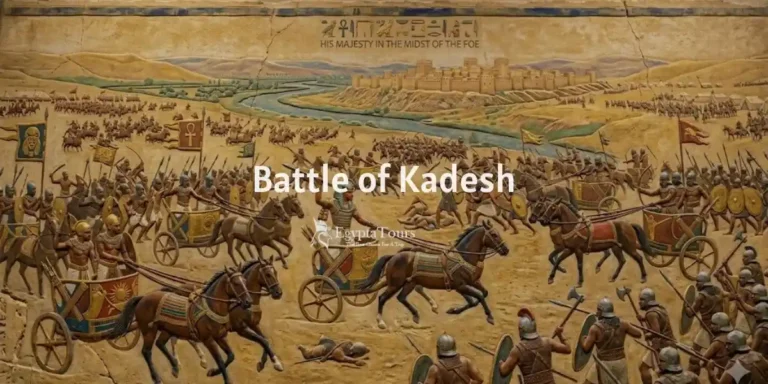
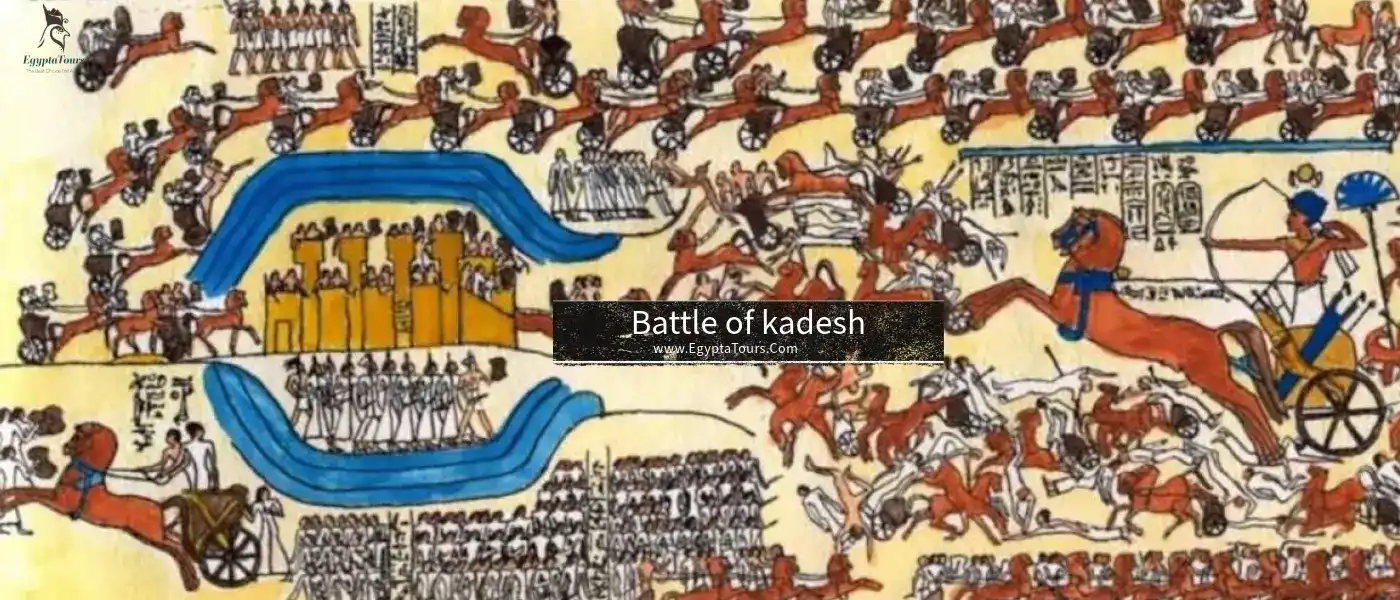
The Battle of Kadesh is one of the most famous battles in ancient history. The battle took place between the Egyptians led By <strong>King Ramesses II</strong> and the Hittites led by King Muwatli II, near the city of Kadesh, which is located on the western bank of the Orontes River south of Lake Homs in Syria, and dates back to the fifth year of Ramesses’ accession. The second is the rule in Egypt, which corresponds to approximately 1274 BC.
Historical-Background-about-the-Battle-of-Kadesh-EgyptaTours
The influence of the Pharaohs in Asia began to decline during the later period of the Eighteenth Dynasty, as a direct result of the internal turmoil caused by the civil unrest in Egypt during Akhenaten’s religious revolution. The Hittites took advantage of this instability and successfully led a coalition against the Pharaohs, resulting in the Egyptians losing a significant portion of their influence in Western Asia. Meanwhile, Pharaoh Akhenaten did not respond to the requests for help sent by the loyal city rulers of Syria as documented in the Amarna Letters.
After the death of Akhenaten and the failure of his religious revolution, Egypt returned to the worship of the traditional gods, particularly Amun.
Pharaoh Horemheb then assumed the throne, benefiting from the military organization established during the reign of Tutankhamun. Horemheb is considered the last Pharaoh of the Eighteenth Dynasty to organize Egypt’s internal affairs and restore stability to the country before his death without an heir. He was succeeded by one of his military leaders, Ramesses I, who founded the Nineteenth Dynasty.
The Pharaohs of the Nineteenth Dynasty took on the task of restoring Egyptian influence in Asia. After the death of Ramesses I, who ruled for only two years, his son and successor, Seti I, launched military campaigns against the Hittites. His main goal was to halt the Hittite advance and reclaim Egyptian control over the Levant, a region that had been under Egyptian rule since the time of Thutmose III in the Eighteenth Dynasty. Seti I achieved several military victories and confronted the Hittite armies near the city of Kadesh in present-day Syria.
Eventually, he reached a peace agreement with them, possibly formalized in a treaty as mentioned in the inscriptions on the walls of the Karnak Temple. Seti I ruled for fourteen years before passing away, leaving the throne to his son, Ramesses II.
Ramesses II launched his first military campaign in the fourth year of his reign, marching through Palestine and reaching the Nahr al-Kalb River near Beirut, where he erected a commemorative stela and regained the region of Amurru from the Hittites. In the fifth year of his reign, he moved northward to secure control over the Levant, eventually confronting the Hittite forces at Kadesh on the Orontes River. The battle ended in a stalemate, leading both empires to pursue a peace settlement, ending the struggle for influence that had cost countless lives and resources on both sides.
The Outcome of Battle of Kadesh
The-Outcome-of-Battle-of-Kadesh-EgyptaTours
Ramesses II failed to break through the defenses of Kadesh, allowing the Hittites to maintain control over the city. The battle ended with both sides retaining their previous gains but it came at a high cost, with significant losses for both empires. After the battle, Ramesses II returned to Damascus.
Despite the stalemate, he recorded his victory in detail, inscribing the full account of the battle on the walls of the Ramesseum, the Luxor Temple and on the northern wall of his Abu Simbel temple in what is famously known as the “Kadesh Battle Hymn.”
On the other side, King Muwatalli, in his records at Boğazköy, claimed the battle as a victory for the Hittites, stating that the region of Amurru had fallen under their control. Over the following ten years, Ramesses II launched several military campaigns in Asia, ultimately capturing the city of Dapur after a siege. This forced the Hittites to retreat, leaving much of Syria inadequately defended.
After Muwatalli’s death, his son ascended the throne, followed years later by his brother, King Hattusili III. Ramesses II seized this opportunity to advance toward Tunip (or Tushpa) and successfully capture it.
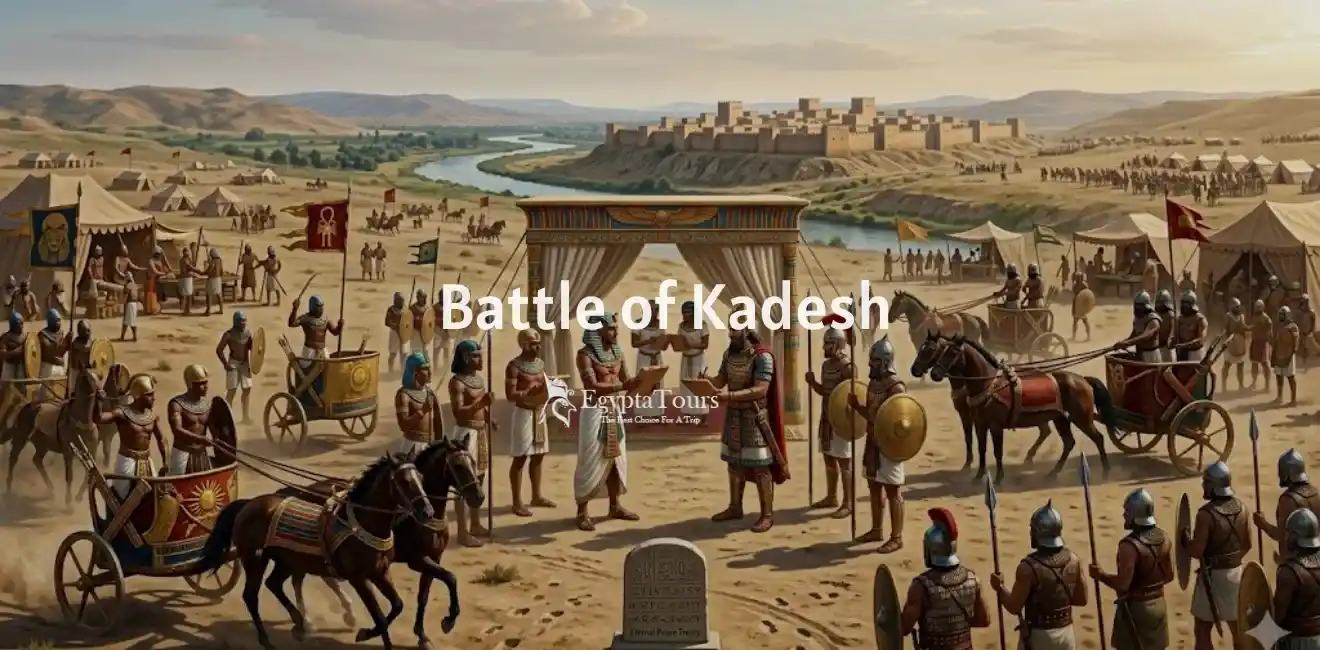
During this period, the Assyrians from northern Iraq began to exert their influence, posing a growing threat to both Egyptian and Hittite territories. This pressure prompted both empires to sign a peace treaty in the twenty-first year of Ramesses II’s reign, around 1258 BCE. The treaty was documented in Hittite cuneiform on a silver tablet in the name of King Hattusili III and in Egyptian hieroglyphs on the walls of the Karnak Temple and the Ramesseum in Thebes (modern-day Luxor, southern Egypt).
The Location of the Kadesh Treaty
According to UNESCO, the tablets containing the Kadesh Treaty were discovered in 1906 in central Anatolia, Turkey, at the site of the ancient Hittite capital, Hattusa. The text is written in cuneiform script and the original tablet is currently preserved at the Archaeological Museum in Istanbul. A replica of the treaty was created by Saadi Kalik, a sculptor and lecturer at the Istanbul Academy of Fine Arts.
The treaty emphasizes eternal friendship, lasting peace, the security of territories, the prohibition of aggression, the extradition of criminals and mutual support between the parties. These commitments outlined in the treaty closely resemble the principles of the modern United Nations.
This replica was presented to the United Nations by İhsan Sabri Çağlayangil, the Minister of Foreign Affairs of Turkey, on behalf of the Turkish state and it was accepted by Secretary-General U Thant. Today, the replica is displayed in the delegates’ corridor on the second floor of the UN conference building, near the entrance to the Security Council chamber.
About the Battle of Kadesh
Ramesses II in the Battle of Kadesh
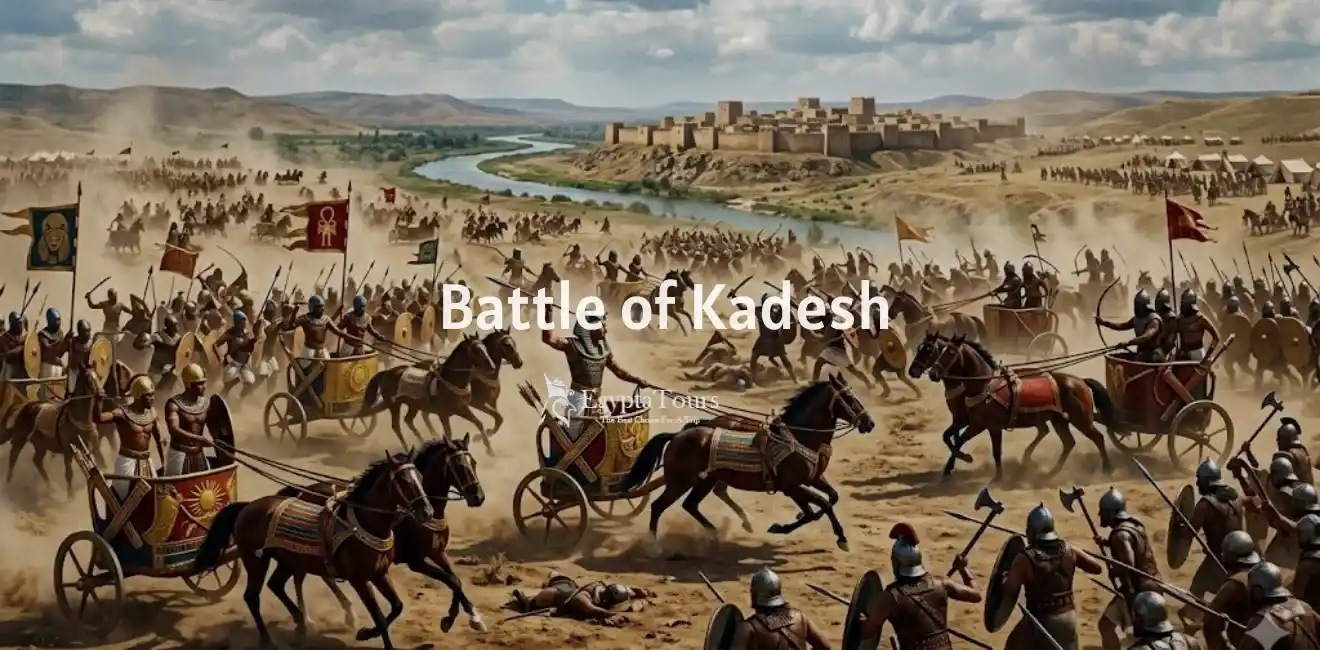
Muwatalli had positioned his forces behind “Old Kadesh.” Ramesses II was deceived by two captured nomads who told him that the Hittite army was far away at Aleppo. In reality, these nomads were Hittite spies sent to mislead the Pharaoh.
Ramesses ordered his troops to set up camp and marched hastily toward Kadesh, unaware of the large Hittite army waiting for him.
Ramesses II describes his arrival on the battlefield in two key inscriptions known as the “Poem” and the “Bulletin”:
From the “Poem”:
“His Majesty prepared his infantry, chariots and Sherden for his majesty’s capture. in Year 5, 2nd month of the third season, day 9, he passed the fortress of Sile and entered Canaan. His infantry advanced through narrow passes as if on Egypt’s highways. After several days, he reached Ramses Meri-Amon, a town in the Cedar Valley.
He proceeded northward, crossed the ford of the Orontes with the Amun division named ‘He Gives Victory to User-maat-Re Setep-en-Re’ and reached Kadesh… The Amun division marched behind him; the Re division was crossing the ford south of Shabtuna, one tier away; the Ptah division south of Arnaim; the Set division on the road. The first ranks of battle were formed by all army leaders while still on the shore of Amurru.”
From the “Bulletin”:
“Year 5, 3rd month of the third season, day 9… His Majesty arrived south of Shabtuna.”
About 11 km south of Shabtuna, Ramesses II met two Shasu nomads who falsely reported that the Hittite king was at Aleppo, 200 km away, afraid to approach the Pharaoh. Egyptian scouts brought two Hittite prisoners, revealing that the entire Hittite army and King Muwatalli II were close, fully prepared for battle behind Old Kadesh.
Ramesses called his princes to discuss the failure of his officials to report the enemy’s location. He was alone with his bodyguard and the Amun division, while the vizier hastened the Ptah and Set divisions and the Ra division approached the camp.
As Ramesses and the Amun division prepared for battle, Hittite chariots crossed the river, charging the Ra division and scattering them. The chariots then attacked the Egyptian camp through the Amun line, causing panic. Ramesses describes being deserted: “No officer, no charioteer, no soldier, no shield-bearer was with me.”
Ramesses II counterattacked, personally leading charges with his bodyguard, Amun chariots and survivors of the Ra division. The Hittites, thinking the Egyptians were defeated, stopped to plunder the camp but were driven back to the Orontes River by Egyptian forces. Lighter Egyptian chariots pursued and destroyed the Hittite forces.
Final phase of the battle
Despite this setback, Muwatalli II still commanded reserve chariots and infantry. He launched another attack near the river with 1,000 chariots led by his nobles. The Ne’arin forces from Amurru surprised the Hittites, while the Ptah division attacked from the south.
After six failed Hittite charges, their forces were almost encircled. Survivors abandoned their chariots and attempted to cross the river “as fast as crocodiles” with many drowning.
Ultimately, the Hittites were routed but retained control of Kadesh.
Battle of Kadesh : How Ramses II’s Tactical Brilliance Saved Egypt from Annihilation

What-are-the-causes-of-the-Battle-of-Kadesh-EgyptaTours
Historical studies indicate that the Hittite or Khiti people were one of the Indo-European peoples, who arrived in the Asia Minor region, to take “Khatushash” (present-day Bugazköy), located in the wide bend of the Khalis River, as the capital of the kingdom that they established in this region, and it was most likely At the beginning of the second millennium BC. At its inception, the Hittite Kingdom, like all the kingdoms of the ancient Near East, was composed of a union of neighboring states in Anatolia. The result of this union was the establishment of the first Hittite Kingdom during the nineteenth century BC.
During the first half of the Eighteenth Dynasty, the Hittites did not have a significant role in their relations with Egypt, but during the reign of Amenhotep III, the name of Khita appeared in four lists, and they were mentioned in the Amarna letters.
Since the reign of the Hittite king “Shubiluluma I”, the star of the Hittites in Anatolia began to rise slowly, and the rise of the Hittites from their strongholds in the Anatolian highlands during the early fourteenth century BC represented a serious threat to Egypt and its empire in Syria and Palestine.
Rise of the Hittite empire
Rise-of-the-Hittit-empire-EgyptaTours
Hittite prosperity was mostly dependent on control of trade routes and mineral sources. Given the importance of northern Syria for the vital roads linking the Cilicia Gates to Mesopotamia, the defense of this region was crucial and was soon tested By <strong>Egyptian expansion under Pharaoh Ramesses II</strong>. The outcome of the battle is uncertain, although it appears that the timely arrival of Egyptian reinforcements prevented the Hittites from a complete victory.
Kings Seti I and Ramesses II worked to restore Egypt’s political and military influence and prestige in the region, and decided to lead the Egyptian army to Syria and Palestine again to restore Egypt’s lost properties there since the Amarna era. Hence, King Seti I succeeded in restoring large parts of Egypt’s possessions in Syria and Palestine.
He also succeeded in clashing with the Hittite Empire, Egypt’s arch enemy in the region, and the Egyptian army was able to achieve some victories over the Hittites that were not decisive, but they restored part of the empire. Great for Egypt’s political and military reputation.
King Ramesses II worked to continue his father’s policy to restore Egypt’s influence and possessions in the region. Indeed, King Ramesses II went out with the Egyptian army in the fifth year of his reign (about 1274 BC) to fight the Hittites and their successors in the Syrian city of Kadesh, and it took place between the Egyptians.
The Battle of Kadesh and the Hittites was considered the most important and famous battle in the history of the ancient world.
A few years after the Battle of Kadesh, King Ramesses II returned to lead the Egyptian army in campaigns against Syria and Palestine aimed at imposing Egypt’s political and military influence, breaking the power of the Hittites in the region, and preventing it from interfering in Affairs of the states of Egypt.
the conflict between the Egyptians and the Hittites ended with the conclusion of a peace treaty and alliance between Kings Ramses II and Khatusil III in the eleventh and twenty-first year of the reign of King Ramesses II, and then the region enjoyed peace and political stability that it had never witnessed before.
What are the causes of the Battle of Kadesh?

What-are-the-most-important-events-of-the-Battle-of-Kadesh
The following is the most important information about the reasons for the outbreak of the Battle of Kadesh:
- Pharaonic influence began to decline in the Asian region at the end of the reign of the kings of the Eighth Pharaonic Dynasty, due to the disturbances that broke out due to the civil war during Akhenaten’s religious revolution in Egypt. The Hittites took advantage of these disturbances and formed many alliances against the Egyptians, and the Pharaohs lost many regions in Western Asia. Akhenaten did not respond to the letters of his princes there in what was known as the Amarna letters.
- After the death of Akhenaten and the return of the Egyptians to the worship of Amun, Pharaoh Horemheb assumed power and died without an heir. After him, one of the army commanders took power, namely Ramesses I, founder of the Nineteenth Dynasty. These rulers tried to restore the influence of the pharaohs from the Hittites, and two years later Seti I took power after the death of his father. Ramesses I began several military campaigns against the Hittites, succeeded in several campaigns, and his son Ramesses II assumed power after him.
- Ramesses II began his first campaigns four years after assuming power. He arrived with his army at Nahr al-Kalb, north of the city of Beirut, and erected a memorial plaque there. He regained control over the province of Amur. In the fifth year, he continued his advance northward with the aim of controlling the Levant, and met the Hittite armies at the city of Kadesh.
What are the most important events of the Battle of Kadesh?

What-are-the-causes-of-the-Battle-of-Kadesh-EgyptaTours
The following are the most important events that took place in the Battle of Kadesh:
- Ramesses II with his army approached the city of Kadesh and camped one day’s walk from it, and during that time two Bedouin men entered him, claiming that they were fleeing from the Hittites, and they told the king about the location of the Hittites, and indicated that the Hittites had left their positions and arrived in northern Syria near the city of Aleppo. This news was fake, and these two men were spies for the Hittites.
- Ramesses marched at the head of Amun’s legion based on that news without confirming its authenticity. He crossed the Orontes River and reached a high place northwest of Kadesh. Ramesses camped there waiting for the rest of the army. During that time, his army arrested soldiers scouting for the Hittites and learned from them the truth, which is that the Hittites were in Kadesh and their armies are on their way to surprise the Egyptians.
- Half of the Hittite armies crossed the Orontes River, and Ramesses was surprised by them. He had left a large distance between him and his army. The Hittites attacked the legion and destroyed it, and besieged Ramesses and the rest of the army. Ramesses led an attack against them and surrounded the Hittites and forced them to retreat to the river. At that moment, supplies arrived from his soldiers from Amur country, the Hittites were besieged and fled into the river, abandoning their weapons and chariots.
- The next day, a second battle took place, which was also inconclusive. King Ramesses claimed that King Muwatalli had sent him a request for peace, but there is no evidence of this among the Hittites, and the battle ended with heavy losses incurred by both sides.
What are the most important events of the Battle of Kadesh?
The following are the most important events that took place in the Battle of Kadesh:
- Ramesses II with his army approached the city of Kadesh and camped one day’s walk from it, and during that time two Bedouin men entered him, claiming that they were fleeing from the Hittites, and they told the king about the location of the Hittites, and indicated that the Hittites had left their positions and arrived in northern Syria near the city of Aleppo. This news was fake, and these two men were spies for the Hittites.
- Ramesses II declared his victory at Kadesh after the battle, the details of which were inscribed in what is known as the Battle of Kadesh Hymn on the walls of the Ramesseum Temple, Luxor Temple, and Abu Simbel Temple.
- King Muwatalli mentioned that the Battle of Kadesh was a victory for the Hittites, and he mentioned that the Amur region fell into the hands of the Hittites as well, but Ramesses did not stop his campaigns, and during the next ten years he seized several areas, the most important of which was “Dabur”, and the Hittites withdrew, leaving the largest part of Syria without protection, and then took over Ali Tushab or Tunib after the death of Muwatalli, until the Assyrians appeared in Iraq and threatened the influence of the Hittites and Egyptians in the Levant.
What is the first peace treaty in history?
After many years of wars between the Hittites and the Egyptians, and the emergence of the Assyrians as a power in northern Iraq, the Egyptians and the Hittites concluded an official peace treaty between them, and that was approximately in the year 1258 BC. The treaty was engraved on a silver tablet, and a clay copy of it remained in the Hittite capital, Hattusa. Hattusas” in Turkey, and is still preserved in the Archeology Museum in the capital, Istanbul. This treaty is the first documented peace treaty in history.
Aftermath of Battle of Kadesh.
The Siege of Dapur
Unable to maintain a long siege of the fortified city of Kadesh, Ramesses II gathered his troops and marched south toward Damascus, eventually returning to Egypt. He proclaimed that he had routed his enemies and had not attempted to capture Kadesh. The battle was a personal triumph for Ramesses. Despite being ambushed and facing potential defeat and death, the Pharaoh rallied his scattered forces and turned the tide. The following day, the Egyptians and Hittites faced each other directly in a battle that ended in a stalemate.
Hittite records from Hattusa present a different perspective, showing that Ramesses was forced to leave Kadesh in defeat. Modern historians generally consider the battle a draw, though it marked a turning point for Egypt, which had developed new military technologies and rearmed after years of Hittite incursions.
The Egyptian and Hittite peace treaty, now on display at the Istanbul Archaeology Museum, is considered the earliest recorded international written agreement. The Hittite king, Muwatalli II, continued his military campaigns southward, reaching the Egyptian province of Upi (Apa). He successfully captured the region and placed it under the authority of his brother Hattusili, the future Hattusili III.
At this time, Egypt’s sphere of influence in Asia had been reduced to Canaan, yet the region remained unstable, occasionally threatened by uprisings from Egypt’s vassal states in the Levant. As a result, Ramesses II had to undertake a series of military campaigns to reinforce his authority and restore control over Canaan before he could launch further operations against the Hittites.
Ramesses’s Military Campaigns and Temporary Victories
In the eighth and ninth years of his reign, Ramesses II significantly expanded his military achievements by successfully capturing the Hittite-controlled cities of Dapur and Tunip. These cities had not seen the presence of any Egyptian soldiers since the reign of Thutmose III, nearly 120 years earlier.
However, Ramesses’ victory proved temporary. The narrow stretch of land between Amurru and Kadesh was not defensible, and within a year, it returned to Hittite control. Ramesses had to campaign against Dapur again in his tenth year. Neither Egypt nor Haiti was able to achieve a decisive victory over the other in the region, leaving control contested between the two powers.
About fifteen years after the Battle of Kadesh, an official peace treaty was signed with the new Hittite king, Hattusili III, in the 21st year of Ramesses II’s reign (around 1258 BC), effectively bringing the border conflicts between Egypt and the Hittites to a conclusion.
The treaty was inscribed on a silver tablet with a clay copy found in the Hittite capital, Hattusa, now in Turkey and displayed at the Istanbul Archaeology Museum. A large replica is mounted on a wall at the United Nations headquarters, regarded as the earliest known international peace treaty. The Hittite text survives, while an Egyptian version exists on papyrus.
According to historian Trevor Bryce, both sides claimed victory. Ramesses gained the upper hand at the end of the Battle of Kadesh but failed to reclaim the disputed regions of Amurru and Kadesh. Essentially, the Egyptians achieved a tactical victory on the battlefield by preventing a complete Hittite defeat, while the Hittites achieved a strategic victory by maintaining control over the contested territories.
The Documentation of Battle of kadesh
Egyptian Sources and Records
There is more evidence for the Battle of Kadesh in the form of texts and wall reliefs than for any other battle in the Ancient Near East, and almost all of it comes from the Egyptian perspective. The first scholarly report and reconstruction of the battle was conducted by James Henry Breasted in 1903, relying on Egyptian sources.
Egyptian influence over Amurru and Kadesh appears to have been permanently lost.
The primary source of information comes directly from the Egyptian records. The exaggerated and grandiose nature of Ramesses’ account is well acknowledged. The Egyptian version of the battle is preserved in two main forms, known as the “Poem” and the “Bulletin.” The Poem has been questioned as true verse as it may be a prose narrative similar to those recorded by other pharaohs. The Bulletin, however, is a caption accompanying the wall reliefs. These inscriptions are repeated multiple times, seven times for the Bulletin and eight times for the Poem in temples such as Abydos, the Temple of Luxor, Karnak, Abu Simbel and the Ramesseum.
In addition to these narratives, numerous small captions highlight specific aspects of the battle. Beyond the inscriptions, textual evidence is preserved in Papyrus Raifet and Papyrus Sallier III, along with a letter from Ramesses to Hattusili III, written in response to a complaint by the Hittite king regarding the Pharaoh’s claims of victory.
Hittite references to the battle, including the letter mentioned above, have been found in Hattusa but no formal annals describe the battle as part of a campaign. Instead, the battle appears within the context of other events. This is especially true for Hattusili III, for whom the Battle of Kadesh marked a significant milestone in his career.
Conclusion.
The Battle of Kadesh, fought around 1274 BCE, was one of the largest chariot battles in history, between the forces of Pharaoh Ramses II of Egypt and the Hittite Empire. According to Egyptian sources, Ramses II claimed a great victory, although modern historians believe the battle ended in a stalemate.
The Egyptians were initially caught off guard by a surprise attack from Hittite chariots at the Egyptian camp, but Ramses II reportedly regrouped and led a counterattack. Despite the unclear outcome, the battle solidified Ramses II’s reputation as a formidable leader and was later immortalized in Egyptian temples and monuments.
FAQs
What was the Battle of Kadesh and when did it take place?
The Battle of Kadesh occurred around 1274 BCE between the Egyptian forces led by Pharaoh Ramses II and the Hittite army under King Muwatalli II. It was one of the largest chariot battles in ancient history.
Who were the main leaders involved in the Battle of Kadesh?
The Egyptian army was commanded by Pharaoh Ramses II, while the Hittite forces were led by King Muwatalli II, who controlled an alliance of states in Anatolia and Syria.
What caused the conflict between Egypt and the Hittites at Kadesh?
The battle stemmed from both empires’ rivalry over control of Syria and the key city of Kadesh, a strategically vital trade and military hub on the Orontes River.
How did Ramses II demonstrate tactical brilliance during the battle?
Despite being ambushed and initially isolated from his reinforcements, Ramses II rallied his troops, organized a counterattack, and personally led his chariot corps to repel the Hittites, preventing Egypt’s annihilation.
What mistakes did the Egyptians make before the Battle of Kadesh began?
Ramses II was misled by false intelligence from Hittite spies posing as deserters, causing him to advance prematurely and divide his army, leaving his forces vulnerable to a surprise attack.
How did the Hittite army manage to surprise Ramses II’s forces?
The Hittites launched a sudden chariot assault on the Egyptian camp when Ramses’ divisions were scattered, nearly overwhelming the Egyptians before Ramses regrouped and countered.
What was the outcome of the Battle of Kadesh and who claimed victory?
The battle ended in a stalemate. Both sides claimed victory, but neither achieved decisive control over Kadesh. Eventually, the two empires signed the world’s first recorded peace treaty.
How did the Battle of Kadesh influence future relations between Egypt and the Hittite Empire?
The aftermath led to a diplomatic understanding and later a formal peace treaty, promoting stability between the two powers and setting a precedent for international diplomacy in the ancient world.
About EgyptaTours

EgyptaTours is a name synonymous with trust, excellence, and unforgettable travel experiences, proudly standing as one of the leading travel agencies in Egypt. Renowned for its deep expertise, personalized service, and carefully crafted itineraries, EgyptaTours serves as the ultimate gateway to discovering Egypt in its most authentic and inspiring form.