The Magical Gates of Cairo: A Journey Through History
The Gates of Cairo are the heavenly guardians of the golden Islamic...



Ancient Egyptian doctors used both medical treatments and spiritual spells, believing illness could come from physical or supernatural causes.
The papyrus contains a “Treatise on the Heart,” showing Egyptians understood the importance of the heart and blood vessels in the body.
It included remedies for eye diseases, headaches, digestive problems, contraception, fractures, skin diseases, and mental conditions like depression.
The Ebers Medical Papyrus is a treasure trove of ancient Egyptian medical genius.
Its secrets lie within the lines of a manuscript written more than three thousand years ago specifically around 1550 BC at a time when civilization was performing miracles.
This rare document containing herbal medicinal recipes was not discovered in a museum or laboratory.
It was acquired by the German researcher Georg Ebers during his winter trip to Luxor in 1873.
It then moved from the golden sands to the shelves of the Leipzig University Library, where it is preserved today as a priceless artifact.

Ebers-Medical-Papyrus-in-ancient-Egypt-EgyptaTours
The Ebers Medical Papyrus was written on a sheet of paper approximately twenty meters long and contains 110 pages of medicinal and botanical secrets.
It is believed to be derived from older texts dating back to periods before its actual writing around 1550 BC, between the end of the Second Intermediate Period and the rise of the New Kingdom.
This papyrus was not alone in its use during this period. Other papyri such as the Kahun Papyrus which delved deeply into gynecology from around 1800 BC, and the Edwin Smith and Hearst Papyri both dating back to 1600 BC were also included.
In addition to the Brugsch and London Papyri both from the 13th century BC, there is a striking similarity between some of the Ebers texts and the contents of the Brugsch and London Medical Papyri as if they were extensions of the same wisdom.
Even more bizarrely a portion of the Carlsberg Papyrus VIII appears to mirror a face of Ebers although the origins of this mysterious papyrus remain unknown opening the door to unanswered questions.
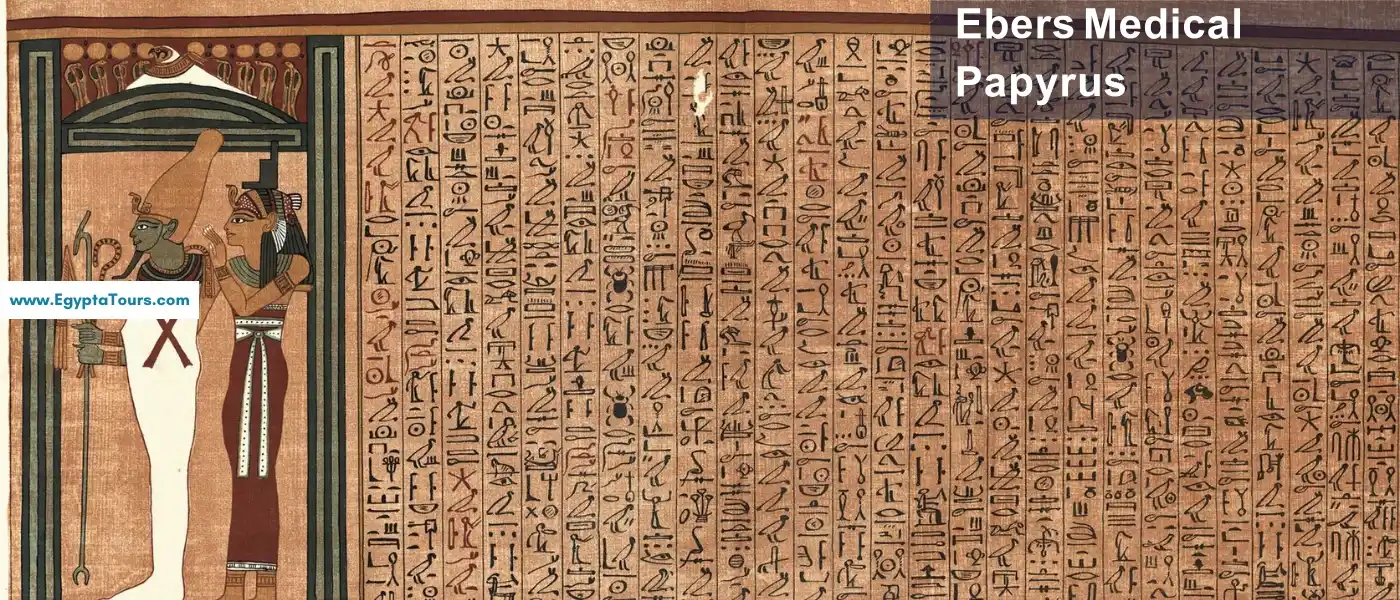
The-Ebers-Papyrus-Contents-in-Medicine-EgyptaTours
The legendary Ebers Papyrus written by the ancient Egyptians in hieratic script is a medical encyclopedia containing nearly 700 prescriptions that blend folk magic and empirical healing.
The papyrus also included spells used to exorcise evil spirits and opened the door to a nascent scientific understanding.
Amidst these prescriptions appears a text titled “A Treatise on the Heart,” revealing that the pharaohs understood the role of the heart as a central pump that pumps life throughout the body through vessels branching out to all organs despite their ambiguity regarding the kidneys which seemed to be absent from their medical equation.
What is impressive is the degree of precision with which the ancient Egyptians delved into the human psyche.
The papyrus devotes chapters to what are now known as psychological disorders including chapters describing conditions similar to depression and dementia.
In a chapter known as “The Book of Hearts,” they did not distinguish between physical and psychological pain, but rather viewed the body and mind as a single entity that pulsates suffers, and heals together.
Not only that but the papyrus expanded to cover topics that were beyond the reach of its time such as contraception pregnancy control, women’s problems parasites, eye and skin diseases, and even surgery such as draining abscesses and setting fractures.
They assumed that health resided in the smooth flow of fluids within the body from blood and tears to urine and semen believing that any obstruction to this flow led to illness.
This idea despite its simplicity was the seed for what later became known in Greek medicine as the theory of the four humors. Indeed it can be said that the Ebers Papyrus formed the first foundation that linked ancient Egyptian medicine with Greek thought and medieval theories.

Treatments-Ebers-Medical-Papyrus-EgyptaTours
The Ebers Medical Papyrus contains many treatments that cover most physical ailments.
These include:
Thousands of years ago the ancient Egyptians innovated strange but effective methods for combating insects and pests as evidenced in their ancient medical documents.
Pesticides were not manufactured as we know them today, but were derived from nature. In the Ebers Medical Papyrus lice and fleas are treated with oils or sprays.
They even resorted to a strange recipe: a warm mixture of date flour and water which was drunk and then spat out as if to repel insects from the body both internally and externally.
To protect their grain stocks they wove a network of unpleasant odors to deter rodents. They used gazelle dung and mouse urine scattering them around fires to create an environment that mice would not dare approach.
The smell may have been unbearable, but for them it was a blessing A food shield.
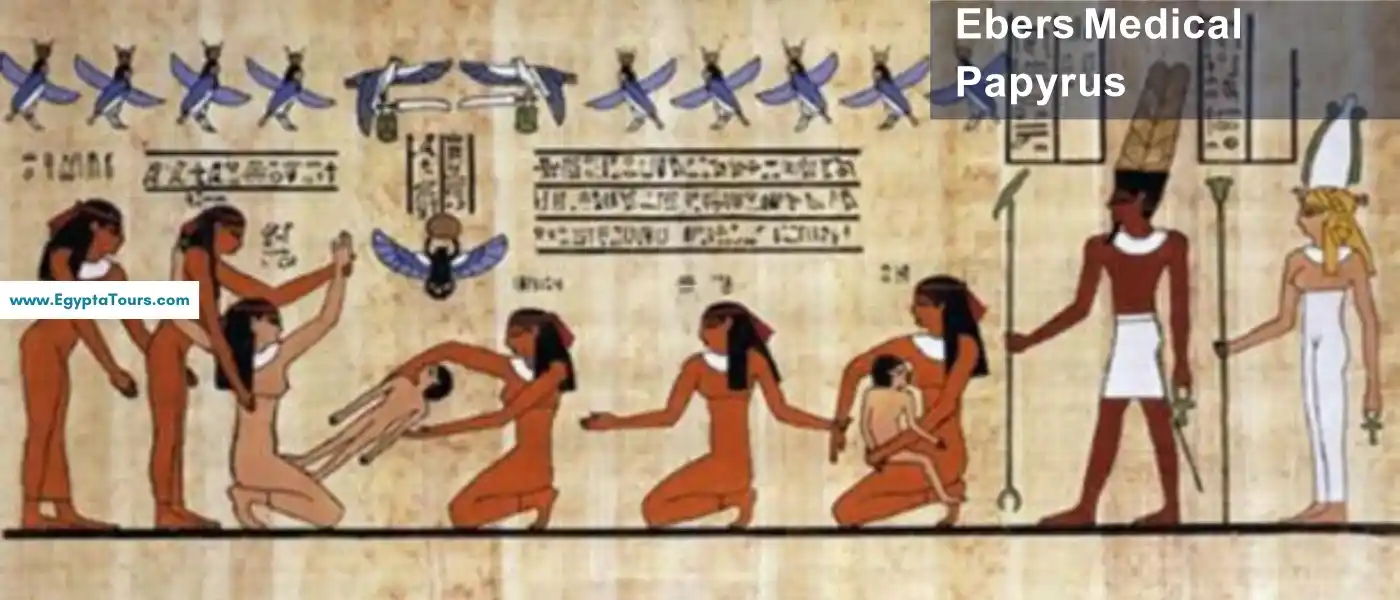
When-was-Ebers-Medical-Papyrus-discovered-in-the-modern-era
The Ebers Medical Papyrus reached the eyes of scientists laden with medical secrets buried with kings.
In 1862, this paper fell into the hands of the American explorer Edwin Smith.
He did not know exactly how it came to him except for a story that it was recovered from between the legs of a mummy lying in Al-Asasif in the tombs of the Theban Necropolis.
The papyrus remained locked away in his private collection for years until it appeared to the public in a rare catalog in 1869.
It was described as a “huge medical papyrus” owned by “an American farmer residing in Luxor.”
A strange description for a man who left his mark on Egyptology. However fate intended for this papyrus to have another name.
In 1872 it was acquired by the German researcher and novelist passionate about Egyptian civilization Georg Ebers, and from then on it became known by his name.
In Pharaonic history and in the Ebers Medical Papyrus acquired by George Ebers in 1862 lies the greatest legacy of the pharaohs in the field of medicine.
This stunning scroll is not only the oldest written medical reference, but also represents the emergence of the inductive medical approach as we know it today.
It presents a sophisticated vision for patient care almost on par with modern standards of analysis and examination.
The process begins with an interview with the patient followed by a thorough sensory examination including sensing smell heartbeat and the body’s vital cycle.
The physician then examines secretions, including urine feces, and saliva.
Afterward the physician issues his or her judgment based on three possible options a possible cure, relative control of the condition, or a terminal illness.
But the papyrus’s brilliance does not stop there. It is replete with astonishing details describing angina pectoris and coronary artery blockage, and addresses tumors of various types from fatty to abscesses.
As for toothache the pharaohs treated it with actual fillings of decayed teeth far ahead of their time.
The papyrus did not neglect the psychological aspect as it included sections on treating psychological disorders and improving mood in patients with depression, in addition to entire chapters on gynecology contraception pregnancy diagnosis digestive system diseases and parasites skin and eye problems local surgery for treating burns, and even bone stabilization.
In all diseases.
The ninth year of the reign of King Amenhotep I.
It contains many medical prescriptions and treatments.
In conclusion, the Ebers Papyrus remains a testament to the genius of the ancient Egyptians who transcended the boundaries of time and space. It also represents a mature medical thought and a research mind that was centuries ahead of its time.
In its lines it glimpses the first signs of analysis diagnosis, and comprehensive medical care as if it were a bridge between a civilization and modern sciences yet to come. This papyrus is a medical reference and an eternal testimony that science was and remains the essence and soul of civilization.


Explore our top-rated Egypt travel packages and embark on an unforgettable journey. From the Pyramids of Cairo to the magical temples of Luxor, Aswan, and Abu Simbel, discover expertly curated tours designed for your perfect Egyptian adventure