





Fayum Mummy Portraits: Stunning Ancient Faces Preserved in Time
Fayum Mummy portraits are considered among the oldest and most significant works of art that vividly reflect the life and culture of ancient Egypt during the Roman era.
These portraits are distinguished by a unique artistic style that skillfully blends Egyptian and Greek influences, making them a living testament to the cultural interaction prevalent at that time.
These works hold immense historical and artistic value, as they meticulously depict the features of individuals with remarkable accuracy and realism, showcasing the early and stunning development of portraiture.

What-is-a-Fayum-Mummy-Portrait-EgyptaTours
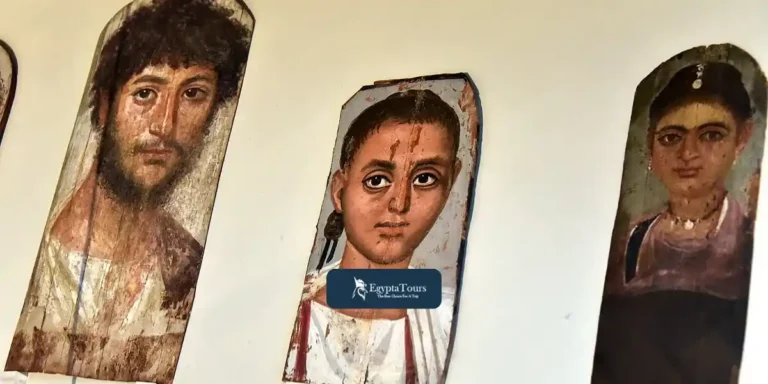
A Fayum mummy portrait is an integral part of an important series of funerary paintings dating back to the Roman era in Egypt, where they were meticulously painted on sturdy wooden panels and respectfully placed on the faces of mummies after the embalming process.
These portraits are characterized by a captivating artistic style that artfully merges classical Greek realism with authentic Egyptian traditions, and they stand as some of the earliest known examples of portrait art in the world, vividly reflecting the features of individuals with unparalleled precision and lifelike details that seem to pulse with life.
How Many Fayum Mummy portraits Exist?
The number of Fayum Mummy portraits is estimated to be around 900 to 1,000, a figure that reflects the sheer scale of this immense artistic heritage. Most of these valuable portraits have been discovered in the fertile Fayum region and other areas in Egypt, such as Hawara and al-Hiba.
These portraits are considered among the most important artistic testaments that combine Egyptian, Roman, and Greek influences, skillfully portraying the features of the deceased in a unique and lifelike portrait style.
Where Can I See Fayum Mummy portraits?

Where-Can-I-See-Fayum-Mummy-portraits-EgyptaTours
Fayum portraits, also known as “Fayum Mummy portraits,” are prominently displayed in several prestigious museums around the world, giving the public the opportunity to enjoy this remarkable art.
Although these portraits were found in Egypt, they have been distributed across various art collections, which has increased their global reach and significance. You can see them in the following locations:
- The Egyptian Museum, Cairo: This ancient museum houses some of the Fayum portraits discovered in Egypt, proudly displayed within the funerary art section, allowing visitors to learn about this important aspect of ancient Egyptian culture.
- The British Museum, London: This famous museum contains several magnificent Fayum portraits within its permanent collection, displayed alongside other Egyptian-Roman artworks, providing a rich historical and artistic context for the visitor.
- The Louvre Museum, Paris: This renowned French museum includes some stunning Fayum portraits, carefully displayed in the Department of Egyptian Antiquities, reflecting the importance the museum places on this type of art.
- The Metropolitan Museum of Art, New York: This prestigious museum holds a substantial number of Fayum portraits that vividly reflect the distinctive painting techniques prevalent in Roman-era Egypt, giving visitors a unique opportunity to explore these techniques.
- The J. Paul Getty Museum, Los Angeles: This outstanding museum exhibits some portraits that beautifully highlight the art of painting on wood that was widely used in Roman-era Egypt, shedding light on this important artistic aspect.
- The Egyptian Museum of Munich, Germany: This museum houses a valuable collection of portraits that reflect the evolution of diverse artistic styles during the Roman era in Egypt, providing a comprehensive view of this development.
- The State Museums of Berlin, Germany: This museum contains a large number of well-preserved Fayum portraits, allowing visitors to see these portraits in their best condition.
Materials and Techniques Used in Painting the Portraits
Fayoum Mummy portraits are stunning personal portraits dating back to Roman-era Egypt (1st – 3rd century AD), distinguished by their meticulous details and refined techniques.
Here are detailed specifications of the materials and techniques used in painting Fayoum Mummy portraits:
- Surfaces (Wooden Panels): Fayoum Mummy portraits were carefully painted on sturdy wooden panels, such as those made of lime and sycamore wood. These panels were prepared with a layer of gesso to enhance the stability of the colors used in the painting.
- Pigments (Colors Used): Artists at the time used natural pigments extracted from minerals and plants, such as iron oxide for red, yellow ochre for yellow, and azurite for blue, demonstrating their extensive knowledge of natural color sources.
- Encaustic Technique: This technique was characterized by mixing pigments with hot wax, then carefully applying this mixture to the painting using hot metal tools, to achieve three-dimensional effects that increased the realism of the painting.
- Tempera Technique: This technique relied on mixing pigments with egg yolk or gum Arabic to bind the colors together. This mixture was applied using fine brushes to create fine details that added beauty and splendor to the painting.
- Painting and Shading Techniques: Artists skillfully used tonal gradients and shading to impart stunning realism to the painted faces, with precise highlighting of fine details such as the eyes and features, demonstrating their superior artistic talent.
- Clothing and Jewelry Details: The details of clothing and jewelry were meticulously painted using fine brushes to realistically display patterns and light, reflecting the artists’ attention to small details.
- Preservation of Portraits: The dry climate in Egypt and the hot wax technique used in painting helped preserve the colors and aesthetic appearance of the paintings for thousands of years, demonstrating the effectiveness of these techniques in preserving art.
Famous Fayum Portraits Displayed in World Museums

Famous-Fayum-Portraits-Displayed-in-World-Museums
Fayoum Mummy portraits are among the most important artistic discoveries ever found, and many of these valuable portraits have been displayed in prestigious world museums. Here are some of the most famous paintings displayed in world museums:
- Portrait of a Bearded Man at the Metropolitan Museum (New York): This prestigious museum displays a magnificent portrait of a man with a long, square beard. This portrait shows his facial features in fine detail in the eyes and hair, and it is considered one of the most famous paintings that reflect extreme realism in painting faces.
- Family Portrait at the National Gallery of Art (Washington): This stunning portrait shows an Egyptian family from the middle class. The faces painted in the portrait are characterized by vivid details and precise expressions, and this portrait is displayed as one of the wonderful examples of family photography in ancient Egypt.
- Portrait of a Female Face at the Musée d’Orsay (Paris): The Musée d’Orsay displays a beautiful portrait of a young woman characterized by extreme care in painting the eyes and hair. This painting is considered one of the paintings that represent the great evolution in portrait art during the Roman period in Egypt.
- “Old Man” Portrait at the Berlin Museum (Germany): This painting is considered a wonderful example of extreme realism in painting elderly faces, as it shows the face of an old man with fine details in wrinkles and gray hair. This painting is displayed as one of the most prominent examples of the encaustic technique used in painting.
The Relationship of Fayum Portraits to Modern European Portrait Art

Fayum-Mummy-portraits-EgyptaTours
Fayoum Mummy portraits show a marked and profound influence on modern European portrait art through their precise details and realistic expressions, such as skillful shading and the highlighting of the eyes and hair with talent.
These paintings have greatly contributed to the development of the concept of realistic depiction in art, as many prominent European artists, such as the Flemings and Italians in the Renaissance, were greatly influenced, using similar techniques to create accurate portraits that clearly show the personality and honestly express it.
The Role of Fayum Portraits in Egyptian Funerary Rites and Beliefs
Fayum Mummy portraits were an essential and integral part of the ancient Egyptian funerary rites and beliefs, as it was widely believed that these portraits greatly helped preserve the soul after death and keep the person alive in the afterlife.
The paintings were carefully placed on the mummies to present a realistic image of the deceased in the other world, and this image is used as an important means of introducing the soul to its place in the afterlife.
It was also believed that the fine details drawn in the painting effectively contribute to enhancing the personal identity of the deceased and make it easier for the soul to recognize its body after it is resurrected.
Fayum Mummy portraits are an artistic and historical legacy of immense importance and value, as they skillfully embody the wonderful integration between multiple cultures and provide us with a vivid and detailed glimpse of life and beliefs in ancient Egypt.
These paintings remain a testament to the talent of the ancient artists in presenting human faces with realism and extreme accuracy, making them truly one of the most wonderful works of art that have reached us through the ages.
FAQs
What are Fayum Mummy Portraits?
Fayum Mummy Portraits are paintings of people that were attached to the faces of mummies in Roman Egypt. Artists painted them on wooden panels and placed them over the mummy after the embalming process. They show the real appearance of the dead person with clear and realistic details.
When were Fayum Mummy Portraits created?
These portraits were made during the Roman period in Egypt, mainly between the 1st and 3rd centuries AD. At that time, Egyptian culture mixed with Greek and Roman traditions which influenced the artistic style of the portraits.
How many Fayum Mummy Portraits exist today?
Archaeologists estimate that about 900 to 1,000 Fayum portraits have been discovered so far. This large number shows how popular this funerary tradition was in Roman Egypt and how important portrait art was at that time.
Why were Fayum portraits placed on mummies?
The portraits were placed on mummies to represent the face of the dead person. Ancient Egyptians believed that the image could help the soul recognize the body in the afterlife and keep the person’s identity alive.
Where can people see Fayum portraits today?
Today, many Fayum portraits are displayed in famous museums around the world. Some can be seen in the Egyptian Museum, the British Museum and the Metropolitan Museum of Art where visitors can learn about this important type of ancient art.
Why are Fayum Mummy Portraits important in art history?
Fayum portraits are very important because they are among the oldest realistic portraits in the world. They show the skills of ancient artists and give us a clear idea of how people looked and lived in Roman Egypt.
Where did Fayum mummy portraits come from?
They come from the Fayum Oasis in Roman Egypt, where local communities practiced mummification with a Greco-Roman aesthetic.
What materials were used to make them?
Most were painted on wood panels using encaustic (hot wax) or tempera paints, then placed over the mummies.
Why do they look so lifelike?
Artists blended Egyptian funerary conventions with Greco-Roman portrait style, aiming for a realistic, individualized likeness.
Who painted these portraits?
The exact artists are unknown; they were likely trained local painters working in a Greco-Roman artistic tradition.
What is the purpose of these portraits?
They were meant to preserve the memory and identity of the deceased, bridging Egyptian burial practices with Greco-Roman aesthetics.
How were the portraits attached to the mummies?
They were affixed to or placed over the face of the mummy, often behind an outer coffin or lid.
Are all Fayum portraits the same style?
No, styles vary: some show solemn, idealized faces; others display more individualized features and vivid expressions.
Where can I see Fayum mummy portraits today?
They are housed in major museums worldwide, including the British Museum, the Louvre, the Metropolitan Museum of Art, and the Egyptian Museum in Cairo.
How were the colors preserved given the age?
The dry desert climate, burial conditions, and the wax/paint binders helped preservation; many remain remarkably well-preserved.
Are Fayum portraits considered “realistic eyes”?
Yes, the eyes and facial features are often depicted with careful attention to realism, a hallmark of their style.
Do all portraits have inscriptions or names?
Some do, but many lack explicit names; researchers often rely on context, provenance, and stylistic analysis to theorize identity.
How do these portraits differ from other Egyptian funerary art?
Unlike typical Egyptian funerary imagery (façades, gods, and hieroglyphic texts), Fayum portraits are secular, individualized images of the deceased.
Why are they important for art history?
They offer a rare fusion of Egyptian and Greco-Roman portraiture, illustrating cross-cultural exchange in the ancient world.
About EgyptaTours

EgyptaTours is a name synonymous with trust, excellence, and unforgettable travel experiences, proudly standing as one of the leading travel agencies in Egypt. Renowned for its deep expertise, personalized service, and carefully crafted itineraries, EgyptaTours serves as the ultimate gateway to discovering Egypt in its most authentic and inspiring form.