
God Set
Set (pronounced /sɛt/, also written as Sutekh in Egyptian texts) is an...



The ancient Egyptian civilization has always fascinated us with its numerous and mysterious secrets, many of which remain hidden even now, sparking the curiosity of researchers and history enthusiasts worldwide to discover and decipher them.
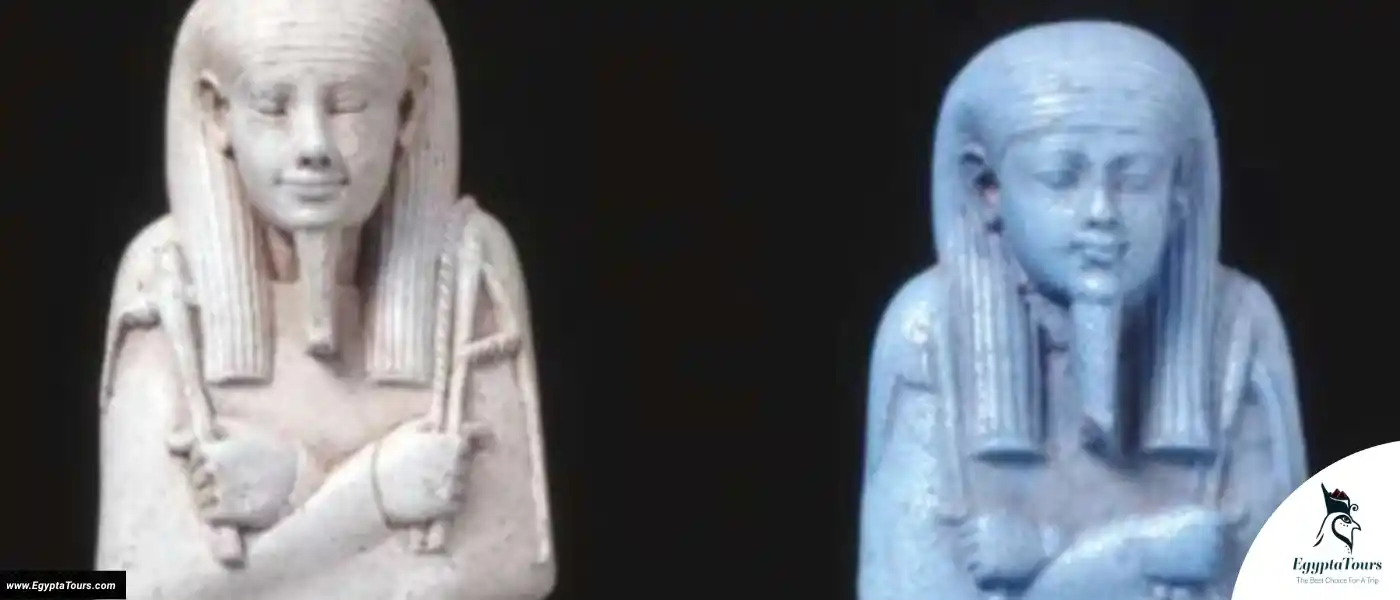
Among these intriguing secrets are the Ushabti in ancient Egypt which in their belief, represent an important symbol of the afterlife for the pharaohs.
It was not merely a small, aesthetic statue, but directly embodied the firmly rooted beliefs of the ancient Egyptians in life after death and the concept of eternal service.
What-is-Ushabti-EgyptaTours
The Ushabti in ancient Egypt is a relatively small statue that was usually made of faience, clay, wood and sometimes other materials.
It was placed with great care in ancient Egyptian tombs alongside the deceased and their other belongings.
This statue primarily symbolizes the servant or worker who would act on behalf of the dead.
It was believed that it would undertake the strenuous tasks and duties for the deceased in the afterlife in the fields of Osiris.
It was firmly believed that this statue would respond immediately to the call if summoned for work and service in the afterlife when its owner’s name was called.
What-are-the-uses-of-the-Ushabti-in-ancient-Egypt-EgyptaTours
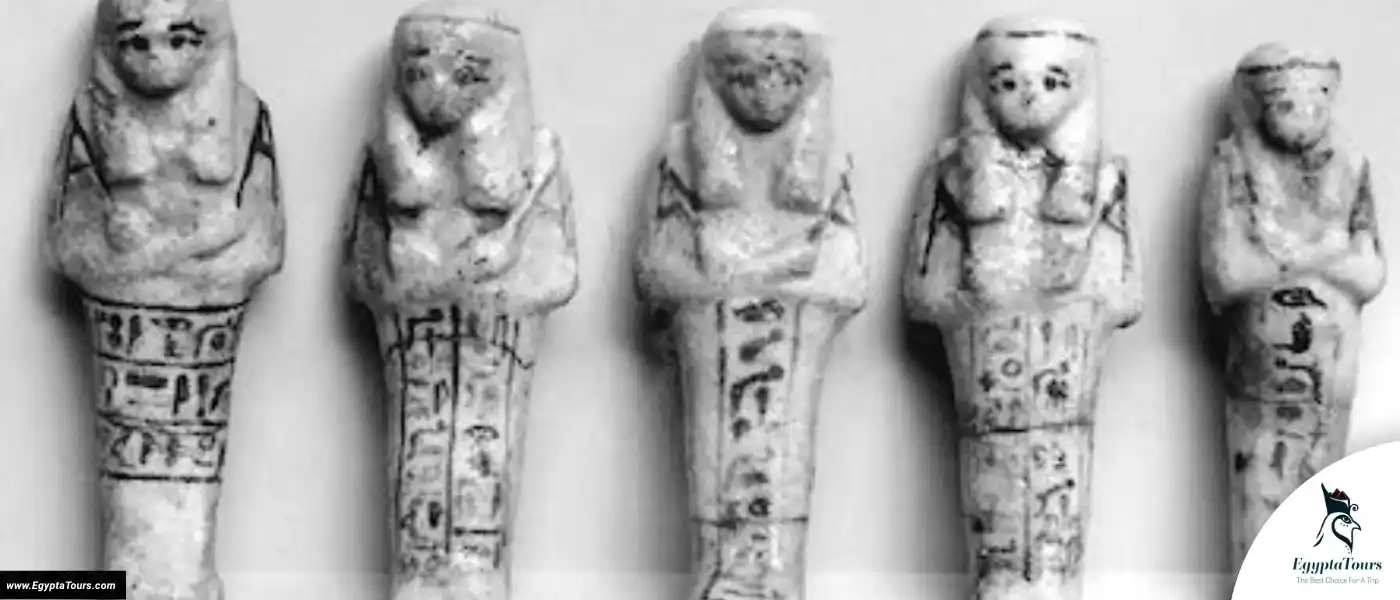
The Ushabti in ancient Egypt was used exclusively for religious and funerary purposes.
Its main and fundamental purpose was to act as a substitute or deputy for its deceased owner in agricultural and other tasks that might be required of them in the afterlife, such as farming, digging irrigation canals, or even construction work.
To achieve this symbolically, some statues held small agricultural tools like a hoe and a basket in their hands.
During certain periods, especially in the New Kingdom and later, hundreds or even thousands of Ushabti statues were buried with the deceased person themselves, particularly wealthy kings and nobles, to ensure a sufficient and abundant number of servants to serve them in every detail of their eternal life in the afterlife.
The use of Ushabti in ancient Egypt was not exclusive to one social class of society as might be thought.
Individuals from the middle classes and even some of the poor who could barely afford the price were buried with a small number of Ushabti statues.
However, kings, nobles and the wealthy were buried with very large numbers of these statues, sometimes of high quality.
The idea was essentially religious in nature as the Ushabti was considered a fundamental and necessary part of the burial rituals and tomb preparation.
We frequently observe that many Ushabti statues have a false, braided beard which closely resembles the distinctive beards that characterize statues of ancient Egyptian kings and gods.
This sacred beard was not just a detail or an aesthetic feature; it carried a connotation and symbol of power, authority and high status.
By adding a beard to the Ushabti, the ancient Egyptians believed they were increasing its power, authority and ability to work more effectively in the afterlife.
Materials-used-in-making-Ushabti-in-ancient-Egypt-EgyptaTours
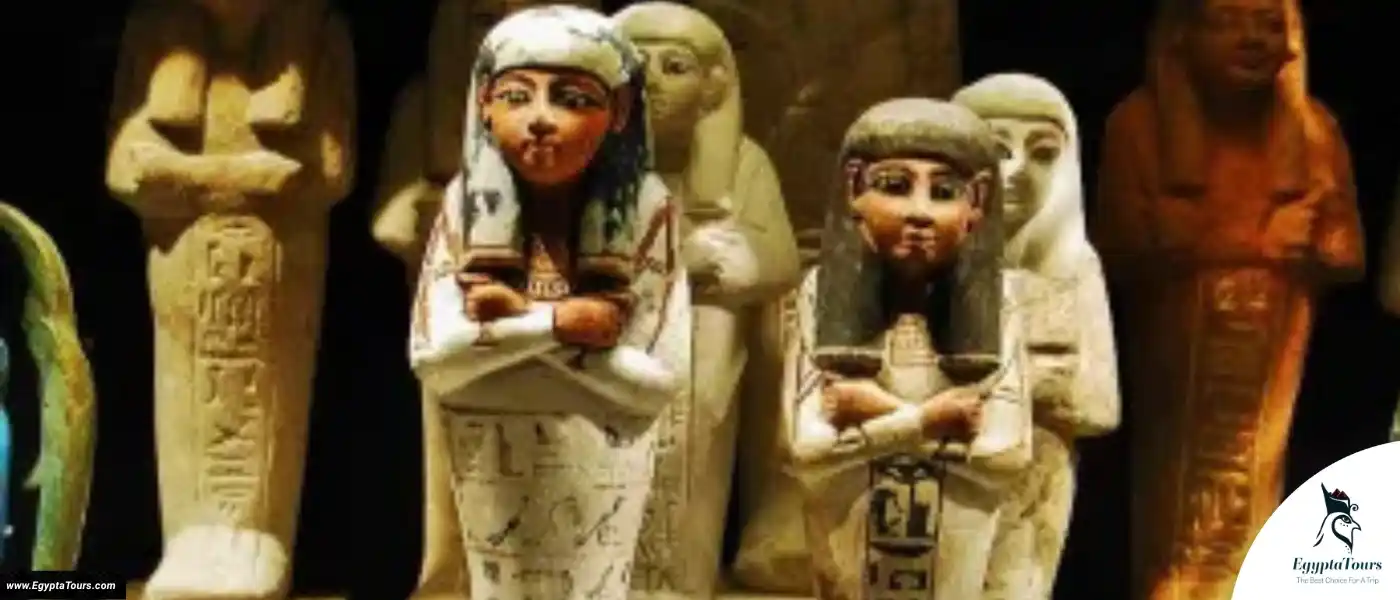
The materials that the ancient Egyptians skillfully used to make Ushabti statues in ancient Egypt varied according to the time period, era, the social status of the statue’s owner and their financial ability.
Mostly, blue or green faience was used extensively which is a shiny and attractive ceramic material made from a paste of white sand, quartz and some binding agents.
They also used fired clay, local limestone, sometimes imported wood and rarely, precious metals such as bronze or even solid or gilded gold for the statues of exceedingly wealthy kings and nobles.
These different materials, in turn, carried different symbolic meanings.
The color blue, for example, strongly symbolized immortality, the sky, the primordial waters and the source of renewed life.
Some non-specialists confuse the terms Ushabti and Shawabti and sometimes they are used interchangeably to refer to the same type of small funerary statues. However, in archaeological and linguistic reality, there is a subtle difference between them.
Initially, during the Middle Kingdom, these statues were called ‘Shabti’ or sometimes ‘Shawabti’.
The word Shabti most likely means ‘wood’ or perhaps ‘servant’ or ‘substitute’. Then, during a later period, often in the New Kingdom, the name evolved into ‘Ushabti’ which probably means ‘the answerer’ or ‘the respondent’.
This more clearly refers to the statue’s role in responding immediately to its owner’s call to perform work after death.
The word ‘Shawabti’ reappeared or continued to be used in later periods and was associated in some contexts more with the burial rites of the god of the afterlife and fertility, Osiris as the Shawabtis were considered in this case direct servants of Osiris in his celestial fields.
Ushabti in ancient Egypt were not just mute figures devoid of meaning; most were adorned with brief or detailed hieroglyphic inscriptions which tell much about their deceased owner and identity.
Usually, these engraved or painted inscriptions included the deceased’s name, titles and sometimes worldly functions.
At other times, they included short excerpts from Chapter Six of the famous Book of the Dead which contains a magical and religious spell addressed to the Ushabti itself, explicitly ordering it to perform the hard labor instead of the deceased if called upon.
Sometimes the statues also bore additional prayers and supplications to ensure the Ushabti’s proper and effective obedience to its owner’s commands in the afterlife.
Ushabti statues in ancient Egypt played a pivotal and extremely important role in the complex funerary rituals.
They were placed with great care and precise organization in the tombs next to or sometimes inside the coffin, either scattered individually or carefully arranged in dedicated wooden or pottery boxes.
The priests supervising the rituals during the funeral ceremonies would recite or read special magical spells over these statues to awaken and activate them, ensuring their response to work in the afterlife.
Some of the wealthy and kings placed a large number of these statues in their tombs, equivalent to the number of days in the year (365 statues), in addition to a number of supervisors (36 supervisors).
Over the long passage of time and successive historical periods, the shape, size and quality of the Ushabti evolved from a simple, undetailed form to become more complex, elaborate and decorated with colors and fine details.
Initially, during the Middle Kingdom and before, the statues were small in size and their anatomical details were few and somewhat rudimentary. However, later, especially in the New Kingdom and Late Period, the statues became larger, more detailed and more beautifully decorated.
In some rare cases specific to kings, they were covered with pure gold or adorned with precious and colored gemstones.
This artistic and technical evolution, of course, clearly reflects the changing Egyptian perspective on life after death and the increasing importance and complexity of funerary rituals and the necessity of thorough preparation for the afterlife.
Today, Ushabti statues are considered rare and very valuable artifacts displayed in most major museums around the world, such as the Egyptian Museum in Cairo, the British Museum, the Louvre and others.
These small yet expressive statues receive significant and growing attention from researchers, historians and those interested in Egyptology as these statues brilliantly reflect the deep and complex philosophy of the ancient Egyptians in dealing with death, the afterlife and eternity.
The primary religious purpose of the Ushabti statue is to serve the deceased in the afterlife, performing all agricultural or other tasks that might be required of the deceased in the fields of Osiris in the afterlife.
This theoretically allows the deceased to enjoy a blissful eternal life free from toil and hardship.
Today, Ushabti statues are preserved and displayed in various museums as precious and important artifacts that embody a distinctive and unique aspect of the religious beliefs of the ancient Egyptians.
They are a tangible material symbol of the pursuit of immortality and the close connection to the world of ancient Egyptian secrets and mysteries.
In ancient Egyptian mythology, the god Set represented the forces of evil, conflict, chaos and desert storms.
Set was often seen as responsible for inciting chaos, natural disasters and political unrest.
His most famous myth is the one concerning the murder of his righteous brother, King Osiris which plunged him into an eternal and violent conflict with his nephew Horus, the heir to the throne and the force of good and order.



Explore our top-rated Egypt travel packages and embark on an unforgettable journey. From the Pyramids of Cairo to the magical temples of Luxor, Aswan, and Abu Simbel, discover expertly curated tours designed for your perfect Egyptian adventure