
God Set
Set (pronounced /sɛt/, also written as Sutekh in Egyptian texts) is an...



The Ouroboros is one of the oldest symbols to emerge in world civilizations. The symbol features a creature of imagination, like a snake or dragon, eating its own tail in a scene resembling a closed loop. This symbol represents the eternal cycle of renewal, life, and death.
It was discovered by archaeologists engraved on the tomb of the young King Tutankhamun. If you are interested, our article will provide all the details related to the Ouroboros symbol.
We will shed light on the origin of the Ouroboros symbol, which stands at the forefront of early symbols in civilizations around the world. It is likely that the symbol’s origin dates back to ancient Egyptian iconography. From there, it evolved and was transmitted to Western cultures through the traditions of Greek magic.
Consequently, it was adopted by Gnostics and Hermeticists to signify the concept of unity and to symbolize eternal renewal, or what is called the cycle of life.

The-History-of-the-Ouroboros-Symbol-Through-the-Ages-EgyptaTours
The history of the Ouroboros symbol has evolved through the ages, dating back to the 14th century BC. This became evident through its appearance in funerary texts related to the god Atum, which referred to the renewal of life in their beliefs. It was transmitted from Egypt to Phoenicia and finally to Greece.
This can be detailed as follows:
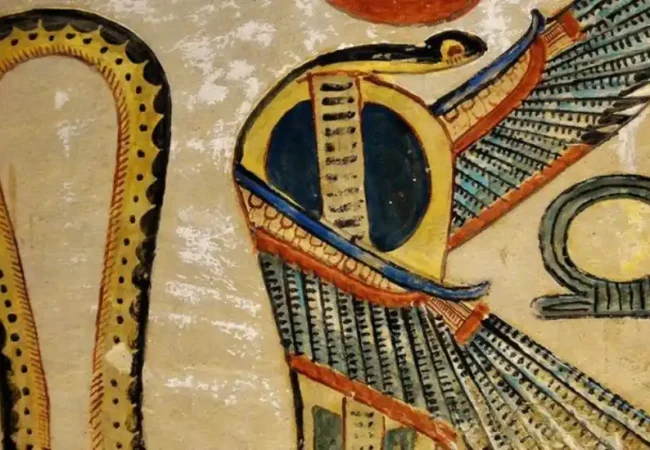
The Ouroboros symbol first appeared in Egyptian origins within a funerary text in the “Book of the Netherworld.” It symbolized the daily cycle of the sun, from sunrise to sunset. It also expressed a concept of theirs representing the unity of things that emerge from chaos only to return to order.
The symbol spread from Egypt to the Phoenician civilizations and then to the Greeks, who named it “Ouroboros.” This name is derived from two parts: the first, “oura,” meaning tail, and the other, “boros,” meaning eating, which refers to the tail-eater.
The symbol acquired many meanings, including the eternal cycle, where the serpent represents an infinite circle that devours its tail, signaling a cycle with no end.
Although the symbol first appeared in Egyptian culture, it quickly spread to many other cultures, including Hermeticism and Gnosticism.
The Ouroboros symbol encompasses both philosophical and symbolic meanings, which we will clarify as follows:
The philosophical meaning involves several references and legends:
All of these are legends with no basis in reality.
We clarify the symbolic meaning of the Ouroboros across several cultures, each with its own different legends:

Different-Names-and-Forms-of-the-Ouroboros-Symbol-EgyptaTours
The symbol has a variety of different names, foremost among them being Ouroboros, which is the most common and means “tail-eater.” Another common variant is Oureboros. The list of names also includes Uroboros and Ourobori.
The symbol takes on several forms, most notably a snake or a dragon. The snake or dragon may have legs or wings, reflecting its changing nature. The symbol might also appear as a hermaphroditic human, signaling both masculine and feminine qualities. It may also take the shape of an armadillo lizard coiled into a ball, holding its tail.
The Ouroboros symbol originated in ancient Egypt, and then ancient Greece drew inspiration from it. It was there that it was named and came to represent the movement of the stars and the cycle of the universe. It was transmitted to Western cultures through magical as well as philosophical traditions, which was reflected in many civilizations, and the symbol spread widely.

The-Role-of-the-Ouroboros-in-Ancient-Myths-and-Religions-EgyptaTours
In ancient myths, the Ouroboros symbol appeared in the form of a snake holding its tail, taking a shape as if coiled around itself, reflecting the eternal, endless cycle of life, from creation to annihilation. This symbol manifests in various forms, including Jörmungandr in Scandinavian myths and the symbol of the universe in ancient Egypt.
The symbol also came to be a precise expression of transformation and personal growth in life. Not only that, but in many religions, the symbol represents wisdom and cosmic evolution in their beliefs.

Modern-Interpretations-of-the-Ouroboros-Symbol-EgyptaTours
The interpretation of the Ouroboros symbol encompasses a range of cultures, all of which are based on incorrect myths and beliefs, which we summarize as follows:
The Ouroboros symbol spread among many cultures worldwide, but its beginnings were in ancient Egyptian civilization. It has numerous names and forms that make it relevant to multiple cultures, and in their myths and beliefs, it symbolizes eternity and immortality.
In general, the Ouroboros symbol is one of the primary positive symbols that reflects the continuous cycles of existence in their beliefs. This is in contrast to some evil symbols in Christian traditions that appear as serpents. It expresses the natural cycle of life and death.
It is an ancient symbol that appeared among Egyptian icons and reflects, in their myths, the life cycle of the sun, containing a reference to the power of renewal. It spread widely to Greek cultures through magical traditions.
The Ouroboros does not represent a religion in itself, but it does represent multiple religious and philosophical symbols. It has been used in various beliefs and religions throughout the ages, most notably in alchemy, Hinduism, Christianity, and Gnosticism.
The symbol does not have a single story but is a symbol that contains deep concepts such as renewal, eternal cyclicality, and, in some other cultures, immortality. The symbol has been adopted by many cultures.


Explore our top-rated Egypt travel packages and embark on an unforgettable journey. From the Pyramids of Cairo to the magical temples of Luxor, Aswan, and Abu Simbel, discover expertly curated tours designed for your perfect Egyptian adventure