King Seti I: Legacy, Achievements & Historical Significance
Egypt has a rich history, and King Seti I was an important...



King Pepi I was the third pharaoh of Egypt’s Sixth Dynasty (circa 2332–2283 BC), ascending the throne as a child following his father’s assassination. His 40-to-50-year reign was a period of stability, marked by the creation of Egypt’s first organized standing army to secure borders and trade routes. His legacy is defined by massive architectural projects, specifically his Saqqara pyramid complex which contains the largest collection of Old Kingdom religious “Pyramid Texts.”
Key Takeaways
The First Regular Army: Under the command of the legendary official Weni the Elder, Pepi I established Egypt’s first organized, multi-regional standing army (including Nubian and Libyan loyalists) to repel Bedouin raids in the Levant and secure trade routes.
Political Marriages: To stabilize the kingdom after palace conspiracies and growing regional independence, Pepi I married two daughters of a powerful noble family from Abydos, resulting in the births of his successors Merenre I and Pepi II.
Saqqara Pyramid Complex: Pepi I constructed his pyramid in southern Saqqara. Though heavily damaged by stone thieves over millennia, it is historically vital for containing the largest known corpus of Old Kingdom “Pyramid Texts” (over 2,200 columns of protective afterlife spells).
Nine Queens’ Pyramids: As of 2017, archaeologists have discovered nine smaller pyramids southwest of his main complex belonging to his queens, some containing the oldest known Pyramid Texts created for non-ruling royals.
Trade and Expansion: Pepi I actively sponsored mining expeditions in the Sinai and Eastern Desert, and expanded vital trade networks into Nubia, Lebanon, and Punt to secure precious materials.
Shift in Power Dynamics: To secure loyalty, Pepi I granted significant land, wealth, and titles to provincial leaders. While this secured his reign, it ultimately contributed to the decentralization of power that led to the collapse of the Old Kingdom.
King Pepi I is the third king of the Sixth Dynasty, and the son of Titi and Ibut. He succeeded to the throne of Egypt as a child, after his father was assassinated. He ruled the country for at least forty years.
In the twenty-first year of his reign, Pepi I married the daughter of Kho-Wei of Abydos. After being exposed to a secret conspiracy from the palace harem, in which the queen and two sons she wanted on the throne were convicted; Instead, the older sister may have died shortly after giving birth to her two children, Ra and Neith. As for the younger sister, she remained alive until she lived through the reign of her son, Pepi II.
King Pepi I, the third pharaoh during the Sixth Dynasty. The period of his rule was considered a period of stability and prosperity, and when the rule of the country came to him, he had to appease the priests of the Temple of the Sun, whose influence was still present, as well as the new priestly power represented by the priests of the god Ptah, whose influence began to increase since the beginning of the Sixth Dynasty during the period of Pharaoh Tet. Therefore, some researchers believe that King Teti came from the city of Memphis, whose main deity was Ptah.
Pharaoh Pepi built a pyramid for himself in Saqqara, and erected several temples for himself in Tel Basta and Abydos. Art flourished during his reign, as evidenced by his temple inscriptions, his large copper statue located in the Egyptian Museum in Cairo, and the collection of alabaster statues in the Brooklyn Museum in New York.
It Is known from the life history of one of the important figures of this era, Wani, that the king sent some expeditions to Palestine and the south to curb the rebels. Pepi tried to win the favor of some powerful families, so he resorted to the policy of intermarriage, where he married the daughter of the ruler of Abydos, who bore him his son, “Mren-Ra,” who assumed power after him.
The most important kings of the 6th dynasty were Teti, Pepi I, and Pepi II, who were said to have ruled for about 94 years, in the order of their accession to power. It was not long before the beginning of the reign of this dynasty until Egypt began to suffer from problems. The economic problems were initially solved by resorting to increasing taxes on By repeatedly counting livestock numbers.
Pepi I military conquests King Pepi I ruled in the Sixth Dynasty near the end of the Old Kingdom era, and he pursued an expansionist policy in Nubia and worked to reach and secure trade routes to countries far from Egypt, such as Lebanon and Somalia. During his reign, the first regular army was formed in Egypt, and he was among the most famous senior men. His state was the famous employee the great Wani, the owner of the tomb located in Abydos in Sohag
One of the most beautiful biographies from the Old Kingdom era is the biography of this employee, which was written on one of the walls of his tomb and was transferred for display in the Egyptian Museum.
According to the book “Warrior Pharaohs: Diplomats and Military Personnel,” by Dr. Hussein Abdel Basir, that during the reign of this king, the Egyptian delta was subjected to numerous raids from the Bedouins on Egypt’s northeastern borders, whom the Egyptian texts called “Amu Hiryu Sha,” meaning “the Asians on the sand.” “.
In order to repel their attacks, which the few military garrisons in these areas were unable to confront, Pepi I commissioned Weni the Elder to lead military campaigns in the Levant, and thus the first Egyptian regular army was established, consisting of many thousands of Egyptian recruits from southern to northern Egypt. In addition to a large number of Nubians and Libyans loyal to Egypt.

Old-Kingdom-Egyptian-Military-EgyptaTours
The book “Warrior Pharaohs: Diplomats and Military” explained that Wani the Great succeeded in leading this Egyptian army of the valiant regime and eliminating Bedouin attacks. Wani the Elder is proud in the text of his wonderful biography of His Majesty King Pepi I appointing him to lead this army consisting of thousands of Egyptian soldiers. The brave ones, the best soldiers on earth, from Upper Egypt and its delta. These Bedouins were defeated with great success.
The “Warrior Pharaohs…diplomats and military personnel” confirmed that all of this indicates the greatness, strength and valor of the Egyptian fighter, the extent of the Egyptian army’s civilization, and its adherence to the etiquette and behavior that the world later approved by refusing to attack civilians and steal or plunder anything from enemy land, as well as good treatment. Prisoners, this is great Egypt, establishing the first regular army in history and establishing laws, behaviors, and etiquette for dealing with the enemy and its land in times of war.
“Foreign policy, general objectives that guide the activities and relationships of one country in its interactions with other states. The development of foreign policy is affected by domestic considerations, the policies or behavior of other states, or plans to advance specific geopolitical designs. Leopold von Ranke asserted the primacy of geography and external threats in shaping foreign policy, but later writers asserted domestic factors. Diplomacy is the tool of foreign policy, and war, pact, and international trade may all be semblance of it.”

The-Architectural-Achievements-of-King-Pepi-I-EgyptaTours
Pepi I pyramid It is a pyramid complex built for the Egyptian King Pepi I of the Sixth Dynasty in the twenty-fourth century BC or the twenty-third century BC. The complex gave its name to the Egyptian capital, Memphis. As in the pyramids of his predecessors, Pepi I’s substructure was filled with vertical columns of hieroglyphic scripts, the Pyramid Scripts.
These texts were first discovered in the Pyramid of Pepi I in 1880 by Gaston Maspero, although they originated in the Pyramid of Unas. The corpus of Pepi I is also the largest from Old Kingdom Egypt, consisting of 2,263 columns and lines of hieroglyphs.
Pepi I located his pyramid complex south of Saqqara approximately 2.4 km (1.5 mi) north of Djedkare’s pyramid. It is unclear why Pepi I moved to southern Saqqara. Pepi I may have moved the royal palace south and away from the city, or perhaps no viable sites were left in northern and central Saqqara after Titi built the pyramid there.
Pepi I entrusted one of his wives, Ennek Enti, with the construction of the funerary monument.
The pyramid and substructure repeat the basic design of Djedkare and are relatively similar. The pyramid was severely damaged and now stands as a small ruined mass.
The mortuary temple also saw extensive damage from stone thieves, but work by the French Archaeological Mission of Saqqara/Ministry Franco-Swiss Archaeological Saqqara (MAFS) has revealed that the temple was laid out in almost exactly the same way as those of its predecessor. The bridge’s excavations extended to only a few metres, and the Valley Temple and Pyramid City remain unexposed.
The most important finds in the complex are the pyramids of the queens. As of 2017, a total of nine pyramids have been discovered southwest of Pepi I’s complex.
These pyramids belong to Nob, Nent, Ennek-Enti, Merit-etes IV, Ankhes-en-Pepi II, Ankhes-en-Pepi III and Pepi I, with a tomb belonging to her son Hornetjrekhet to the north of them, Behnu, the pyramid of Rhaereshfnakht and one, the western pyramid, still unknown.
The pyramids of the Queens Ankhesenpebi II and Behenu contain pyramid texts. The Pyramid of Rhaereshfnakht contains both Pyramid Texts and Coffin Texts. This finding is important for two reasons. The first is that it is the oldest known pyramid that was not built for a member of the royal family. The second is that his writings represent a link between the Old and Middle Kingdoms.
Religion was average to ancient Egyptian culture. Many notions and beliefs about divine influences in the world intersect with modern classes of not just religion, but also medicine and glamor. Throughout much of ancient history Egyptian religion was polytheistic, meaning it famed to many gods and goddesses, as well as a diversity of other divine beings. Not all of them were similar in significance.
Some rose to the status of state idols and received national attention during certain eras of history, while others received devotion mostly in regional or local areas, or only in very particular stages or circumstances of life.
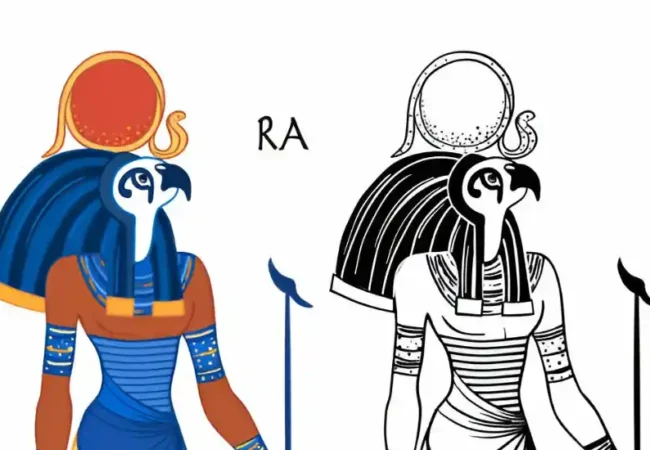
The main god of state during the Old Kingdom was the sun-god, Re (also Ra), though it also witnessed growing publicity of the underworld god of the dead, Osiris. It was during the Old Kingdom that kings begin inserted “Son of Re” as one of their regal titles. They were thought to be godly also. The histories surrounding one god or goddess might change somewhat from one region to the next or from one time era to another.
Ancient Egyptians pictured envisioned gods and goddess as a diversity of forms. The most popular variants of a single idol were a human form, an animal form, and a form that united human and animal components – most often a human body with an animal head. However, divine forms could contain many combinations of human and animal parts.
Major idols formed family groups, commonly trios of two parents plus a child. While names of Egyptian gods and goddesses show in hieroglyphic text during the Old Kingdom, visual depictions of them – like statues and carved images – were not popular outside of regal or temple settings.
But it is clear that many essential aspects of Egyptian religion were in place and continued to advanced through the Old Kingdom. Since a lot of Giza tombs back to the Old Kingdom, these tombs and the goods in them tend not to portray deities. In later times, idols were shown in more places and on more objects.
For example, talisman placed with funeral were intended to protect dead Egyptians and assist in them in reaching the endless afterlife that they believed watched them. Another example is a specific kind of figurine that came into utilize much later. Called ushabtis (also shabtis or shawabtys), they show a dead individual in the form of the god Osiris: mummified, with arms crossed over the chest.
The ancient Egyptians thought that they might be called on to do work in the afterlife, just as in life. These figurines, they thought, could magically take their site and do the hard labor for them (in Egyptian, “ushabti” means “one who replys” the call to work).

Pepi-I-Military-Campaigns-and-Territorial-Expansion-EgyptaTours
The stone quarrying activities, which were bounded to Pepi’s necropolis during the New Kingdom and had expansion his mortuary temple, became widespread during the Late era of Egypt, with intermittent funeral continuing nonetheless. Both the stone robbing and burials activities stopped at some point during the era, and the necropolis was deserted until the Mamluk era when intense stone quarrying resumed.
King Pepi I ruled Egypt in the late Old Kingdom, Sixth Dynasty. He reigned in the 23rd century BCE, likely for about five decades. Records praise his building drive and wide trade links across Africa and Asia. His pyramid at Saqqara carries Pyramid Texts, prayers for the king’s afterlife.
He backed expeditions to Sinai for copper and turquoise, and to Nubia and Punt. The official Weni reports campaigns against border foes, showing active control of trade routes.
Pepi raised many provincial elites, granting titles and land that spread royal power. This move also fed local power, a change that shaped late Old Kingdom life. His queens, including Ankhesenpepi I and II, held rare influence at court. Curious to see his world up close, start with his pyramid site at Saqqara.
Pepi I, also called Pepy I Meryre, was a pharaoh of Egypt’s Sixth Dynasty. He ruled in the Old Kingdom, around 2332 to 2283 BCE, according to many scholars.
He stabilized royal power, expanded trade, and led campaigns abroad. His reign helped spread royal influence while shaping religion and art that marked the late Old Kingdom.
He sponsored quarrying and mining in Sinai and the Eastern Desert, built temples, and strengthened trade with Nubia and the Levant. He also oversaw military expeditions recorded by the official Weni.
His pyramid complex stands at Saqqara. It includes Pyramid Texts carved inside the burial chambers, one of the earliest sets after Unas.
They are religious spells and hymns meant to guide the king in the afterlife. The texts in Pepi I’s pyramid preserve important versions of these early compositions.
Yes. He commissioned temples and way stations for expeditions, plus infrastructural works tied to quarrying and mining. Many sites show inscriptions from his reign.
Estimates vary, but many place his reign around four to five decades. Exact years differ due to gaps in the sources.
He married several queens, including Ankhesenpepi I and Ankhesenpepi II. His son Merenre I succeeded him, followed by his grandson, Pepi II.

Explore our top-rated Egypt travel packages and embark on an unforgettable journey. From the Pyramids of Cairo to the magical temples of Luxor, Aswan, and Abu Simbel, discover expertly curated tours designed for your perfect Egyptian adventure