





Why Nikola Tesla was Obsessed with the Egyptian pyramids
Nikola Tesla is undoubtedly considered one of the greatest inventors and scientists in history and one of the most impressive and creative figures who took a particular interest in studying the pyramids of Egypt.
He was interested in their unique and amazing architectural design and their great historical depth.
Although Nikola Tesla had many revolutionary inventions in the world of physics and electricity, he paid significant and unconventional attention to studying the pyramids, firmly believing that they were not just massive buildings constructed merely as tombs for the pharaohs, but were built for other, more important and complex purposes.
In this article, we will explore Why Nikola Tesla was Obsessed with the Egyptian pyramids, learn about his other prominent inventions and how his intense interest in the Egyptian pyramids began.

Who-is-Nikola-Tesla-EgyptaTours
Before we understand why Tesla was interested in studying the pyramids of Egypt, we must briefly know who Nikola Tesla was.
He was one of the most important physicists of his time and worked as a mechanical engineer and electrical engineer.
Tesla became famous for his significant and numerous achievements and inventions.
Tesla was born in a small village in present-day Croatia which was then part of the Austrian Empire.
He possessed exceptional and great talents in making some innovative mechanical devices and household tools from his early childhood.
He studied from a young age in some German schools and institutes.
An attractive note is that some of his teachers noticed his outstanding proficiency in calculation and mathematics.
He then moved to America, where he made many important achievements and received numerous awards and patents that changed the face of the world. He later passed away alone while staying in an American hotel in New York City at the age of 86.
Nikola Tesla’s beliefs extended to unusual ideas about the Egyptian pyramids.
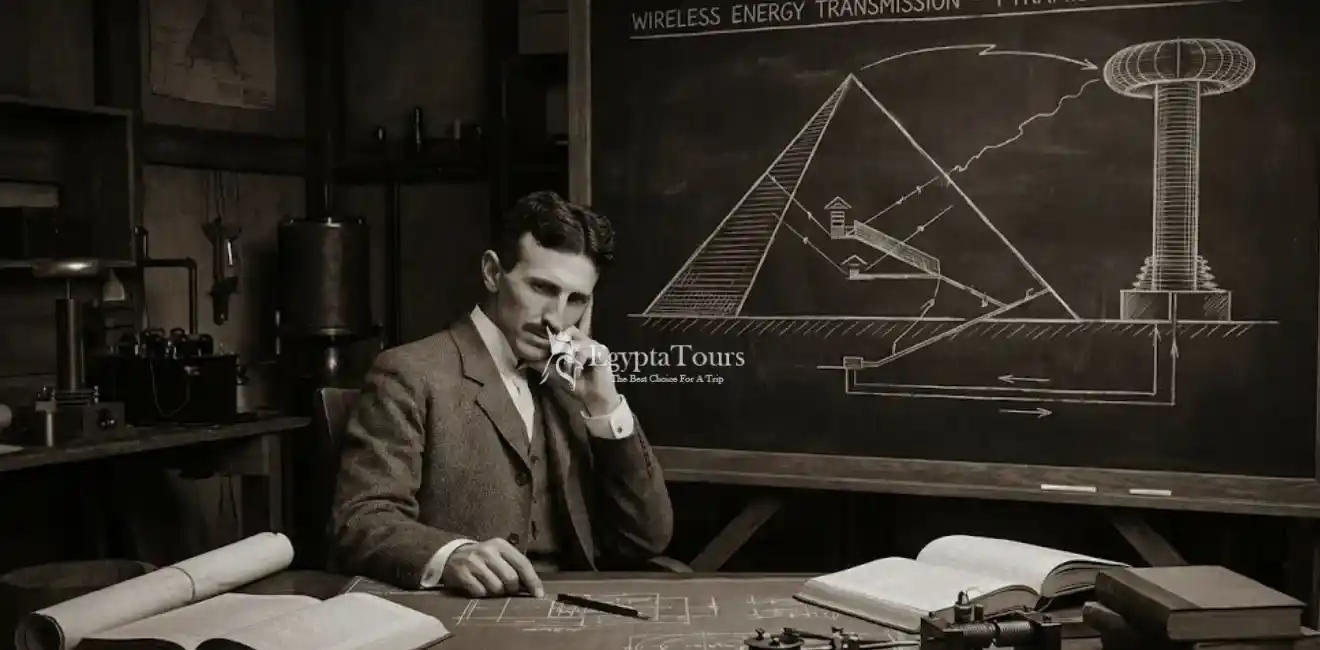
He had many eccentric obsessions, one of the most notable being his belief that the pyramids were not just tombs, but giant energy transmitters.
He designed his Tesla towers partly based on principles inspired by studying these pyramids.
Tesla passed away somewhat unappreciated during his lifetime, yet his fame and legend grew tremendously after his death.
Today, he is seen as:
- The mad scientist, a visionary thinker ahead of his time.
- The inventor who helped shape the modern world.
He is credited with foundational ideas that eventually led to inventions such as:
- Smartphones
- Wi-Fi
- Alternating current (AC) electricity systems
and many other modern innovations.
Besides the projects he implemented and patented, Tesla had varied interests across multiple research fields, some of which were more personal and philosophical than strictly scientific.
Among the most unusual aspects of his life was his persistent fascination with the Egyptian pyramids, considered some of the most mysterious and remarkable human structures.
He believed that the pyramids served a higher purpose and studied them throughout his life, as part of his enduring passion for energy and the natural world.
What are his most prominent inventions?
The great and sometimes controversial scientist and inventor Nikola Tesla invented many important things that significantly contributed to changing the course of the world’s life and its technological development, including:
- Wireless transmission: This was later widely used to transfer data and sound from one place to another. Tesla built a tower known as the Wardenclyffe Tower or Tesla Tower which aimed to be the world’s first global wireless system for transmitting energy and information.
- Alternating current (AC): Considered one of Tesla’s most important inventions and developments, it is safer, more efficient and less costly to transmit over long distances than the direct current (DC) that Thomas Edison advocated for.
- Unit of magnetic flux density (Tesla): This honor in his name is one of Tesla’s less widespread inventions among the general public. This concept helps describe the strength of a magnetic field, as is the case with magnetic resonance imaging (MRI) machines.
- Electric motors (AC): Which convert electrical energy into mechanical energy with high efficiency. The invention of AC electric motors is considered one of the top 10 technological inventions globally and subsequently became the gateway to a major industrial revolution in the field of manufacturing electrical appliances and various equipment.
- X-rays: Tesla contributed to early research on X-rays which are still used today for many medical diagnostic purposes.
How did his interest in the pyramids begin?
To understand why Tesla was interested in studying the pyramids of Egypt, Tesla’s interest began when they greatly sparked his curiosity about certain ancient sciences, advanced engineering and physical and natural knowledge that the ancients might have possessed.
He was greatly interested in the concept of free and cosmic energy and believed that the pyramids served as energy centers or generators.
They were designed in a unique and extremely precise geometrical way that helps in effectively directing and generating energy.
Therefore, he might have later built the Tesla towers according to some laws and principles partially inspired by his study of the pyramids and their design.
Tesla conducted many theoretical analyses of the architectural structures of the pyramids, recording and studying their dimensions and mathematical ratios. He asserted in his writings that they hold many deep secrets related to the laws of nature and the universe.
His curiosity was also intensely piqued by how the ancient Egyptians built these pyramids with such superior engineering precision, considering them among the most marvelous and mysterious human constructions up to the present era.
Why Nikola Tesla was Obsessed with the Egyptian pyramids

Why-Nikola-Tesla-was-Obsessed-with the-Egyptian-pyramids-EgyptaTours
The question of why Tesla was interested in studying the pyramids of Egypt is one of the important and recurring questions that occupies the minds of many people even today.
However, Tesla was not the only person interested in studying the Egyptian pyramids.
The pyramids, with their mystery and grandeur, sparked the curiosity of many scientists and thinkers throughout the ages, including Tesla, of course.
Tesla obtained an important patent in the United States of America in 1905 titled “Art of Transmitting Electrical Energy Through the Natural Mediums.”
He drew parts of this idea from his own understanding of the construction of the pyramids which he believed were giant transmitters or receivers of energy via the atmosphere and the Earth.
Accordingly, he designed and experimented with building something resembling an experimental pyramid, later named the Tesla Electromagnetic Pyramid.
Its primary purpose was to attempt to harness natural energy and Earth’s energy.
Were the Great Pyramids originally the basis for Tesla’s towers? How were the pyramids built?
It is said that another aspect of Tesla’s thinking was related to numerology.
According to many accounts, Tesla was an unusual individual with obsessive traits.
One of his notable obsessions was the numbers 3, 6, and 9, which he believed held the key to understanding the universe.
He would walk around buildings three times before entering and chose to stay in hotels with numbers divisible by three.
He also made other decisions in groups of three.
Some believe that Tesla’s fascination with these numbers was connected to his interest in pyramidal shapes and his belief in the existence of fundamental mathematical laws and ratios that form part of a universal mathematical language.
Since we do not know exactly how the pyramids were built, some researchers consider them mysterious creations, possibly designed to generate energy, act as intentional transmitters, or even serve as symbols of an ancient civilization.
What is the secret behind physicist Tesla’s obsession with the Egyptian pyramids?
Physicist and inventor Nikola Tesla is considered one of the scientists who were largely underappreciated during their time, despite the significance of their contributions. Over time, Tesla became increasingly famous in the modern era, surrounded by many myths. His work is now seen as a cornerstone for much of today’s technology, including smartphones, wireless networks, and more.
Beyond the patented ideas he implemented, Tesla had numerous research interests, some of which were mysterious and philosophical. One of the most unusual aspects of his life was his fascination with the Egyptian pyramids, among the most magnificent and enigmatic human structures. Tesla believed the pyramids were not just tombs for the pharaohs but were built for a greater purpose, which led him to study them throughout his life.
What fascinated Tesla most about the pyramids was the possibility that each pyramid could function as a giant energy transmitter, an idea aligned with his work on wireless energy transmission. In 1905, he was granted a U.S. patent titled “Art of Transmitting Electrical Energy Through the Natural Mediums”, which outlined designs for a series of generators around the world intended to harness the ionosphere and collect energy.
Tesla viewed the Earth itself as a generator of infinite electrical energy through its poles, and he created a triangular design known as the Tesla Electromagnetic Pyramid. According to him, the pyramids’ power came not only from their shape but also from their location, which was linked to Earth’s longitude and latitude and its movements. He built experimental sites such as the Colorado Springs Experimental Station and the Wardenclyffe Tower on the U.S. East Coast to attempt harnessing the Earth’s energy, choosing these locations based in part on the positioning of the Giza pyramids.
Another aspect of Tesla’s interest in the pyramids was numerology. He was reportedly obsessed with the numbers 3, 6, and 9, which he considered the key to the universe. Stories say he would walk around buildings three times before entering, choose hotels with numbers divisible by 3, and make several life decisions based on the same principle.
Some believe his obsession with numbers was connected to his fascination with pyramidal shapes and his belief in fundamental mathematical laws forming part of a universal mathematical language. Since the exact methods and purposes behind the construction of the pyramids remain unknown, some researchers view them as creations capable of generating energy or as symbolic messages from an ancient civilization, while others regard such claims as mere exaggerations with no scientific basis.
Did Tesla believe that the pyramids were a source of wireless energy?

Did-Tesla-believe-that-the-pyramids-were-a-source-of-wireless-energy-EgyptaTours
Yes, Nikola Tesla largely believed that the pyramids were not just tombs but perhaps were a source or device for generating or receiving wireless energy.
Thus, we have learned one of the main reasons why Tesla was interested in studying the pyramids of Egypt.
Their design at that time was unique and highly advanced and did not resemble the design of any other building around the world.
Tesla believed they played a significant and hidden role in converting the natural energy present in the universe and the Earth into another usable form of energy, where energy could be received through the pyramids, amplified and converted into electrical energy or other forms.
How did the Giza pyramids influence Tesla’s future projects?
Tesla’s studies and theories about the Giza pyramids likely influenced some of his subsequent projects significantly.
He perhaps drew inspiration from them for the idea of building the first tower resembling a pyramid that was built to transmit electromagnetic energy, known by his name (Wardenclyffe Tower).
Later, they established a station called the Tesla Experimental Station in Colorado Springs. Its primary and ambitious goal was to demonstrate the feasibility of transmitting wireless electrical energy from one place to another over vast distances.
What did Tesla discover in the geometric dimensions of the pyramids?
Tesla discovered, or rather believed based on his calculations and analyses of the pyramids, that their geometric and mathematical dimensions were made precisely and deliberately.
This confirmed that those who built the pyramids possessed sufficient and advanced knowledge of the size and shape of the planet Earth and its proportions, as the Great Pyramid was built near the 30th latitude.
Tesla asserted that the dimensions of the pyramids have a precise and harmonious relationship with the Earth’s movements, rotation and electromagnetic oscillations.
He had a particular interest and theory called the 3-6-9 theory which he linked to the universe and energy, believing it reflected the hidden harmonic relationship between the dimensions of the pyramids and the fundamental laws of nature present in the universe.
What are the criticisms directed at Tesla’s theories?
Some of Nikola Tesla’s theories and ideas, especially those related to free energy and the pyramids, were criticized.
Many contemporary and later scientists believed that his ideas in these areas were misleading and his understanding of some phenomena was scientifically weak or incorrect.
For example, he believed that radioactive activity was not real.
He also seemed to have a great obsession with numbers, especially the number 3 and its multiples. Some also thought that some of his ideas were illogical and based on foundations that were not scientifically sound or experimentally proven.
What symbols were used in the design of the pyramids?
There are some known and potential symbols that were used in the construction and orientation of the pyramids.
Among them are religious symbols such as the symbol of the Eye of Horus which signifies protection and royal care and the symbol of the pyramid triangle itself which represents the shape of the pyramid and was called ‘Mer’ in the ancient Egyptian language.
Pyramids are still considered a symbol of power, engineering, art and ancient Egyptian architecture throughout history.
They still hold many secrets and mysteries that occupy the minds of many scientists, researchers and enthusiasts even in our current era.
The question of Why was Tesla so anxiously studying the pyramids of Egypt remains one of the most important questions that has circulated and continues to circulate in the minds of many people interested in his work and theories, especially since Tesla was one of the most important physicists and electrical engineers.
But ultimately, the greatness of the pyramids was and still is a perplexing mystery for many scientists and thinkers, not just Tesla. Many scientists even in our current era are still trying to discover the secrets of the construction and function of the mysterious pyramids.
FAQs
What is Nikola Tesla’s IQ?
Nikola Tesla is considered one of the most important scientists and inventors whom many in the world believe was exceptionally intelligent and a genius.
It is thought that if he had taken modern IQ tests, he would have scored very high, with scores reaching 195 or more which means he is classified as exceptionally intelligent.
Why is Egypt considered mysterious?
Ancient Egypt and its civilization are considered mysterious and intriguing because they contain many secrets and monuments that are still the subject of ongoing study and research by many scientists worldwide who are trying to uncover these secrets, whether related to the construction of the pyramids and the Sphinx, the secrets of King Tutankhamun’s tomb and its treasures, the search for Cleopatra’s tomb, or fully and accurately deciphering the hieroglyphic writings found on the walls of tombs and temples.
Why did the Egyptians choose pyramids?
It is believed that the Egyptians chose the pyramid shape for royal tombs because they are considered one of the most important and enduring wonders that the ancient Egyptians excelled at building.
The geometric pyramid shape allows weight to be distributed evenly over the base of the structure which gives it exceptional stability and strength, making it one of the most prominent unique and durable architectural designs.
They also perhaps believed that this shape facilitated the ascent of the king’s soul to the sky.
The location of the pyramid was chosen with great care.
Why did they try to destroy the pyramids?
Throughout history, some people and rulers attempted to destroy or remove parts of the pyramids for various reasons, including their mistaken belief that their construction violated the teachings of Islam and what is stated in the Holy Quran, or for the purpose of using their stones in other buildings, or in search of alleged treasures inside them.
Was Tesla actually “obsessed” with the Egyptian pyramids, or is that exaggerated?
“Obsessed” is often an overstatement. Tesla did show repeated interest in the pyramids as engineering achievements and as useful symbols for thinking about energy, scale, and geometry. But a lot of today’s pyramid talk tied to Tesla comes from later writers who blend his real ideas (wireless power, resonance, the Earth as an electrical system) with claims he never made.
What’s factual is that Tesla liked big, practical structures, and he often used bold comparisons to explain how he thought energy could be produced and moved. The pyramids fit that style of thinking, even if he didn’t leave behind a single, definitive statement that he thought they were literal power plants.
What did Tesla think the pyramids had to do with energy or electricity?
Tesla was drawn to the idea that shape, height, and location can matter in electrical systems. In his own work, he focused on high-voltage coils, resonance, and how electrical energy behaves when you scale things up.
Modern claims sometimes say he believed pyramids “collected energy” from the Earth or sky. That specific claim isn’t supported by strong primary sources from Tesla himself. A safer way to put it is this: he admired structures that seemed to reflect mathematical order, and he spent his career chasing efficient ways to generate and transmit power. The pyramids were an obvious reference point for anyone thinking on that scale.
Did Tesla design Wardenclyffe Tower based on the pyramids?
There’s no solid evidence that Wardenclyffe Tower was a direct copy of pyramid design. Wardenclyffe was built around Tesla’s ideas about wireless transmission and the Earth’s electrical properties, plus the practical needs of a large experimental facility.
That said, it’s easy to see why people connect the two. Wardenclyffe had a prominent vertical form, and Tesla sometimes talked about how geometry and the planet itself could play a role in power transmission. The similarity is more thematic than documented, unless a source clearly cites Tesla’s own words.
What’s the deal with Tesla, pyramids, and the numbers 3, 6, and 9?
The “3, 6, 9” pyramid narrative is mostly internet folklore. Tesla did have personal routines and preferences that people interpret as number fixation, but the popular version often runs far past what can be verified.
If you’re trying to keep it factual, it’s best to treat this as a mythologized part of Tesla’s story. It gets repeated because it sounds mysterious, not because it’s well-supported by primary documents.
Is there any scientific proof that pyramids have special power, and did Tesla prove it?
No. Claims about “pyramid power” (razor blades sharpening, food preservation, energy amplification) don’t have strong, repeatable scientific support. Tesla also didn’t publish a verified scientific proof that the Egyptian pyramids produced or focused usable energy.
Tesla’s real legacy is already big enough without the extras: his contributions to AC power, motors, transformers, and high-voltage research are well documented. When pyramid claims show up alongside Tesla’s name, it’s smart to ask for primary sources, experiments, and repeatable results.
About EgyptaTours

EgyptaTours is a name synonymous with trust, excellence, and unforgettable travel experiences, proudly standing as one of the leading travel agencies in Egypt. Renowned for its deep expertise, personalized service, and carefully crafted itineraries, EgyptaTours serves as the ultimate gateway to discovering Egypt in its most authentic and inspiring form.