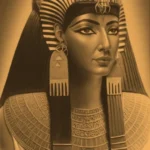
Queen Neferu
The rule of the great pharaohs extended for thousands of years in...



Queen Nefertiti remains one of ancient Egypt’s most iconic and powerful figures, globally renowned for her legendary elegance and immense political influence during the 14th century BC. As the Great Royal Wife of Pharaoh Akhenaten, she played a central role in a radical religious revolution that shifted the empire toward the worship of a single deity, the sun disk Aten. Despite her unprecedented authority—and compelling evidence suggesting she may have ruled independently as a pharaoh after her husband’s death—her final resting place remains one of archaeology’s greatest unsolved mysteries.
Today, her legacy endures primarily through her impeccably preserved limestone bust, a masterpiece discovered in 1912 that continues to captivate millions.
Key Takeaways
A Symbol of Timeless Beauty: Her name translates to “The beautiful woman has come,” a title perfectly immortalized by her famous limestone bust, which is currently valued at over 300 million euros.
Architect of a Religious Revolution: Alongside Akhenaten, she drove Egypt’s transition from traditional polytheism to the monolatric worship of the sun god, Aten, and helped establish a completely new capital city at Amarna.
Unprecedented Royal Power: Ancient artwork frequently depicts her performing duties traditionally reserved for ruling pharaohs, such as smiting enemies and wearing the blue crown, leading historians to theorize she ruled as a co-regent or an independent sovereign.
An Enduring Archaeological Mystery: Despite decades of modern exploration in the Valley of the Kings and extensive DNA testing on unidentified mummies, her tomb and bodily remains have never been definitively located.
A Controversial Discovery: Unearthed in 1912 by German archaeologist Ludwig Borchardt under allegedly deceptive circumstances, her iconic bust resides in the Museum Berlin, sparking ongoing and urgent repatriation requests from Egypt.
She is the Egyptian queen famous for her elegance, and it is known that she possessed elegant beauty, and she had a statue that is considered a symbol for many women and for many modern cosmetics lines, and many societies around the world have adopted Queen Nefertiti as a symbol of true beauty, and some historians they declared her to be the most beautiful woman in the world.
The heroine of today’s story is the sweetest and most beautiful woman in Egypt in the 14th century BC.
Everyone agreed on her beauty despite the disappearance of her body. As for her strength, all ancient history books spoke about her.
“The beautiful woman came – Jamila Jamilat Aten.” These are the meanings of her name that have been immortalized in history forever. Today I am talking about Queen Nefertiti.

Queen-Nefertiti-EgyptaTours
Queen Nefertiti, whose name means “the beautiful one has come,” is the wife of King Amenhotep IV (who later became Akhenaten), the famous pharaoh of the Eighteenth Dynasty, and the mother of Tutankhamun.
She was considered one of the most powerful women in ancient Egypt. She lived a short period after her husband’s death, and helped Tutankhamun take over the kingship.
This beautiful queen had a high status during her husband’s rule.
She belonged to the Eighteenth Dynasty, and lived in the fourteenth century BC, and like what happened with her husband, her name was erased from historical records and her pictures were distorted after her death.
Nefertiti is famous for the bust of her depicted face carved on a piece of limestone in one of the most wonderful pieces of art from the ancient era, and it is the most famous drawing of Queen Nefertiti.

About-Queen-Nefertiti-and-her-husband-EgyptaTours
The royal consort participated with the pharaoh in worshipping the new god, Aten, the power of the sun disk.
She and her husband were the mediator between the people and Aten, and she was supposed to grant full blessing only when the royal couple united.
During the first years of her husband’s rule, Nefertiti changed her name according to the change in her faith to Neferneferaton Nefertiti, which means “Aten shines because the beautiful one has come.”
Nefertiti is remembered for the bust of her depicted face carved on a piece of limestone in one of the finest pieces of art from the ancient era.
It is the most famous image of Queen Nefertiti. It was found by the German Egyptologist Ludwig Borchardt on December 6, 1912 in the workshop of the sculptor Thutmose in Tell el-Amarna.
Almost nothing is known about Nefertiti’s life before her marriage to Akhenaten.
Scenes from the tombs of the nobles at Amarna indicate that Nefertiti had a sister named Mutpenert.
Ti also held the title of “nurse of the great royal wife [Nefertiti].” In addition, Ti’s husband (Ai) held the title of “Father of God.”
Some Egyptologists believe that this title was given to a man whose daughter married the Pharaoh. Based on these titles, it has been suggested that Ai was actually Nefertiti’s father.
However, neither Ai and Ti are explicitly referred to as Nefertiti’s parents in extant sources.
At the same time, there are no sources that directly contradict Ai Nefertiti’s parentage, as he had great influence during Nefertiti’s life and after her death.
The queen first appeared in artwork from Thebes. In the damaged tomb (TT188) of the royal butler Parennefer, the new king Amenhotep IV is shown with a royal woman who is believed to be an early image of Nefertiti. In these scenes, the king and queen are worshipping the Aten. In the tomb of the vizier Ramose, Nefertiti stands behind Amenhotep IV at the Window of Appearance during a ceremony where the vizier receives rewards.
During the early years in Thebes, Akhenaten, still called Amenhotep IV at the time, built several temples at Karnak. One of these buildings, called the Mansion of the Benben, was dedicated to Nefertiti. She is shown there with her daughter Meritaten, and sometimes the princess Meketaten appears as well.
On the talatat reliefs, Nefertiti is shown almost twice as often as Akhenaten. She is seen standing behind him in offering scenes, supporting him as queen. But she is also shown in scenes normally reserved for the king alone. For example, she is shown striking enemies, and images of captured enemies appear on her throne.
In the fourth year of his rule, Amenhotep IV decided to move the capital city to Akhetaten (modern Amarna). In his fifth year, he officially changed his name to Akhenaten, and after that, Nefertiti became known as Neferneferuaten-Nefertiti.
These name changes showed the growing importance of the Aten religion. This new belief system shifted Egypt from worshipping many gods to a form of religion focused mainly on one god, which can be described as monolatry or henotheism.
The boundary stelae from years 4 and 5 show the borders of the new city and indicate that the move to Akhetaten happened around that time. The new city had several large open-air temples dedicated to the Aten.
Nefertiti and her family likely lived in the Great Royal Palace in the center of the city, and they may have stayed at the Northern Palace as well. She and the rest of the royal family appear often in scenes found in the palaces and in the tombs of the nobles.
with her household efficiently managed by a steward named Meryre II. He was responsible for managing her household.
The earliest pictures of Nefertiti come from the Theban tombs of the royal butler Parennefer and the vizier Ramose, where she is shown with her husband. In the Theban temple called Hwt-Benben Mansion of the Benben Stone, a sacred object connected to sun rituals, Nefertiti had a bigger role. She took on some royal powers to act as a priest and make offerings to the Aten.
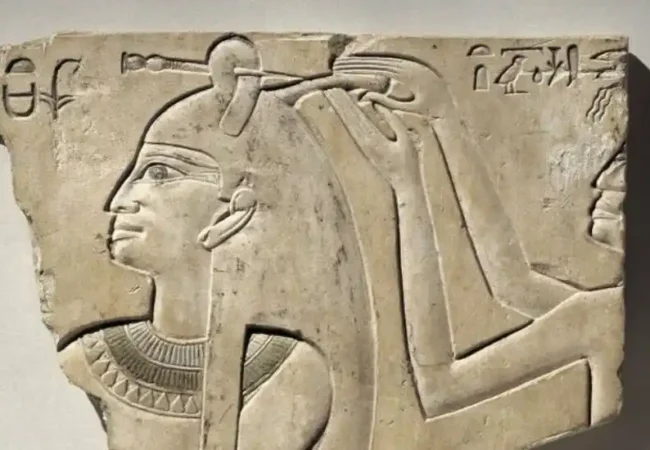
Blocks found at Karnak Luxor and Hermopolis Magna Al-Ashmunayn show Nefertiti taking part in rituals where female enemies of Egypt are defeated. She wore her own special crown, a tall, straight-edged, flat-topped blue crown.
By the end of Akhenaton’s fifth regnal year, the Aten had become the main god of Egypt. The old state temples were closed, and the royal court moved to a new capital city built for this purpose, called Akhetaten (modern Amarna).
In the new capital, the queen maintained a crucial religious role. She worshipped alongside her husband and acted as the female part of the divine group made up of the god Aten, King Akhenaten, and Queen Nefertiti.
Her depictions emphasized femininity and fertility through her body shape. Her body shape and fine linen clothing highlighted her womanhood, and the frequent appearance of her six daughters emphasized her role as a living fertility goddess.
Images of Nefertiti and the royal family were shown on private devotional stelae and on the walls of non-royal tombs. Statues or images of Nefertiti were also placed at the four corners of her husband’s sarcophagus.
Some historians, looking at her carvings and statues, think that Nefertiti might have ruled as a queen in her own right, acting as a co-ruler with her husband rather than just his wife. However, the proof is not certain, and there are no written records that clearly show her political role.
Soon after Akhenaton’s 12th regnal year, one of the princesses died, three others disappeared and are also thought to have died, and Nefertiti disappeared as well. The simplest conclusion is that she died, yet no burial records exist in the royal tomb at Amarna and no proof that she was buried in the royal tomb at Amarna.
Early Egyptologists misunderstood some texts found at the Maru-Aten sun temple in Amarna. They thought Nefertiti might have separated from Akhenaten and moved to live either in the Northern Palace at Amarna or in Thebes.
This idea is no longer accepted. Some people have suggested that Nefertiti lived longer than her husband, took the name Smenkhkare, and ruled alone as a female king before giving the throne to Tutankhamun. There is clear evidence that a king named Smenkhkare existed, but in the 20th century, a male body found in the Valley of the Kings was identified as Tutankhamun’s brother. This makes it unlikely that Nefertiti and Smenkhkare were the same person.
It seems likely that Nefertiti was the female pharaoh called Neferneferuaten. If so, she lived longer than her husband Akhenaten and had a lot of power in the royal family. If this is true, her influence and life probably ended in the third year of Tutankhaten’s rule when she died and the young king took over 1331 BC. That year, Tutankhaten changed his name to Tutankhamun, which shows he returned to worshipping the god Amun, and he left Amarna to move the capital back to Memphis and Thebes, according to Aidan Dodson.
Other Egypt experts, like Athena van der Perre and Nozomu Kawai, believe that Nefertiti ruled alone and was not just a senior co-ruler with Tutankhamun. Kawai explains:
Some items found in Tutankhamun’s tomb were first made for Neferneferuaten Nefertiti, then changed for Tutankhamun. This shows that Tutankhaten and his followers did not want to recognize the previous ruler. Neferneferuaten ruled alone even though Tutankhaten, the crown prince, was the rightful heir. Instead of giving the throne to a young boy, she may have wanted to continue ruling because she was already queen and Tutankhaten was only five to ten years old.
While Neferneferuaten started bringing back the worship of Amun and other gods, she also kept the worship of Aten at Amarna. This made some officials and priests unhappy, especially those like Ay and Horemheb, who wanted a fast return to the old religious ways.
Nefertiti’s burial was planned to be inside the Royal Tomb according to the Boundary Stelae. It is possible that the unfinished part of the Royal Tomb was meant for her. However, since Akhenaten seems to have died before her, it is very unlikely she was ever buried there. One shabti (funerary figurine) was made for her. The unfinished Tomb 29, which would have been almost the same size as the Royal Tomb if completed, is the most likely tomb started for Nefertiti. But because it does not have a burial chamber, she was not buried there either.
In 1898, French archaeologist Victor Loret found two female mummies in the tomb of Amenhotep II (KV35) in the Valley of the Kings. These two mummies, called The Elder Lady and The Younger Lady, are thought to possibly be Nefertiti’s remains.
A 2001 article in KMT magazine suggested that the Elder Lady could be Nefertiti. However, later research showed that the Elder Lady is actually Tiye, Akhenaten’s mother. A strand of hair found in a small coffin with Queen Tiye’s name matched the Elder Lady’s hair almost perfectly. DNA tests confirmed that she was the daughter of Tiye’s parents, Yuya and Thuya.
In 2015, English archaeologist Nicholas Reeves said that detailed scans showed empty spaces behind the walls of Tutankhamun’s tomb, which he thought might be Nefertiti’s burial chamber. However, later radar scans showed that there are no hidden rooms.

Queen-Nefertiti-Statue-EgyptaTours
The story begins when a statue of Nefertiti was found on December 6, 1912 AD, at Tell el-Amarna, led by the German archaeologist Ludwig Borchardt, in the workshop of the sculptor Thutmose.
Along with many other busts of Nefertiti, Borchardt described the discovery in his memoirs, saying: “Suddenly, we have in our hands the best surviving Egyptian works of art.
It cannot be described in words. You must see it.”
In 1924 AD, a document was found in the archives of the German Oriental Company about a meeting that took place on January 20, 1913 AD, between Ludwig Borchardt
And the director of the Inspection of the Antiquities of Middle Egypt, Gustav Lefebvre, to discuss the division of the archaeological discoveries that were found in 1912 AD, between Germany and Egypt.
Borchardt was determined to make the bust belong to the Germans, and it is suspected that Borchardt had concealed the bust’s true value, although he denied this.
Borchardt showed Lefebvre a poorly lit photo of the statue of Nefertiti, and hid the statue in a box when Gustave Lefebvre visited.
The document revealed that Borchardt claimed that the statue was made of gypsum, while it was made of good quality limestone.
After Lefebvre signed the division, it was approved by the director of the Antiquities Department at the time, Gaston Maspero, and it was shipped directly to Berlin, and the statue arrived in Germany in the same year 1913 AD.
Thus the famous bust ended up traveling to Berlin, not without a certain deception, where Borchardt, realizing the importance of the piece, hastened to wrap it up.
And show “only a bad image to the Egyptian Ministry of Antiquities” at the time, which was naive to give its approval to the distribution proposed by the skilled archaeologist.
First displayed in 1924, it remains a heavily visited masterpiece, housed today in the Museum Berlin despite Egypt’s ongoing, urgent requests for its return, causing great expectations and where it remains, despite urgent calls from Egypt to return home, it is difficult for him, visited every year by a million people, many of whom head to the North Dome Room.
In the Berlin Museum just to see it. Two years ago, the insurance company valued the business at more than 300 million euros.
There is another statue of Nefertiti’s head in the Egyptian Museum, made of red quartz and decorated with touches of ink. It is no less meticulous in its workmanship than the head in Berlin, but it is less famous.
Nefertiti was given many titles: she is the hereditary princess, the great of praise, the lady of grace, the sweetest of love, the lady of the two lands, the king’s great wife, his lover, the lady of all women, and the lady of the south and the north.
Nefertiti supported her husband in his new religious calling, which amounted to a religious and social revolution, and she supported him in moving the capital to its new headquarters.
Which was called “Akhet Aten,” meaning the horizon of Aten, and its location is now the village of Tel Amarna in Minya Governorate.
There, alongside her husband, she played an essential role in spreading the teachings of the new religion that he called for, and she appeared with him on all religious and official occasions and celebrations.
This is what can be known from the scenes that depicted them together and their daughters with them on the walls of the temples of Aten and the tombs of the nobles at Tell el-Amarna.
She appeared in some scenes attacking enemies like the king, which confirms the broad and unparalleled power she enjoyed in ruling the country alongside Akhenaten.
Nefertiti was a distinguished queen among the queens of the Eighteenth Dynasty. She had a unique personality in Egyptian history, as appeared to us from the large number of works of art that she left to us.
Some historians suggest she might have ruled as a co-regent rather than just a consort, though definitive written proof of this political role is currently lacking
Her power and status increased under Akhenaten, as scenes and inscriptions showed her in ritual scenes next to him as a partner in rule.
Although Nefertiti was not mentioned in the Amarna Letters, which explained the political and diplomatic relations between Egypt and its neighbors at that time,
However, we can also imagine that it played some role in foreign policy, as is evident from the painting preserved in the Boston Museum
Which shows Nefertiti standing, raising her fist to strike an enemy in the form of a woman, and this scene of suppressing enemies is a masculine scene throughout the dynasties of the Pharaonic era of the ruling king who subjugates the enemies of Egypt.
In addition to the scene of striking enemies, Nefertiti appeared with the royal crowns of a ruling king and not just the crown of a king’s wife, and in addition to the crown known as the blue khabarish crown that the king wears in ritual scenes.
Nefertiti appeared wearing the same blue crown, which is only represented with a ruling queen, as was the case with Hatshepsut.
One of their daughters, Meket-Aten, died, and their grief for her is depicted in some wall paintings. After the death of their daughter, Nefertiti disappeared from the royal court and was replaced by her daughter, Meritaten
She obtained the title of Great Royal Wife. After the twelfth year of Akhenaten’s rule, Nefertiti disappeared and there was no mention of her. It is believed that she died and was buried in the cemetery of Akhet Aten.
It is also believed that Tutankhamun moved her mummy with his father Akhenaten when Aten’s sister abandoned him.
Egyptologists were unable to determine the location of Nefertiti’s tomb during years of research after the discovery of Tutankhamun’s tomb.
In 2015, Dr. Nicholas Reeves from the University of Arizona announced that he may have found the tomb of Queen Nefertiti and that she may have been secretly buried inside the tomb of Tutankhamun.
Queen Nefertiti, one of the most iconic figures of ancient Egyptian history, is celebrated for her beauty, power, and influence during the Amarna Period.
Her famous painted bust, housed in the Neues Museum at the Museum Berlin, has become a symbol of timeless elegance and royal grace.
Though her final resting place remains uncertain, scholars continue to search for her royal tomb, which may still lie hidden among the secrets of ancient Egypt’s desert sands.
Nefertiti was an Egyptian queen known for her beauty and power. She ruled alongside Pharaoh Akhenaten around 1353-1336 BC during the Amarna period.
She’s famous for her stunning bust, discovered in 1912, and her role in a religious revolution with Akhenaten, promoting the worship of Aten, the sun disk.
While primarily recognized as a queen, some theories suggest she may have ruled as pharaoh after Akhenaten, possibly under the name Neferneferuaten.
Nefertiti was Akhenaten’s Great Royal Wife. Together, they led significant cultural and religious transformations in ancient Egypt.
Yes, she had six known daughters with Akhenaten. Their names are Meritaten, Meketaten, Ankhesenpaaten, Neferneferuaten Tasherit, Neferneferure, and Setepenre.
The location of Nefertiti’s tomb remains a mystery. Some believe she’s buried in the Valley of the Kings, but no definitive evidence has surfaced.
Nefertiti was influential in religious reforms and governance. She played a key role in promoting the worship of Aten and is often depicted in positions of power.
Nefertiti influenced a new art style, the Amarna style, marked by realism and portraying the royal family’s daily life differently from previous conventions.
Her legacy lives on through her bust, artworks, and the radical changes she helped introduce to Egypt’s society and religion.



Confidently choose your perfect Egyptian adventure from our selection of trusted, expert-curated tours.



Unlock the true wonders of Egypt with confidence. We combine expert local knowledge, seamless logistics, and round-the-clock support to deliver flawless, responsible, and unforgettable travel experiences.