Discover the Vibrant Traditions of Ancient Egyptian Festivals: History, Rituals and Cultural Significance
In ancient Egyptian civilization, some ancient Egyptian festivals were held, and they...



The ancient Egyptian sarcophagus was a vital element of their funerary practices, serving as a powerful symbol of eternal life and resurrection. Originally crafted to protect mummified bodies and secure them against theft, these elaborately decorated coffins date as far back as 3000 BCE. The word “sarcophagus” originates from a Greek term meaning “flesh-eating stone,” reflecting early beliefs about the limestone materials used. By combining protective spells, beautiful decorations, and sturdy materials like wood and granite, these coffins were believed to safeguard the deceased’s soul and ensure a safe journey into the afterlife.
Key Takeaways
Purpose and Belief: Sarcophagi were designed to protect the physical body and provide a safe resting place for the soul during its transition to the afterlife.
Evolution of Materials: Early coffins were constructed from woods like cedar and acacia, while later, more permanent versions were carved from stones like limestone, granite, and basalt.
Rich Symbolic Decorations: They were heavily adorned with natural symbols representing fertility, hieroglyphic spells from the Book of the Dead, and images of protector gods such as Anubis.
Indicators of Social Status: The complexity of the sarcophagus reflected the owner’s wealth; pharaohs and elites had nested coffins adorned with gold and jewels, while commoners utilized much simpler designs.
Fascinating Etymology: The term “sarcophagus” is derived from ancient Greek, translating literally to “flesh-eating stone”.
The ancient Egyptian civilization is one of the most important civilizations in the history of the world, and this civilization was distinguished by creativity in many different fields, whether in agriculture, industry, art or religion, and this reflects the culture of the ancient Egyptians,
This civilization was distinguished by many important symbols, the most important of which is the ancient Egyptian Sarcophagus and coffin, which is a symbol of eternal life after death for the ancient Egyptians.
This coffin was associated with the beliefs of the ancient Egyptians about resurrection after death and the existence of another life.
In this article, we will talk about the materials and decorations from which the Ancient Egyptian Sarcophagus was made.

History-of-Ancient-Egyptian-Sarcophagus-EgyptaTours
The history of the ancient Egyptian Sarcophagus dates back to the pre-Christian era, dating back to about 664 BC, and was discovered in many ancient Egyptian cities.
At that time, it was made of some copper materials and some shapes such as the Great and snakes were placed on the outer surface of the coffin.
This coffin was made to preserve and secure the bodies after death to prevent the theft of the bodies.
It developed over time until it was made of other materials such as wood, stone or granite.
It was decorated with many decorations according to the social and material status of the deceased.
The coffins of the poor contained buried bodies inside them, while the coffins of the rich contained small gold pieces and gold sheets and many treasures inside them.
Some materials found inside ancient Egyptian Sarcophagus are still being discovered to reveal the presence of some skulls of some animals, some of which contain snakes topped with a crown, and it is believed that this drawing in that era refers to the ancient Egyptian god Aton.
Some skulls of wall lizards and fragments of bones of some other animals wrapped in pieces of linen cloth were also discovered.
Due to the difficulty of opening these coffins, some modern technological methods were used to detect the materials inside them, such as neutron tomography, which is not affected by searching inside metals.
Due to the absence of this type of imaging, these coffins remained hidden for thousands of years.
The ancient Egyptians interest in the coffin to preserve the body of the dead arose after the idea of mummification for the purpose of protecting it.
At the beginning of its manufacture, it took an oval shape, then it was made in square shapes starting from the first or second dynasty, and the wealthy class used to place their coffins inside other large coffins made of granite.
The ancient Egyptian Sarcophagus were made in many types according to the economic and social differences in this period.
The most important of these types are:

Symbols-and-decorations-used-in-coffins-EgyptaTours
Many decorations and symbols used for decoration in ancient Egypt appeared on the ancient Egyptian Sarcophagus, and these symbols carry many cultures and religious connotations, including some natural scenes such as plants and flowers, and at that time they symbolized eternal life and fertility.
There are hieroglyphic writings, which are the name and title of the deceased written in hieroglyphics.
Some spells were also written to protect the dead in the afterlife, as the ancient Egyptians believed at that time.
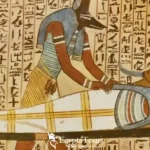
There are some coffins on which some gods were drawn, such as the god Anubis, who was the protector of the dead at that time.
The ancient Egyptians decorated these coffins by using some colored materials or by carving on the coffin to form the face, hand, beard and hair, The ancient Egyptians inlaid the coffin with some precious stones and some glass pastes.
The wealthy class inlaid the coffin with some gold pieces.
The ancient Egyptians used limestone powder to prepare the surface and bottom of the coffin, and a percentage of water and glue were added to it to form a paste that Capitano used to cover the defects inside the coffin and make it smooth to protect the dead when they woke up in the afterlife.

The-importance-of-Ancient-Egyptian-Sarcophagus-as-religious-belief
The ancient Egyptians cared about coffins because they played a pivotal role in the religious beliefs of the ancient Egyptians, They believed that the soul needed a safe place to protect it and rest after death.
These coffins were like the souls of the ancient Egyptians to continue in eternal life.
The Egyptians performed some religious rituals while burying the coffin.
They also buried some personal tools and some jewelry of the deceased to help his soul during the transition to the afterlife.
At the end of this article, we have learned with you about Ancient Egyptian Sarcophagus, which is considered a profound symbol of eternal life after death for the ancient Egyptians.
It reflects their artistic and religious culture, The ancient Egyptian civilization was one of the greatest civilizations at that time, Through it, we learned about the ancient Egyptians’ view of death and the afterlife.
The ancient Egyptian Sarcophagus is an embodiment of a whole world of ideas that existed among the ancient Egyptians.
It is a stone coffin, often decorated with inscriptions and carvings, used to protect the body and guide the soul to the afterlife.
They believed the physical body had to be preserved for the afterlife; the coffin shielded the mummy from damage while the carvings protected the soul on its journey.
Early versions were made from woods like pine and cedar, while later ones utilized durable stones like limestone, granite, or basalt.
They featured hieroglyphs, spells from the Book of the Dead, natural symbols of fertility, and images of protective gods like Anubis.
The earliest sarcophagi date back to around 3000 BCE during the early dynastic period of Egypt.

Explore our top-rated Egypt travel packages and embark on an unforgettable journey. From the Pyramids of Cairo to the magical temples of Luxor, Aswan, and Abu Simbel, discover expertly curated tours designed for your perfect Egyptian adventure