Abdeen Palace Museum: History, Tickets & Visitor Guide
There are many museums in Cairo and each place in it tells...



Al-Hussein Mosque is one of Cairo’s most sacred and historically significant Islamic landmarks, located near the famous Khan Al-Khalili bazaar. Originally constructed in 1154 AD by the Fatimids, it serves as a major pilgrimage site for both Sunni and Shia Muslims, who revere it as the burial place of the head of Imam Hussein, the grandson of the Prophet Muhammad. The Gothic-style red stone mosque is deeply woven into the city’s religious and cultural fabric, particularly during Ramadan and the Ashura commemorations.
Key Takeaways
Al-Hussein Mosque is considered one of the most important religious tourist attractions, as tourists from all over the world flock to it. During the month of Ramadan, it is decorated with lights and various types of decorations, and it is surrounded by dhikr rings of supplications and tawasheeh, which add unique spiritual notes in the heart of Cairo.
Al-Hussein Mosque, is an old mosque in Cairo, Egypt, near the Khan Al-Khalili area in the Al-Hussein district. Al-Hussein Mosque is considered one of the most important Islamic holy places in Cairo. It was built during the era of the Fatimid Caliphate in 1154. Al-Hussein Mosque contains many important collectibles, such as the oldest copy of the Holy Quran.

Al-Hussein-Mosque-History
Al-Hussein Mosque was built during the era of the Fatimids in the year 549 AH, corresponding to the year 1154 AD, under the supervision of the Minister Al-Saleh Tala’i.
Al-Hussein Mosque includes 3 doors built of white marble overlooking Khan Al-Khalili, and another door next to the dome and is known as the Green Door.
The mosque was given this name due to people’s belief that the head of Imam Hussein was buried in it, as many stories tell that with the beginning of the Crusades, the ruler of Egypt, the Fatimid Caliph, feared for the honorable head of the harm that might befall it in its first place in the city of Ashkelon in Palestine.
So he sent a request for the head to come to Egypt, and the honorable head was carried to Egypt and buried in its current location, and the mosque was built on it.
In the year 1171 AD, Saladin Al-Ayyubi established a school next to the shrine known as Al-Mashhad. This school was later demolished, and the current mosque was built in its place.
In the late Ayyubid era, in the year 1235 AD, Sheikh Abu al-Qasim bin Yahya bin Nasser al-Sukari, known as the Starling, began building a minaret above Bab al-Mashhad, now known as the Green Gate.
Abu Al-Qasim bin Yahya died before the minaret was built, so his son completed it in the year 1236 AD. It is a minaret full of decorations.
What remains of this minaret is its square base, and on it are two marble memorial plaques that include the date of the minaret’s construction and the name of the builder.
In the year 1862, Khedive Ismail ordered the renovation and expansion of the landscape and the construction of the current mosque. Al-Hussein Mosque was built in 1873, and its current minaret was built in the style of Ottoman minarets in 1878 AD.
The beautiful Al-Hussein Mosque is in the center of Islamic Cairo, on Al Azhar Street near Khan El-Khalili Bazaar in Sayyida Zeinab Square. You can get there easily by taxi, bus, or the Cairo Metro. It is a good idea to hire a travel agency to handle transportation and provide a tour guide who can explain the mosque’s history and architecture.

Al-Hussein-Mosque-building-Design
The building includes five rows of arches mounted on marble columns, and its mihrab was built from small pieces of colored faience instead of marble. It was made in 1303 AH.
Next to it is a wooden pulpit, adjacent to which are two doors leading to the dome and a third leading to the waste room, which was built in 1311 AH.
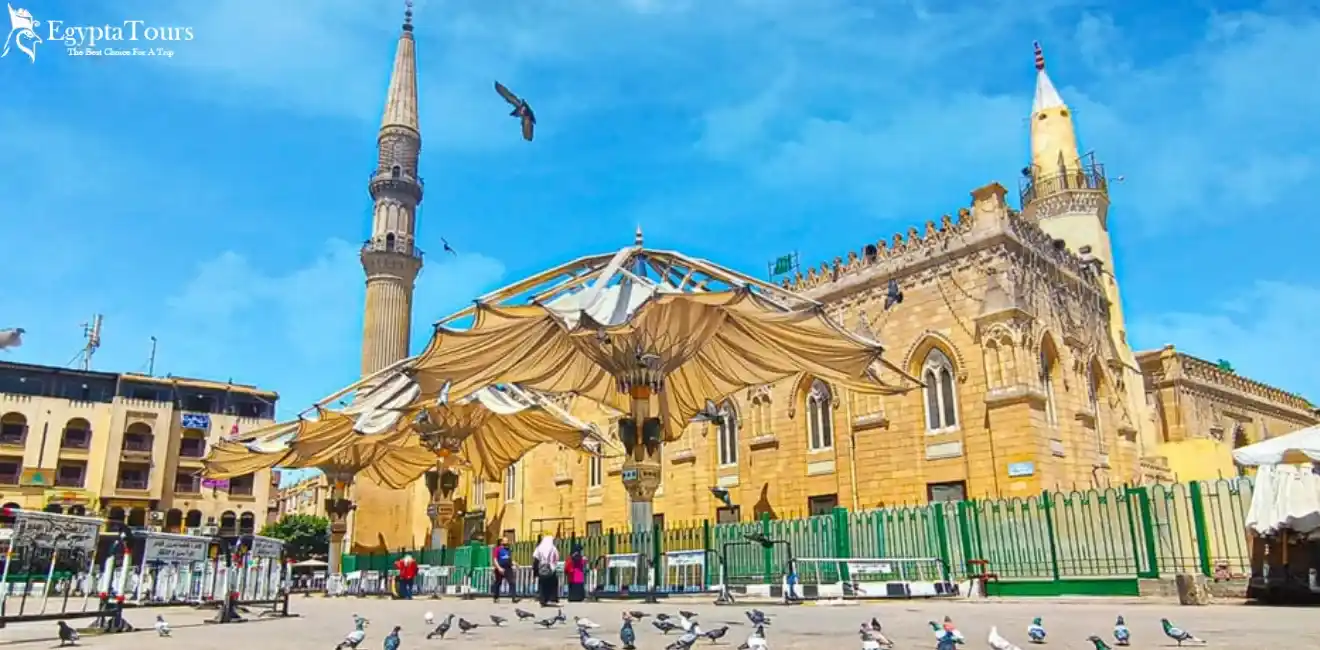
The mosque is built of red stone in the Gothic style, while its minaret, which is located in the western corner, was built in the style of Ottoman minarets and is cylindrical in shape.
It has two courses and ends with a cone. The mosque has three doors on the western side, a door on the tribal side, and a door on the sea side that leads to a courtyard containing the place for ablution.
Inside Al-Hussein Mosque is the largest chandelier in the Arab world, which weighs up to five tons and is made of crystal decorated with pure gold and its legs are made of pure silver.

Al-Hussein-Mosque-History-Shrine
Al-Hussein is Al-Hussein bin Ali bin Abi Talib, the grandson of the Prophet Muhammad. He was born in the fourth year of the Hijra in Medina and grew up in the house of the Prophet.
After the people of Kufa convinced him that they had pledged allegiance to him for the caliphate instead of Yazid bin Muawiyah, he marched to Kufa and at Karbala, the soldiers of Abdullah bin Ziyad attacked him, killed him and his family, and beheaded him on the day of Ashura in the year 61 AH.
Opinions differed about its location, and it was said that the head of Hussein was buried in the Shrine of Hussein in Cairo after it was brought from Ashkelon in the year 1154 AD.

Timings-of-the-Hussein-Mosque-and-Shrine
Visiting times for the Shrine of Hussein begin at 9 a.m., provided that women are allowed to visit the shrine first, starting from the time the visit is permitted, 9 a.m., until 11 a.m.
Men are allowed to visit the shrine of Hussein, starting from the noon prayer until the evening prayer, provided that only women are allowed to visit during the period between the evening and evening prayers.
Then, men are allowed to visit the shrine and the shrine of Hussein again after the evening prayer for one hour.
The most important tourist activities in Al-Hussein Mosque
The Hussein neighborhood and mosque are among the areas that attract many tourists, due to the fact that they are considered one of the archaeological areas.
You can see how the mosque was built with red stone in the Gothic style. As for its minaret, which is located in the western corner, it was built in the style of Ottoman minarets. It is cylindrical in shape, has two courses, and ends with a cone.
You can also see the three doors of the mosque, a door from the western side, a door from the tribal side, and a door from the sea side that leads to a courtyard containing the place for ablution.
It also includes many tourist places that are considered an ancient archaeological symbol of Egypt, and Al-Hussein Streets are among the streets that are distinguished with its wonderful and authentic atmosphere, which combines ancient times and modern times
When tourists wander around, they find sellers selling antiques that indicate the archaeological heritage and Islamic heritage of Egypt, as they indicate the authenticity of art in ancient times.
Among the most wonderful of these things are the statues that were specially designed in the shapes of ancient kings, the Sphinx, and pyramids. We also find shops that sell his beloved stones everyone, especially foreign tourists, loves it.
The-Religious-and-Cultural-Importance-of-Al-Hussein-Mosque-EgyptaTours
Imam Hussein’s stand at Karbala in 680 AD is one of the most important events in Islamic history. He stood against the unfair rule of Yazid, becoming a symbol of bravery, sacrifice and justice. Called Syed us Shohda (Master of the Martyrs), he continues to inspire Muslims of all groups.
Al-Hussein Mosque is a special place where both Sunni and Shia Muslims come to worship. Shia Muslims who love Hussein deeply, visit the mosque believing his head is buried there. Sunni Muslims also respect the Prophet’s grandson and often go for prayers, lectures and religious events.
In Egypt, the Shia population of about 800,000 to 2 million people sees the mosque as an important pilgrimage site. Sunnis see it as one of Cairo’s most sacred places.
The mosque is very busy during Ashura, the 10th of Muharram, when Muslims remember Hussein’s martyrdom. Security measures are often used to keep the events safe. In contrast, the Mawlid al-Hussein celebration is joyful, with parades, religious poems and community gatherings. Daily prayers, especially on Fridays, attract thousands of worshippers.
Behind Bab al-Mukhallafat, a beautiful gold and silver door made in 1986, there is a room with important Islamic relics. These include clothes, a staff, a kohl box and hairs said to belong to Prophet Muhammad. There is also an old Quran manuscript written by Ali ibn Abi Talib on deer skin, making this place very sacred.
Abū ʿAbd Allāh al-Ḥusayn ibn ʿAlī is an important and famous figure in Islamic history. He was the grandson of the Prophet Muhammad and the son of Ali ibn Abi Talib and Fatima, Muhammad’s daughter. He was the younger brother of Hasan ibn Ali, the third Imam of Shia Islam. The Prophet Muhammad called him and his brother (Leaders of the Youth of Paradise). Al-Hussein supported Hasan during wars in the time of Caliph Ali.
He and his brother stayed in Medina to avoid getting involved in politics after Hasan gave up the leadership in 660 AD until his death in 669 AD. After Hasan died, the people of Iraq chose Hussein to be their leader.
When the caliph Mu’awiya died around 680 AD, his son Yazid became the new leader and asked Hussein to pledge loyalty, but Hussein refused and left Medina for Mecca.
The people of Kufa asked Hussein to be their leader (Imam) and he agreed. On his way there, he was stopped by the Umayyad army, which led to the Battle of Karbala on October 10, 680 where he was killed.
This battle started with the pro-Alid group (Shi’at Ali) which is strong in Iran. Both Sunni and Shia Muslims remember his death on Ashura and honor him as a martyr and one of the greatest losses in Islamic history.
The best time to visit Al-Hussein Mosque is during Ramadan.
Ramadan is the ninth month of the Islamic calendar. Muslims around the world fast, pray, reflect and spend time with the community during this month. In Egypt, Muslims go to mosques more often to perform special prayers called Tarawih.
These prayers are done after Isha’a (night prayer) and can last an hour or more. Non-Muslims do not have to fast, but they should avoid eating or drinking in public during the day to respect those who are fasting.
Pray in the main hall : The mosque’s main entrance is open for prayers five times a day. If you visit during prayer, take off your shoes and enter through the correct door.
Visit Muhammad Ali Pasha’s mausoleum :The mosque has the tomb of Muhammad Ali Pasha, a famous Egyptian leader. Visitors can enter for free to see his tomb.
Take a tour of the mosque : Guided tours are available for groups of 10 or more. Learn about the mosque’s history and design while seeing its inside and outside beauty.
See the stained glass windows : The mosque’s stained glass windows are beautiful artworks. They were made by Gamal el-Din Mokhtar and show nature scenes and Quran verses.
Eat at a local restaurant : There are many good restaurants nearby. Try dishes like koshary (rice, pasta and lentils with tomato sauce), foul medames (mashed fava beans) and shawarma (chicken or beef in pita bread).
Attend a lecture or event : The mosque hosts lectures about Islam and cultural events like concerts and film showings. Check the website or ask at the reception desk for upcoming events.
Shop for souvenirs : Nearby stores sell keychains, magnets, postcards and other items showing Egyptian culture.
Pray at Husayn’s mausoleum : Husayn ibn Ali, the Prophet Muhammad’s grandson, is greatly respected. His mausoleum is inside the mosque and many visitors pray and pay respects there.
In downtown Amman, Jordan; a prominent landmark near the city center.
It is named in honor of King Hussein of Jordan and serves as a major national mosque.
Visiting hours vary by day and prayer times. It’s best to check the official schedule or ask at the entrance.
Non-Muslims can visit the exterior and often the courtyard, but interior access may be restricted during prayers.
Modest clothing required. For women: shoulders to ankles covered; headscarf in some areas. For men: shoulders and knees covered.
Yes, shoes must be removed before entering the prayer halls.
Photography is generally allowed in exterior areas and courtyards; interiors may have restrictions, especially during prayers.
Most typically there is no general entry fee, though donations are welcome. Check locally for any changes.
You can attend public areas outside the prayer hall; participation inside the hall is reserved for worshippers.
The mosque features traditional Islamic architectural elements with a prominent dome/minarets and a grand prayer hall.
Guided tours may be offered by on-site staff or local tour operators; inquire at the entrance or through the visitor desk.
Bring modest attire, a valid ID if requested, and be prepared for security checks in common with major landmarks.
Best by taxi or local transport from central Amman; look for the main entrances near the city center.
Close to other city landmarks such as Rainbow Street, Citadel Hill, and downtown markets.
Check Jordan tourism official sites or the mosque’s own info desk for hours, dress code updates, and events.

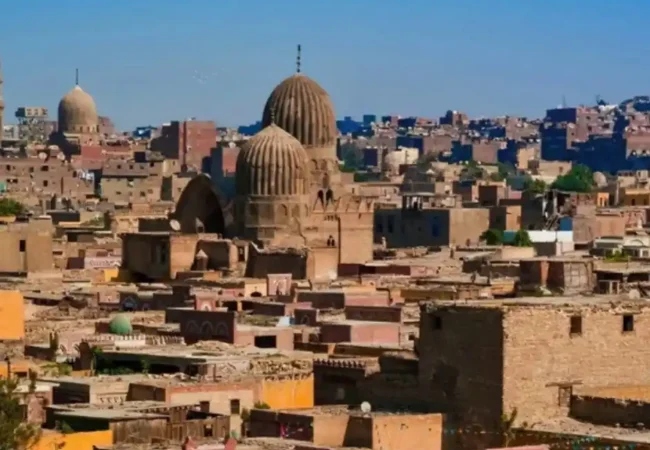
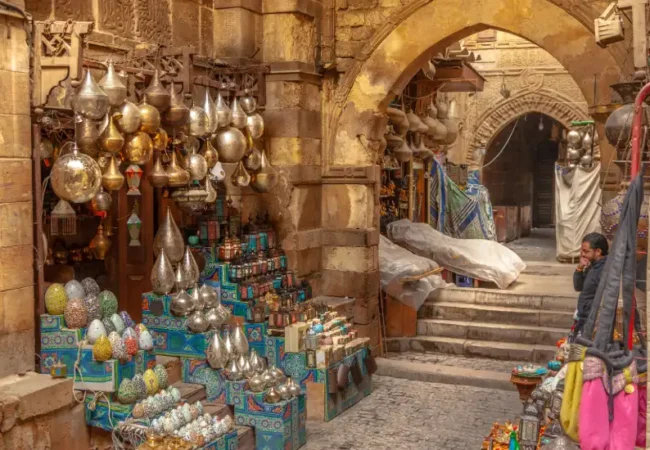

Explore our top-rated Egypt travel packages and embark on an unforgettable journey. From the Pyramids of Cairo to the magical temples of Luxor, Aswan, and Abu Simbel, discover expertly curated tours designed for your perfect Egyptian adventure