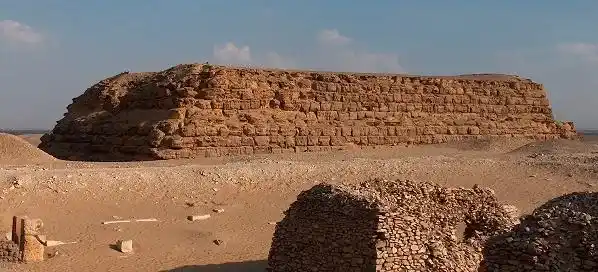
Mastaba
The mastaba is considered one of Rthe first types of tombs that...



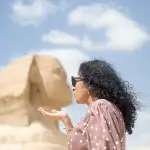
The Great Sphinx of Giza is a monumental limestone statue located on the Giza Plateau near the Great Pyramids. Carved to represent a mythical creature with a lion’s body and a human head, it was traditionally constructed during the reign of khafre around 2500 BC.
Serving as a symbol of power, protection, and the sun god, this iconic 73-meter-long monument has captivated humanity for millennia. Despite centuries of erosion, significant restorations, and ongoing debates about its exact age and missing features, the Sphinx remains a profound testament to the engineering prowess of the ancient Egyptian civilization.
Historical Origins: Most historians agree the Sphinx was carved around 2500 BC during the reign of khafre. However, some researchers theorize an older origin based on water erosion patterns.
Physical Dimensions: The statue stretches approximately 73 meters (240 feet) in length and stands 20 meters (65 feet) high. It was carved directly from an existing limestone outcrop.
The Dream Stele: Between the front paws lies a monument erected by Pharaoh Thutmose IV around 1401 BC. This stele records his dream of clearing the Sphinx of sand to claim the throne of Egypt.
Name Evolution: The ancient Egyptians did not use the word “Sphinx,” which is a later Greek term meaning “to squeeze”. The monument was historically known as “Hor-em-Akhet” and is currently referred to as “Abu al Houl” (father of terror) in Arabic.
Ongoing Mysteries: Legends persist about hidden tunnels and secret knowledge beneath the monument. Nevertheless, archaeological excavations have found a few small cavities but no evidence of the legendary “Hall of Records”.
The Missing Nose: The loss of the Sphinx’s one-meter-long nose predates Napoleon Bonaparte and his cannons. The damage features marks of chisels and long rods, indicating intentional removal.
Are you planning a trip to Cairo, Egypt? If so, be sure to check out The Great Sphinx – one of the world’s most iconic monuments. Located near the Pyramids of Giza, The Great Sphinx has been a source of mystery and awe since ancient times.
In this comprehensive guide, we’ll provide all the information you need to know about The Great Sphinx in Cairo, Egypt. From its ancient history and mythology to its current state of preservation and restoration, this guide will help you get the most out of your experience.

The-Great-Sphinx-Location-Giza-Plateau-Near-The-Pyramids-EgyptaTours
The Great Sphinx is located in Giza, Egypt, near the Pyramids of Giza. It stands at the edge of the plateau, facing eastward towards the rising sun. The Sphinx is made of limestone, and is believed to have been carved around 4,500 years ago by ancient Egyptians.
The exact purpose of the Sphinx remains a mystery, but it is believed to have been a guardian of the plateau and an important symbol in the ancient religion.
The Great Sphinx can be visited as part of a tour of the Pyramids of Giza. There are many tour companies that provide guided tours to the site, which usually include a visit to the Sphinx, along with other attractions in the area such as the Solar Boat Museum and the Valley Temple or khafre’s valley temple.
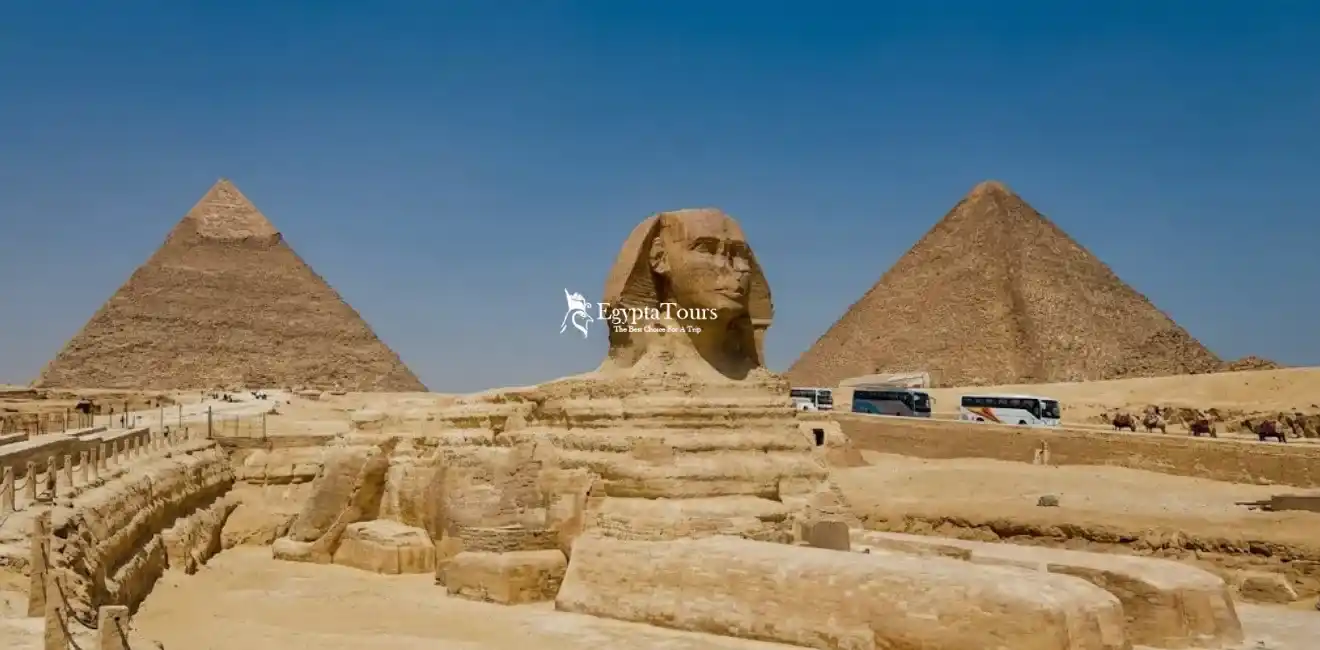
The-Sphinx-History-Ancient-Monument-From-The-Old-Kingdom-EgyptaTours
The Great Sphinx of Giza is one of the most iconic monuments in the world, having stood guard at the entrance to the Pyramids of Giza for centuries. The history of the Sphinx is shrouded in mystery and its true age remains a matter of debate.
Some historians believe it was carved around 2500 BC, making it one of the oldest known monumental statues in the world. Others think it could have been constructed as early as 4500 BC, during the reign of Pharaoh Khafra, who also built the second pyramid at Giza.
It is believed that the Sphinx was originally carved in the likeness of Pharaoh Khafre, with a human head and lion’s body to represent his strength and power. Over time, the features of the face have been eroded by wind and sand, making it difficult to identify with any certainty whose face it was meant to be.
In more recent times, the Sphinx has become a symbol of national pride and an important tourist attraction. It continues to draw visitors from around the world, many of whom come to marvel at its immense size and majestic beauty.
Between the front paws of the Great Sphinx stands the Dream Stele, one of the most interesting monuments found at Giza. It was placed there by Pharaoh Thutmose IV during the 18th Dynasty, around 1401 BC, to commemorate a famous story from his early life.
According to the inscription carved on the stele, Thutmose was still a prince when he stopped to rest near the Sphinx and fell asleep. In his dream, the Sphinx spoke to him and promised that he would become king if he removed the sand that had buried much of the monument. After becoming pharaoh, Thutmose fulfilled this promise by clearing the sand and restoring the Sphinx. He then erected the Dream Stele between its paws to record the event.
Many visitors wonder what lies between the Sphinx’s paws. Rather than a secret chamber or hidden entrance, they will find the Dream Stele, a monument that helped show the connection between the king, the gods and his right to rule Egypt.
One of the most discussed mysteries surrounding the Great Sphinx is the erosion visible on its body. Most Egyptologists believe the damage was caused by thousands of years of exposure to wind, sand and changing weather conditions. However, some researchers think the erosion may have been created by water which could mean the monument is much older than traditionally believed.
Stories about hidden tunnels and chambers beneath the Sphinx have also captured people’s imagination for centuries. Some legends claim these spaces hold lost knowledge or ancient treasures. So far, archaeologists have found no clear evidence to support these claims, but the mystery continues to inspire new studies and keeps visitors fascinated by the monument.

What-Does-The-Sphinx-Mean-In-Egypt-Guardian-Of-Sacred-Places-EgyptaTours
The ancient and original name of the Sphinx is unknown because the construction of the surrounding area was not completed at the same time as the Sphinx. It was considered an incarnation of the sun god “Horemakhet”. This is evidenced by the famous Dream Stele of Thutmose IV.
The name “Sphinx” appeared in classical antiquity. It is said that the statue refers to a mythical creature in Greek mythology with the head of a woman, hawk, cat or ram and the body of a lion and eagle wings. However, the Sphinx differs from this model as it features a human head and a lion’s body only without wings.
The English word “Sphinx” is derived from the ancient Greek word “Σφίγξ”, taken from a verb meaning “to squeeze” which refers to a Greek mythical creature that strangled anyone who failed to solve its riddles.
In the Middle Ages, it was called “Bilihib”, “Bilihoba” or “Bilihowa”. This name is associated with the god “Hauron” and they believed it was associated with the Sphinx. It appeared in French drawings as “Abluhon” then the name was shortened to “Abu al Houl”. Its meaning is “the terrifying father” or “father of terror”.
The Sphinx of Giza is an iconic symbol of Egypt and its ancient civilization, and has been a source of mystery and fascination for centuries. In ancient Egypt, the Sphinx was associated with the god Horus and represented power, strength and protection.
It was also believed to be a guardian of the pharaohs, protecting their tombs and temples from evil spirits. The Sphinx has been linked to the sun god Ra, which is why it is sometimes depicted wearing a solar disc around its head. It is even speculated that the Sphinx may have represented Pharaoh Khafre, who commissioned it.
The Sphinx has come to symbolize the long and rich history of Egypt, as well as its great monuments and monuments that are still standing today. It’s presence in Egypt is an important reminder of the country’s vast cultural heritage, and of its influence on many other civilizations around the world.
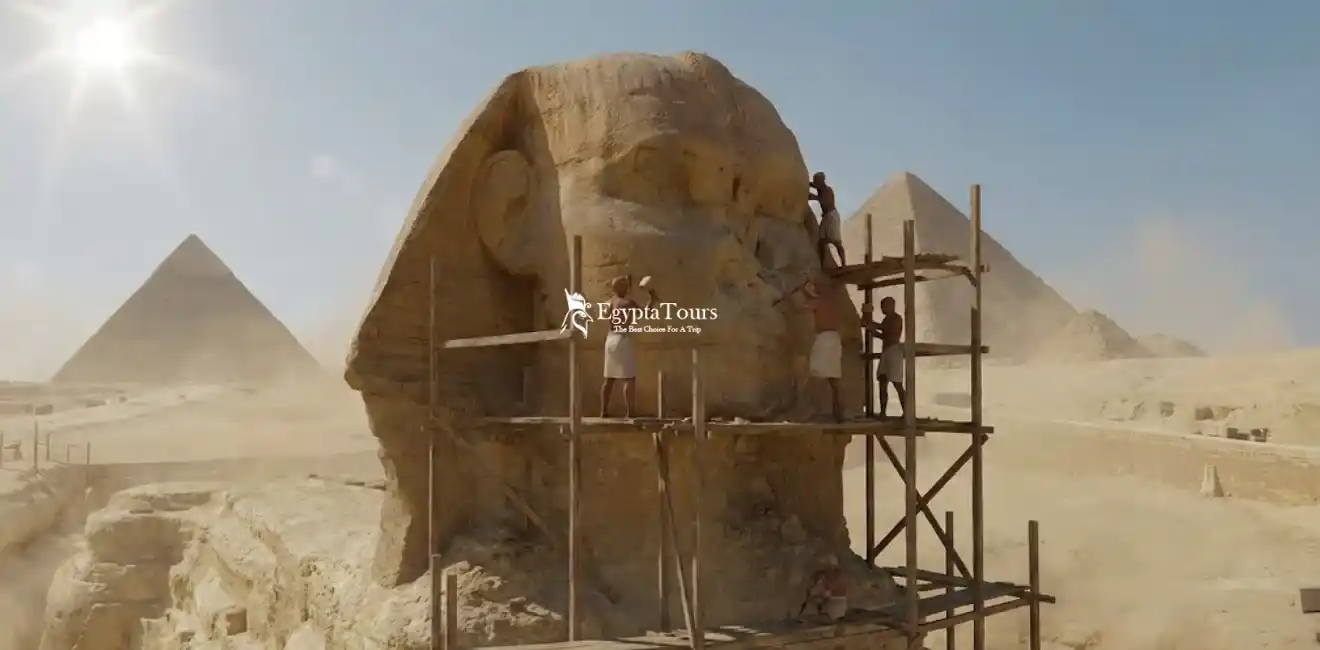
How-Was-The-Great-Sphinx-Constructed-Carved-From-Limestone-Rock-EgyptaTours
The Sphinx of Giza is one of the most iconic monuments in Egypt. Despite its immense size and grandeur, we still do not know exactly how it was constructed.
The traditional belief is that it was carved from an existing limestone outcrop, a theory supported by the fact that there is no evidence of quarried stone around it.
However, there is debate over whether this was done using copper tools or hard stone tools like dolerite.
Another suggestion is that it was constructed using large blocks of limestone, as evidenced by the presence of larger pieces near the head of the Sphinx. This suggests that the builders used a technique known as “polygonal masonry” in which each block was cut to fit perfectly with its neighbors.
In addition to these theories, some believe that the Sphinx was built with a combination of both methods.
The face and head of the Sphinx are thought to have been carved from a single large block of limestone, while the body was built with smaller blocks.
The exact age of the Sphinx remains a mystery.
It is believed to be at least 4,500 years old but some archaeologists have suggested that it could be much older.
The lack of records of its construction make it impossible to determine its exact date.
Regardless of how it was constructed, the Great Sphinx remains an incredible feat of engineering and one of the most mysterious monuments in Egypt. Its size and presence make it an impressive sight and a must-see for any visitor to Cairo.

What-To-See-In-The-Great-Sphinx-Area-Temples-And-Giza-Plateau-Views-EgyptaTours
The Sphinx of Giza is one of the world’s most iconic monuments, and its presence in Cairo, Egypt is a sight to behold. At over 73 meters long and 20 meters high, the Sphinx is a massive structure that has stood for centuries.
It is believed to have been carved from a single block of limestone during the reign of the Pharaoh Khafre, around 2500 BC.
Visitors to the Great Sphinx will be amazed by its grand size and detailed features.
The body of the sphinx is lion-shaped with the head of a man, wearing a headdress of a Pharaoh. Its eyes are still visible and its ears are pierced with holes, suggesting that it once wore jewellery or decorations.
The Great Sphinx is more than just a large sculpture; it’s also a symbol of Ancient Egyptian culture and beliefs.
Carved out of the limestone bedrock, it was designed to guard the entrance of Khafre’s temple complex. Its face is thought to depict Khafre himself, making the statue an homage to the ruler.
When visiting The Great Sphinx, it’s worth exploring the surrounding area.
The sprawling Temple Complex of Khafre houses ancient tombs, temples, and chapels that offer an insight into Egypt’s past.
You can also explore other monuments near the Sphinx, such as the Great Pyramid of Giza, as well as several smaller pyramids and tombs that were built nearby.
No trip to Cairo would be complete without visiting The Great Sphinx. It’s one of the most iconic sights in Egypt and a must-see for any traveler. With its impressive size and fascinating history, it’s sure to leave you in awe!
After the fall and erosion of part of the head covering, Egyptian government engineers repaired it. This erosion also included its neck so its original appearance was slightly altered.
Many repairs were made to the rock body and stone base in the 1980s then in the 1990s.
The body of the Sphinx is experiencing uneven deterioration due to the varying resistance of the rock layers used in its construction. The lower part is made of hard rocks while the upper part is made of softer layers. The head is considered the hardest layer.
There are columns under or inside the body of the Sphinx. The nose, which is believed to be about a meter long, is missing. There are marks of chisels and long rods used in its removal.
There are many folk stories about the missing nose, such as that it was lost due to Napoleon Bonaparte’s cannon shells but the nose was missing before that. Some say the damage was due to Mamluk attacks or riots. It is said that a Muslim Sufi was responsible for this as he saw farmers offering sacrifices to the Sphinx to increase crops so he disfigured the face.
The Great Sphinx of Giza is one of the most iconic and mysterious monuments in the world, and it is shrouded in mystery.
Throughout its history, many theories have been proposed about the origins, purpose and meaning behind the Great Sphinx.
Here are some fascinating secrets about the Great Sphinx that are worth exploring.
The most prominent secret about the Great Sphinx is its age.
It is widely accepted that the Great Sphinx was constructed sometime during the reign of King Khafre (2558-2532 BCE). However, some experts believe that the monument could be much older, predating even the Fourth Dynasty of Egypt.
This theory is based on the fact that the monument appears to have been worn away by water erosion, which would not be possible if it was only constructed during the Fourth Dynasty.
The location of the Great Sphinx has also sparked controversy among scholars. Many believe that the Great Sphinx was placed at its current location due to a deep spiritual significance or ancient wisdom.
There are several theories as to why the Sphinx was placed in this exact spot, from honoring a solar deity to being an astronomical marker.
One of the most compelling secrets about the Great Sphinx is its facial features.
Historians have long debated about why the face of the Sphinx does not match with any known pharaohs, as was common for royal statues in ancient Egypt.
Some believe that the face of the Sphinx may have originally been meant to represent a lion goddess, rather than a pharaoh.
The true secrets of the Sphinx will likely remain unsolved for years to come, as there is no way to definitively answer these questions without further excavations and studies.
However, all of these mysteries have only added to the intrigue and mystique of this enigmatic monument.
It is believed that this beard was added after the construction of the original statue because it did not cause damage to the chin. Remains of red pigment were found on the face as well as yellow and blue in other places. This led scientists to believe that the statue was once decorated with colors.
Several holes were found in the Sphinx statue, such as the hole through the waist of the Sphinx. In the head of the sphinx there is a big hole.
The Great Sphinx is located within the Giza Plateau and can be easily reached from Cairo by taxi, Uber or as part of a guided tour.
Access to the Sphinx is included in the regular entrance ticket for the Giza Plateau so there is no need to buy a separate ticket.
Most visitors spend about 30 to 45 minutes at the site. This gives you enough time to admire the monument, take photos and learn about its history.
The best times to see the Sphinx are early in the morning or later in the afternoon. During these hours, the weather is usually more comfortable, the light is better for photographs and there are often fewer visitors.
If you are planning a trip to the Sphinx, it is a good idea to visit it together with the pyramids, as both landmarks can be explored comfortably on the same day.
1. Make sure you dress appropriately when visiting the Sphinx. A hat and comfortable shoes are a must!
2. Bring plenty of water and snacks, as there is no food available on-site.
3. Early morning or late afternoon are usually the best times to visit the site, as it gets quite hot in the mid-day sun.
4. The Sphinx is located close to the Pyramids of Giza, so if you are visiting both sites on the same day, consider taking a guided tour for a more comprehensive experience.
5. Photography is allowed, but be respectful when taking pictures, and refrain from using a flash as it can be disrespectful to visitors who are praying or meditating at the site.
6. Don’t forget to bring some cash with you as you may need it for admission fees or souvenirs or Check Our What To Pack For Egypt Blog.
| Tour Name | Duration |
|---|---|
| 10 Days Cairo & Nile Cruise and Hurghada Trip | 10 Days – 9 Nights |
| 6 Days Cairo and Hurghada Tour Package | 6 Days – 5 Nights |
| 2 Days Cairo Short Break | 2 Days – 1 Night |
| Cairo Short Breaks | Tour Category |
The Great Sphinx, a monumental limestone statue located on the Giza Plateau, is one of the most iconic symbols of ancient Egypt. Dating back to the 14th century BC, the Sphinx was believed to have been commissioned by Pharaoh Thutmose IV as a tribute to his royal lineage and a guardian of the Giza necropolis.
Carved from massive limestone blocks, the Sphinx measures an impressive long and 66 feet in length, featuring the body of a lion that represents strength and power, while its head of a human symbolizes wisdom and intellect.
This remarkable structure has captivated the imagination of countless visitors over the centuries, standing as a testament to the artistry and engineering prowess of ancient Egyptian civilization. Despite the wear and erosion it has faced, the Great Sphinx continues to inspire awe, embodying the mysteries and grandeur of the era in which it was built.
The Sphinx of Giza, one of the most iconic monuments in Egypt, is a massive limestone statue with the body of a lion and the head of a pharaoh, believed to represent Amenhotep II or possibly another ruler.
This Egyptian sphinx stands as a symbol of strength and mystery, attracting scholars and tourists alike.
The Sphinx has long fascinated historians, especially in the 20th century, when significant restoration efforts were made to preserve its grandeur. Though its exact purpose and origins remain subjects of debate, it is widely regarded as a testament to the architectural and cultural achievements of ancient Egypt.
The Great Sphinx of Giza stands as one of the most iconic monuments of ancient Egypt, guarding the pyramid complex on the Giza Plateau. Carved from limestone, it represents a lion’s body with a pharaoh’s head, symbolizing strength and wisdom. In front of the statue lies the Sphinx Temple, believed to have been used for rituals connected to the sun god, further highlighting the monument’s religious and cultural importance.
The Great Sphinx is located in Giza, Egypt near the pyramids.
The Great Sphinx is believed to have been built around 2500 BCE.
The Great Sphinx stands at 20 meters (65 feet) tall and is 73 meters (240 feet) long.
It is believed that the Great Sphinx was built by the ancient Egyptians during the reign of the Pharaoh Khafre.
Climbing on the Great Sphinx is not allowed as it is a protected archaeological site.
It is believed that there are many secret chambers and tunnels beneath the Great Sphinx, however none have been discovered yet.

Explore our top-rated Egypt travel packages and embark on an unforgettable journey. From the Pyramids of Cairo to the magical temples of Luxor, Aswan, and Abu Simbel, discover expertly curated tours designed for your perfect Egyptian adventure