
Amr Ibn Al-Aas Mosque: A Timeless Islamic Treasure
Stand in the Fustat area of Old Cairo and it’s easy to forget you’re in a modern capital. The streets feel older, quieter, and closer to the city’s first chapters. At the center of that story is the Amr Ibn Al-Aas Mosque, widely known as the first mosque built in Egypt and among the oldest in Africa.
This place isn’t about glittering tiles or towering domes. It’s about beginnings, how a new community formed, and how a simple prayer space grew with the city around it. In this guide, you’ll get a quick, clear history, what to notice in the architecture, and practical advice for visiting today without feeling out of place.
The leader Amr ibn al-Aas was born in 575. Amr is distinguished by being black in color and short in stature. He was one of the most important military leaders throughout Islamic history. And he conquered Egypt in the year 640 AD, and he was a contemporary of the Prophet Muhammad, and made him one of his companions. He is the principal founder of the ancient capital, Fustat. Amr is from the people of Quraysh. After that, he embraced Islam and took care of the matters of the Islamic religion.
Amr ibn Al Aas was a highly respected figure in Islamic history and he was known for his exceptional diplomatic skills and military expertise. He played a crucial role in spreading Islam and establishing new governance systems in the territories he conquered.
One of his most important achievements was the conquest of Egypt in 640 CE which brought the region under Muslim rule for the first time. This victory marked the beginning of a new era for Egypt shifting it from Byzantine to Islamic control.
Amr founded Fustat which became Egypt’s first Islamic capital and built the Mosque of Amr Ibn Al Aas, a landmark that symbolizes Islam’s presence in Egypt and Africa.
He was renowned for his intelligence, diplomatic skills and unwavering loyalty to his faith. Amr Ibn Al Aas remains a respected and influential figure in Islamic history admired for his contributions to the spread of Islam and the establishment of new governance systems.
Why did Amr ibn al-Aas choose this particular place to build the mosque?
After his occupation of the city of Alexandria “the capital of Egypt in the Greco-Roman era”, he thought of building a new city to be the capital of Egypt instead of Alexandria. Then he set up a large tent in which a white dove was placed in front of Fustat, so they considered it sacred and settled there. After that, Amr Ibn Al-Aas Mosque was built in the city of Fustat.
It is the first building erected in Al-Fustat and Al-Askar and the last building in them. It was called Al-Nasr Mosque and the Crown of Mosques. It was built by Amr ibn al-Aas after he completed the conquest of Alexandria in the year (21 AH / 642 AD).
The Story and reason of Building the Mosque
When Egypt was conquered, Umar Ibn Al Khattab sent a message to the governors of Kufa, Basra, Sham and Egypt instructing them to establish a mosque for performing congregational prayers and not to build two mosques in the same place so that one would not harm the other. He also instructed them to allocate mosques for the tribes to perform Friday prayers. At that time, Amr Ibn Al Aas was the one who conquered Egypt so he established the mosque in Cairo for performing prayers.
The Site of the Mosque before its Construction
The site of the mosque before its construction was a place that belonged to Qaysiba ibn Kalthum Al Tujibi, one of the Bani Sum, who came to Egypt with Amr ibn Al Aas. When they wanted to build the mosque, the Muslims consulted about the most suitable place for it and they agreed that it should be the location of Qaysiba’s house. Qaysiba donated the land to the Muslims and left. There are other accounts that say the site was a garden, a church or a khan but the first story is more likely to be true.
The Foundation of the Mosque and the Determination of its Qibla

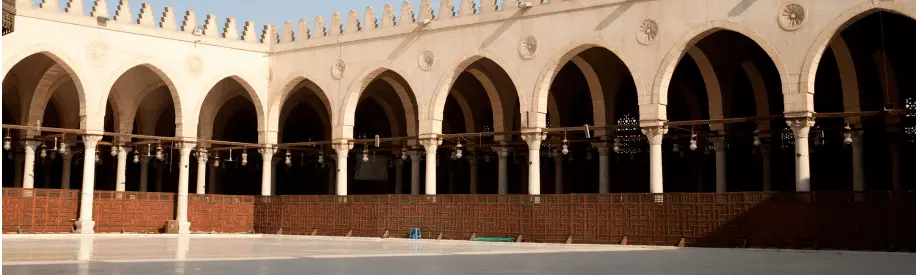
Explore the stunning exterior of Amr Ibn Al-Aas Mosque, one of Cairo’s most historic Islamic landmarks.
The foundation of the mosque was laid by four companions, Abu Dhar al Ghifari, Abu Basir, Muhamiya ibn Juz al Zubaidi and Nabiya ibn Sawab. Amr ibn Al Aas himself placed the bricks and Ibn Al Maysir was the engineer who designed the mosque. Umar sent Rabiya ibn Shurahbil, Amr ibn Alqama and Al Adawi to determine the qibla.
He told them “When the sun is at its highest point, place it (the qibla) on your eyebrows.” They did so and determined the qibla. Amr said, “Orient the qibla towards the east and you will hit the Haram.” Al Lith said that Umar was stretching ropes to determine the qibla. Amr would pray in the mosque towards the east and when he prayed in the mosque, he would turn to the right.
Amr Ibn Al Aas and the Conquest of Egypt
The conquest of Egypt was an extension of the conquest of the Levant which happened after the Romans withdrew from Palestine. Amr Ibn Al Aas suggested to Caliph Umar Ibn Al Khattab that they enter Egypt to protect the Muslims’ rear from Roman attacks.
Umar Ibn Al Khattab was initially hesitant but eventually agreed and sent reinforcements to Amr Ibn Al Aas. Amr Ibn Al Aas entered Egypt with his army and conquered it after Alexandria fell in 21 AH.
The Romans had ruled Egypt before and they had persecuted the Egyptians because of their different creed. The Egyptians followed the Monophysite doctrine while the Romans followed the Chalcedonian doctrine. So the Egyptians preferred Islamic rule because it guaranteed them freedom of belief.
After the Islamic conquest, most Egyptians converted to Islam and some remained Christian. The Egyptians became Arabized over time and Arabic became their native language.
In Islamic belief, the Prophet Muhammad predicted the conquest of Egypt before it happened. Many hadiths quote the Prophet as saying that Egypt would be conquered and its people would be an aid to the Muslims.
Amr Ibn Al-Aas Mosque Design & Layout
The mosque features a prominent main entrance located on its western side leading into a large open courtyard surrounded by four corridors, each with simple wooden roofs.
The largest of these corridors is the qibla riwaq and next to it are two open mihrabs adjacent to each wooden platform. On the qibla wall, there are two paintings that date back to the Mamluk era.
In the northeast corner of the qibla riwaq, there is a dome that dates back to Abdullah ibn Amr ibn al Aas.
At the center of the mosque’s courtyard stands a dome supported by eight round marble columns and remnants of frescoes decorate the windows of the old mosque, particularly on the south wall.
Additionally, the mosque’s gallery in the direction of the qibla riwaq is supported by marble columns with different crowns from ancient groves.
Amr Ibn Al-Aas Mosque, which is famous for his name. At the time of its construction, Amr Ibn Al-Aas Mosque was known as the Crown of Mosques. Then it was known as the old mosque for the passage of time. It is located north of the Babylon Citadel.
The mosque was very simple, measuring 50 by 30 cubits. Its roof was made of palm fronds, its pillars were made of palm trees, and it did not have a wide nave, but people lined up to pray in this narrow courtyard because the mosque was narrow with them. ).
The mosque was surrounded on all four sides by a seven-armed road.
And it remained in this state until the year 53 AH / 672 AD, when the expansions continued, and the area of Maslamah ibn Makhlid al-Ansari, the governor of Egypt at the hands of Muawiyah ibn Abi Sufyan, was increased, and he built four minarets in it. Architectural expansions continued until it reached an area of about 120 x 10 meters. The mosque was burned when the city of Fustat burned in 564 AH while it was exposed to the Crusaders, then Salah al-Din al-Ayyubi reconstructed and restored it in 568 AH, four years after this incident.
Why Choosing this particular place to build The mosque
In 640 A.D, The Muslim army led by General Amr Ibn Al Aas successfully captured Alexandria (the capital of Egypt during the Greco Roman period) and advanced to modern day Cairo to attack the powerful Babylon Fortress along the Nile. The mosque was constructed on the site of Amr Ibn Al Aas’s tent in the city of Fustat, which became the capital of Muslim Egypt. The Mosque of Amr Ibn Al Aas was rebuilt multiple times over the centuries in 827 A.D, it was expanded doubling in size and arcades with columns were added.
In 1172 the city of Fustat was set on fire by the Crusaders and later restored by the great ruler Saladin. After years of neglect, partly due to the arrival of Napoleon Bonaparte’s troops in Cairo in 1798 the mosque underwent its last major renovation in 1875. The mosque features elements of Greek and Roman architecture and is supported by 150 white marble columns. It also has three minarets designed in a simple style along with an open courtyard surrounded by four riwaqs, the largest of which is the Qiblah Riwaq.
The remains of the archaeological mosque!
It has been proven from an archaeological and historical point of view that only a few of the old mosque’s architecture and decorations remain, and the oldest archaeological elements found in it date back to the era of Abdullah bin Taher.
The Department of Conservation of Arab Antiquities was able to redraw the facades of the mosque based on the description of Ibn al-Daqmaq on the one hand, and a summary of the manifestations of some of the remaining monuments from the facades of the mosque. Old mosque.
Visiting the Amr Ibn Al-Aas Mosque today, tips, etiquette, and nearby places
A visit here works well for travelers who want context, not just photos. The mosque is active, so your experience depends on timing and respect. If you arrive with a quiet, observant attitude, you’ll get more from the space.
Plan for a calm pace. Give yourself time to sit for a minute and take in the layout. If you’re visiting Old Cairo for the first time, pairing the mosque with nearby landmarks makes the day feel connected rather than rushed.
Best time to go, what to wear, and respectful mosque etiquette
Early daytime visits often feel easiest. The light is softer, and the space can be calmer. Friday is the main congregational prayer day in Islam, so access may be limited around prayer times, and crowds can be larger.
Keep clothing modest. Covered shoulders and legs are a safe choice, and bring socks since you’ll remove your shoes before entering carpeted prayer areas. A few basics make the visit smoother:
- Speak quietly and avoid phone calls inside.
- Don’t walk in front of people who are praying.
- Ask before taking close-up photos of worshippers, and avoid photos during prayer if staff request it.
What else to see nearby in Old Cairo
Old Cairo rewards slow exploring. After the mosque, you can build a half-day plan with stops that show the area’s mix of faiths and eras:
- Coptic Cairo (Hanging Church area): A compact cluster of historic churches and lanes, easy to walk and full of atmosphere.
- Ben Ezra Synagogue: A key Jewish heritage site in the same neighborhood, often included on Old Cairo routes.
- National Museum of Egyptian Civilization: A strong add-on if you want a wider view of Egypt’s story across many periods, from ancient to modern.
Tours To Amr Ibn Al-Aas Mosque by Category
| Category Name |
|---|
| Alexandria Tour Packages |
| Cairo Short Breaks |
| Giza Pyramids Day Tours |
| Egypt Honeymoon Packages |
| Egypt Travel Packages |
| Luxor Short Breaks |
| Nile Cruises |
| Egypt Sahara Tour Packages |
Discovering the Amr Ibn Al-Aas Mosque: FAQs
Where is the Amr Ibn Al-Aas Mosque located?
The mosque is in Cairo, Egypt. It stands in the district of Old Cairo, a site full of historic significance.
When was Amr Ibn Al-Aas Mosque built?
It was initially constructed in 641–642 AD, making it one of the earliest mosques in Africa.
Who was Amr Ibn Al-Aas?
Amr Ibn Al-Aas was a prominent military commander and companion of the Prophet Muhammad. He played a key role in the spread of Islam into Egypt.
What architectural style is Amr Ibn Al-Aas Mosque known for?
The mosque combines early Islamic architecture with some Byzantine influences. Its design embodies simplicity and spaciousness.
Can visitors enter the Amr Ibn Al-Aas Mosque?
Yes, the mosque welcomes visitors of all faiths. Be sure to dress modestly and follow local customs when visiting.
Has the Amr Ibn Al-Aas Mosque undergone any renovations?
The mosque has been through several restorations and expansions since its original construction to preserve its structure and accommodate more worshippers.
What is the significance of the mosque in Islamic history?
As one of the first mosques built in Egypt, it symbolizes the spread of Islam in North Africa and serves as a living testimony to early Islamic architecture.
Are there any special events held at the mosque?
The mosque hosts regular prayer services and special religious events, particularly during the holy month of Ramadan.
How can I get to the mosque?
The mosque is accessible by public transport and taxi services in Cairo. It’s a notable landmark, so most drivers will know the location.
Is there any entrance fee?
There is no entrance fee to visit the mosque. However, donations are appreciated to aid in its maintenance.