Ancient Egyptian Artifacts
Ancient Egyptian artifacts are among the most important historical evidence of Egypt’s...



Deep in history, specifically on the banks of the Nile River one of the greatest human civilizations arose, the ancient Egyptian civilization. This civilization was not only concerned with architecture, arts, and religious rituals, it was also a beacon in the fields of science and knowledge particularly in ancient Egyptian mathematics.
The Egyptians used numbers and symbols to express advanced arithmetic concepts paving the way for the development of mathematics as a science in its own right.
Through the inscriptions and papyri that have survived we can discern the depth of their mathematical thinking and its connection to daily life and economic, administrative, and religious activities.
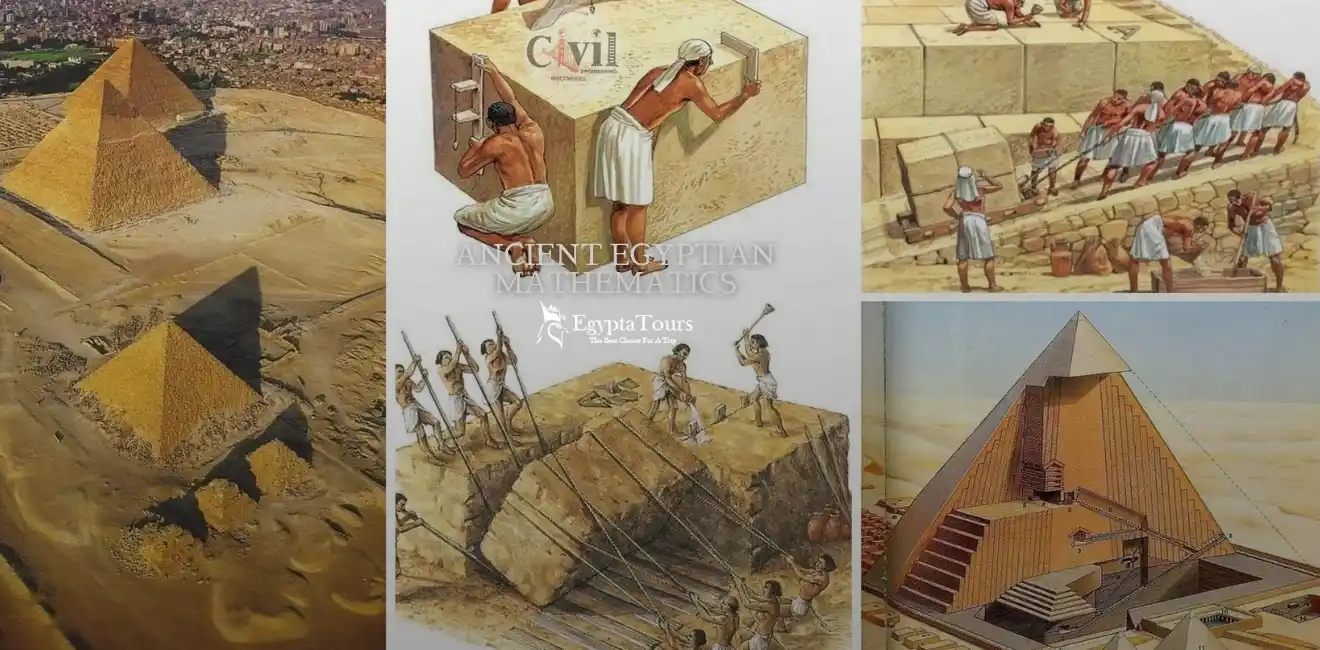
Ancient-Egyptian-Mathematics-EgyptaTours
Symbolism in ancient Egyptian mathematics is an integrated system used to represent information through signs and drawings with specific meanings. From the earliest beginnings humans realized the importance of using symbols to document what spoken language alone cannot express.
In symbolism we find that each shape or symbol reflects a specific idea, number, or command enabling communication across time as the Egyptians did through their inscriptions on the walls of temples and tombs.
Among the most important ancient symbolic systems are Roman numerals, Egyptian hieroglyphics, Braille Morse code, and even modern symbols such as barcodes and digital codes. Although symbolism is similar to cryptography the fundamental difference lies in its purpose.
Symbolism seeks to convey information in a simple and clear manner while encryption aims to conceal it from unauthorized persons.
The need to count and calculate things in ancient Egyptian mathematics arose from the earliest moments of organizing human societies. Before numbers evolved into the digital form we know today humans used tangible means such as sticks, stones, or lines engraved on the ground or walls.
These means were sufficient to record quantities and perform simple addition and subtraction operations.
In the market for example, if a merchant wanted to count barrels or heads of cattle he would use straight lines to represent the number with each stick or line representing a single unit. Over time the Egyptians became adept at transforming these simple lines into artistic symbols.
They created a comprehensive system of numbers linked to their religious and economic thought embodying it on the walls of temples and obelisks.
Hieroglyphic symbols in ancient Egyptian mathematics were essentially pictorial meaning each symbol represented something familiar in ancient Egyptian life. The number (1) was represented by a single stick the number (10) by a bull’s belt, the number (100) by a coil of rope, (1000) by a lotus flower (10,000) by a raised finger, (100,000) by a froglet, and (1,000,000) by the image of a man raising his hands to the sky.
These symbols were repeated as many times as the desired number. If a scribe wanted to write the number 3,000 he would draw three lotus flowers. The number 4,622 was written with a combination of symbols four lotus flowers (4,000), six coils of rope (600) two bull belts (20), and two sticks (2).
This number was one of the numbers engraved on the walls of the Karnak Temple in Thebes indicating its use in architectural documentation or temple construction calculations.
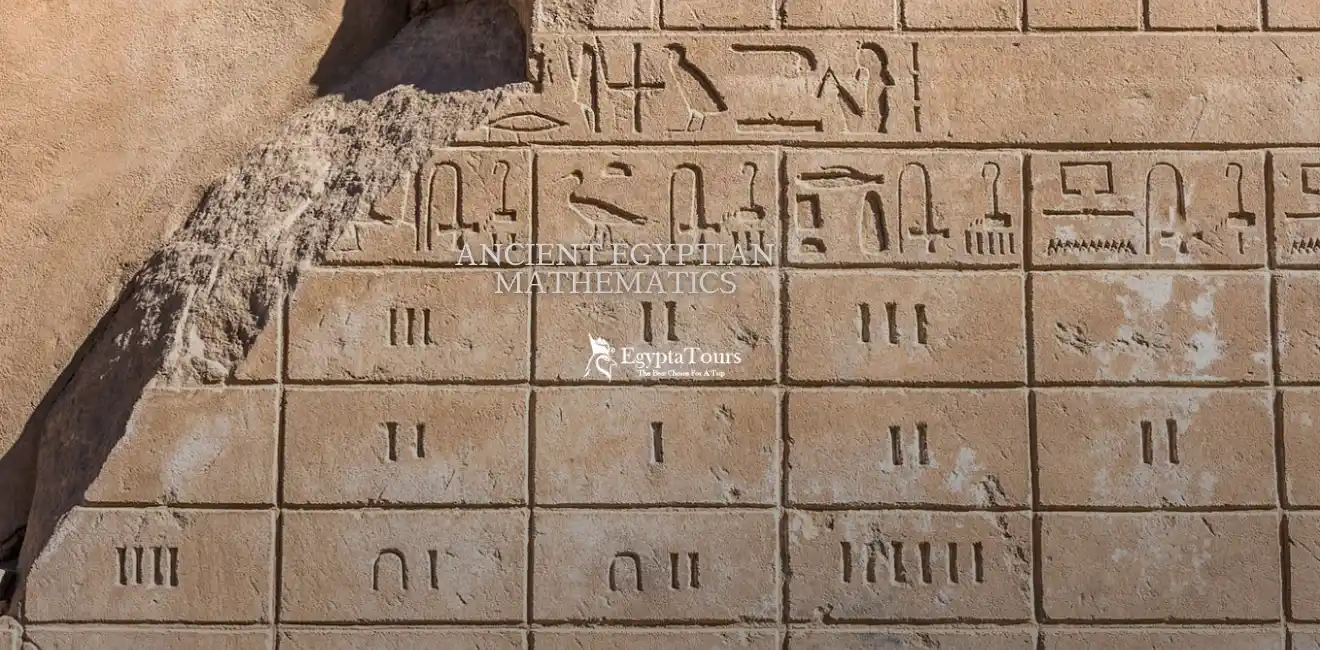
Ancient-Egyptian-Mathematics-and-Writing-Numbers-EgyptaTours
While the Babylonians devised a positional system based on the arrangement of numbers in ancient Egyptian mathematics to take on different values the Egyptians remained faithful to the non-positional system where the position of a symbol had no indication of its value.
Nevertheless they followed a nearly uniform order writing the symbols with the largest values at the top or to the left followed by progressively smaller symbols.
This arrangement gave their numbers visual clarity and decorative symmetry reflecting their concern for beauty even in their calculations.
When the state’s administrative needs evolved and stone writing was no longer the optimal method hieratic writing emerged a simplification and elaboration of official hieroglyphs. These symbols were written in ink on papyrus and were widely used in commercial accounts official documents, and educational texts.
One of the most remarkable examples of this script that has survived to us is the Rhind Papyrus currently preserved in the British Museum.
Written by the Egyptian scribe Ahmose this papyrus contains more than 80 problems in ancient Egyptian mathematics including addition, subtraction, multiplication, and division as well as advanced concepts such as prime and composite numbers arithmetic means, and whole numbers.
This document reveals a high level of mathematical and intellectual maturity in ancient Egyptian society.
Among the most unique concepts in ancient Egyptian mathematics was the use of fractions. The Egyptians used the symbol “eye,” also known as the Eye of Horus to represent a part of a whole. If the eye is placed over the number 4, it symbolizes 1/4. Egyptian fractions always began with the numerator “1” and were called unit fractions such as 1/2, 1/3, 1/2, and others.
But the question arises how did the Egyptians express non-unit fractions like 3/4 or 5/6? The answer is that they decomposed the fraction into a set of non-repeating unit fractions. For example, 3/4 was written as 1/2 + 1/4 while 7/12 was not simplified into a single fraction as we do today but was left as 1/3 + 1/4.
One of the reasons the Egyptians may have adopted the unit fraction system in ancient Egyptian mathematics was to simplify the process of distribution in real life. For example if a pizza seller wanted to divide five trays among eight people the modern method would require cutting each tray into two pieces to an eighth resulting in a large number of pieces.
Under the Egyptian method 5/8 can be represented by two fractions: 1/2 + 1/8. Therefore the vendor divides four trays into halves and distributes them then cuts the last tray into eighths and distributes them as well making the distribution process fairer and less complex.
Furthermore this system ensures visual and psychological equality as each person receives two pieces rather than one for some and two for others. This reflects the Egyptians’ tendency toward fairness and harmony in distribution even in mathematical calculations.

The-Role-of-Geometry-and-Ancient-Egyptian-Mathematics-Ancient-Egyptian-Engineering
Geometry was essential to the construction of Egypt’s famous architectural feats, including the pyramids. The ancient Egyptians possessed an advanced understanding of geometric principles, such as calculating areas, volumes, and ratios. The Great Pyramid of Giza, for example, required precise calculations for its angles and proportions to ensure its stability and symmetry.
One notable geometric principle used was the concept of the “right angle.” The Egyptians used ropes and pegs to create right angles during construction. They also utilized the 3-4-5 triangle method, a rudimentary but effective method for achieving accurate right angles, which was essential for ensuring the structural integrity of their buildings.
In addition to the monumental architecture, geometry was also used for practical land measurement, particularly in the aftermath of the annual flooding of the Nile River.
The floodwaters would often wash away land boundaries, and the Egyptians used geometric techniques to re-establish property lines. The use of ropes with evenly spaced knots, as well as the division of land into right-angled sections, was an efficient and necessary method for conducting surveys.
Ancient Egyptian mathematics has proven that it was not merely a means of calculating taxes or building temples, but rather the product of an analytical mind and an advanced awareness of the universe and order.
At a time when the world had not yet discovered zero the Egyptians innovated in developing symbols numerical systems, and fractions that continue to fascinate researchers and scientists to this day.
By studying this ancient knowledge we realize that mathematics was not limited to modern times, but was born thousands of years ago on the banks of the Nile in a language of inscriptions and silence yet it spoke a wisdom that lives on today.
The ancient Egyptians used a pictorial symbolic system to write numbers in ancient Egyptian mathematics known as hieroglyphic numerals. Each number had a special symbol inspired by everyday objects such as a stick for the number 1, a bull’s belt for the number 10, and a lotus flower for the number 1000.
The number was written by repeating the symbol according to its value without relying on a positional system as in modern numerals. For example the number 3000 was written using three consecutive lotus flowers. These symbols were used in stone inscriptions especially in temples and tombs as a means of documenting calculations and measurements.
The fundamental difference between ancient Egyptian fractions an
d modern fractions lies in the method of representation. The ancient Egyptians relied on what are known as “unit fractions,” which are fractions whose numerator is always (1), such as 1/2, 1/3, or 1/8, with the exception of the fraction 1/2 which had a special symbol.
If they needed to express a non-unit fraction such as 3/4 they would divide it into a sum of unit fractions such as 1/2 + 1/4.
Modern fractions on the other hand are written directly with the numerator and denominator regardless of the numerator’s value such as 3/5 or 7/12.
The ancient Egyptians did not know the concept of “zero” as used in modern numerical systems, given their reliance on a non-positional system. In this system, the value of a symbol did not change depending on its position, so there was no need for a symbol to represent a numerical void or zero.
Although the Babylonians used a temporary symbol to distinguish between positions, the Egyptians dispensed with this through symbol combinations and repetition, so they wrote numbers linearly using multiple symbols without the need for zero.

Explore our top-rated Egypt travel packages and embark on an unforgettable journey. From the Pyramids of Cairo to the magical temples of Luxor, Aswan, and Abu Simbel, discover expertly curated tours designed for your perfect Egyptian adventure