Heliopolis
Heliopolis, known in ancient times as the “City of the Sun,” is...



Egypt Lotus Flower has always been one of the most famous symbols expressing the sophistication and depth of ancient Egyptian civilization both spiritually and aesthetically.
Since its discovery it has become a renowned symbol representing ancient Egypt throughout the world.
It grew from the rich silt of the Nile and its pure petals opened with sunrise representing the meanings of life, resurrection, and purity simultaneously.
This flower influenced many aspects of ancient Egyptian life from the myths associated with the origin of the universe to the designs of their great temples.
This flower was associated with several deities such as Nefertem and appeared prominently in funerary inscriptions and temple decorations.
The Egyptians also used it in healing rituals and in perfume making where it became a symbol of purity renewal, and creation.
Its recurring opening in the morning and closing in the evening was in keeping with their concept of the permanence of life and the universe.

The-Religious-Symbolism-of-the-Lotus-Flower-in-Ancient-Egypt-EgyptaTours
The importance of the Egypt lotus flower extended to the early periods of the Egyptian state beginning with the Early Period (c. 3100–2686 BC). Its symbolism likely existed even before the establishment of the state itself in the Hermopolis creation myth recorded during the Middle Kingdom (c. 2055–1650 BC).
The solar god emerged from a lotus flower that grew from the primordial waters of Nun.
This story directly reflects the flower’s daily cycle of blooming making it a metaphor for the creation of the universe and the ongoing process of rebirth.
With the development of religious doctrine in the New Kingdom (1550–1070 BC) the lotus’s status as a symbol of creation became more evident in religious inscriptions and funerary texts.
Nefertem the god of beauty fragrance, and healing appears in inscriptions from the Old Kingdom (2686–2181 BC) often depicted as a young man with a lotus flower on his head sometimes flanked by two feathers.
During the New Kingdom his depiction became common in religious inscriptions amulets, and monuments. The flower was also associated with the sun god Ra or the god Horus who were sometimes depicted as children emerging from a lotus flower further enhancing the flower’s symbolism as a symbol of divinity and renewal.

The-Egypt-Lotus-Flower-in-Funerary-and-Temple-Reliefs
Egypt lotus flower appears prominently in Egyptian art particularly in tomb paintings from the New Kingdom. For example in the tomb of Nebamun (1350 BC) we find depictions of banquet guests holding a lotus flower and inhaling its fragrance expressing happiness renewal, and entry into the cycle of eternal life.
Dried lotus flowers were also found in the tombs of kings such as Ramesses II (1279–1213 BC) confirming its use in funerary rituals and its connection to the afterlife.
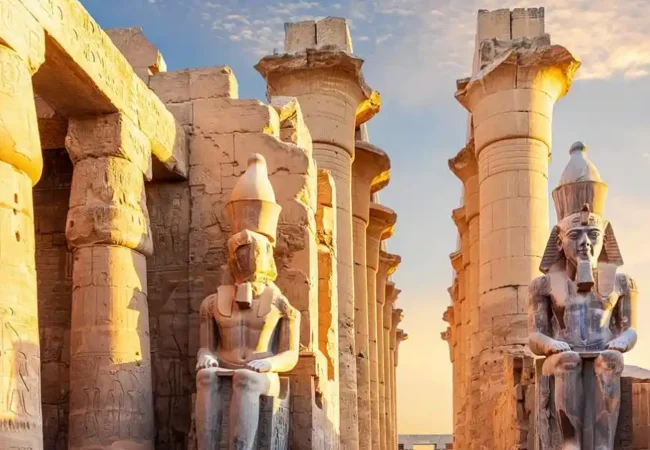
The symbolism of the Egypt lotus flower influenced the architectural style of ancient Egypt. The flower design was used as a decorative element in column capitals since the time of the pyramids, and its use increased in New Kingdom temples such as Karnak and Luxor (1550–1069 BC).
In the Karnak Temple especially during the expansion phases of the reigns of Hatshepsut, Thutmose III and Ramesses II columns with lotus-inspired capitals helped depict a scene symbolizing the first swamp of creation where life first emerged from the primordial waters.
Although famous medical papyri such as those by Edwin Smith and Ebers (1550 BC) do not directly mention the use of the Egypt lotus flower it is likely that it was used for simple aromatic or therapeutic purposes.
During the Late Period (664–332 BC) some inscriptions refer to oils and perfumes containing plant extracts which may have included the lotus especially in religious purification rituals.

The-Role-of-Egypt-Lotus-Flower-in-Religious-Rituals-EgyptaTours
Egypt lotus flower was offered as offerings to statues of the gods or the good spirits of the dead especially during religious ceremonies and priestly ceremonies. Inscriptions from the Ptolemaic period (332–30 BC) the offering of flowers is mentioned in rituals due to its fragrant scent and spiritual symbolism associated with purity and renewal.
This enhanced harmony with the cosmic order of Maat and ensured the approval of the gods.
The Egyptian blue lotus (Nymphaea caerulea) held a special place in the New Kingdom (1500–1100 BC) particularly in feasts and religious rituals.
Despite the lack of direct textual evidence of its narcotic properties, scenes appearing in tombs from that period in addition to recent research indicate that soaking the flower in wine could induce a state of relaxation or mild euphoria.
In the Late Period it was cultivated in sacred gardens and artificial lakes within temples reflecting its role in creating a spiritual and aromatic atmosphere within religious rituals.

The-Cultural-Influence-of-Egypt-Lotus-Flower-EgyptaTours
Many artifacts such as drinking vessels jewelry, and decorative boxes have been found decorated with blue lotus motifs dating back to the Middle Kingdom and were frequently used in the New Kingdom.
The Egypt lotus flower also appears in lyrical literature with romantic songs from the Nineteenth Dynasty including references to the flower’s fragrance demonstrating its widespread presence in popular culture. Over time the flower’s influence spread to Greek and Roman cultures.
Egyptians from early times observed how the flower closes at sunset and reopens at dawn making it a symbol of the cycle of life and renewed resurrection.
By the Middle Kingdom this symbol became entrenched in funerary texts such as the Coffin Texts where the flower frequently appeared as a symbol of resurrection in the afterlife.
Although its roots are buried deep in the Nile mud the Egypt lotus flower emerges bright and beautiful upon the surface making it a symbol of spiritual and moral purity.
The Egyptians saw this as a powerful indication that purity could emerge from a chaotic environment consistent with the core values of ancient Egyptian society which valued balance and order.
This symbolism persisted throughout the Late Period and even into the Greco-Roman era as the flower was considered a symbol of purity and spiritual enlightenment influencing later civilizations.
The Egypt lotus flower represents a bridge between earth and heaven between life and death, and between beginning and end. Throughout the centuries and successive dynasties the symbolism of the lotus has remained unchanged it represents creation from darkness purity from clay, and life triumphing over mortality.
Whether it appears on a temple column within a sacred legend or on a tomb wall it carries a message of hope, renewal, and spiritual ascension.
Even after the demise of the Pharaonic civilization this flower continues to arouse admiration and inspire researchers and lovers of Egyptian civilization representing the living link between nature and the deepest secrets of existence.
In conclusion, the Egypt lotus flower remained a symbol in ancient Egyptian history reflecting their vision of the world, the universe, and eternity. It combined natural beauty with spiritual significance and occupied a place in texts, rituals, and the arts.
Over time its image has continued to influence cultures confirming the depth of its symbolism and the power of its presence in human consciousness throughout the ages.
Yes, the Egypt lotus flower is found in Egypt particularly in the Delta regions and along the banks of the Nile River. It is an aquatic plant that grows in calm muddy environments. It was widespread in ancient times where it was associated with religious rituals and funerary decorations. It remains a cultural symbol of ancient Egyptian identity to this day.
The Pharaonic lotus flower is a type of aquatic flower distinguished by its unique beauty and fragrant scent. Known in ancient Egypt as “seshen,” it was considered by the Egyptians to be a symbol of resurrection and purity as it opens in the morning and closes in the evening making it a symbol of the sun and renewed life.
It appeared frequently in temples amulets, and funerary inscriptions and played a role in the religious and mythological thought of the ancient Egyptians.
The ancient Egyptians considered the lotus flower a sacred plant associated with divine creation and cosmic purity. Priests used it in rituals and offerings and it appeared in myths related to the birth of the sun from a lotus flower sprouting from the waters of Nun. It was also associated with a number of deities such as Nefertim and Ra representing beauty and divine renewal. Kings considered it a symbol of power and eternal life in the underworld.



Explore our top-rated Egypt travel packages and embark on an unforgettable journey. From the Pyramids of Cairo to the magical temples of Luxor, Aswan, and Abu Simbel, discover expertly curated tours designed for your perfect Egyptian adventure