


Beni Hassan Tombs Egypt – Incredible History & Secrets
The Beni Hassan Tombs are one of the most prominent tourist and archaeological landmarks in Egypt. They have a special place in the history of ancient Egyptian civilization and date back to the Pharaonic eras. They reflect the architectural arts that distinguished the ancient Egyptians during that period.
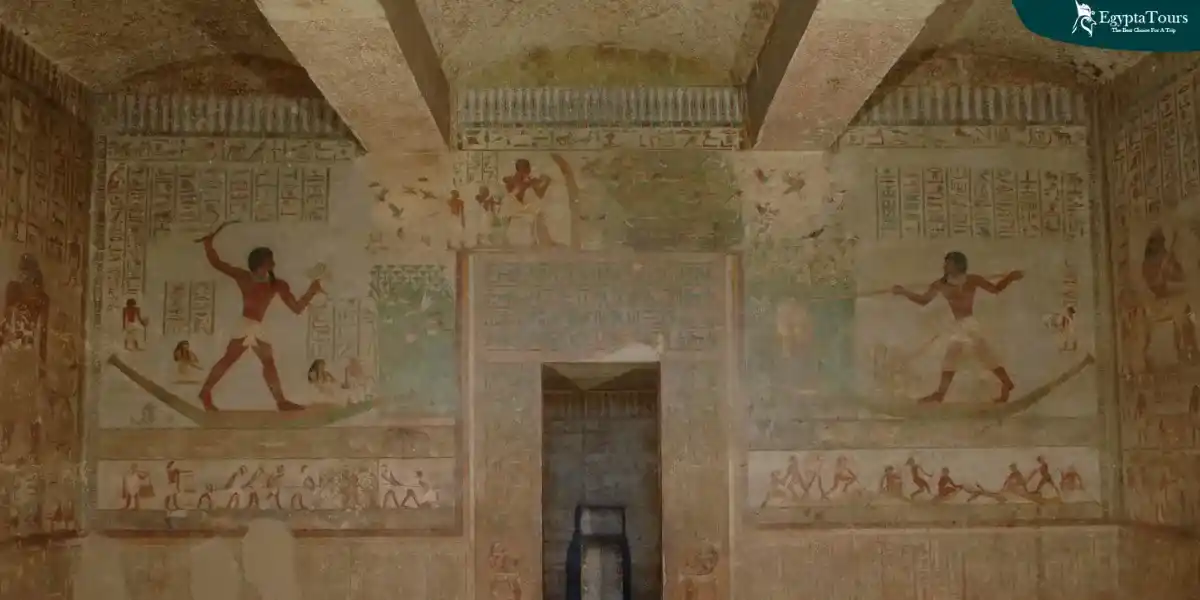
These tombs represent a mixture of history and art because they contain a group of inscriptions and drawings that tell stories of religious beliefs and the daily life of the ancient Egyptians at that time.
They are distinguished by their unique design, as they were carved into the limestone rocks, making them a wonderful example of funerary architecture during this period. In this article we will learn about the Beni Hassan Tombs and some of their details, so follow us.

Discovery-of-the-Beni-Hassan-Tombs-EgyptaTours
The Beni Hassan Tombs were discovered in the nineteenth century. It was a distinctive discovery at that time, as a mural was discovered in it containing many inscriptions. These inscriptions contained some of the religious and societal customs that distinguished the ancient Egyptians at that time, There were also a large number of provincial rulers in it.
It contains the tomb of Khnumhotep II, who was the ruler of this province during the reign of King Senusret II.
This cemetery is considered one of the secrets of the ancient Egyptian civilization that never ends. There are many stories and monuments in the history of the ancient Egyptians that are being discovered to this day and that have received the attention of the entire world because the ancient Egyptians excelled greatly in the arts of sculpture and architecture. Therefore the ancient Pharaonic monuments are the focus of attention of many tourists from all over the world.
The Beni Hassan tombs are considered one of the most important things that express the Egyptians’ ingenuity in art and architecture. These tombs were carved using some simple tools such as chisels or some wooden hammers, Despite this their impact has continued in Egypt until now and some entire families were buried in them.
The location of the Beni Hassan tombs
The Beni Hassan tombs are located south of Minya in a village known as the village of Beni Hassan, affiliated with the Abu Qurqas Center. This area is known as Middle Egypt. The ancient Egyptians used it extensively in the Middle Kingdom era. There is a temple built by Queen Hatshepsut near it, and King Thutmose III is also located near it. It was later named the cave because it is located entirely underground.
Use of Beni Hassan Tombs

Use-of-Beni-Hassan-Tombs-EgyptaTours
The use of these tombs spread in the Middle Kingdom because a number of ancient Egyptians at that time were buried in local tombs and they were made of rock and decorated with engravings in the belief of the afterlife. With the change of the ruling system more than once in Egypt, the use of Beni Hassan tombs decreased and the ancient Egyptians began to rely on burying their dead by building tombs resembling pyramids. After many attempts the ancient Egyptians succeeded in building the pyramids of Giza known today.
Formation of Beni Hassan Tombs

Formation-of-Beni-Hassan-Tombs-EgyptaTours
The Beni Hassan Tombs consist of about 39 tombs that were built between the 21st century and the 19th century BC. Some of the rulers who ruled the country at that time were buried in them. The rocks in these tombs vary until they end at some slopes in the west.
The Beni Hassan tombs were built on the eastern banks contrary to the belief of the ancient Egyptians before them, as most of the tombs were built on the western banks.
The Beni Hassan tombs are characterized by their diverse shapes, as there are tombs in the upper range and others in the lower range, and this difference depends on the deceased’s belongings. Important figures were buried in the upper range while the lower tomb was a large number of small tomb openings, although they are similar in general design.
Design of Beni Hassan tombs

Design-of-Beni-Hassan-tombs-EgyptaTours
Although these tombs date back to the Pharaonic era, the ancient Egyptians excelled in building them, as each tomb was a small room, and at the entrance to the tomb there was a place to receive the coffin of the deceased, and a group of food and drink was also placed in it, as well as some furniture that the ancient Egyptians believed they would use in the afterlife.
As for the upper tombs, they were decorated and some of the sculptures were placed in them because these tombs were made for the owners of prestigious social and political positions. They were an external courtyard and a room with stone columns decorated with engravings, then a narrow corridor leading to the burial chamber of the dead.
The biography of the owner of the tomb was engraved as well as some of the daily practices he practiced such as sports, hunting or war.
Art and Symbolism in the Wall Paintings
Art-and-Symbolism-in-the-Wall-Paintings-EgyptaTours
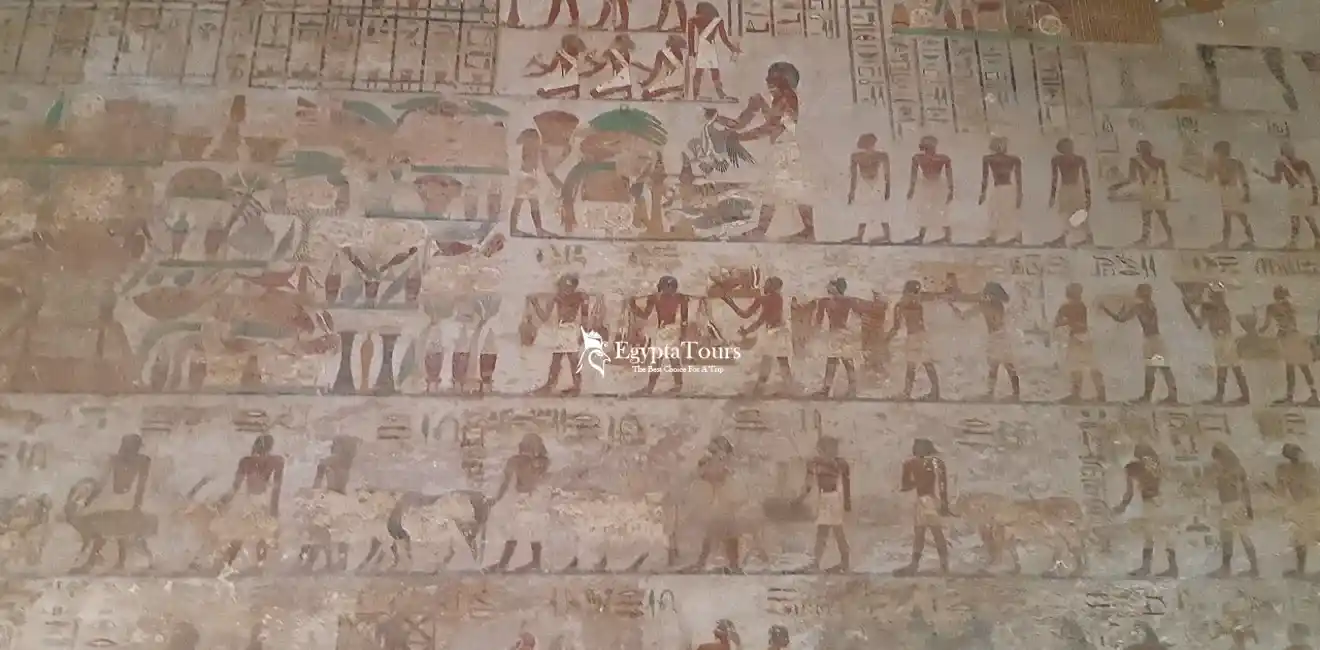
The wall paintings at Beni Hassan attract people because of their beautiful art style and deep meaning. The artists used natural mineral colors on plastered walls. Their color choices were limited but bright including red, yellow, green, blue, white and black. These colors make the scenes look alive even after almost 4,000 years.
The paintings show many parts of life in ancient Egypt. They include farming work, hunting trips and religious ceremonies. There are also rare pictures of wrestlers practicing. In Tomb 15 of Baqet III, there are about 400 pairs of wrestlers showing different moves and fighting techniques. This is considered the oldest known artistic example of an organized fighting system from about 2000 BCE.
The tomb of Khnumhotep II (Tomb 3) has a famous scene of a caravan. It shows 37 people from Asia bringing stibium (black eye makeup) to Egypt. The artists carefully showed the differences between Egyptians and foreigners. They painted different skin colors, clothes and physical features.
The animal pictures in the tombs have two roles. They show animals from nature and also carry symbolic meanings. Hunting scenes with birds represent winning over chaos, while cats were important spiritually because they were connected to the local goddess Pakhet. The artwork also shows mythical creatures, such as a dog-like figure with a falcon head from Egyptian mythology.
Some of the Political Positions that were buried in the tombs of Beni Hassan
Some of the governors of the regions who were buried in the tombs of Beni Hassan, especially in the era of the 11th and 12th dynasties. The most important of these are the tomb of Kheti, the tomb of Baqet III, the tomb of Khnumhotep II, and the tomb of Amenhotep III. All of these tombs are complete tombs that were skillfully made by the ancient Egyptians. Many engravings were drawn in them and were an example of precision and magnificence.
Although the necropolis of Beni Hassan has about 39 tombs, most of which date to the Middle Kingdom, only four tombs are open to visitors. There is also another tomb that has no decorations.
The tombs of Beni Hassan are special compared to other ancient necropolises. They allow visitors to see the unique decoration style that was common during the Middle Kingdom, especially the brightly colored wall paintings.
In addition, most burial places in ancient Egypt were built on the west bank of the Nile. The ancient Egyptians believed that the west bank was the City of the Dead, while the east bank was the City of the Living.
The Tomb of Baqet
Although the Tomb of Baqet is numbered as the 15th tomb of Beni Hassan (BH15), it was the first tomb to be excavated. Baqet, the owner of the tomb, was the governor of El Minya during the 6th Dynasty, around the beginning of the 21st century B.C.
The tomb of Baqet has a simple front with no decorations or special architectural details. The tomb itself is rectangular and cut into rock, with two pillars shaped like lotus flowers.
The northern walls have many interesting paintings showing Baqet in his daily life. Since he was the governor of a province, he is shown hunting animals in the deserts of El Minya, chasing birds and performing his daily duties as a ruler.
The eastern walls show scenes of battles that happened in the region during the 6th Dynasty which was common in tomb paintings of that time. The southern wall, the most traditional wall of the tomb, shows Baqet’s burial, as well as scenes of him playing sports and sitting with his family.
The Tomb of Khety
Khety, the son of Baqet, had the same job as his father. He was the governor of a province near El Minya which may be why his tomb’s design was very similar to his father’s.
The tomb of Khety has six lotus-shaped columns and a rectangular shape, just like Baqet’s tomb. The paintings on the eastern and northern walls show Khety on hunting trips in the deserts of his province.
Some scenes also show Khety with his wife supervising activities in the province. These include women singing and dancing. The eastern wall shows soldiers training for battles. The artist skillfully painted the soldiers’ movements using different shades to show how each one moved during practice.
The southern wall shows Khety overseeing wine-making and it also includes some burial rituals.
The Tomb of Amenemhat
Amenemhat lived during the 7th period which may be why his tomb is a bit more complex and the walls are more decorated and carefully made.
Amenemhat was the last official to receive an important royal title. He worked at a time when Egypt’s government was more centralized and used to report to the capital.
The tomb of Amenemhat has a central courtyard and two pillars in front of the entrance to the main chapel. The chapel is rectangular but has a larger space than earlier tombs.
The walls of Amenemhat’s tomb have paintings similar to those in earlier tombs at Beni Hassan. The main theme of the paintings shows Amenemhat in different military and daily life activities.
The southern wall shows Amenemhat sitting with his wife at a large table with many goods from the lands he ruled. There are also some remains of statues of Amenemhat, his wife and his mother giving offerings to the gods which was common in earlier Beni Hassan tombs.
The Tomb of Khnumhotep II
Khnumhotep II was the son of Amenemhat. His power as the governor of the province of Menat-Khufu was less than that of his ancestors. However, he followed the same architectural style as his father. The tomb has a courtyard and a portico with columns that lead to the main chapel.
The tomb is special because it contains the owner’s autobiographical text carved at the bottom of the walls and it is still well preserved. Another important feature is the beautiful portraits of Khnumhotep and his family.
Restoration work in the Beni Hassan tombs
The Egyptian Ministry of Antiquities seeks to restore these tombs to attract more tourists because they express the religious and social life of the ancient Egyptians during this period. Indeed restoration of some tombs began in 2021. Some manual and mechanical tools were used to remove some of the dirt on the walls to begin cleaning and restoration work. Some chemical solutions were also used to remove the salts accumulated on the walls.
These tombs bear some funerary inscriptions, and there are some tombs in which the owner of the tomb was drawn and there is a table for offerings in front of him.
This tomb is considered one of the most important places that attract tourists to visit Minya Governorate, so the Egyptian government seeks to complete the restoration of these tombs to attract more tourists.
FAQS
Where are the Beni Hassan Tombs located?
On a cliff above the Nile near Minya in Egypt, about 200 km south of Cairo.
From which period do the Beni Hassan Tombs date?
They date to the Middle Kingdom of ancient Egypt, mainly 11th Dynasty.
Why is Beni Hassan important to Egyptology?
The site contains well-preserved rock-cut tombs with detailed wall paintings depicting daily life, merchants, boats, and agricultural scenes, offering insight into Middle Kingdom society.
Which tomb is the most famous at Beni Hassan?
The tomb of Khnumhotep II is among the best known and best preserved, with vivid wall scenes.
What kinds of scenes can visitors expect to see in these tombs?
Scenes of daily life, including caravans, farming, hunting, religious rituals, and offerings to the deceased.
Are the tombs above ground or carved into rock?
They are rock-cut tombs carved into the cliff face.
How were the tombs used in ancient times?
They were burial places for provincial governors (nomarchs) and their families, as well as a place for offerings and ritual remembrance.
Are photography and guidebooks allowed at the site?
Photography rules vary by site and current conservation policy; check local guidelines when visiting. Guides are often available.
What is the best time to visit Beni Hassan?
Cooler months (roughly October to April) are more comfortable; early morning or late afternoon helps with lighting for viewing wall paintings.
How do you access the tombs?
The tombs are accessed via a path from the main road; some sites require careful walking on uneven ground.
Are the paintings inside the tombs still legible?
Yes, many scenes are fairly legible, though some areas have faded over time due to weather and exposure.
What makes Khnumhotep II’s tomb special?
Its detailed reliefs and fresco-like paintings provide a rare, vivid glimpse into Middle Kingdom life and the status of a provincial governor.
Is the site well-preserved or fragile?
The site is fragile due to wind, sand, and erosion; ongoing conservation work helps protect the paintings and carvings.
Can I see inscriptions in the tombs?
Yes, there are hieroglyphic inscriptions and reliefs that identify the tomb owner and depict ceremonial and daily activities.
Are there nearby attractions to pair with a Beni Hassan visit?
Yes—close by are other Middle Kingdom sites along the Nile, as well as modern towns with museums and Nile
What is the importance of the Beni Hassan tombs?
The importance of these tombs is due to the Pharaonic inscriptions found in them. These inscriptions narrate more about the daily life religious life, and funerary practices of the ancient Egyptians in that A number of provincial governors were buried in these tombs and some of the activities they practiced were depicted.
What are the best times to visit the Beni Hassan tombs?
Spring and fall are considered the best times to visit these tombs due to the moderate weather at that time. They can also be visited in the winter because the weather in Minya Governorate is warm during the winter and should be avoided in the summer due to the high temperature in this area in the summer.
Were kings and princes buried in these tombs?
Kings and princes from the ruling family were not buried in the Beni Hassan tombs, but rather some provincial governors who married into the royal family were buried.
At the end of this article it should be noted that the Beni Hassan tombs are considered one of the most important things that indicate the ingenuity of the ancient Egyptians in art and architecture. It also contains a lot of information about religious and daily life and some funerary practices of the ancient Egyptians.
About EgyptaTours

EgyptaTours is a name synonymous with trust, excellence, and unforgettable travel experiences, proudly standing as one of the leading travel agencies in Egypt. Renowned for its deep expertise, personalized service, and carefully crafted itineraries, EgyptaTours serves as the ultimate gateway to discovering Egypt in its most authentic and inspiring form.