The Ultimate Guide to Nightlife in Egypt: Clubs, Bars & Evening Tours
Egypt never truly sleeps. From the rooftop bars of Cairo overlooking a...



Egypt is one of the most important tourist destinations in the world, so a large number of tourists flock to it every year.
This is because it is characterized by its diverse and moderate climate, as the tourism sector in Egypt is greatly affected by the climate, so we will learn more in this article about the climate in Egypt and its impact on the tourism sector.
Egypt is located in the northeast of the African continent, bordered by the Mediterranean Sea to the north, and the Red Sea to the east and Libya borders it to the west, and Sudan to the south.
Egypt has a hot, dry climate in summer, cool winter with rain in coastal areas and also has many coastal, desert, and rural areas, due to its strategically important location, making it an attraction for tourists from around the world.
The four seasons in Egypt are divided as follows:
It is hot and dry, with temperatures ranging from 40 to 50 degrees Celsius. Coastal areas are warm in summer. The hottest months of summer are July and September.
This season is ideal for visiting coastal areas in Egypt, such as visiting the Mediterranean coast, represented by Alexandria and Ras El Bar, or visiting the Red Sea coast, such as Ain Sokhna or Sharm El Sheikh.
It is cool with the possibility of winds. Temperatures drop to 10 degrees Celsius. The coldest winter month is January. This season is suitable for visiting historical and archaeological sites in Egypt, such as visiting the Pyramids, and visiting Luxor and Aswan.
The climate is warm in spring, with the possibility of winds that lead to storms, especially in March and May, with some humidity. This season is suitable for visiting governorates that contain various activities, such as visiting Wadi El Rayan or Wadi Al-Hitan in Fayoum, and practicing sandboarding and seeing migratory birds.
You can also visit some museums in Cairo, such as the Gayer-Anderson Museum, which displays many artifacts and historical pieces, or visit the Umm Kulthum Museum and see the panoramic hall there, which displays many pictures of her, and visit the library that displays her films and songs.
Temperatures drop in autumn, especially in September, reaching 24 degrees Celsius, with temperatures differing from one region to another. This time is suitable for strolling in gardens such as Al-Azhar Park, or visiting the Cairo Tower and seeing Cairo from the top of the tower.
You can also take a fun tour of the Citadel and see the historical exhibits inside the Citadel, or visit Al-Muizz Street, which is one of the most famous historical streets in Cairo, where you can shop and buy beautiful souvenirs.
Here are the best times to visit Egypt:
The climate in Egypt greatly affects tourist activities, as each season has a dedicated tourist activity, such as:
There are some tips that we can offer tourists while visiting Egypt, and the most prominent of these tips are:
In the end, we learned about the climate in Egypt and its impact on the tourism sector, so that visitors and tourists can know the best time to go to Egypt and enjoy a wonderful and very special tourist experience.
Understanding-Climate-In-Egypt-EgyptaTours
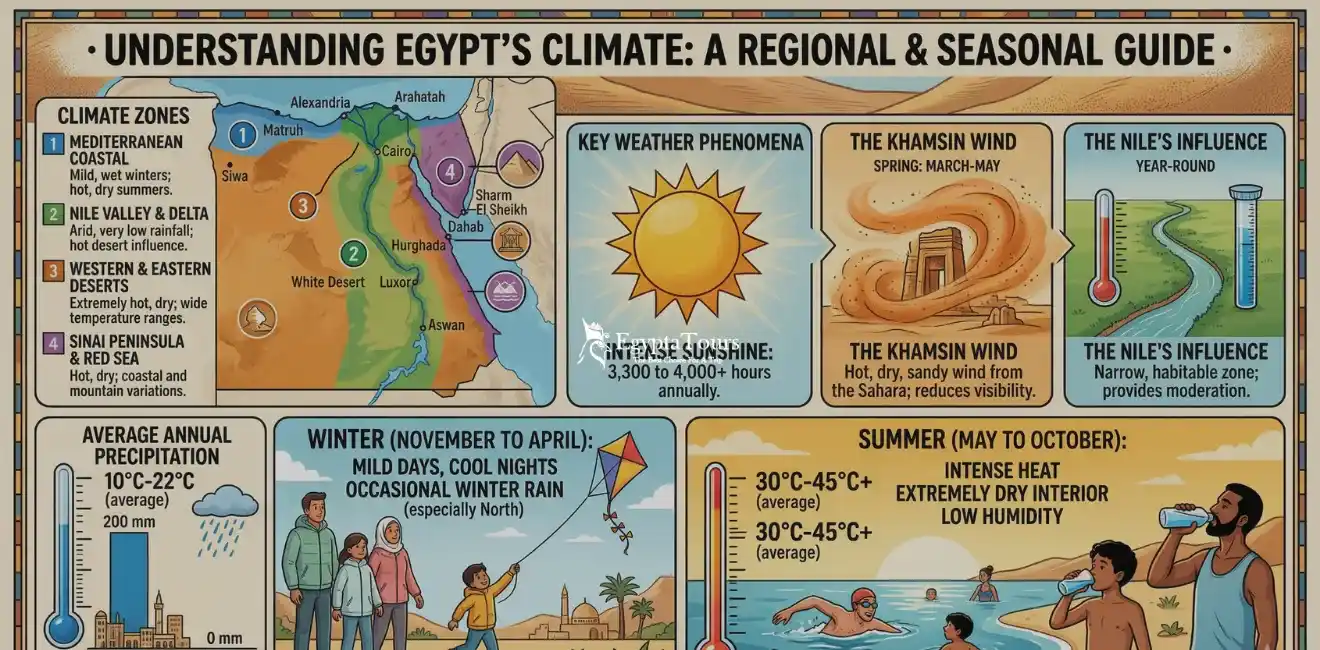
To understand Egypt’s climate, we need to look at the main factors. Location is very important. Egypt is in the northeast of Africa, between two deserts: the Sahara to the west and the Arabian Desert to the east. This position gives Egypt its mostly dry desert climate.
But the deserts are not the only factor. The Mediterranean Sea to the north helps control the temperature, especially near the coast. The sea cools the summers and makes the winters a bit wetter and milder than the desert areas.
The Nile River also affects Egypt’s climate, creating a narrow area of fertile land in the middle of the desert. The Nile Valley and Delta have a more moderate climate than the deserts, with milder temperatures and higher humidity.
The social effects of climate change are not the same for everyone in Egypt. It is expected to hit the most vulnerable people the hardest, causing over 9 million more people (about 0.8% of the population) to live below the poverty line (earning less than $4 a day) by 2030 because of its effects on farming, health, temperature and natural disasters.
Climate change will also affect water supply, farming, air quality, and tourism, which could cause big economic losses, from 2% to 6% of Egypt’s GDP by 2060, according to the World Bank.
Egypt’s growing urban population, with around 41.4 million new city residents expected in the next 30 years, will put more pressure on public services and make people more at risk from climate hazards. The Upper Egypt region where almost half of the poor live and rely mostly on farming, is expected to feel the strongest impact.
In Egypt, dust and sandstorms are common and they are linked to more cases of infectious diseases like the flu and pneumonia. They also make other health problems worse, such as breathing issues in children and long-term heart and lung diseases in older people.
Climate change will also affect health indirectly by changing where diseases carried by insects or water can spread. It will also affect how much water and food is available.
While climate change and extreme weather will impact all people in Egypt, certain groups like the elderly, children, women, people with existing health problems and those living in rural areas with fewer resources will be affected more.
Egypt also has the Khamsin wind, a hot and dry wind that carries sand and dust across the country. It usually happens in the spring, especially in March and April and can make the weather feel even hotter. Visitors should be ready for these conditions by wearing light, breathable clothes and protecting themselves from dust storms.
Egypt gets very little rain, mostly along the Mediterranean coast. Cities like Cairo, Luxor and Aswan rarely see rain, so Egypt is mostly a dry and sunny country.
The climate in Egypt affects many parts of life including the economy, culture and how people live. Farming, an important part of Egypt’s economy, depends a lot on the weather and the flooding of the Nile River. The hot and sunny weather is also good for producing solar energy, making Egypt strong in renewable energy.
The weather also affects daily life and culture. The extreme heat changes how people spend their day, with many resting during the hottest hours and being more active in the cooler mornings and evenings. It also affects traditional building styles, with houses made to stay cool in summer.
Rain in Egypt is rare and not spread out evenly. The coastal areas along the Mediterranean Sea get the most rain, especially in winter. For example, Alexandria, a coastal city, gets more rain than most of the country, with about 200mm each year. In contrast, the desert areas and the south get very little rain. Some years, these places may not get any rain at all. Cairo, for instance, only gets about 25mm per year.
Many people think it never rains in the desert, but this is not true. Rain is rare there, but it does happen. When it does, it can be heavy and may cause flash floods.
Egypt is in the northeast of Africa, bordered by the Mediterranean Sea to the north, the Red Sea to the east, Libya to the west, and Sudan to the south.
Egypt has a hot, dry summer, cool winters with some rain in coastal areas and many desert, coastal and rural regions.
The best time is in winter, from November to February, when the weather is moderate and sunny during the day and cool at night.
Because of its rich history, moderate climate and diverse attractions including deserts, coasts, archaeological sites and cultural landmarks.
The hot summers encourage people to rest during midday and be active in the morning or evening. Climate also affects tourism, dictating the best seasons for different activities and locations.


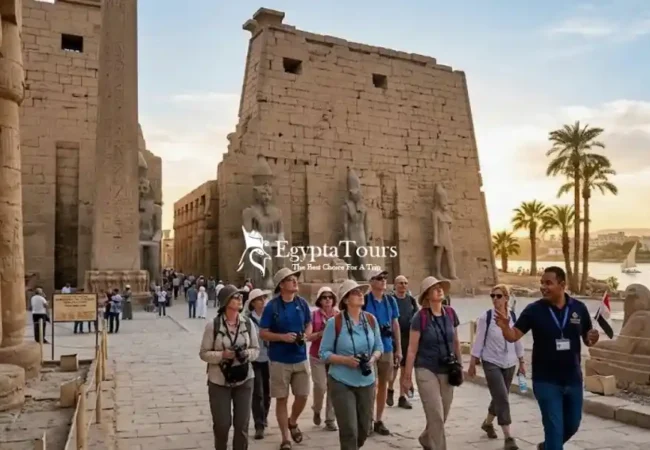
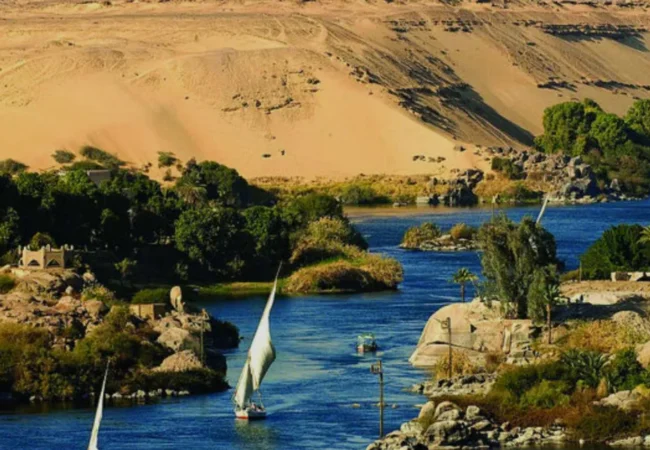

Explore our top-rated Egypt travel packages and embark on an unforgettable journey. From the Pyramids of Cairo to the magical temples of Luxor, Aswan, and Abu Simbel, discover expertly curated tours designed for your perfect Egyptian adventure