Abu Simbel Temple: Unlock The Treasures
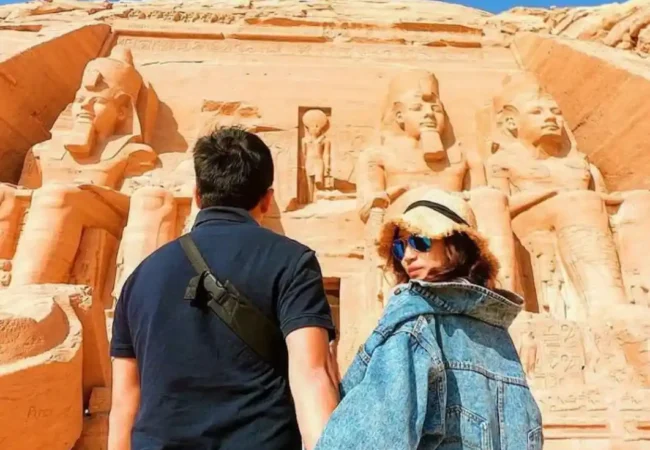
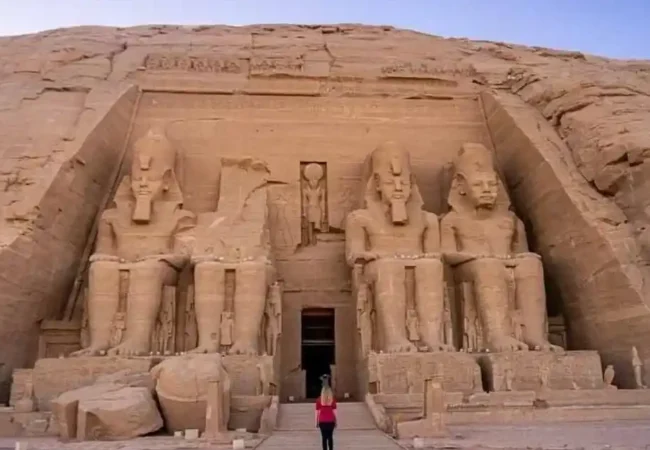
The Great Temple of Abu Simbel, carved directly into the living rock...



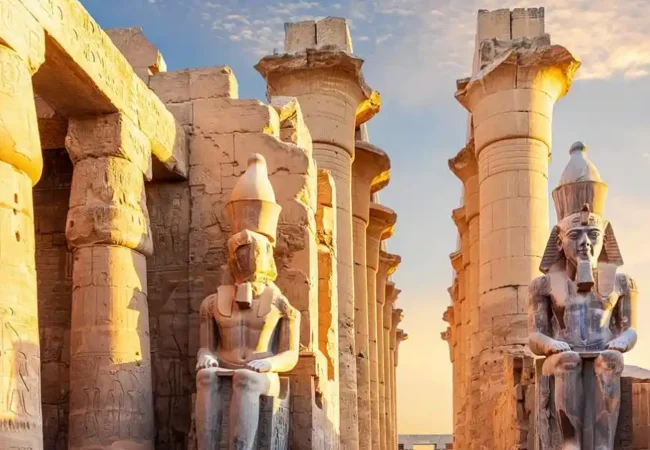
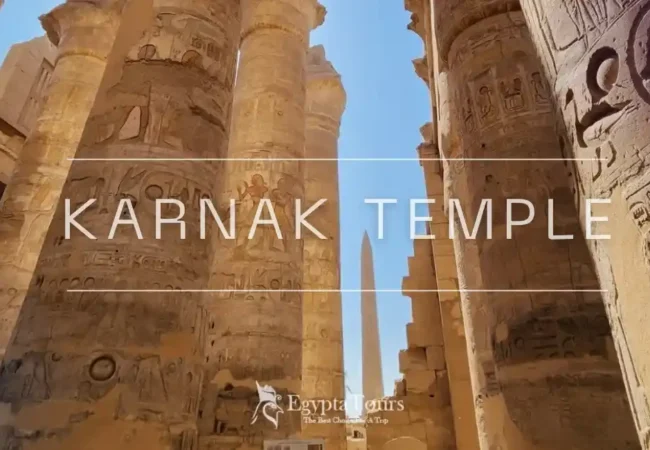
The Great Hypostyle Hall is located within the Karnak Temple Complex, in the Court of Amun-Re and is one of the most important and visited landmarks of Ancient Egypt. It was built approximately during the 19th Egyptian Dynasty (around 1290–1224 BCE). The original design was created by Queen Hatshepsut in the northwestern temple dedicated to Amun on the upper terrace of Deir el-Bahri. The name refers to the hypostyle architectural style which relies on columns to support the roof.
The hall is dedicated to Amun-Re, the greatest god in the Egyptian pantheon and Karnak was once the grandest religious sanctuary in Thebes, the imperial capital of Egypt, now known as Luxor.
The -Architecture- and -Construction- of -The- Great- Hypostyle- Hall
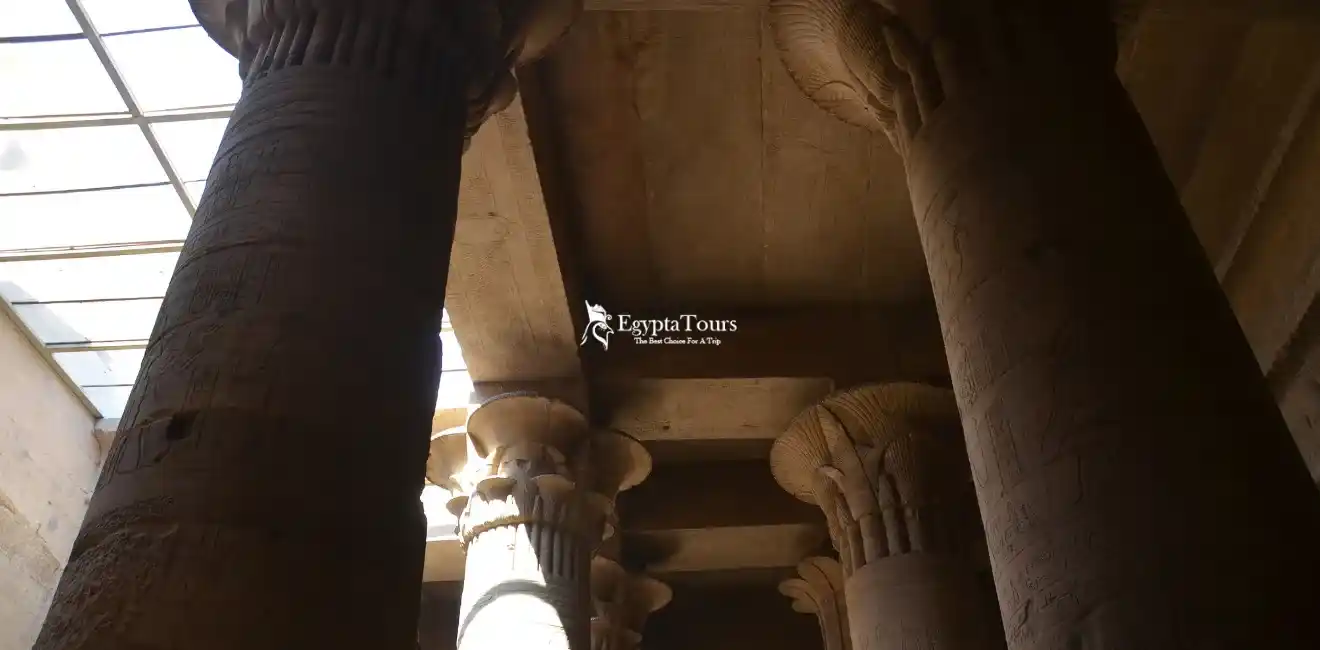
The Great Hypostyle Hall covers an area of approximately 5,000 square meters (1.2 acres). The roof which has now collapsed, was supported by 134 columns arranged in 16 rows:
The 122 outer columns reach a height of 14 meters (46 feet) with capitals shaped like closed papyrus buds. The 12 central columns are taller and wider with a circumference of 10 meters and a height of 24 meters (79 feet) and their capitals are shaped like open papyrus flowers to support the elevated section of the roof. Small clerestory windows allow natural light into this section.
These 134 columns represent the primordial papyrus marsh from which the self-created god Atum emerged from the waters of Nun at the beginning of creation.
The Great Hypostyle Hall was entirely constructed by King Seti I who carved inscriptions in the northern wing. The southern wing decoration was completed later under Pharaoh Ramesses II of the 19th Dynasty. Builders used mudbrick ramps and local materials to construct the hall efficiently.
The -Inscriptions- and- Reliefs -of -The- Great- Hypostyle- Hall
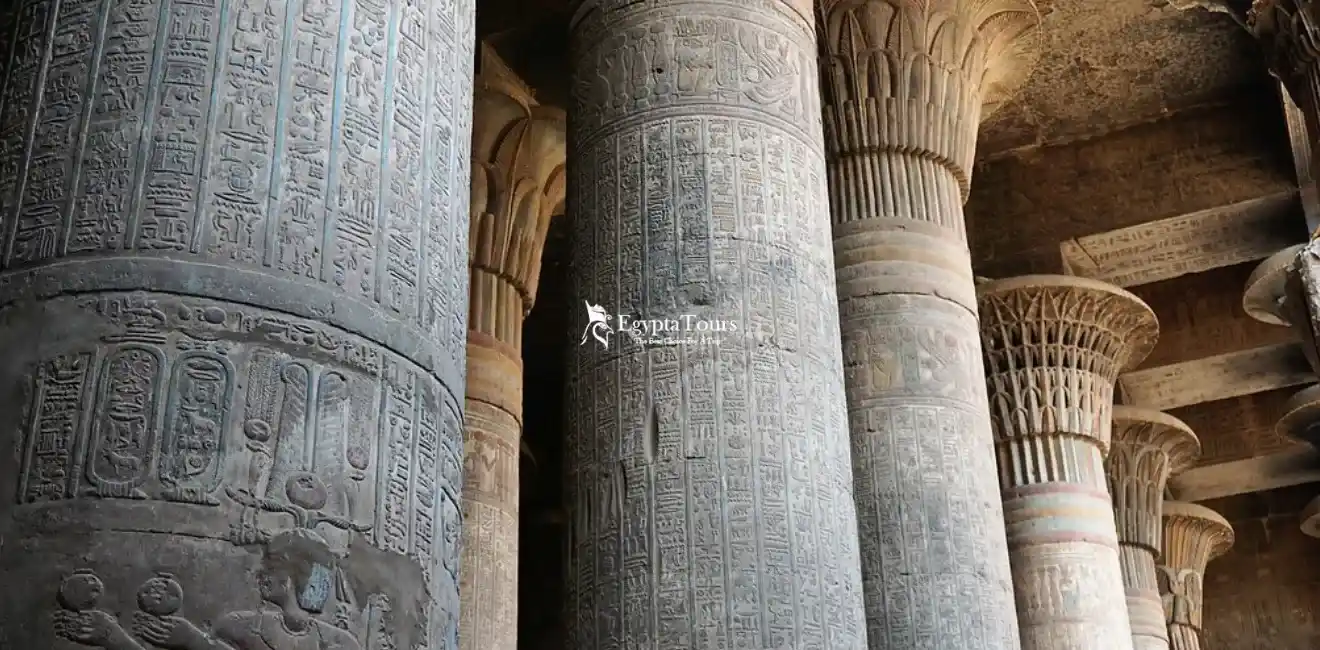
The Great Hypostyle Hall is an outstanding example of ancient Egyptian art and architecture. It reflects the legacy of successive pharaohs through its inscriptions and reliefs. Over centuries, kings like Seti I, Ramesses II and later pharaohs such as Ramesses IV, contributed to the hall’s collection in their own artistic styles.
The walls and columns depict religious events, military campaigns and royal achievements, serving as a visual record of Egypt’s rich history. These carvings reflect the evolution of artistic styles and beliefs over time and highlight the temple’s long-standing religious and political significance.
Seti I and later pharaohs including Ramesses III, IV and VI, added inscriptions to walls and columns left blank by predecessors. His artisans created precise reliefs on walls, columns and column ceilings, often considered of the highest quality. Features include detailed modeling of humans, objects and Egyptian symbols.
The southern wing and 12 central columns were carved under Ramesses II. The columns display the three stages of his relief decoration (R, R2, R3). Reliefs on the north-south axis and central passage were prioritized at the beginning of his reign.
The interior reliefs are sunken, carved into the wall rather than raised, depicting mostly the reigns of Ramesses II and Seti I with decorative scenes showing religious ceremonies and military victories.
The outer walls depict battle scenes with Seti I in the north and Ramesses II in the south. Another wall records the Egyptian–Hittite peace treaty signed by Ramesses II in the 21st year of his reign.
Ancient Egyptians called Karnak Temple “Ipet Sut”, meaning “The Chosen Place.” It is Luxor’s most important temple and was dedicated to Amun, “Lord of Thebes.” The temple grew very wealthy and its priests held significant political power.
The Great Hypostyle Hall contains 134 columns, each 15 meters high, except the 12 central columns at 21 meters. Construction began under Amenhotep III (1390–1352 BCE) of the 18th Dynasty while decorations belong to Seti I (1294–1279 BCE) and Ramesses II (1279–1213 BCE).
The -Collapse -and -Restoration -of- The- Great -Hypostyle- Hall
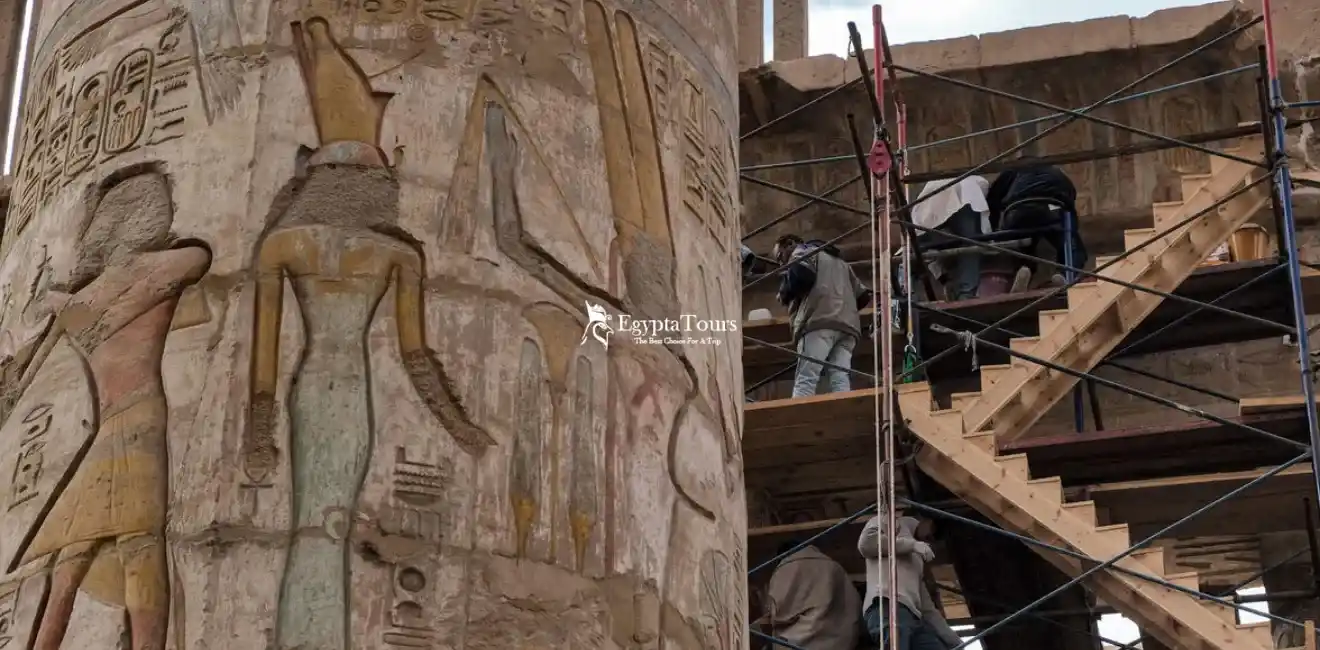
In 1899, eleven massive columns collapsed due to weakened foundations from groundwater. Archaeologist Georges Legrain supervised reconstruction, completed in May 1902. Further work continued to strengthen the remaining columns.
The hall’s inscriptions, covering walls, ceilings and columns, astonish visitors and reflect different historical eras. Successive pharaohs, Roman emperors, high priests and ordinary Egyptians added reliefs, repaired damage and left religious inscriptions over the centuries.
To restore the hall’s original splendor, Egypt launched a project to reveal its original colors by removing layers of dust and grime. This is part of developing the Avenue of the Sphinxes, linking Karnak Temple and Luxor Temple.
The restoration team from the Ministry of Tourism and Antiquities, with graduates from Luxor University, South Valley University and the Luxor Institute of Restoration, completed about 60% of the hall. Dr. Mostafa Waziri confirmed that the restoration of remaining columns is ongoing with the first phase focusing on columns shaped like open papyrus flowers.
Salah El-Masakh, director of Karnak Temple, said Prime Minister Mostafa Madbouly admired the restored reliefs during his recent visit, prompting restoration of all columns at Karnak and Luxor temples before the Avenue of the Sphinxes inauguration.
The project began before Eid al-Adha, currently restoring 12 central columns with completion expected before the end of October. Restoring the remaining columns will take over two years with a budget exceeding 20 million Egyptian pounds. All columns retain their colorful inscriptions, though covered by dust over time.
Other projects for the Avenue of the Sphinxes inauguration include:
These projects are expected to finish by October, ahead of the grand inauguration. Restoration at Luxor Temple is also ongoing, following precise scientific studies to ensure methods suit the current condition and comply with international standards.
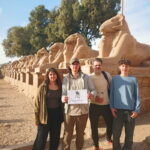
The Avenue of the Sphinxes is an ancient route connecting Karnak Temple and Luxor Temple, passing the Temple of Mut. It stretches 2,700 meters with a sandstone pavement lined by approximately 1,058 ram-headed sphinx statues, sacred symbols of Amun.
Egypt began restoring the avenue in 2006 to remove encroachments and make it a tourist site, paused in 2011 due to political events and resumed in 2017.
The Great Hypostyle Hall is located within the Karnak Temple Complex, in the Court of Amun-Re and is one of the most important and visited landmarks of Ancient Egypt.
It was built approximately during the 19th Egyptian Dynasty (around 1290–1224 BCE). The original design was created by Queen Hatshepsut in the northwestern temple dedicated to Amun on the upper terrace of Deir el-Bahri.
The hypostyle architectural style relies on columns to support the roof which is the main design of the Great Hypostyle Hall.
The hall is dedicated to Amun-Re, the greatest god in the Egyptian pantheon.
The hall has 134 columns arranged in 16 rows:
The 122 outer columns are 14 meters high with capitals shaped like closed papyrus buds. The 12 central columns are taller and wider, 24 meters high with capitals shaped like open papyrus flowers.
The 134 columns represent the primordial papyrus marsh from which the self-created god Atum emerged from the waters of Nun at the beginning of creation.
The Great Hypostyle Hall was entirely constructed by King Seti I who carved inscriptions in the northern wing. The southern wing decoration was completed by Pharaoh Ramesses II of the 19th Dynasty.
The walls and columns depict religious events, military campaigns and royal achievements, reflecting the legacy of successive pharaohs and Egypt’s rich history.
King Seti I, Ramesses II, Ramesses III, Ramesses IV and Ramesses VI added inscriptions and reliefs to the walls and columns.
The interior reliefs are sunken, carved into the wall rather than raised, mostly showing the reigns of Ramesses II and Seti I with religious ceremonies and military victories.


Explore our top-rated Egypt travel packages and embark on an unforgettable journey. From the Pyramids of Cairo to the magical temples of Luxor, Aswan, and Abu Simbel, discover expertly curated tours designed for your perfect Egyptian adventure