





The Judgment of the Dead in Ancient Egypt: Secrets of the Afterlife
Ancient Egyptian afterlife beliefs were centered around a different of complex ceremonial that were influenced by many aspects of Egyptian culture. Religion was a main contributor, since it was an important social practice that tied all Egyptians together. For example, many of the Egyptian gods played roles in guiding the souls of the dead through the afterlife. With the development of writing, religious ideals were recorded and quickly spread throughout the Egyptian community.
The judgement of the dead in ancient Egypt commencement and solidification of these doctrines were formed in the creation of afterlife texts which explained and illustrated what the dead would need to know in order to complete the journey safely.
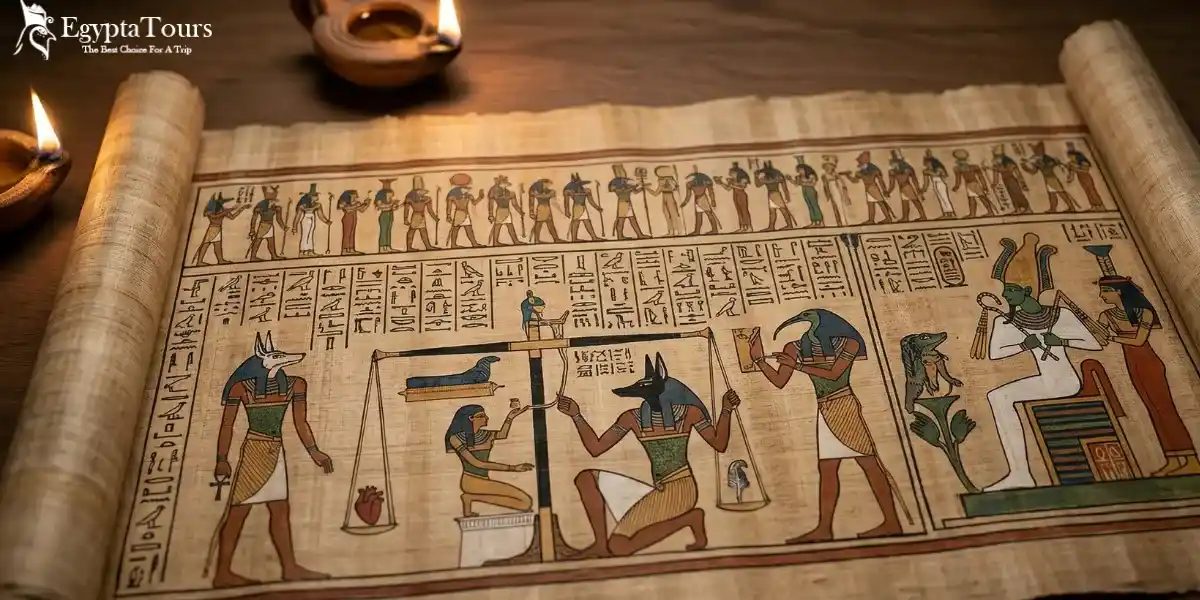
This detail view from the Papyrus of Hunefer (c. 1375 BC) appear Hunefer’s heart being weighed on the scale of Maat against the feather of truth, by the jackal-headed Anubis. The ibis-headed Thoth, scribe of the gods, write the result. If his heart is lighter than the feather, Hunefer is pliable to pass into the afterlife. If not, he is eaten by the waiting Ammit. Vignettes like these were a popular illustration in Egyptian books of the dead.
Egyptian religious doctrines contain three afterlife ideologies: belief in an underworld, endless life, and rebirth of the soul. The underworld, also recognized as the Duat, had only one inlet that could be reached by traveling through the tomb of the dead.
The premier image a soul would be presented with upon entering this Kingdom was a corridor filled with an array of fascinating statues, including a difference of the hawk-headed god, Horus.
The path taken to the underworld may have different between kings and public people. After entry, spirits were presented to another eminent god, Osiris. Osiris would determine the virtue of the dead’s soul and grant those counted deserving a peaceful afterlife. The Egyptian meaning of ‘eternal life’ was often seen as being reborn indefinitely. So, the souls who had lived their life elegantly were guided to Osiris to be born again.
In order to obtain the ideal afterlife, many practices had to be performed during one’s life. This may have inclusive acting justly and following the beliefs of Egyptian creed. Additionally, the Egyptians stressed the ceremonial completed after an individual’s life has finished. In other words, it was the responsibility of the living to carry out the last traditions required so the dead could immediately meet their final fate.
Ultimately, maintaining high religious morals by both the living and the dead, as well as complying to a diversity of traditions, guaranteed the dead a smoother transition into the underworld.
Egyptians request to perform their jobs and partake in their hobbies in the afterlife. Rivers and natural places with fertile soil for farmers were thought to exist in the afterlife, and drawings on tomb walls of objects like boats were thought to make them show in the afterlife for people who used the objects before they died.

Egyptian-Mythology-Judgement-of-the-Dead-in-Ancient-Egypt-EgyptaTours
The Egyptian underworld was named Duat, though some argue that it wasn’t really an underworld, but a way to the stars.
Egyptians thought that, after you died, your spirit would journey through Duat to see Osiris, the dead king of the underworld. If you had money, your family would construct a tomb and have you mummified in order to protect your spirit. If you had a lot of money, or were a pharaoh, you could have built (before your death) a pyramid, of which there are over 90 in Egypt, as a tomb.
The way to Osiris was risky; you would have to compete with monsters and traps. The Egyptian Book of the Dead outlined how to make it through the different traps and trials that you would meet in the afterlife, as well as chants and spells that the living would use to help you along your way.
Once you arrive to Osiris, you would have to declare yourself guilty or innocent of different crimes. Then, the jackal-headed Anubis would weigh your heart on a device of scales, with a feather from the goddess of truth as the counterweight. If the heart weighed more than the feather, that meant that you were sinful, and you were eaten by Ammit, the aptly called Devourer of the Dead. If you passed, you were allowed to join the gods in the Field of Reeds — Egyptian paradise.
Egyptian Book of the Dead
Egyptian Book of the Dead, ancient Egyptian collection of morgue texts made up of spells or charm formulas, placed in tombs and believed to protect and aid the dead in the hereafter. Probably compiled and reedited during the 16th century BCE, the collection inclusive Coffin Texts antedate from c. 2000 BCE, Pyramid Texts antedate from c. 2400 BCE, and other writings. Later compilations included chants to Re, the sun god. Numerous compilers, authors, and sources share to the work.
Scribes reproduce the texts on rolls of papyrus, often colorfully illustrated, and sold them to individuals for burial use. Many copies of the book have been found in Egyptian tombs, but none include all of the approximately 200 known chapters. The series, literally titled “The Chapters of Coming-Forth-by-Day,” received its present name from Karl Richard Lepsius, the German Egyptologist who published the first series of the texts in 1842.
The Process of the Judgement of the Dead in Ancient Egypt: Weighing the Heart
Anubis Ancient Greek: Ἄνουβις), also known as Inpw, Jnpw, Inpu, or Anpu in Ancient Egyptian is the god of funerary ceremonial, protector of graves, and guide to the underworld, in ancient Egyptian religion, usually depicted as a dog or a man with a dog head.
Like many judgements of the dead in ancient Egypt, Anubis supposed different roles in various contexts. Drown as a protector of graves as early as the First Dynasty (c. 3100 – c. 2890 BC), Anubis was also an embalmer. By <strong>the Middle Kingdom</strong> (c. 2055–1650 BC) he was changed by Osiris in his role as lord of the underworld. One of his notable roles was as a god who ushered souls into the afterlife.
He made the weighing scale during the “Weighing of the Heart”, in which it was intend whether a soul would be allowed to enter the kingdom of the dead. Anubis is one of the most frequently depicted and mentioned gods in the Egyptian pantheon; however, no relevant legend involved him.
Anubis was depicted in black, a color that symbolized regeneration, the soil of the Nile River, life, , and the discoloration of the corpse after mumming. Anubis is connected with his brother Wepwawet, another Egyptian god portrayed with a dog’s head or in dog form, but with grey or white fur. Historians suppose that the two numbers were eventually combined. Anubis’ female counterpart is Anput. His daughter is the snake goddess Kebechet.
Egyptian God Osiris

Judgement-of-the-Dead-in-Ancient-Egypt-EgyptaTours-Egyptian-God-Osiris
Osiris from Egyptian wsjr is the god of fertility, agriculture, the dead, resurrection, the afterlife, life, and vegetation in ancient Egyptian religion. He was classically depicted as a green-skinned idol with a pharaoh’s beard, partially mummy-wrapped at the legs, wearing a distinctive ate crown, and holding a symbolic juggler and flail. He was one of the first to be connected with the mummy wrap.
When his brother Set cut him up into parts after killing him, Osiris’ wife Isis found all the parts and wrapped his body up, enabling him to revive him . Osiris was widely idol until the decline of ancient Egyptian religion during the ascent of Christianity in the Roman Empire.
Judgement of the Dead in Ancient Egypt associate with Osiris , however, he had many important roles, he was the embodiment of death and resurrection. Osiris was also responsible for the yearly flooding of The Nile River, which the ancient Egyptians depend on for agricultural fertility.
In terms of powers, he didn’t have any stereotypical ones like the ability to fly or form shift like many Greek Gods. The Ancient Egyptians instead thought that power was control. So Osiris was not only the Judgement of the dead in ancient Egypt of the dead but also the power that granted all life from the underworld.
Egyptian God Maat

Egyptian-God-Maat-Judgement-of-the-Dead-in-Ancient-Egypt
Maat or Maʽat comprised the ancient Egyptian concepts of truth, order, harmony, balance, law, morality, and justice. Ma’at was also the goddess who personified these concepts, and regulated the seasons, stars, and the actions of mortals and the deities who had brought order from chaos at the moment of creation. Her ideological reverse was Isfet (Egyptian jzft), meaning chaos, injustice, violence or to do evil. Maat was judgement of the dead in ancient Egypt.
Weighing of the Heart Ceremony
Vignette from a papyrus depicting the Weighing the Heart of the deceased in a balance. The Two Maat in the Judgment of the dead in ancient Egypt Hall weigh the heart of the dead against a statue of Maat. The goddess Maat was the icon of the universal order and it was believed that there were two of them:
One for the living and one for the dead. She was characterized by two major aspects: on the one hand, she represented the cosmic order or balance – including concepts like truth and justice – that were decided at the time of creation.
On the other, Maat also represents the concept of ‘judgement’ and in fact, in later funerary literature, the dead, during his journey to the afterlife, comes to the hall of the ‘two Maats’ to have his heart weighed. The gods themselves, presenting as judges of the divine court, are called “the council of Maat”.
The baboon Is one shape of Thoth, inventor of writing and secretary to the gods, whose other shape is as an ibis-headed man. He is usually connected with this scene in order to register the outcome of the weigh in. Above the balance is a block of written hieroglyphs taken from the spell 125 of the Book of the dead.
Egyptians thought that it was the heart, “ib”, the most important organ of the human body.
The heart was the place of thought and emotions, the creator of all feelings and all actions, as well as being the place of memory, and therefore accountable for the character of each individual. No wonder then that it was carefully the heart that was weighted during the final judgment.
The ancient Egyptians believed that the heart registered all of the good and bad deeds of a person’s life, and was necessary for judgment in the afterlife. After a person died, the heart was weighed against the feather of Maat (goddess of justice and truth).
The Role of the Deceased’s Deeds in Determining their Fate

The-Role-of-the-Deceased’s-Deeds-in-Determining-their-Fate
The judgement of the dead in ancient Egypt appear in texts to show the importance of morality and crime-fighting with various penalties. There were two kinds of prosecution for violating the moral norms: the first was the religious court of the underworld, where the dead was tried in front of Osiris for his actions, and the second was a civil court, where the correction of the community was achieved.
All the judicial issues were controlled by the vizier, the king’s right hand. The regional court or “Kenbet” (a court on the local and national level) was made up of community leaders who would hear the situation and decide who was guilty and who was innocent; there were also other courts that administered the law, like the Seru (a group of elders in a rustic community), the Djadjat (the regal court) alongside the Kenbet.
The vizier was the ultimate supreme judge but most court situation were handled by lower magistrates. The court could even be held in the marketplace or on the street, and there was also an administrative building called the judgment hall, which be in any city. In the new kingdom of ancient Egypt, there were no lawyers or adjurations, the vicar of Amun were the ones who decided the judge as the people trusted them to give a just hearing and to make the right judgment.
The Afterlife in Ancient Egypt
The-Afterlife-in-Ancient-Egypt-EgyptaTours
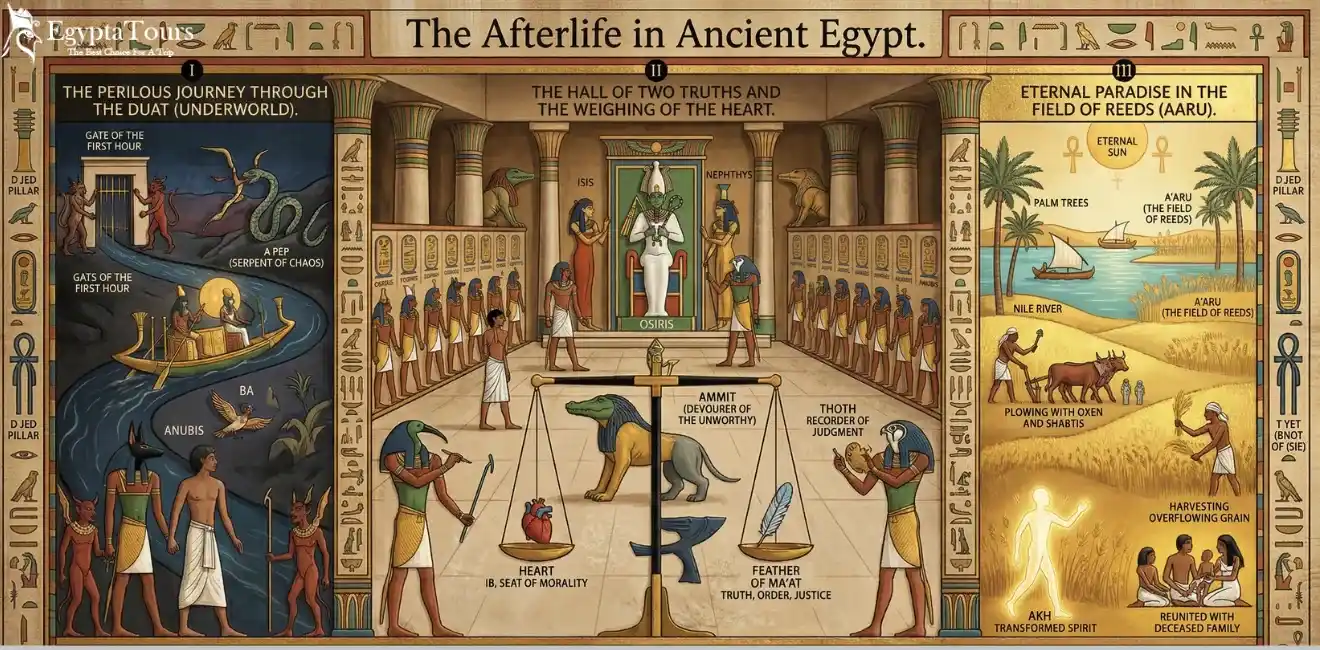
The ancient Egyptians had detailed ideas about life after death. They believed that after a person died, their life would continue in another world that was similar to the one on earth. They also believed the soul never died and that each person would be judged based on how they lived. What someone did during their life would decide what happened to them next.
They believed in a special place called the Field of Reeds which was like a perfect version of the real world and a home for good souls. But to reach this place, a person had to pass a test. Their hearts would be weighed against the Feather of Ma’at which stood for truth, fairness and balance. If they passed, they could enjoy a peaceful life after death.
The Role of Spells and Prayers
The-Role-of-Spells-and-Prayers-EgyptaTours
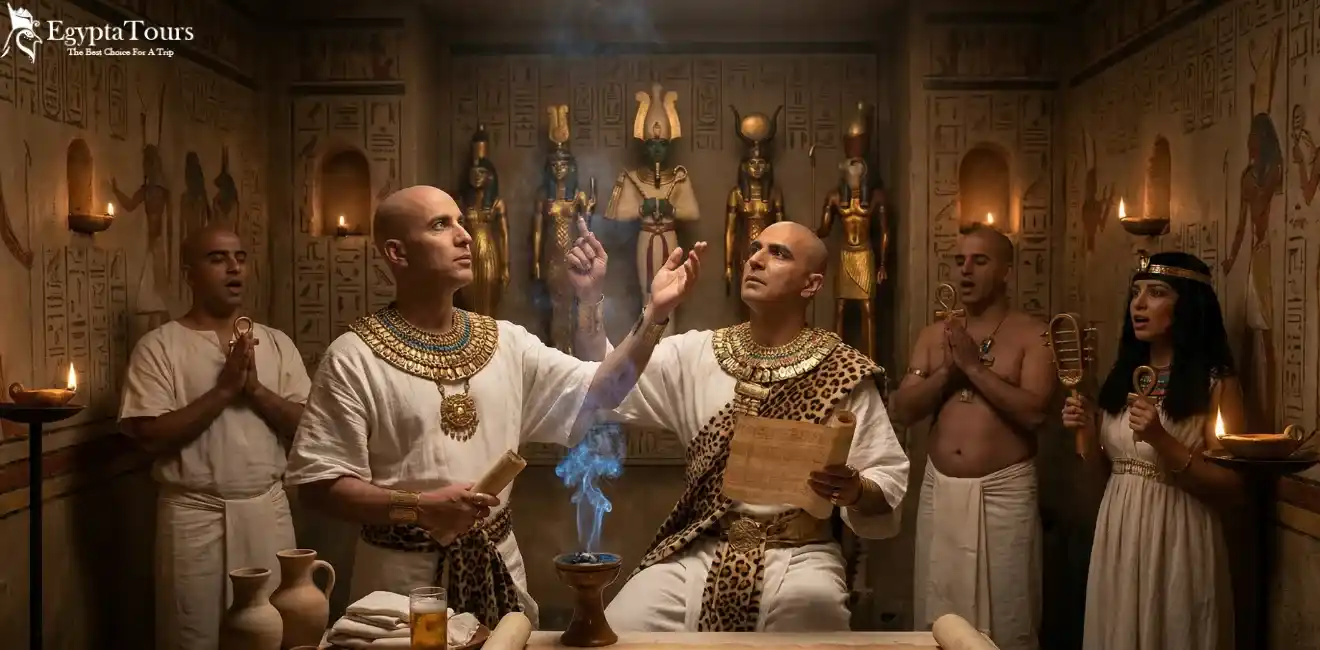
To get ready for judgment, the ancient Egyptians believed that special spells and prayers could help the dead person succeed in the weighing of the heart. These writings were part of the Book of the Dead and were placed inside tombs to guide the soul on its journey in the afterlife. The spells were meant to protect the person from dangers, like Ammit and other harmful beings. They also included prayers asking Osiris and Thoth for help and support.
These spells and prayers worked like a guide and a kind of protection at the same time. They were meant to prepare the soul for what it would face and to help it pass the judgment safely.
Ra’s Journey and the Afterlife
In ancient Egypt, traveling by boat to the underworld was mostly meant for dead pharaohs. People believed that the sun god Ra sailed across the sky during the day and then moved through the underworld by boat at night. To follow this idea, Egyptians placed model boats in the tombs of their rulers so they could make the same journey after death.
A well known example is the Khufu ship, found near the Pyramid of Khufu. It was a full sized boat, showing how much the Egyptians respected their king and how strongly they believed in life after death. This also shows that the living had an important role; they prepared everything needed to help the dead reach the afterlife safely.
Sekhet-Aaru
Sekhet-Aaru, called the Field of Reeds, was the final place for souls who were allowed to live again. This idea became common during the Fifth Dynasty.
Sekhet-Aaru was seen as a paradise. People imagined it as a very green and beautiful place, with waterfalls and other natural wonders. Egyptian art, like the Papyrus of Nebseni, showed the land divided into many parts. Each part looked like an island, so people would travel by boat.
The Field of Reeds was for both gods and good souls. The land was very fertile which gave two main rewards: access to the Nile River and the ability to grow food. The dead could eat and drink the same foods as the gods.
This made people believe that living forever gave them qualities like the gods. Another special reward of living in Sekhet-Aaru was communication. The dead could share thoughts with each other, with the gods and with people they had loved in life.
FAQs
What is the Judgment of the Dead in Ancient Egypt?
It is the process the deceased underwent in the Afterlife to determine whether their soul could reach the Field of Reeds, guided by Ma’at and the gods, especially Osiris.
Who presided over the judgment?
Osiris, the god of the afterlife, along with other beings like Anubis, Thoth, and the heart-weighting panel of deities.
What role did Ma’at play in the judgment?
Ma’at represents truth and cosmic order; her feather of truth weighed against the dead person’s heart determined guilt or purity.
what happens to the heart during the weighing?
Anubis weighs the deceased’s heart against Ma’at’s feather; if the heart is lighter or equal, the soul proceeds; if heavy with sins, trouble ensues.
What is the “Weighing of the Heart” actually like in stories?
It’s a ritual scene often depicted in texts and tombs where the heart’s balance is checked before Osiris and a council of gods.
What if the heart is heavy with sins?
The soul is devoured by Ammit, a fearsome creature of the underworld, and may suffer a second, disembodied judgment or be denied the Afterlife.
Are there defenses the deceased could use during judgment?
Yes—recitations of the “Negative Confessions” or “Confession of Sins” claiming innocence of various misdeeds written in the Book of the Dead.
What is the Book of the Dead?
A collection of spells, prayers, and magical formulas to help guide and protect the deceased on their journey through the underworld and into the afterlife.
How did the heart survive the weighing if the person was innocent?
The heart remained intact during judgment if the person led a morally upright life and recited the proper spells, allowing admission to the Field of Reeds.
What is the Field of Reeds?
An idealized, peaceful afterlife paradise where the deceased live in abundance, akin to an eternal version of the Nile’s productivity.
Were there different outcomes besides entering the Field of Reeds?
Yes—some souls entered the underworld’s contested zones, were transformed, or faced oblivion; outcomes depended on moral purity, divine judgment, and protective spells.
How were the gods represented in the judgment scene?
Gods appeared as guardians, judges, or witnesses—often including Osiris, Anubis, Thoth, and multiple deities connected to order and justice.
Did entire communities believe in this judgment system?
Belief varied across time and regions, but the overarching ideas of truth, balance, and a moral afterlife were widespread in Egyptian religion.
How did the deceased prepare for the judgment during life?
By living according to Ma’at, performing proper funerary rites, making offerings, and mastering spells and prayers from the Book of the Dead.
Why is the Judgment of the Dead still studied today?
It reveals how ancient Egyptians understood ethics, justice, memory, and the hope for an orderly, enduring afterlife.
About EgyptaTours

EgyptaTours is a name synonymous with trust, excellence, and unforgettable travel experiences, proudly standing as one of the leading travel agencies in Egypt. Renowned for its deep expertise, personalized service, and carefully crafted itineraries, EgyptaTours serves as the ultimate gateway to discovering Egypt in its most authentic and inspiring form.