Al Azhar Park Location: A Hidden Gem in Cairo
In this article we give you all the information you need about...



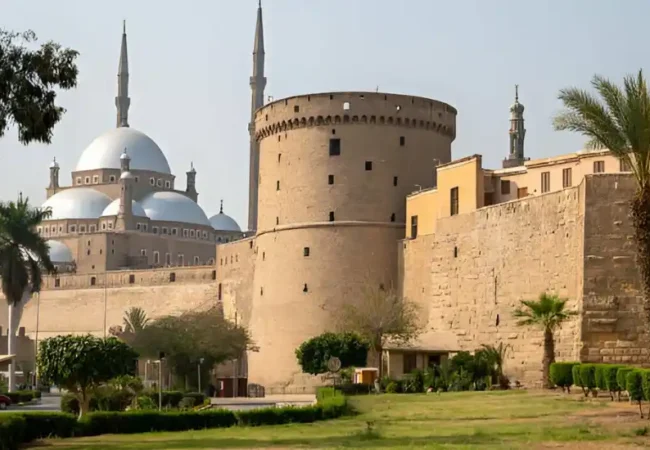
Perched majestically atop Mokattam Hill within the historic Saladin Citadel, the Mohamed Ali Mosque is Cairo’s most imposing and iconic Islamic landmark. Commissioned by Muhammad Ali Pasha—the visionary founder of modern Egypt—and constructed between 1830 and 1848, the monument was designed in a grand Ottoman style inspired by Istanbul’s Blue Mosque, reflecting an era of sweeping administrative and architectural modernization.
Featuring soaring twin pencil minarets, a vast central dome, and opulent interiors adorned with cascading chandeliers and ornate decorations, the mosque serves both as a masterpiece of 19th-century design and as the final resting place of its founder.
Key Takeaways
Ottoman Architectural Inspiration: Designed in a grand Ottoman style heavily influenced by the Sultan Ahmed Mosque in Istanbul, the structure features a massive central dome, multiple secondary domes, and twin pencil-thin minarets.
Commanding Citadel Location: Situated within the historic Saladin Citadel, the mosque’s elevated position on Mokattam Hill provides visitors with sweeping, panoramic views across the Cairo cityscape.
Royal Burial Site: The interior houses the ornate tomb of Muhammad Ali Pasha, commemorating his pivotal role as the ruler who drove Egypt’s 19th-century industrial and political modernization.
Queen Victoria’s Clock Gift: A unique historical feature of the mosque’s minarets is a set of four interconnected clocks presented by Queen Victoria of England as a diplomatic gesture of friendship, synchronized to display the exact same time.
Modest Dress Code: As an active place of worship located within a major cultural site, visitors are required to dress modestly by covering their shoulders, arms, and legs before entering.
Symbol of Modernization: The construction of the mosque mirrored Egypt’s broader 19th-century transformation, blending traditional Islamic architectural grandeur with European-influenced artistic elements.
Of all the mosques in Cairo, the Mohamed Ali Mosque is easily the most imposing. The structure itself is grand, but it’s also the history associated with it that makes it so special. Let’s take a closer look at this incredible mosque.

Background -of- the- Mohamed- Ali -Mosque
When you visit the Mohamed Ali Mosque in Cairo, you’re seeing a sight that’s over two hundred years old. The mosque was commissioned by Muhammad Ali Pasha, who ruled Egypt from 1805 to 1848.
Ali Pasha was a fascinating figure, and his rule had a lasting impact on Egypt. He was born in Albania in 1769, and he rose through the ranks of the Ottoman army until he was made governor of Egypt in 1805.
One of Ali Pasha’s biggest achievements was his modernization of Egypt. He built new roads, bridges and canals, and he encouraged trade and industry. He also founded schools and hospitals, and he paid for the restoration of many ancient monuments.
The Mohamed Ali Mosque is a beautiful example of Ali Pasha’s legacy. It’s one of the largest mosques in Cairo, and it’s decorated with elaborate carvings and mosaics.
If you’re lucky, you might be able to catch a glimpse of the mosque’s famous minaret, which is covered in intricate carvings of plants and animals.

The- Design -of -the- Mosque
The mosque was designed by the French architect Jean-Louis Pascal and it was finished in 1848. It is one of the largest mosques in Cairo, and it’s also one of the most popular tourist destinations in the city.
The mosque is named after Mohamed Ali, who was the founder of modern Egypt. He was also a renowned general and politician. The mosque was built to commemorate his victories in the War of Greek Independence and the Russo-Turkish War.
The design of the mosque is very unique. It’s based on Islamic architecture, but it also incorporates some elements of European architecture. This makes it one of the most interesting mosques in Cairo, and it’s definitely worth visiting if you’re in the city.

Features -of -the- Mosque
The mosque is named after Mohamed Ali, who ruled Egypt from 1805 to 1848. It’s an imposing structure, and its most distinctive features are the two minarets that flank the entrance.
The mosque was originally built in the mid-19th century, but it’s been extensively renovated and expanded over the years. The latest renovation took place in 2009, and it was officially reopened by President Hosni Mubarak.
The mosque is open to visitors from 8am to 4pm, and admission is free.

Visiting -Tips- to -the- Mohamed- Ali -Mosque
If you plan to visit the Mohamed Ali Mosque in Cairo, there are a few things you should know. This majestic mosque can be found on the Saladin Citadel, or Citadel of Cairo, and it’s definitely worth a visit.
When it comes to dress code and manners, you should wear modest clothing that covers your arms, legs and shoulders. No need to wear a headscarf if you’re not Muslim, but please keep in mind that it is a place of worship and respect is expected from all visitors. Also, try to arrive before noon if you plan to pray there as it tends to get very busy in the afternoon.
It is recommended that you hire a guide for your visit for the best experience possible. Your guide will be able to provide historical context as well as teach you about some of the customs and etiquette associated with being inside this sacred space. Just be sure to follow their advice so that your visit can be enjoyable for everyone involved!

Interesting -Facts- About -the- Mohamed- Ali- Mosque
Did you know that the Mohamed Ali Mosque is unique in design and construction? The mosque was built in the Ottoman Baroque style, making it the first and only mosque built in this manner. It also has ornate decorations, including domes, arches, and colorful tiles.
Not to mention that this stunning mosque also holds a secret: On its minarets, there are four clocks gifted by Queen Victoria of England as a sign of friendship. And speaking of clocks, an interesting detail is that the mosque’s four clocks are connected to each other.
This means that they all show the same time which is amazing!
Another interesting fact is Mohamed Ali was the founder of the Muhammad Ali Dynasty and is buried inside the mosque. His body rests there alongside his two grandchildren who were killed in 1848 during a massacre.

How -to -Get -to -the- Mohamed -Ali- Mosque -From -Cairo
The Mohamed Ali Mosque is easily accessible from Cairo. You can take a metro or bus and get off at the Bab al-Futuh station. From there, it’s just a 10-minute walk to the mosque. For those without access to public transportation, it’s also possible to hire a taxi or use ride sharing services such as Uber or Careem. You can also book guided tours that include transportation to the mosque and back.
Once you arrive, you will be able to see the majestic white dome and two towering minarets of this historical site that stands out in sharp contrast against the city skyline. It is truly an awe-inspiring sight that you won’t want to miss!
| Category Name |
|---|
| Alexandria Tour Packages |
| Cairo Short Breaks |
| Giza Pyramids Day Tours |
| Egypt Honeymoon Packages |
| Egypt Travel Packages |
| Luxor Short Breaks |
| Nile Cruises |
| Egypt Sahara Tour Packages |
The mosque was commissioned by Mohamed Ali, who ruled Egypt from 1805 to 1849. It was originally designed by the Italian architect Antonio Barluzzi, but it was later redesigned by the French architect Pascal Coste. The mosque was completed in 1848.
The Mohamed Ali Mosque is an important Islamic landmark in Cairo, and it attracts tourists from all over the world.
| Tour Name | Duration |
|---|---|
| Egypt 12 Days : The Ultimate Itinerary | 12 Days – 11 Nights |
| 5 Days Cairo and Luxor Trip | 5 Days – 4 Nights |
| 2 Days Cairo Short Break | 2 Days – 1 Night |
| 4 Days Cairo Tour | 4 Days – 3 Nights |
The Mosque of Muhammad Ali, built under the orders of Muhammad Ali Pasha, ruler of Egypt, stands as a symbol of Egypt’s modernization in the 19th century. Completed between 1830 and 1848, this iconic structure was inspired by the grandeur of the Sultan Ahmed Mosque in Istanbul.
Muhammad Ali Pasha intended the mosque not only as a religious monument but also as his final resting place, with his tomb located within its walls. The mosque is situated in the Citadel of Cairo, originally constructed by Salah al-Din, offering a connection to Egypt’s medieval past.
Despite its grandeur, the Mosque of Muhammad Ali has shown signs of cracking over time.
The tomb of his son, Tusun Pasha, also lies within, reflecting the personal legacy tied to the structure. With its resemblance to European landmarks like the Place de la Concorde, this mosque embodies the cultural exchange and transformation that characterized Egypt’s 19th-century history under Muhammad Ali’s rule.
The Mosque of Muhammad Ali pasha between 1830 and 1848 under the orders of Ali Pasha, is one of Cairo’s most iconic landmarks. Located within the Citadel, the mosque was constructed in an Ottoman style, symbolizing Egypt’s modernization efforts during Muhammad Ali’s rule.
The mosque also holds personal significance, as it contains the tomb of Muhammad Ali Pasha himself, making it both a religious and commemorative monument.
The Mohamed Ali Mosque, located in Cairo, Egypt, is a key landmark. Built between 1830 and 1848, it commemorates Mohamed Ali Pasha, the ruler credited with modernizing Egypt. It’s a prime example of Ottoman architecture, symbolizing Egypt’s 19th-century transformation.
The mosque is situated within the Citadel of Cairo, one of the city’s most famous historic sites. Sitting atop the Mokattam Hill, it offers panoramic views of Cairo, making it a popular tourist destination.
The mosque is renowned for its Ottoman architectural style. Inspired by the Blue Mosque in Istanbul, it features a large central dome flanked by two smaller domes and four semicircular domes. Its twin minarets are a distinct feature of this architectural style.
Yes, visitors should dress modestly. Men and women are advised to cover their arms and legs. Women may need to wear a headscarf, which can sometimes be provided at the entrance.
The mosque is generally open to visitors daily, from 8:00 AM to 5:00 PM, but these hours can vary. It’s best to check the latest schedule before planning your visit.
Yes, there’s an entry fee to visit the Citadel of Cairo, where the mosque is located. This fee grants access to the mosque and several other attractions within the citadel complex.
Photography is usually allowed, but it’s polite to be discreet and avoid taking photos during prayer times. Always respect the sanctity of the space and the privacy of worshippers.
Taking a taxi or using a rideshare app is the most convenient way. Alternatively, you can take a bus to a stop near the citadel. Always allow extra time for traffic, which can be busy.
The citadel and the mosque have some accessibility features, but parts of the site might be difficult to navigate due to uneven surfaces and steps. It’s advisable to contact the site in advance to ensure a smooth visit.
Don’t miss the stunning interiors, particularly the main prayer hall with its elegant chandeliers and expansive domes. The courtyard offers a quiet place for reflection and impressive views of Cairo cityscape.

Explore our top-rated Egypt travel packages and embark on an unforgettable journey. From the Pyramids of Cairo to the magical temples of Luxor, Aswan, and Abu Simbel, discover expertly curated tours designed for your perfect Egyptian adventure