When Did Ancient Egypt Start and End? A Complete Timeline
Ancient Egypt is one of the world’s oldest and most fascinating civilizations,...



Among the vast pantheon of ancient Egyptian deities, few are as fiercely debated and deeply complex as Seth. Often branded simply as the villain who murdered his brother Osiris, Seth’s true role is far more nuanced. As the god of the desert, storms, and chaos, he was both feared for his destructive nature and deeply revered for his immense power.
For centuries, he stood as the mighty protector of the sun god Ra, battling the evil serpent Apep night after night. Spanning from an honored warrior to an eventual symbol of absolute darkness, Seth represents the ancient Egyptian belief that cosmic balance can only be achieved through the eternal, turbulent struggle between order and chaos.
Key Takeaways
A Dual Nature: Seth was not inherently evil; he was the vital embodiment of chaos and turmoil, acting as the necessary counterbalance to order and harmony.
The Ultimate Protector: During the New Kingdom, he was highly venerated as a fierce warrior god whose primary role was to stand at the bow of Ra’s solar barque and slay the chaos serpent, Apep.
The Osiris Myth: He is most famous for his cunning betrayal of his brother, Osiris, initiating an epic, eighty-year struggle for the throne with his nephew, Horus.
A Shifting Legacy: His reputation drastically changed over time. Honored in the Old and New Kingdoms for his martial prowess, he was later demonized in the Late Period as a treacherous figure of pure ruin.
The “Seth Animal”: In ancient art, he is distinctively depicted as a strange, unidentifiable mythical beast (or a man with its head) featuring a curved snout, squared ears, and a rigid, forked tail.
Amidst the ancient Egyptian myths, the god Seth emerges among the most mysterious and controversial gods. Here, myths overlap between good and evil, order and chaos, and many contradictions, as they take him as the god of strength and the desert, who mediates between order and ruin.
He is included in the family of the great gods and quickly took for himself a path different from his brothers, a path full of ambition pursued by conflict, which carries within it the power of nature and the secrets of the eternal struggle.
As one of the oldest deities, he symbolizes a complex side of Egyptian religious beliefs as he mixed between the qualities of strength, turmoil, and chaos according to the belief of the ancient Egyptians. His origin, according to the myths, goes back to the god Geb, the god of the earth, his father, and the goddess Nut, the goddess of the sky. He is also the brother of Nephthys, Isis, and Osiris.
His origin and role in ancient Egyptian myths are represented in what follows:

Symbols -Of -The -God -Seth
He is considered among the gods who received much appreciation and respect from the ancient Egyptians, and here he appeared with several symbols and qualities, which are:

The-Complex-Relationship-Between-Seth-And-Horus
The relationship between them in the beliefs of the ancient Egyptians represents the power of the eternal struggle between both good and evil, order and chaos, life and death:
His image through the ages was characterized by constant changes and multiple stages from a god of strength to a god of evil and chaos, and we clarify this as follows:
Seth went through many developments, and this is clearly shown through the statues and inscriptions that depicted him as follows:
Among the ancient Egyptians, he had a special status, but like the rest of the gods, he was subject to developments and changes through the ages, which affected later beliefs. A god would prevail during a period of time, then another would succeed him later. However, the myths of Seth spread widely throughout Egypt, shaping the spiritual aspect and religious beliefs of the ancient Egyptians.
According to the beliefs, he was considered during a period of time a symbol of the dual power that embodied nature from light to darkness, which is considered an inspiration for the ancient Egyptians for the balance between opposing forces. He also gradually transformed into one of the most important symbols of evil, which affected the ancient Egyptians’ perception of the forces of evil and considering them a force that transcends the divine order.
After that, the conflict of Horus and Seth appeared as a model for the longest conflicts that affected later ages, and it became evident in the universal concepts that history is a struggle between two eternal forces.
Delving into the ancient Egyptian beliefs through the ages, he was not absolutely evil, but was a god who combined good and evil and many contradictions. His personality witnessed many developments during which he appeared as a protector and guardian of the god Ra, and perhaps he appeared as a rebel and opponent of the system, and then the killer of his brother out of greed for the throne and to seize it. Despite that, he did not always appear as evil but was an embodiment of the necessity of achieving cosmic balance.
According to ancient Egyptian myths, the god Seth may appear as a very mysterious and complex character, as he combines aspects of evil, chaos, courage, and protection at the same time. He is not just a myth that evolved through the ages, but a symbol of the nature of life and the existing struggle between order and chaos.
The god is an embodiment of strength and conflict according to ancient Egyptian beliefs and was worshipped before the advent of Christianity, while Jesus symbolizes mercy and love.
In the Bible, Satan was mentioned as a symbol of evil, and there are some interpretations of the similarity of the satanic qualities with Seth, whether deception, chaos, or darkness.
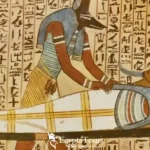
Anubis is the god of the dead and funerals according to ancient Egyptian beliefs, and he is the son of Seth and Nephthys, but the ones who raised him were Isis and Osiris.
He represents the god of storms, the desert, and chaos, and is considered an embodiment of disorder and strength. Despite his protection of the god Ra, he killed his brother Osiris.


Explore our top-rated Egypt travel packages and embark on an unforgettable journey. From the Pyramids of Cairo to the magical temples of Luxor, Aswan, and Abu Simbel, discover expertly curated tours designed for your perfect Egyptian adventure