The Solar Boat Museum Incredible Secrets of Khufu’s Ancient Ship
The Solar Boat Museum is one of the distinctive museums and archaeological...



Amun (often referred to as amon the god) was an incredibly powerful egyptian deity whose influence shaped the core of ancient Egyptian civilization. Originally worshipped as a deity of the sun, wind, and fertility, his prominence grew steadily from the middle kingdom onward, especially within the city of Thebes.
He eventually merged with the sun god ra to become the supreme Amun-Ra, earning him the title of king of the gods. Together with his wife Mut and their son Khonsu, he formed the famous theban triad.
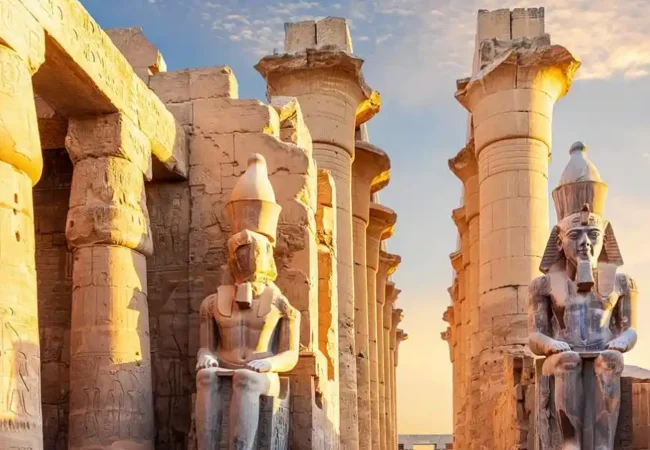
Over the centuries, the cult of amun gained massive political and economic influence, inspiring the construction of grand monuments like the luxor temple. Endowed with titles such as the bull of his mother, Amun was viewed as the ultimate creator and protector. Although the pharaoh Akhenaten briefly attempted to erase his worship, Amun’s legacy as a father to the pharaohs and a champion of the people remained a cornerstone of their religion.
Key Takeaways
Supreme Power: Amun started as one of eight local deities but rose to absolute prominence, eventually merging with god ra to become Amun-Ra, the ultimate creator and lord of all.
The Divine Family: He was married to the sky cow Mut, and together with their son Khonsu (the moon god), they formed the revered theban triad worshipped heavily in Thebes.
Protector of Pharaohs: The ancient Egyptians believed Amun was a father figure to the pharaohs, guiding them in battle and acting as a vital intermediary between humans and the divine.
Priestly Influence: During the New Kingdom, the high priests dedicated to the cult of amun wielded immense political and economic power, controlling 90% of Egyptian ships and influencing major military decisions.
Enduring Legacy: Despite Pharaoh Akhenaten’s attempt to erase his name and introduce monotheism, the worship of Amun survived, and he remained a beloved symbol of strength, fertility, and divine protection.
The god Amun is one of the most prominent ancient Egyptian gods, and they considered him at that time a symbol of power. He was initially worshipped in the city of Thebes, and it is believed that he is credited with protecting the ancient pharaohs and that he gives them strength and wisdom. Therefore, many rituals and celebrations were held, which were drawn on the walls of many temples, and the ancient Egyptians were greatly influenced by him.

Who-Is-The-God-Amun-In-Ancient-Egyptian-Civilization
This god is one of the most prominent gods in ancient Egypt because he was the god of the sun, the wind, and fertility, and he had a great status among all the gods worshipped by the ancient Egyptians. Therefore, there are many myths surrounding him, the most important of which is that he was a crowned king in the sky and all his teachings were listened to, according to their beliefs.
One of the most prominent of these myths is that he married the sky cow called Mut and from her, he fathered Khonsu, the moon god, and together they formed the divine triad that the city of Thebes later worshipped. One of his most important stories is also that he would appear during the day, which is why he was called the sun god, then he would disappear at night, leaving the moon as the upper part of him. During the night period, he would travel through the Nile River to face the demons and destroy them.
It is an old Hebrew name meaning the maker or the faithful. As for the ancient Egyptian language, it meant the hidden one or the concealed one. He was worshipped in Upper Egypt, then his status rose until he became the most important god to the Egyptians. Then the name Ra merged with him to become Amun-Ra, which means to the ancient Egyptians the lord of all.
He was originally one of the eight gods that were worshipped in ancient Egypt. With the increasing power of the city of Thebes, his importance increased and evolved over time until, in the era of the New Kingdom, he surpassed all the gods and became the greatest god. He had high priests who enjoyed wide authority, as they became of the same importance as the pharaoh because they considered him as the creator and god of everything, but he was not the only god.

The-Relationship-Between-Amun-And-The-Pharaoh-Kings
There was a close relationship between him and the kings of ancient Egypt, as the ancient Egyptians considered that the pharaohs played the role of an intermediary between humans and the god. They also believed that he protected the ancient pharaohs and that he was a father to them and would watch them on the battlefield and help the poor and needy.
Queen Nefertari considered herself the wife of Amun, and that he is the one who carried Hatshepsut on the throne, and that the pharaohs were in contact with him through oracles.
The influence of the priests of Amun increased significantly in the era of the New Kingdom. They imposed their control over Egypt as a political and economic power that competed with the pharaoh. They controlled 90% of the Egyptian ships and also interfered in the military field.
Especially the high priest, who had enormous political and religious authority. The importance of Amun-Ra increased as one of the greatest ancient Egyptian gods, and they used religion as a primary means to maintain their status.

The-Artistic-Symbols-That-Represented-The-God-Amun
This god was symbolized by many images on the walls of ancient Egyptian temples. He was symbolized by the sun disk because they believed he was responsible for the sun’s emergence and that light appears only during the daytime.
He was also symbolized by the head of a ram, which is a symbol of strength and fertility. He was also represented in the form of a man with a falcon’s head, having two long feathers and carrying the symbol of life.
His existence was greatly linked to prosperity, especially after the victory of Thebes over the Hyksos. He eliminated the worship of some other gods. The priests of Amun envisioned him as part of the holy trinity which included him, his wife, and his son.
There was a boat dedicated to Amun, plated with gold, used in his worship during the Opet Festival, and it would dock on the banks of the Nile. Many other ships were built that resembled floating temples and were also used during festivals and occasions for his worship.
Akhenaten tried to impose a worship on the Egyptians, as he saw that all gods were but useless images, with a new religious doctrine for one god. He took the city of Tel el-Amarna in Minya governorate as his headquarters and took it to be far from Thebes, the center of the worship of the god Amun.
But the priests of Amun enjoyed strong influence, and this led to a revolution and their persecution until the memory of Amun was completely erased and the worship of Akhenaten was spread. But after Akhenaten’s death, the Egyptians returned to worshipping their old gods, and the new god was neglected.
Akhenaten ordered the erasure of all images and drawings that symbolize Amun on the walls of the temples, and the looting of tombs and temples spread at that time.
Amun was one of the most important gods to the ancient Egyptians and was symbolized by strength and fertility. Many ancient Egyptian myths were found about the power of Amun and how he controlled the country, and they believed he was their protector.
One of the greatest gods worshipped by the ancient Egyptians. He gained great popularity among many Egyptians to the point that he almost eliminated the other gods.
Yes, the name Amun appeared in the Bible and he was the fifteenth king of Judah.
No, not a girl, but he symbolizes the god of the sun and fertility to the ancient Egyptians. He was symbolized in the form of a man with a ram’s head and was married to the divine wife who formed the holy trinity with them.
There were many gods in ancient Egypt and they were all of great importance, like the goddess Isis. However, the god Amun was considered the main god in the capital Thebes, and his worship spread widely.
The ancient Egyptians considered Amun one of the good gods who gives to the poor and needy and brings victory to the kings.


Explore our top-rated Egypt travel packages and embark on an unforgettable journey. From the Pyramids of Cairo to the magical temples of Luxor, Aswan, and Abu Simbel, discover expertly curated tours designed for your perfect Egyptian adventure