



Tanis
Tanis, currently known as “San El-Hagar” in the Sharqia Governorate, was a major city in northern Egypt during ancient times.
It was part of the Fourteenth Nome of the Delta Remains and artifacts dating back to the Fourth Dynasty have been found there, and it is believed that these artifacts were transported from other sites.
The city also gained great importance during the Ramesside period especially because some of their kings were associated with it most notably Ramesses II, who built a large temple dedicated to the god Amun.
Later, Tanis became the capital during the Twenty-first and Twenty-second Dynasties, and several kings from these periods were buried in its royal tombs.

History-of-Tanis-EgyptaTours
The city of Tanis emerged at the end of the Twentieth Dynasty and became the center of government in northern Egypt during the Twenty-first Dynasty. It was the birthplace of King Smendes who founded this dynasty.
Tanis continued to serve as the political capital during the reign of the Twenty-Second Dynasty.
The city was not merely a seat of government but also an important commercial site and a major strategic asset. Over time specifically in the sixth century AD it was abandoned after it became threatened with submergence due to the approaching waters of Lake Manzala.
Historically, the name Tanis was unknown before the New Kingdom. Unlike the ancient city of “Saw,” known today as “Sa el-Hagar,” located west of the Nile branch in the Nile Delta this city is much older, dating back to around 4000 BC. The Pharaohs called it “Saw,” while the Greeks knew it as “Sais.”
Tanis’ Fame and Major Discoveries
Tanis’-Fame-and-Major-Discoveries-EgyptaTours
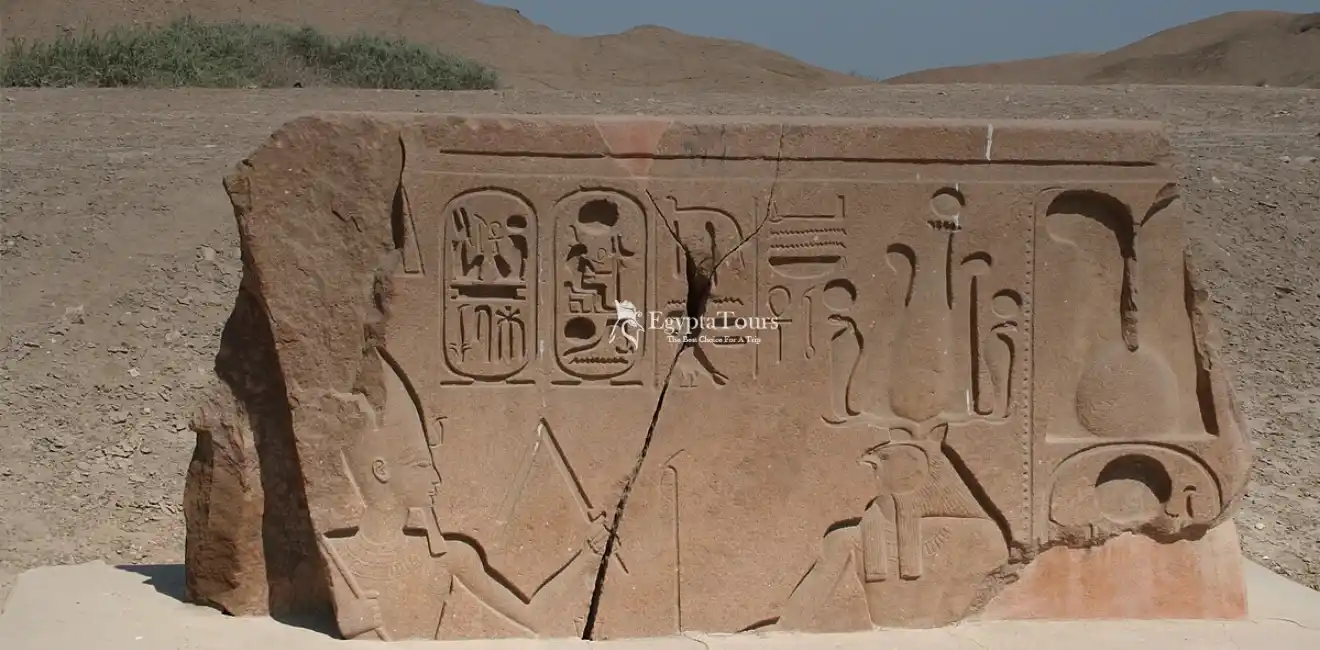
Tanis is famous for the presence of a huge and distinctive temple most of whose remaining buildings date back to the reign of King Ramses II.
Among the most important remains of this temple are a group of granite obelisks one of which was transported to Cairo and stands today near the western banks of the Nile a short distance from the current Cairo Tower.
During excavations led by archaeologist Pierre Montet around the Great Temple many important artifacts were discovered.
The most significant of these discoveries occurred in 1940 when a royal cemetery containing the tombs of several kings of the Twenty-first and Twenty-second Dynasties was discovered outside the temple walls in front of the temple of the goddess Anat, This marked a major archaeological event.
Among the most important finds inside this cemetery were luxurious collections of jewelry and royal possessions which are now preserved in a special hall in the Egyptian Museum.
These pieces belong to kings such as Psusennes I and Amenope of the Twenty-first Dynasty, and Osorkon II and Sheshonq III of the Twenty-second Dynasty in addition to a king named Heqa-kheper-Ra Sheshonq who was previously unknown on the list of Egyptian kings until his tomb was discovered.
Tanis’s Connection to the City of Avaris and Pi-Ramessu

Tanis’s-Connection-to-the-City-of-Avaris-and-Pi-Ramessu-EgyptaTours
The name “Tanis” still raises much controversy among researchers especially when discussing its connection to two ancient Egyptian cities Avaris and Pi-Ramessu.
The former Avaris was the capital of the Hyksos while Pi-Ramessu was the seat of government for Ramesses II in the Delta. Some archaeologists believe that these two cities were located on the same site as Tanis but this view is not fully agreed upon.
The current strongest view among a large number of researchers indicates that the city of Pi-Ramessu was located in a site now known as Qantir in Faqus Sharqia Governorate. Remains of palaces dating back to Ramesses II have been found there along with other artifacts confirming clear royal activity in the area.
The same site also likely served as the seat of government for the Hyksos meaning it may be the site on which the ancient city of Avaris was built.
Although some scholars such as Montet and others maintain that the two cities were located within the current borders of Tanis the lack of conclusive archaeological evidence casts doubt on this view.
Therefore, the most likely view at present is that Qantir and its surrounding area were indeed the capital of the Hyksos, and that it was the same site on which the city of Pi-Ramessu was later built.
The Most Famous Kings of Tanis

The-Most-Famous-Kings-of-Tanis-EgyptaTours
Tanis represents one of the most important milestones in the history of ancient Egypt. It was more than just a political capital it was a center where governance religion, and major transformations in the structure of the Egyptian state intersected.
From within its walls and tombs emerged royal families that left traces of the power of their influence and the wealth of their civilization.
The most prominent of these include:
Ramses II
Son of King Seti I he ruled Egypt for a long period exceeding six decades. His reign was marked by a clear passion for monumental construction.
His projects extended from north to south, and he erected enormous statues in his name leaving his mark in many areas most notably Tanis Karnak, the Ramesseum, and Nubia.
Among his most important achievements is the “Four Hundred Years” stela found in Tanis, a rare relic.
His victory at the Battle of Kadesh despite its exaggerated depiction did not change the political reality. However it skillfully immortalized his name.
Despite all his achievements his excessive self-glorification led to artistic and architectural exhaustion but his influence continued to extend for generations after him and his image remained firmly embedded in Egyptian memory.
Psusennes I
the second ruler of the 21st Dynasty settled in Tanis and made it the capital of his rule in northern Egypt. His presence coincided with the presence of the priests of Amun in Thebes who formed a ruling power in the south.
Over time, a rapprochement developed between the two parties culminating in the unification of Egypt under the royal house at Tanis.
His tomb was fully discovered in 1940, containing precious treasures including golden masks silver coffins, and rare jewelry. Some of its details surpassed those found in the tomb of Tutankhamun.
It is sufficient that all its contents were meticulously documented.
His name was “Paspakhaenniut,” meaning “shining star of the city.”
Smendes
Smendes whose original name was “Nesbanebdjed,” was the ruler of Tanis during the late reign of Ramesses XI. He then became pharaoh of Egypt in agreement with the priests of Amun in the south establishing the 21st Dynasty and making Tanis the capital.
His rule lasted for about 26 years, and Egypt witnessed major transformations during his reign It lost most of its influence in Asia and Nubia shrinking to its natural borders.
Despite the division between two ruling authorities in the north and south it maintained effective control in the Delta and Middle Egypt. One of its most important achievements was sending thousands of men to extract stones for the restoration of the Luxor temples.
Amun-em-nesu (Neferkare)
His existence was not confirmed until the discovery of a tomb preceding that of Psusennes I in 1940 when some evidence of his existence emerged. His name meaning “Amun is the King,” was recorded in the list as a king who ruled for four years but he remained a mysterious figure due to the paucity of inscriptions documenting his reign.
Amun-em-opet
Son of Psusennes I he shared power with his father in his later years. His name means “Amun in the Feast of Opet.” He ruled for nine years.
His tomb was discovered in the same year as his father’s. It was also filled with treasures including golden masks, coffins, and stunning jewelry. Archaeological work was halted due to World War II but resumed after its end.
Sargon II
Sargon II inherited power after Takelot I and began distributing power within his family to ensure stability in the country. He appointed his sons to influential religious and military positions in Thebes Memphis, and Tanis.
Despite his attempts to consolidate power disputes resurfaced between the religious authority in Thebes and the royal authority in the north. This prompted him to include his son Takelot II in the government to consolidate the succession to the throne.
Conclusion
The city of Tanis was one of the most important cities in ancient Egyptian history.
It served as a political and religious center for long periods. It was associated with the names of prominent kings and contained monuments, temples, and royal tombs that highlight its role in the state.
Despite differing opinions about its exact location compared to other cities the treasures and artifacts discovered there confirm its significant position in Egyptian civilization.
FAQS
What was found in the Tanis necropolis?
A number of important royal tombs were discovered in the Tanis necropolis the most important of which is the tomb of Psusennes I which was found completely intact and contained silver coffins, gold masks, and rare jewelry.
It is considered one of the most important discoveries of the 20th century and is currently housed in the Egyptian Museum in Cairo.
Was Tanis the capital of Egypt?
Yes, Tanis became the capital of northern Egypt during the Twenty-first Dynasty and then maintained its status as the political capital during the Twenty-second Dynasty where kings and high-ranking officials resided. It was the center of government in Lower Egypt.
What is the difference between Tanis and Sa el-Hagar?
Tanis is the ancient name for Saan el-Hagar but it is sometimes used to refer to a separate area from Saan el-Hagar also known as “Saw,” which was located on the western branch of the Nile. Tanis on the other hand, appeared in the New Kingdom while Saan el-Hagar dates back to an earlier period dating back to around 4000 BC.
About EgyptaTours

EgyptaTours is a name synonymous with trust, excellence, and unforgettable travel experiences, proudly standing as one of the leading travel agencies in Egypt. Renowned for its deep expertise, personalized service, and carefully crafted itineraries, EgyptaTours serves as the ultimate gateway to discovering Egypt in its most authentic and inspiring form.