
The Judgment of the Dead in Ancient Egypt: Secrets of the Afterlife
Ancient Egyptian afterlife beliefs were centered around a different of complex ceremonial...



The police in ancient Egypt were an advanced security system designed to protect people’s lives and valuable property.
Because the Nile River was the lifeblood and lifeline of the time the Pharaohs did not hesitate to establish a special force known as the Water Police to secure the waterways from attacks by thieves and bandits.
This constituted the cornerstone of establishing security and tranquility throughout ancient Egypt.
This unique initiative was the nucleus of a civilization that believed that stability begins with safety.

The-Role-of-the-Police-in-Ancient-Egypt-EgyptaTours
The police in ancient Egypt devoted their efforts to protecting the vast desert and ensuring the safety of caravans and travelers traveling through it.
They worked to:
While discussing the police in ancient Egypt we must also discuss the prevailing law at the time.
Humans by their innate nature understand that living within a society requires them to curb their personal desires for the good of the group.
It has become clear over the ages that the stability and tranquility that result from peaceful coexistence far outweigh what an individual might gain from selfishly pursuing their desires.
For this reason every civilization has sought to enact laws governing behavior and regulating relationships to ensure balance and justice.
In ancient Egypt law was imposed by rules and a reflection of a supreme value that formed the core of thought and culture Ma’at, the principle of universal harmony and balance.
Ma’at was not merely a theoretical concept, but a sacred goddess who appeared from the first moment of creation, and her existence was linked to the maintenance of an orderly and cohesive universe.
The ancient Egyptians believed that respecting this principle was the only way for life to continue, and that deviating from it would lead to a descent into chaos.
The ancient Egyptians believed that adhering to the principle of Ma’at not only guaranteed a life of harmony and tranquility, but also opened the doors to immortality in the afterlife where paradise was not an abstract promise but a well-deserved reward for righteous behavior which was encouraged by the police in ancient Egypt.
Among the most important Egyptian beliefs for living in peace are the following:

Stages-of-Police-Development-in-Ancient-Egypt-EgyptaTours
In the Old Kingdom of Egypt (2686–2181 BC), there was no police force in the institutional sense.
Kings were satisfied with personal guards to protect them and appointed others to secure their tombs and valuables from vandals.
The police force evolved as follows:
With the fall of the police force in ancient Egypt the country entered a turbulent period known as the First Intermediate Period (2181–2055 BC). During this period the authority of the central government declined and the influence of provincial governors emerged, who ruled their regions with near-total independence.
The state of the country was as follows:
During the reign of Amenemhat I of the Twelfth Dynasty the first army or police force in ancient Egypt was established.
It was a permanent force of trained warriors replacing traditional guards and undertaking the tasks of border protection and escorting caravans.
The police force developed in the Middle Kingdom as follows:
With the rise of Ahmose I and the beginning of the New Kingdom (1550-1077 BC), the police in ancient Egypt witnessed significant development, and the judicial system became more organized and efficient.
There were no lawyers in the modern sense, but witnesses were allowed to defend the accused before court officers.
Police officers assumed multiple roles such as investigation prosecution execution of judgments, and drafting reports. Special police units composed of priests were also formed to enforce temple laws and ensure strict and disciplined worship rituals and festivals.

Police-Departments-in-Ancient-Egypt-EgyptaTours
The police in ancient Egypt were divided into several departments each with a specific mission as follows:
Security forces were responsible for maintaining order within major cities such as Memphis Thebes Qift, Tell el-Amarna, and Pi-Ramesses as well as controlling the surrounding desert areas.
They also organized continuous patrols along the roads to search them track down fugitives, and pursue criminals.
The High Minister was tasked with creating an elite group of guards whose sole mission was to protect and secure the king, and to ensure the king’s prestige and control.
This force did not include mercenaries but rather consisted of constantly prepared units specially trained for the direct protection of the ruler.
Military units were stationed in strategic forts on Egypt’s northern southern, and western borders to monitor the borders and prevent any incursions. Some Bedouins were also deployed in Sinai to guard the outskirts at specific times.
These units’ missions included tracking down fugitives apprehending those who violate the law, and protecting quarry and mine workers from Bedouin raids.
This special unit was composed of selected members from religious communities and worked alongside priests to protect the sanctity of temples and maintain rituals and ceremonies under the direct supervision of the High Priest.
Given the indispensable lifeline of the Nile River, or “Hapiwer,” as it was called the state created a unit dedicated to guarding it. Its mission was to monitor waterways secure river transportation routes, and prevent any threat to this resource.
The Medjay or the guard.
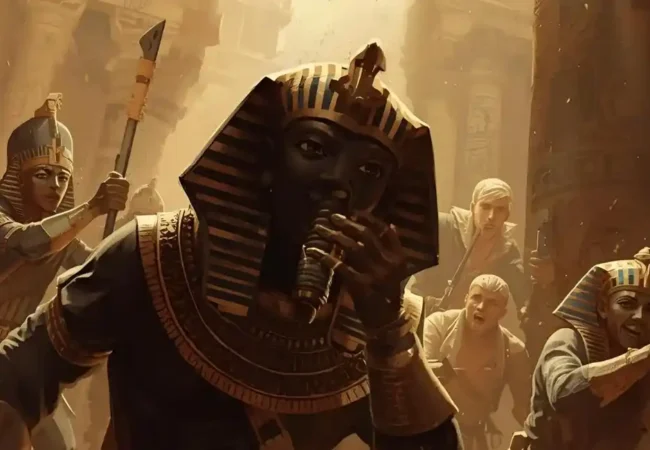
The police force in ancient Egypt transformed into a highly organized system particularly during the New Kingdom. Specialized elite units such as the Medjay were formed dedicated to protecting tombs and preventing any form of crime.
Tomb robbery.
In conclusion, the police force in ancient Egypt appears to have been one of the fundamental pillars that contributed to the stability of Egyptian society and the organization of daily life.
From royal guards to temple police units and river police security in ancient Egypt was an integral part of political and social life.
With the development of the judicial system and the spread of police forces across various aspects of life security became an important element in maintaining the balance and order of the state.






Explore our top-rated Egypt travel packages and embark on an unforgettable journey. From the Pyramids of Cairo to the magical temples of Luxor, Aswan, and Abu Simbel, discover expertly curated tours designed for your perfect Egyptian adventure