Tutankhamun
When your eyes look into Egyptian civilization, you see wonders that are...



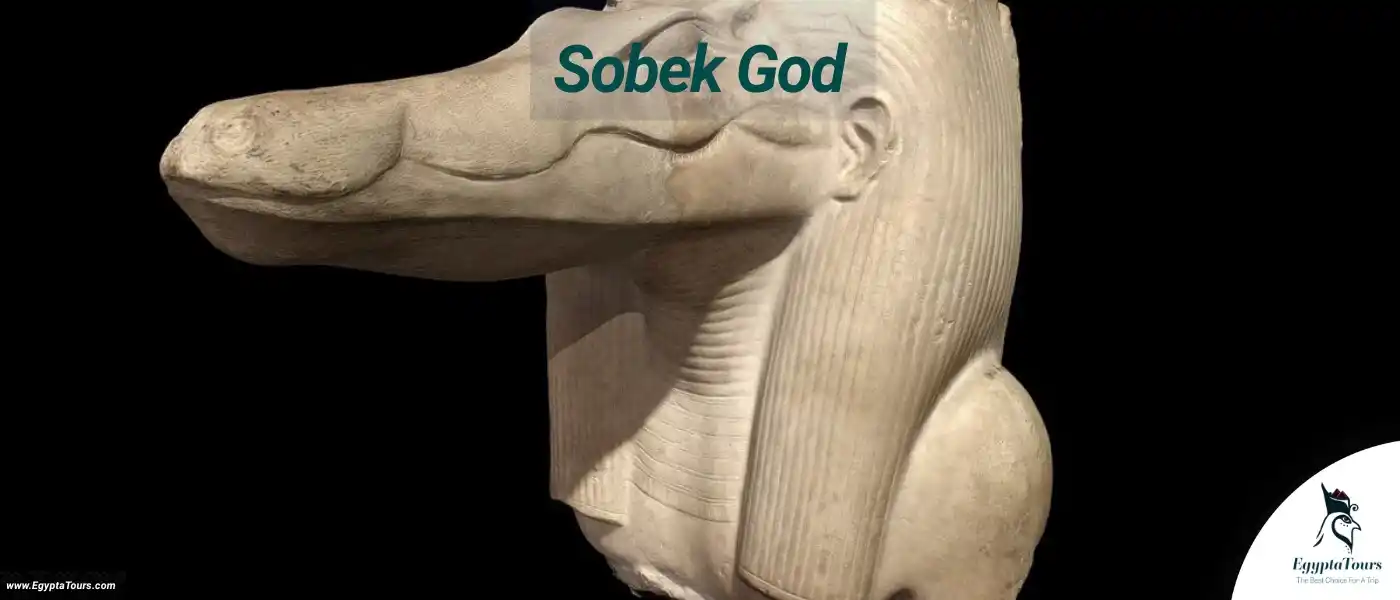
Sobek, also known as Sebek or Sukht, was an ancient Egyptian god associated with the Nile, crocodiles, and royal power. He symbolized both protection and destruction, fertility and military strength, and was believed to control the Nile’s life-giving waters while guarding Egypt from chaos and evil.
Who-is-the-god-Sobek-EgyptaTours
The origin of the name “Sobek” remains a matter of debate among researchers, but the prevailing view is that it is derived from a linguistic root meaning “fertility” a symbolic reference to the power of creation and reproduction.
Most Egyptologists think that Sobek’s name comes from the ancient Egyptian word s-bak, which meant “to make pregnant,” connecting Sobek to ideas of strength, fertility, and power.
Other scholars believe that Sobek’s name comes from the word sbq, which means “to bring together.” In some stories, Sobek helped Isis collect the pieces of Osiris’s body so that the god could come back to life. In other versions of the Osiris myth, Sobek was said to have eaten some parts of Osiris’s scattered body.
Sobek was worshiped all over Egypt and had many different names, such as Sebek, Soknebtunis, Souxei, Sokonnokonni, Pnepheros, and Petsuchos. Even though people everywhere honored him, each area had its own slightly different stories about the god.
In some places, people respected Sobek. They worshiped crocodiles, gave them pools in temples, and offered them treats and jewelry. In other areas, people were afraid of Sobek and hunted crocodiles, trying to kill as many as they could.
By the Twelfth Dynasty (1991–1786 BC), Sobek was respected all over Egypt and became an official state god. He was given many titles, such as “Lord of the Waters,” “Lord of Faiyum,” “The Rager,” “Lord of the White Crown,” and sometimes he was called “God of the Nile.”
Sobek was honored as the Egyptian god of strength and power, a fierce protector, and a symbol of fertility. His link to power came from the nature of the crocodile. With its strong body, sharp teeth, and ability to live both in water and on land, the crocodile represented great and unstoppable strength.
Because of this power, pharaohs often called on Sobek to support and justify their rule. The pharaoh was usually seen as the human form of Horus, the sky god. However, when a pharaoh showed great strength or skill, he was connected to Sobek instead. This connection raised Sobek’s importance and confirmed his role as a god of power.
In addition to strength, Sobek was also worshiped as a god of fertility. Although this may seem strange, it comes from the natural behavior of crocodiles. Crocodiles reproduce in large numbers, and this was noticed by the ancient Egyptians. Sobek’s link to fertility was also strengthened by his connection to the Nile, the river that gave life and supported Egyptian civilization.
Sobek began his path to solar divine glory when he was associated with Horus.
This relationship was his first window into the world of solar divinity.
Sobek, the ancient Egyptian crocodile god, was revered as a powerful deity of strength, fertility, and protection.
Associated with the Nile and its life-giving waters, Sobek was both feared and worshipped.
References to him appear in the Pyramid Texts, where he is invoked as a fierce guardian and a guide for the pharaoh in the afterlife, emphasizing his divine role in both creation and rebirth.
Sobek became very important across Egypt during the Twelfth Dynasty (1991–1786 B.C.). Pharaohs Amenemhat I and Senusret I strengthened the worship of Sobek in the Faiyum region, where it already existed. Senusret II later built a pyramid there. Amenemhat III called himself “beloved of Sobek of Shedet” and greatly expanded Sobek’s temple. The first female ruler of Egypt, Sobekneferu, whose name means “Beauty of Sobek,” also came from this dynasty. After that, during the Thirteenth Dynasty, several lesser-known kings were named Sobekhotep.
Sobek was mainly worshiped in the Faiyum, an oasis in Upper Egypt also known as Shedet. He stayed an important god throughout Egypt’s long history. According to legend, one of Egypt’s earliest kings, Aha, built a temple for Sobek in the Faiyum. In the Old Kingdom Pyramid Texts of Pharaoh Unas, Aha is described as the “lord of Bakhu,” a mountain believed to hold up the sky.
Even during the Greco-Roman period, Sobek was still respected. The writer Strabo, in his book Geography, wrote about the Faiyum area, also called Arsinoe, Crocodopolis (meaning “City of the Crocodile”), and Shedet. He explained that the people of this region greatly honored the crocodile. There was a sacred crocodile that lived in a lake, cared for and fed by priests, and it was gentle with them.
Crocodiles were also worshiped near Kom Ombo, where the Ptolemies built a large temple complex. Near the city of Thebes, there was also a burial ground filled with mummified crocodiles.
In the Pyramid Texts, Sobek’s mother, Neith, is mentioned, and Sobek’s powers are described. The texts say that Sobek speaks of himself as Neith’s son and describes his strength, sexuality, and control over life and reproduction. This shows that Sobek was strongly connected to fertility. In the Middle Kingdom Hymn to Hapy, Sobek is linked to the flooding of the Nile, showing his power as the river rises and brings new life to Egypt.
Sobek was also shown as a frightening, monster-like god. He was said to have eaten the god Osiris, and stories of gods eating other gods were not unusual in Egyptian myths.
Crocodiles were not always seen as kind creatures. Sometimes they were believed to be messengers of Set, the god of destruction. However, Sobek also played a helpful role. When Isis accidentally cut off the hands of her son Horus, the god Re asked Sobek to find them. Sobek succeeded by creating a fishing trap to recover the hands.
Where-was-god-Sobek-worshipped-EgyptaTours
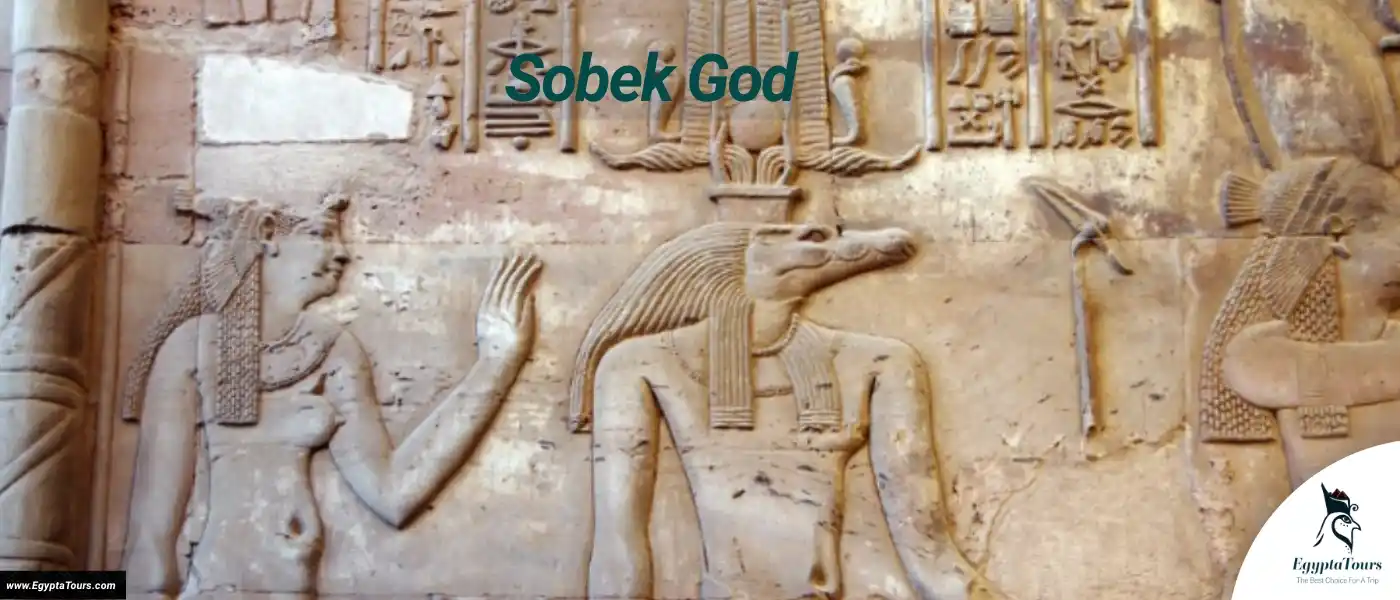
Fayoum known in ancient times as “Land of the Lake,” in reference to Lake Qarun was the original site of worship of the god Sobek.
He instilled a sense of faith in the crocodile god since ancient times.
Sobek is considered the embodiment of brutal strength and instinctive violence.
His divine personality is inspired by the Nile crocodile, a merciless predator.
Sobek was not only known for his savage divinity.
To the ancient Egyptians he was a protective shield whose ferocity terrified enemies and whose terror protected the innocent from all evil.
Some religious groups in ancient Egypt believed that the god Sobek was a sacred entity the cosmic force from which order itself emerged when he emerged from the depths of the “dark primordial waters” to spark the first creation.
They saw him as the first father of the great river, the Nile which gave life to the land and made the land fertile with goodness and growth.
Sobek, the ancient Egyptian crocodile god of strength, fertility, and protection, was worshiped in several important temples, especially in regions near water.
The most famous temple dedicated to him is at Kom Ombo, where he was honored alongside the falcon god Horus.
Another major center of Sobek worship was in Fayoum, particularly at the city of Crocodiloplis (modern Medinet el-Faiyum), where sacred crocodiles were kept and revered.
Sobek’s temples often featured pools and lakes to house live crocodiles, seen as physical embodiments of the god, and emphasized his role in controlling the waters of the Nile, ensuring both fertility and safety for the land.
Throughout the year the statue remains in the temple as if light had been deliberately banished from it.
However in a unique moment that only occurs on December 21 of each year the sun’s rays make their way with amazing precision to perpendicularly to the statue of the god Sobek illuminating his face in a magical cosmic scene.
Sobek had an important place among the gods connected to the Nile. Because he was linked to the river which was the main source of life in ancient Egypt his importance grew, and he became a key religious figure. People believed Sobek protected the Nile and the good things it provided.
The Nile brought food and wealth, but it was also dangerous, especially because of crocodiles living in it. As the crocodile god, Sobek was thought to control these animals, and people worshiped him to keep them calm and avoid harm.
Sobek’s role was not limited to life on earth. He was also connected to the afterlife. As a Nile god, he was believed to guide the souls of the dead safely across the river, helping them pass through the dangerous waters of the underworld.
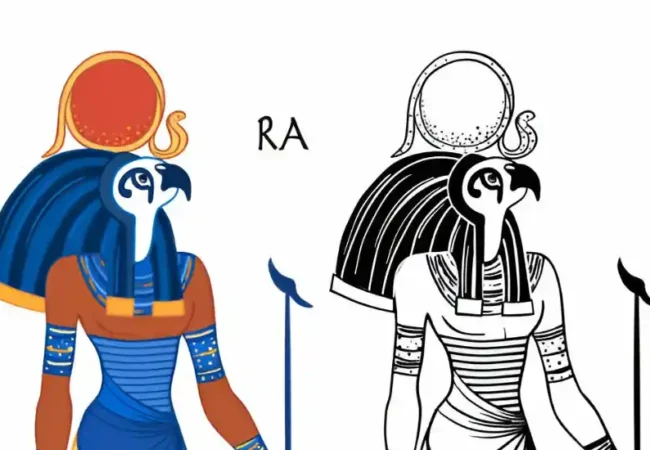
The merging of Sobek with Ra, the sun god, created a powerful god known as Sobek-Ra. This union showed how ancient Egyptians combined different divine qualities into one god. Sobek-Ra brought together the strong, dangerous power of the crocodile with the sun’s ability to give life, forming a god of great strength.
As Sobek-Ra, this god became linked to creation. In Egyptian beliefs, the sun represented creation and rebirth. By joining Sobek with Ra, Sobek was raised to the level of a creator god. This combination showed that Egyptian gods could share roles and easily blend with one another.
The Sobek-Ra union was also important for the pharaoh. Ra was believed to be the divine father of the king, and connecting Sobek to Ra strengthened the pharaoh’s sacred family line. The pharaoh was seen as the human form of Sobek-Ra, showing the powerful connection between the sun god and the crocodile god.
The god Sobek is a strong candidate to embody the “Pharaoh God,” as these gods were worshipped during the time of Abraham. Given the long history of his worship and his great status in Egypt Sobek was a fearsome god.
The crocodile has been associated with the Egyptians since the Pharaonic era as a symbol of good and evil manifesting in contrasting images of reverence hatred, and desecration in their ancient culture.
Sobek the multidimensional ancient Egyptian god embodied in the form of a crocodile or a human with a crocodile head. He was associated with fertility royal authority, and military prowess.
He was also known as a protective deity against danger and a repeller of evil.
In concluding our discussion of Sobek it becomes clear that this name is not only associated with the ancient Egyptian god who manifested strength and protection, but also symbolizes a unique character that combined severity and wisdom.
In mythology he symbolized control over water and the Nile and was a source of security in times of chaos.



Explore our top-rated Egypt travel packages and embark on an unforgettable journey. From the Pyramids of Cairo to the magical temples of Luxor, Aswan, and Abu Simbel, discover expertly curated tours designed for your perfect Egyptian adventure