







What was the population of Ancient Egypt
Some people continually wonder about the estimates related to the population of ancient Egypt during its long historical periods and whether the population density at that time was logically balanced with Egypt’s geographical area and its prevailing economic system or not.
In this article, we will briefly answer the question of What was the population of Ancient Egypt? and how ancient Egyptian agriculture significantly contributed to the increase and growth of the population.

What-was-the-population-of-Ancient-Egypt-EgyptaTours
There is no completely precise and confirmed estimate of the population in the Pharaonic era due to the lack of any comprehensive and confirmed records for the population in this distant and complex time period.
However, according to what some historians and Egyptologists have stated based on the available evidence, the population of Egypt before 3000 BC likely did not exceed one million people.
During the days of the Middle Kingdom, a period of prosperity and stability, the population did not exceed 3 million people.
In the era of the New Kingdom, the age of the vast empire, the population reached approximately four million people.
This serves to provide an estimated answer to the question about What was the population of Ancient Egypt?
The impact of agricultural floods on population distribution
Irregular or destructive agricultural floods perhaps significantly affect population distribution in some cases, as such floods might lead some populations to migrate heavily from the countryside to the cities which increases population density in the cities and reduces the proportion of the population in the affected rural areas.
How agriculture contributed to population increase
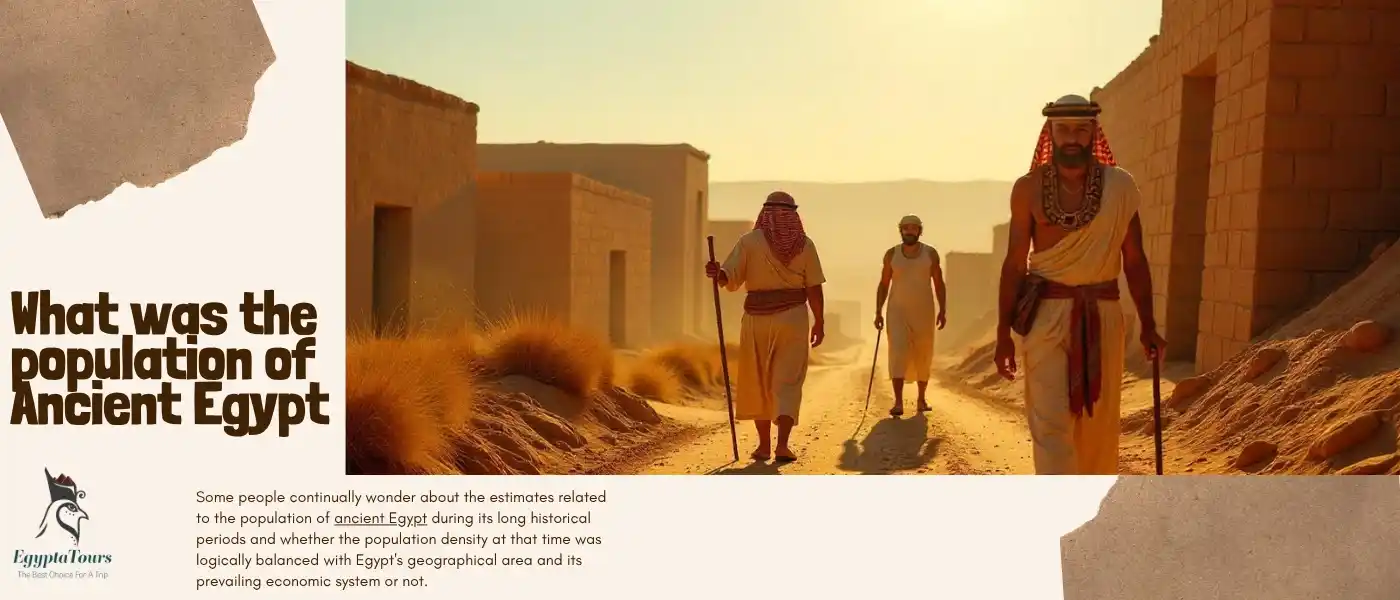
How-agriculture-contributed-to-population-increase-EgyptaTours
Agriculture is considered one of the most important and decisive key factors that contributed significantly and directly to the increase in population in Egypt over thousands of years.
Thanks to the Nile River and its fertile soil, Egypt is famous for cultivating many important food crops such as rice, cotton, wheat, corn, sugarcane and many other diverse crops.
This led to increased agricultural production and the achievement of a surplus which allowed for the growth of commercial and craft activities and an increase in population.
This is because agriculture provided them with relatively sustainable food and reduced the risk of major famines, consequently increasing the human survival rate for a longer period.
Over time, agricultural production, its techniques and tools evolved, enabling the ancient Egyptian people to settle permanently in their place instead of constantly moving from place to place in search of food and water.
This effectively contributed to building and expanding stable rural and urban communities.
Furthermore, the continuous availability of food for humans necessarily led to the improvement of their general health and clearly contributed to increasing the number of births and reducing infant mortality.
Comparison between population in Pharaonic cities and villages
Some historians have stated that estimates of the population in some relatively large Pharaonic cities and villages often ranged from approximately 35,000 to 40,000 people.
During the reign of Ramesses II, perhaps the population of his capital, Pi Ramesses, rose to nearly 500,000 people.
As for the Ptolemaic era, specifically in the city of Alexandria, the population reached approximately one million people or more.
How many people lived in Egypt during Moses’ time?
Some unscientific and highly questionable statistics claim that the population of Egypt during Moses‘ time reached about 100 million people, a figure that completely contradicts all reasonable historical and archaeological estimates.
What did Egypt look like 3000 years ago?
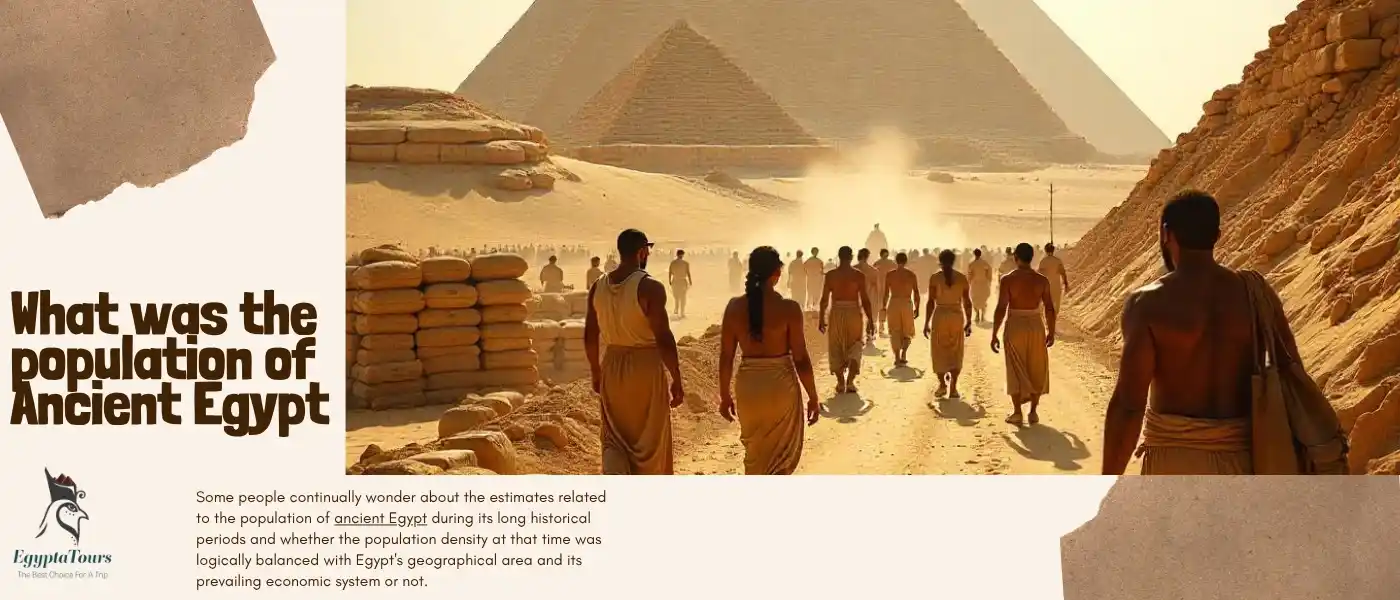
What-did-Egypt-look-like-3000-years-ago-EgyptaTours
Ancient Egypt 3000 years ago was a powerful and prosperous state and one of the most important civilizations in Africa and the ancient world.
The Nile River was the primary center and vital artery which provided fertile land and facilitated agriculture for farmers.
The Nile River was also the main means of transportation for the ancient Egyptians, as they traveled by boat to transport goods, crops and people.
Ancient Egypt was famous for its colossal pyramids and lavish temples which were built to bury and commemorate the pharaohs.
Ancient Egyptian society was divided into three main classes: an upper class consisting of the Pharaoh and his family, high state officials and priests; a middle class of officials, doctors, lower-ranking clergy, scribes and skilled artisans; and another large lower class consisting of peasants, the wealthy, small landowners and laborers.
The ancient Egyptians worshipped many gods who represented the forces of nature and abstract concepts, most notably the sun god Ra.
They strongly believed that there was another, more important life after death, so they were concerned with mummifying the dead and placing them in fortified tombs.
Despite the extreme scarcity of rain in ancient Egypt, agriculture was one of the most important sectors upon which the Egyptians primarily depended because of the Nile River and its annual floods.
They worked hard in agriculture, local and foreign trade, selling linen fabrics, pottery, furniture and various tools. As for education, the children of wealthy Egyptians and the upper class were mostly the ones who had the opportunity to learn, while the rest of the boys learned crafts from their fathers and girls learned household chores and female skills.
How many people lived in Egypt in 2500 BC?
Estimates indicate that the population of Egypt in 2500 BC reached approximately 1.6 million people.
How many people lived in Egypt 4000 years ago?
It is estimated that the population of Egypt 4000 years ago, meaning around 2000 BC, likely did not exceed a few hundred thousand.
The question of What was the population of Ancient Egypt? remains one of the most prominent common questions and is of great interest to many people who wish to learn about the ancient history of Egypt and its inhabitants, who were brilliantly able to adapt to their unique living conditions and contributed greatly to the prosperity and development of Egypt in a way that is impressive to the whole world.
FAQs
What language was spoken in ancient Egypt?
Hieroglyphic writing is one of the writing systems that was used in ancient Egypt, while the language they spoke was the Ancient Egyptian language through its various stages and developments.
How many slaves existed in ancient Egypt?
According to some inaccurate statistics and estimates, the number of those who could be described as slaves in ancient Egypt reached approximately 300,000 people, taking into consideration the different concepts of slavery at that time.
What will be the population of Egypt in 2050?
According to current population projections, it is expected that the population of Egypt in 2050 will reach about 157 million people.
Is Egypt the oldest civilization?
Egyptian civilization is considered one of the oldest continuous and influential civilizations in human history, as it flourished and thrived for more than seven thousand years approximately.
About EgyptaTours

EgyptaTours is a name synonymous with trust, excellence, and unforgettable travel experiences, proudly standing as one of the leading travel agencies in Egypt. Renowned for its deep expertise, personalized service, and carefully crafted itineraries, EgyptaTours serves as the ultimate gateway to discovering Egypt in its most authentic and inspiring form.