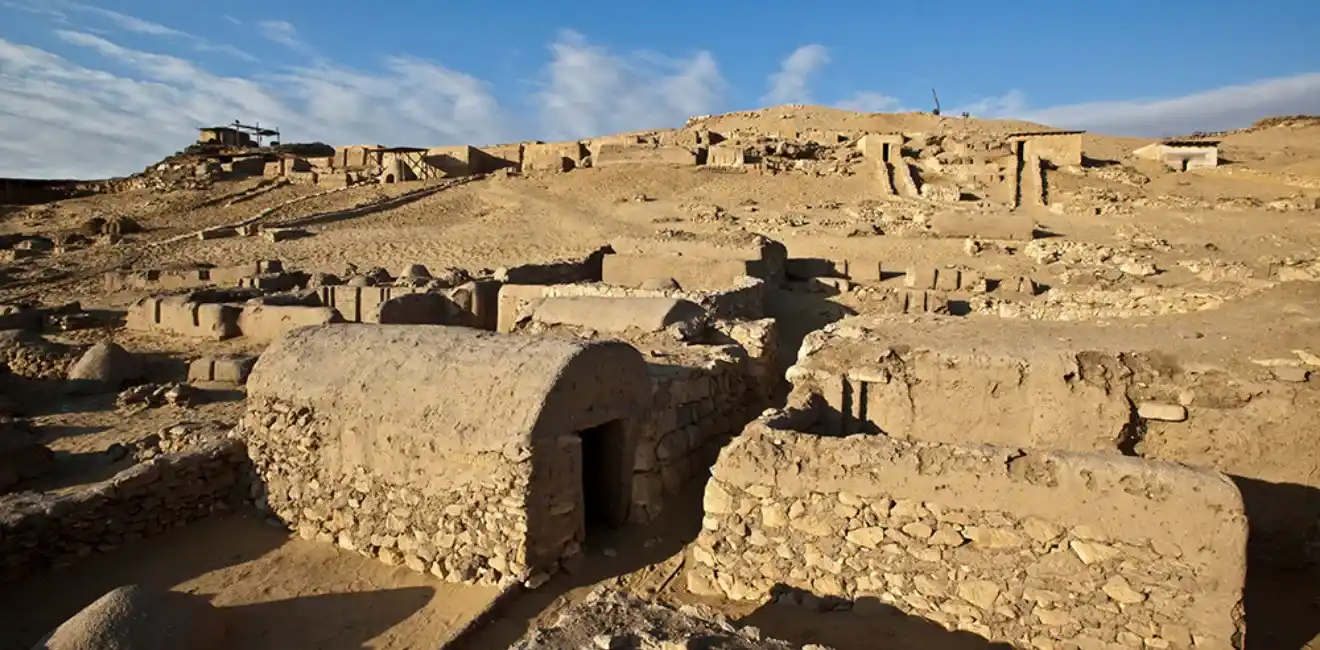
Giza Workers Village
📋 Summary & Quick Facts
- The Giza Workers Village (Heit el Ghurab) was discovered near the Giza Plateau and dates back to the 4th Dynasty during the reign of Khufu, Khafre, and Menkaure. It completely changed the understanding of pyramid construction by proving that the builders were organized, skilled workers not slaves and lived in a structured, state supported community.
- The village was carefully planned like a small ancient city, with streets, barracks, houses, administrative buildings, storage areas, and bakeries. Large communal galleries housed thousands of rotating workers, while skilled artisans and supervisors lived in better homes, showing a clear social hierarchy and strong organization.
- Workers lived tough but organized lives. They received food, clothing, and wages, and worked in teams including masons, carpenters, engineers, and transport workers. Their diet included bread, meat, fish, vegetables, and beer, showing they were well fed to sustain the massive construction effort
- The village included medical care systems, with doctors and assistants treating injuries like fractures and work related accidents. Archaeological evidence shows that Egyptian medicine was advanced, using herbal treatments and physical care. Workers were respected and even buried in organized cemeteries near the site.
- The pyramid construction was managed like a state project with engineers, supervisors, craftsmen, and labor divisions. Each group had defined roles and tasks, ensuring efficient production. The discovery of this village proves that ancient Egypt had a highly advanced administrative and engineering system that made the construction of the pyramids possible.
Giza Workers Village is the secret hideaway behind the construction method of the massive pyramids in ancient times. It was a place of residence and burial for the Egyptian workers who participated in building the pyramids.
Archaeological studies of the village’s remains and artifacts reveal their daily lifestyle and how they carried out the construction of the three pyramids. It was not just a collection of primitive dwellings but featured sophisticated architectural designs, including houses, bakeries, medical centers, and even tombs.
Therefore, this village is considered one of the most important secrets of ancient Egyptian civilization, as it clarifies the truth about the pyramid builders: were they merely workers or slaves?

History-of-Giza-Workers-Village-and-How-It-Was-Built-EgyptaTours
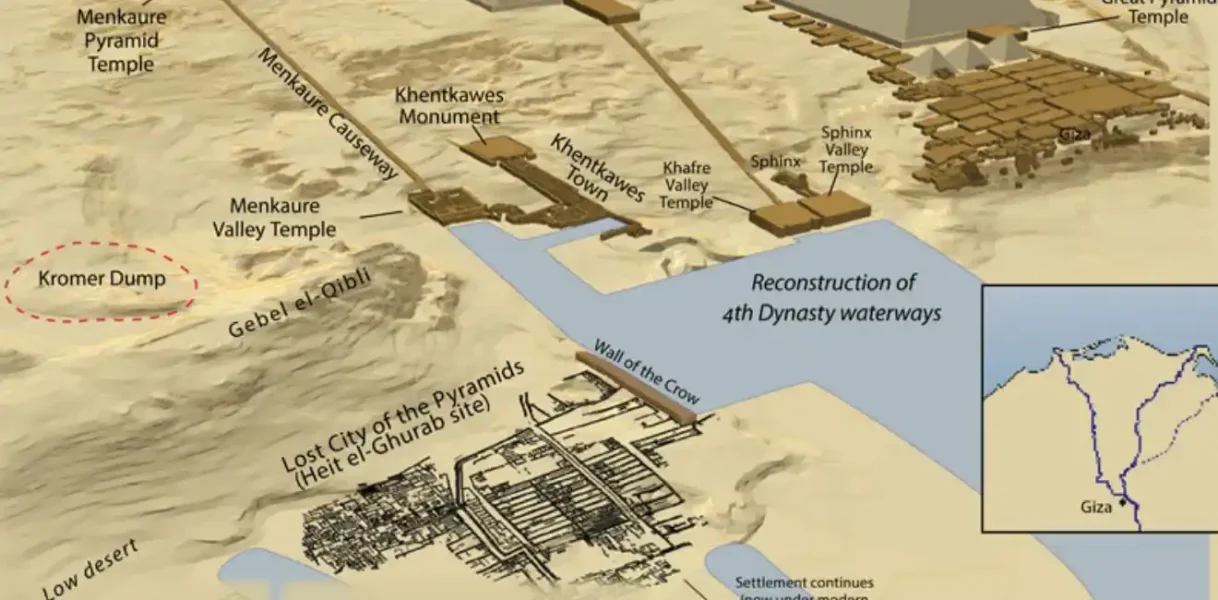
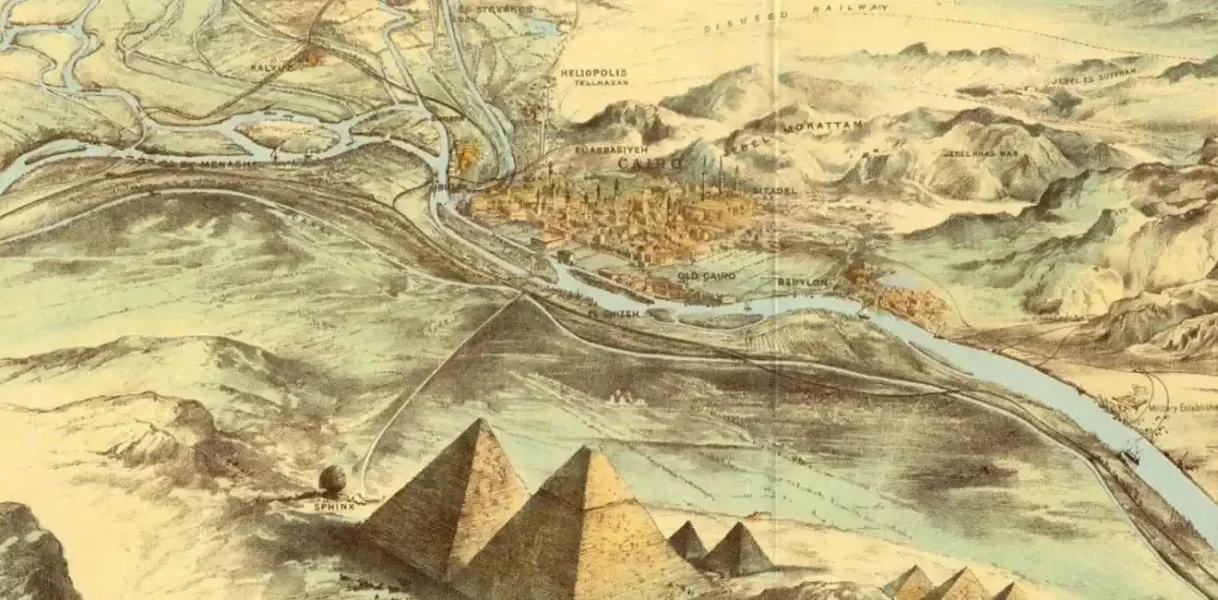
The history of Giza Workers Village dates back to the era of the Fourth Dynasty, during the reigns of the three kings: Khufu, Khafre, and Menkaure, around 2580 BC. The remains and artifacts of a large residential complex were discovered in the southeastern part of the Giza Plateau, near the pyramid complex.
The construction of the massive pyramids required a large city and infrastructure to accommodate thousands of workers and supervisors.
The village was built with meticulous organization, including three streets, houses, storerooms, and an administrative building for the city, in addition to four large galleries believed to be where the workers slept. This confirms the ancient Egyptians’ deep understanding of architecture and administrative organization.
To the west of the village, the city’s dedicated cemetery was discovered, where workers were buried according to their rank. High-ranking individuals were buried in large stone mastabas on the upper hills of the village, while those of lower rank were buried in mud-brick tombs at the bottom of the hills.
The Daily Life of the Pyramid Builders in Giza
The pyramid builders lived in the Workers Village in Giza, known as “Heit el-Ghurab” (The Wall of the Crow), near the pyramids, which covered an area of seventeen acres. Their homes were built of mud brick and roofed with thatch, and some of these houses contained bakeries for making bread.
The workers received regular wages in the form of clothing and food for their work, in addition to receiving rewards, such as being buried in private tombs next to the king.
Ancient Egyptian papyri have revealed how the workers built the great pyramids. The Egyptian workers used artificial channels branching from the Nile River to bring raw materials to the plateau, such as granite, wood, and copper cutting tools. After that, the process of moving the huge stones began via long ramps lubricated with oil to facilitate transport using ropes and levers.
Their work life was very arduous, a fact that became apparent during the examination of the mummies of the Egyptian workers, where tests confirmed the presence of some bone fractures.
Archaeological Discoveries in the Workers Village Reveal the Lives of the Ancients

Archaeological-Discoveries-in-the-Workers-Village-EgyptaTours
Many artifacts have been uncovered within Giza Workers Village, which shed light on the social, economic, and practical life of the pyramid builders.
Among these discoveries are the following:
- Ancient excavations have revealed the remains and artifacts of one hundred and fifty-nine tombs, in which the mummies of supervisors were found.
- The remains of a building used for storing grain and food were found, in addition to stone ovens that produced thousands of loaves of bread.
- Vast remains of fish, bird, and sheep bones were discovered, which was the food provided by the state to the Egyptian workers to give them the necessary energy for maximum work efficiency.
- Tools made of copper and stone were found, which were used to cut the large stone blocks. Special techniques were also used to drag them up the ramps to build the pyramids.
Food and Drink of the Ancient Egyptian Workers

Food-and-Drink-of-the-Ancient-Egyptian-Workers-EgyptaTours
Excavations have revealed numerous plants that shed light on the life and diet of the Egyptian workers within Giza Workers Village.
The Egyptian administration provided them with plenty of food to help them perform their work at the highest quality.
This food included:
- Meats: Research indicates that the Egyptian workers consumed large quantities of various types of meat, including beef, mutton, and goat.
- Bread: Large bakeries and ovens were found where bread was made for the Egyptian workers, and it was their staple food.
- Legumes: Such as lentils, to provide protein.
- Other foods: Such as fruits, wheat, onions, and garlic, for disease prevention.
Doctors and Healthcare for the Pyramid Construction Workers
Giza Workers Village continues to reveal a host of secrets about the lives of the Egyptian workers through a collection of archaeological discoveries and papyri that have confirmed the difficulty and hardship of construction work in Egypt.
This resulted in diseases and fractures from cutting and breaking stones or falling from ramps, in addition to inhaling dust harmful to the respiratory system.
Therefore, the ancient Egyptian government worked to provide complete care for the Egyptian workers to ensure a healthy and psychologically sound life, free from diseases and risks. They did the following:
- Provided doctors and their assistants at the builders’ workplaces for immediate treatment of workers when they were exposed to dangers such as fractures, toxins from the soil, or snake bites.
- Divided the doctors into teams; one group provided healthcare to the workers in the city, while other doctors accompanied the workers at their workplaces and also supervised the provision of necessary tools.
- Excavations and Egyptian papyri have shown the advancement of the ancient Egyptians in herbal medicine and the treatment of diseases.
- They used medicinal plants and physical therapy to treat the pains and wounds resulting from the hard work of the pyramid builders.
Work Organization and Management Between Workers and Ancient Engineers
The Wadi al-Jarf papyrus revealed discoveries about the working methods of the pyramid builders within Giza Workers Village.
It showed the existence of a special administrative system for the Egyptian workers, which included dividing them into engineers, supervisors, construction workers, and specialized craftsmen to coordinate the different aspects of the engineering project, as well as to monitor other operations such as control and accounting mechanisms.
The principles of management were based on the following:
- A central authority to issue tasks and monitor their execution.
- Division of tasks among workers according to their positions.
- Organization of daily tasks and methods of their execution.
- Organization of monitoring and accounting processes.
There was also a division of workers on projects according to their abilities, as follows:
- Architects: They created the plans for building the pyramids and how to execute them.
- Supervisors: They were responsible for dividing the pyramid builders into teams and managing them well.
- Craftsmen: Such as sculptors and tool makers.
- Pyramid Builders: They were responsible for cutting the stones and transporting them up the ramps.
The Difference Between Skilled and Unskilled Workers
The nature of the work in building the pyramids was based on a hierarchical administrative system, according to the nature of the work and the skills possessed by the workers. This was represented as follows:
- Unskilled Workers: Such as the Egyptian farmers who participated in the construction processes of cutting and pulling stones. This was part of their seasonal work alongside their agricultural activities, within an organized work system.
- Skilled Workers: Including engineers, supervisors, and craftsmen. They possessed special skills for building the pyramids, such as drawing plans, determining locations, designing lifting systems, sculpting stones, and supervising the execution.
Challenges Faced by the Giza Village Workers
The pyramid builders within Giza Workers Village faced many difficulties, which can be summarized as follows:
- Difficulty of Transporting Huge Stones: The early builders faced great challenges in lifting and moving the stone blocks. This problem was solved by using internal and external ramps on the pyramids, which greatly helped in lifting and sculpting the stones.
- Early Engineering Mistakes: Such as what happened with the Bent Pyramid of Sneferu, which posed a great challenge that led to the development of construction methods and the correction of engineering processes in the execution of the pyramids.
- Work Hazards and Health Conditions: Many workers were exposed to physical and psychological injuries and diseases as a result of the hard work, such as fractures and emergencies, which required immediate treatment for them.
What Do You See in Giza Workers Village?

What-Do-You-See-in-Giza-Workers-Village-EgyptaTours
The remains and artifacts of Giza Workers Village reveal the daily life of the Egyptian workers during the period of pyramid construction.
This is evident through the following:
- The remains of the workers’ housing, which extended over large areas to accommodate a large number of Egyptian workers during their seasonal work period.
- Large bakeries and ovens for making bread, in addition to food preparation facilities such as fish processing plants.
- The city wall that separated the residential area of the workers from their own cemetery.
- The tombs of the Egyptian workers, which served as a burial place for many farmers who came from different regions of Egypt.
- Remains of wheat grains and animal bones, which indicate the nature of the diet the ancient Egyptians relied on.
- How Is the Village Displayed in Museums? Giza Workers Village is displayed in the National Museum of Egyptian Civilization through various exhibits, which are highlighted in the following points:
- Models of the tools used by the Egyptian workers, which express their daily lifestyle.
- Documentary photos of the activities of the Egyptian workers.
- A display of archaeological documents and papers that clarify the work system, administrative organization, and the wages allocated to them.
- Interactive screens showing images of the lives of the Egyptian workers.
- Virtual tours through photos and video clips inside the Workers Village and their tombs.
The Importance of the Workers Village for Understanding Pyramid Construction

The-Importance-of-the-Workers-Village-for-Understanding-Pyramid-Construction
Giza Workers Village, also known as Heit el-Ghurab, has revealed the nature of the work of the pyramid builders through the following:
- The village revealed the existence of a cemetery and tombs for the Egyptian workers next to the pyramids, which refutes the claims that the workers were slaves or worked under a forced labor system. Instead, they were paid wages.
- Housing and food were provided for the workers, such as the bakeries that produced thousands of loaves of bread, in addition to beer to provide them with the necessary energy for work.
- There was a clear administrative organization from ancient times for the nature of the work, where the workers were divided into teams, supervised by engineers and supervisors responsible for implementing the plans in the construction of the pyramids.
- The existence of a healthcare system of doctors and medical assistants to provide immediate health care to the workers, who always accompanied them in their daily work.
Conclusion
Giza Workers Village is an important archaeological discovery, as it reveals to us the lives of the pyramid builders and their daily activities, and clarifies the nature of their work in building the three pyramids.
FAQs
What was the purpose of the Workers Villages?
The main purpose of the Workers Villages in Egypt was to provide housing and shelter for the Egyptian workers, in addition to other services such as food production facilities and healthcare for them, to ensure the execution of their work at the highest quality.
What is the secret chamber in Giza?
The secret chamber in Giza is the large void inside the Great Pyramid of Khufu, which was discovered using cosmic-ray imaging. It is believed to be located above the Grand Gallery and may have been used for storage or for religious purposes.
Were workers buried in the pyramids?
No, the workers were not buried inside the pyramids. Instead, they were buried in private tombs next to the Workers Village in Giza, which reflects the value of their work and its sanctification in ancient Egypt.
What is the lost city under the Giza pyramids?
There is no clear archaeological discovery that confirms the claims promoting the existence of a lost city under the Giza pyramids, and this has been confirmed by archaeological experts in Egypt.
Were workers’ villages successful?
Yes, the Workers Villages were successful in carrying out the projects entrusted to them, foremost among them the construction of the pyramids, thanks to the healthcare, and the administrative and engineering organization within the village.
Similar Posts

About EgyptaTours

EgyptaTours is a name synonymous with trust, excellence, and unforgettable travel experiences, proudly standing as one of the leading travel agencies in Egypt. Renowned for its deep expertise, personalized service, and carefully crafted itineraries, EgyptaTours serves as the ultimate gateway to discovering Egypt in its most authentic and inspiring form.