In ancient Egyptian mythology there were many gods and they were not just religious symbols but a deep embodiment of the forces of nature that were the cosmic order and the moral values that governed the life of ancient Egyptians. The Egyptians believed that the universe was governed by a sacred order known as Maat which was considered balance and justice and the gods were the first guardians of this order.
The roles of the gods were different between creation, protection, judgment and resurrection and this difference was reflected in every aspect of the daily life of ancient Egyptians. Osiris was at the heart of this religious belief as he was one of the most important and influential gods in ancient Egyptian civilization.
Osiris In The Ancient Egyptian Mythology
Osiris -In -The- Ancient -Egyptian- Mythology
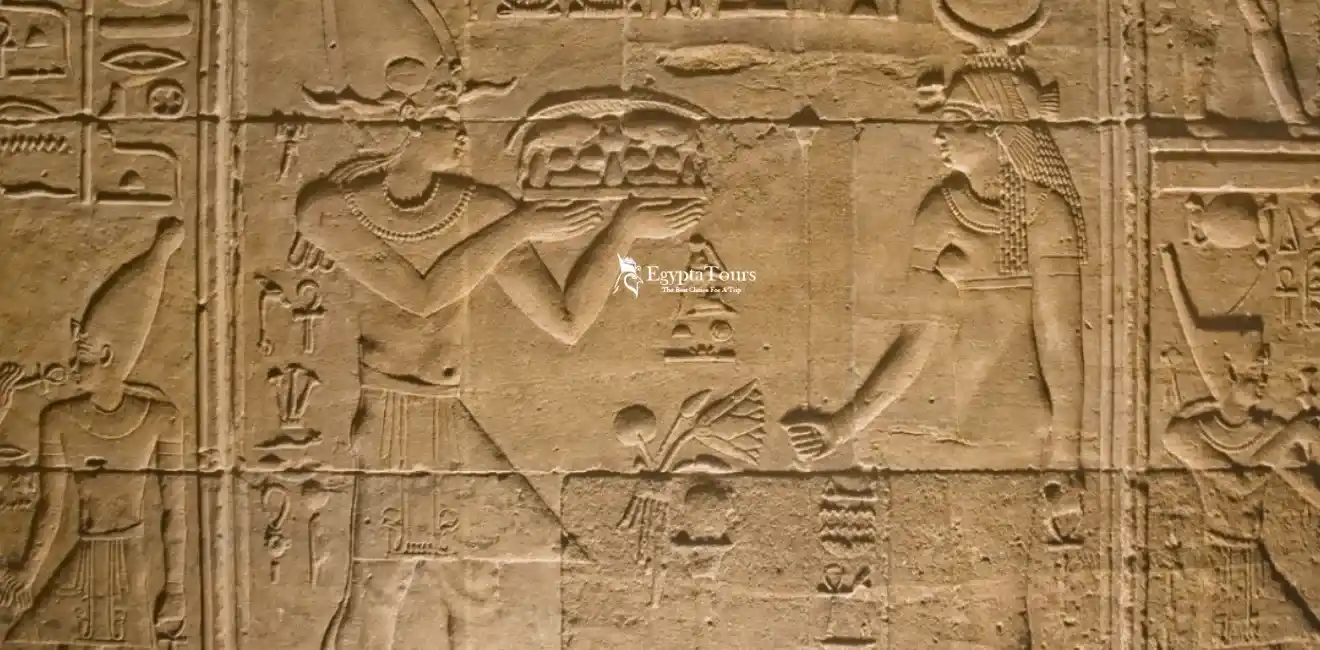
Osiris was one of the most important and famous gods in ancient Egyptian mythology. He was considered the god of fertility, agriculture, resurrection, life and death. He was usually shown as a green skinned god with a pharaonic beard partially wrapped in a mummy from below his chest wearing a distinctive Atef crown and holding a flail and a crook.
Osiris was also a god of the moon and it was believed that he controlled the cycles of the moon. He was also considered a god of floods and was called upon to ensure the flooding of the Nile and bring water to the agricultural lands.
In ancient Egyptian religion, Osiris was also considered a god of justice and it was believed that he would judge the souls of the dead in the afterlife. He was considered a powerful and beloved god and was called upon to save people from evil and protect them.
Osiris was widely worshiped in ancient Egypt and had temples and centers of worship throughout the country. He was considered a god of fertility and agriculture and was called upon to ensure the growth of crops and bring prosperity to the people.
Osiris was also a symbol of resurrection and new life and it was believed that he was resurrected from death every year bringing life back to the earth. He also was considered a god of fertility and agriculture and was called upon to ensure the growth of crops and bring prosperity to the people.
Osiris was also the god of resurrection and judgment and was the head of the court of the dead in ancient Egyptian mythology. He was considered one of the main gods of the sacred ennead in ancient Egyptian religion and is the only god who rivaled the worship of the god Ra. According to ancient Egyptian mythology, Osiris was the brother of Isis, Nephthys and Seth and married Isis. His parents were Geb, the god of the earth and Nut who was the goddess of the sky. The ancient Egyptian myth says that Osiris was the first Egyptian king that ruled Egypt in prehistoric times.
The Origin Of Osiris‘ Name
The name Osiris is a Latinized form of the ancient Greek name Ὄσιρις which is itself a Greek adaptation of the original name in the Egyptian language. In Egyptian hieroglyphics, the name was written as wsjr and is read in various ways such as Asar, Usar, Usir, Wesir or Osir.
There are several proposals for the origin and meaning of the original name but none of them are entirely convincing. Some Egyptologists believe that the name was derived from wsr meaning powerful while others suggest that it is a compound of st jrt meaning seat of the eye. There were also those who interpret the name as referring to the producer, something made, Osiris representing the product of the embalming process.
Recently, alternative interpretations of the name have been proposed with Yoshi Muchiki suggesting that the name should be read as sjr, based on Aramaic, Phoenician and Old South Arabian transcriptions. James P. Allen reads the word as jsjrt and revises the reading to jsjrj deriving it from js jrj meaning the male generative principle.
The Appearance Of Osiris
The -Appearance- Of- Osiris
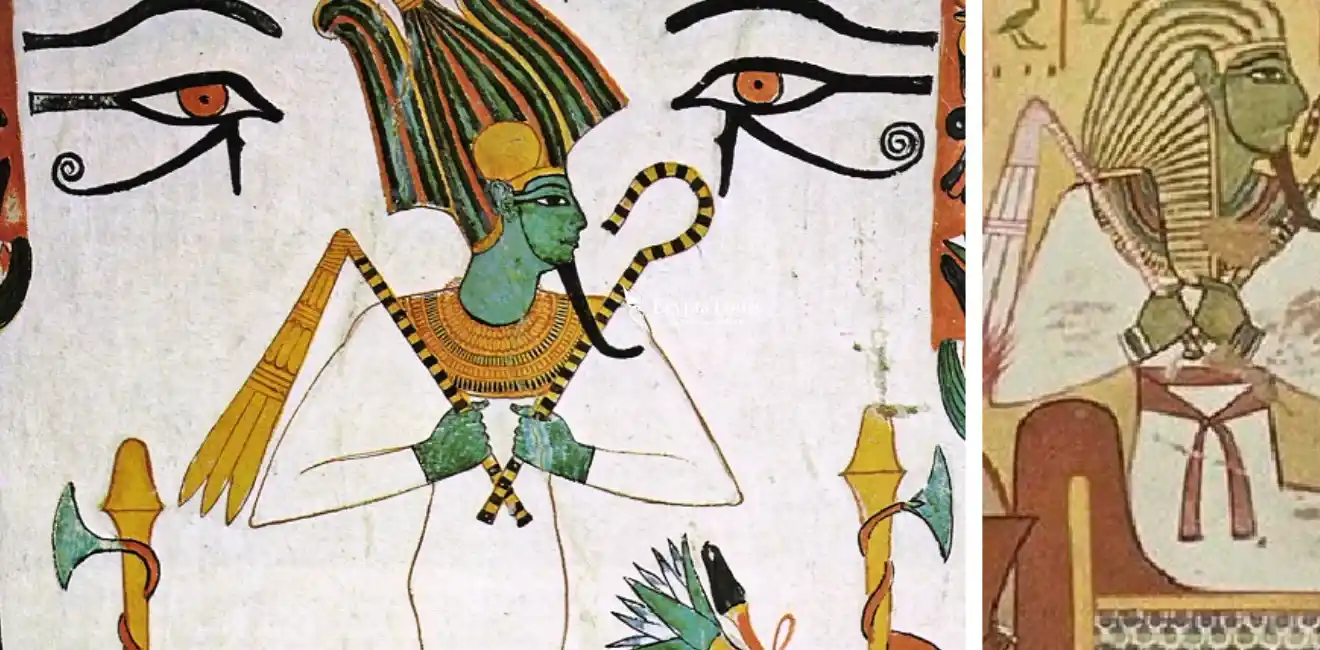
Osiris appears in the most developed form of iconography wearing the Atef crown which resembles the white crown of Upper Egypt but with the addition of two ostrich feathers curled on either side. He also holds the crook and flail where the crook is believed to represent Osiris as a shepherd god and the symbolism of the flail is more obscure with suggestions of a shepherd’s whip or a means of warding off insects or association with the god Andjety of the ninth nome of Lower Egypt.
He was usually shown as a pharaoh with green skin (the color of rebirth) or black skin indicating the fertility of the Nile floodplain in the form of a mummy wearing the wrappings of embalming from the chest down.
The Judgment Scene Of Osiris
The -Judgment -Scene- Of- Osiris
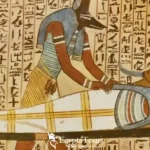
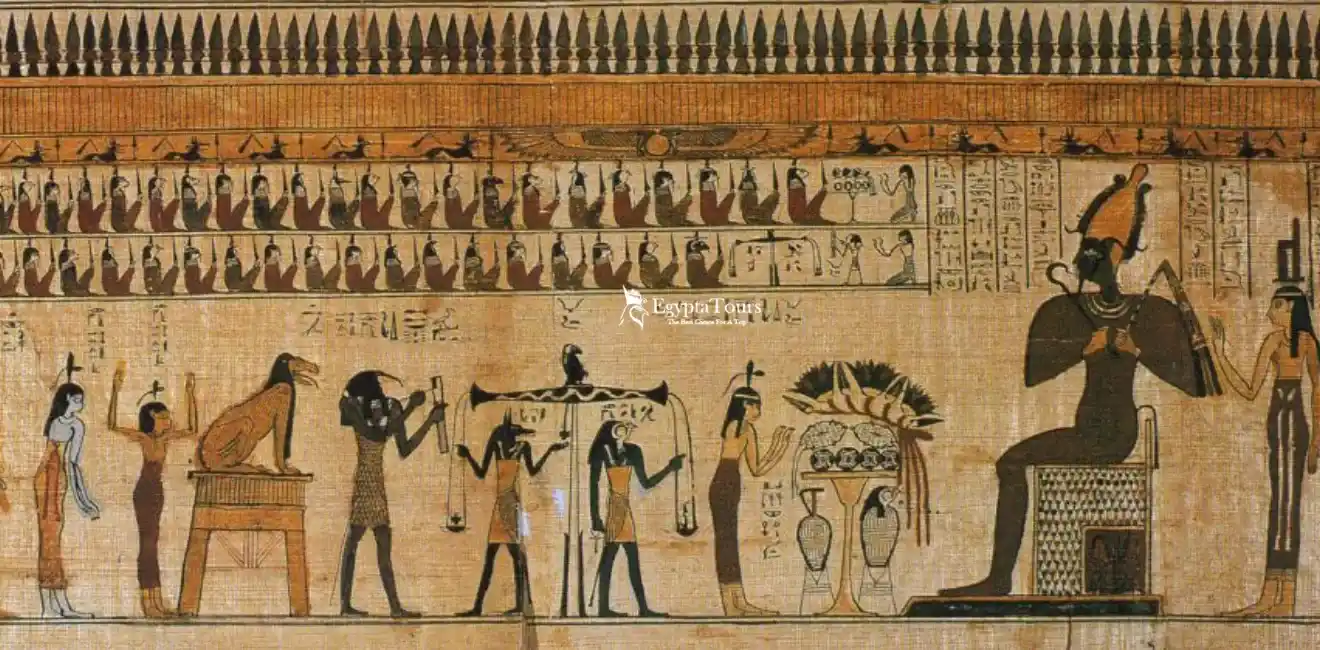
In the judgment scene from the Book of the Dead, the deceased Hunefer is led to the hall of judgment by Anubis with the jackal’s head. The next scene is the weighing of his heart against the feather of Maat with Ammit waiting for the result and Thoth recording. Finally, Hunefer who has passed the test, is presented by Horus with the falcon’s head to Osiris, seated in his shrine with Isis and Nephthys.
The idea of divine justice being exercised after death for wrongs committed during life first arose during the Old Kingdom in the tomb of the Sixth Dynasty containing parts of what would later be described as the negative confessions practiced before the forty two judges of Maat.
Upon death, a person faces judgment by a council of forty two divine judges. If the person lived a life in accordance with the principles of the goddess Maat representing truth and justice, they were received into the kingdom of Osiris. If found guilty, they were thrown to the monster Ammit and did not participate in eternal life.
The Legend of Osiris

The -Legend -of -Osiris
The story of Osiris is one of the most famous myths in ancient Egyptian mythology and it tells of his murder by his brother Seth who was the symbol of evil. Seth invited Osiris to a celebration and presented him with a magnificent coffin and when Osiris lay down in it, Seth closed the coffin and threw it into the Nile River. Isis who was Osiris’ wife and her sister Nephthys wept for him and began a journey to search for Osiris’ body parts.
Wherever Isis found a part of Osiris’ body, the Egyptians built temples such as the Temple of Abydos which commemorates this event. Isis found Osiris’ head in Abydos and the Egyptians built the temple there to honor Osiris.
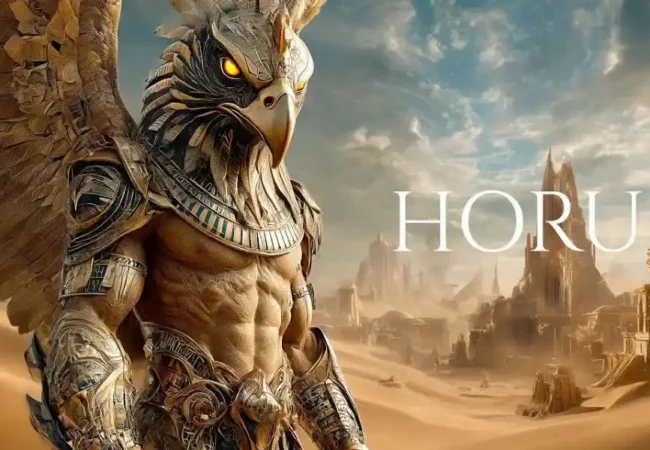
After Isis gathered Osiris’ body parts, she became pregnant and gave birth to their son Horus who became a symbol of justice and right. Horus avenged his father’s death, killed Seth and became the king of Egypt.
Osiris became the god of the underworld, the judge of souls and was believed to be resurrected from death every year bringing life back to the earth. Osiris was associated with the flooding of the Nile, the growth of crops and was considered a symbol of fertility and resurrection.
The myth has different versions but they all tell the story of Osiris and Isis, the struggle between good and evil and the resurrection and eternal life.
Plutarch tells another version of the myth where Seth conspired with the Queen of Ethiopia and 72 conspirators to kill Osiris. Seth tricked Osiris into entering a box, closed it and sealed it with lead and threw it into the Nile. Isis searched for Osiris’ body parts until she found them in Byblos and restored his body.
Diodorus Siculus presents another version of the myth where Osiris was described as an ancient king who taught the Egyptians the arts of civilization including agriculture and then traveled the world with his sister Isis before returning to Egypt. Osiris was killed by his brother Seth who cut his body into 26 pieces and distributed them among the conspirators.
Isis restored Osiris’ body, gathered his parts and brought him back to life briefly so he could impregnate her. She then gave birth to Horus who became a symbol of justice and right.
In the end, the myth is a story about the struggle between good and evil, resurrection and eternal life and the power of love and justice. Osiris became the god of the underworld, the judge of souls and was believed to be resurrected from death every year bringing life back to the earth.
The myth also shows the importance of love and loyalty as Isis remained faithful to Osiris and restored his body. It also speaks of the power of justice as Horus avenged his father’s death and became the king of Egypt.
The Early Myth Of Osiris
The early myth describes the Pyramid Texts which outline the initial concepts of the afterlife where one travels eternally with the sun god among the stars. Among these funerary texts, at the beginning of the Fourth Dynasty, the king is offered to Anubis. However, by the end of the Fifth Dynasty, the formula in all tombs becomes The king is offered to Osiris.
Osiris is the mythical father of the god Horus whose birth is described in the Osiris myth, a central legend in ancient Egyptian religion. The myth describes Osiris as being killed by his brother Seth who coveted Osiris’ throne. His wife, Isis finds Osiris’ body and hides it in the reeds where it is found and dismembered by Seth.
Isis recovers and gathers Osiris’ parts then revives him through magic. This magic allows her the time to conceive with Osiris. Isis later gives birth to Horus who is considered a representation of new beginnings and the defeated usurper Seth.
Due to Horus’ birth after Osiris’ resurrection, Horus is considered a symbol of new beginnings and revenge against Seth. Thus, Osiris became the mythical father of the god Horus who represents new power and revenge against injustice.
In this myth, Osiris is the god who is killed and resurrected, symbolizing life, death and resurrection. Meanwhile, Horus represents new beginnings and revenge against injustice symbolizing power and justice.
The myth also highlights the importance of Isis, who represents motherhood, protection and magic. She is the one who recovers Osiris’ body, gathers his parts and revives him through magic and she is the one who gives birth to Horus.
Ultimately, the myth is a story about the struggle between good and evil, resurrection and eternal life and the power of love and justice.
The Origins Of The Myth
The myth of Isis and Osiris first appeared in the Pyramid Texts which means that most of its basic features were formed before these texts were written. It is possible that the distinctive parts of the story such as the death and resurrection of Osiris, the childhood of Horus and his conflict with Seth, were originally separate mythological episodes. If this is correct, it is likely that these episodes merged into a single story at the time of the Pyramid Texts which loosely connected these parts.
In any case, the story was formed as a result of a combination of influences. Many parts of the story are based on religious ideas and the general nature of ancient Egyptian society such as the divine nature of the king, the succession of one king to another, the struggle to maintain Ma’at and the effort to overcome death.
There are some important points of controversy. The origins of the myth are the subject of great debate and the basis of the myth of Osiris’ death is also a matter of doubt. One influential assumption was put forward by James Frazer who said that Osiris, like any god who dies and is resurrected in the ancient Near East, began as a personification of vegetation. Therefore, his death and resurrection depend on the annual death and regrowth of vegetation.
However, in the late 20th century, J. Gwyn Griffiths argued that Osiris originally arose as a ruler of the dead and that his connection with vegetation is merely a secondary development. At the same time, comparative religion scholars strongly criticized Frazer’s comprehensive concept of “gods who die and are resurrected”.
More recently, Egyptologist Rosalie David has maintained her view that Osiris was originally a “personification of the annual growth of trees and plants after the Nile’s flooding”.
Horus and Seth
There is ongoing debate about the rivalry between Horus and Seth which Egyptologists have tried to link to political events in Egypt’s history or prehistory. The division of the kingdom between the rivals and the predominant association between the union of Horus and Seth and the union of Upper and Lower Egypt suggest that the two gods represent a kind of division within the country.
Traditional and archaeological evidence indicates that Egypt’s unity was achieved at the beginning of its history when the Upper Egyptian kingdom in the north defeated the Delta kingdom in the south. The rulers of the Upper Egyptian kingdom called themselves “Followers of Horus”, and Horus became the patron god of the united nation and its kings.
However, it is not easy to say that Horus and Seth each owned one half of the country. Both gods had several centers in both halves and Horus was often associated with the Delta and Seth with Upper Egypt.
One of the best known explanations for these contradictions is the interpretation put forward by Kurt Sethe in 1930. He suggested that Osiris was originally a human ruler who united Egypt in prehistory before the revolt of Seth’s followers in Upper Egypt. Thus, Horus’ followers in the Delta were the ones who united the country by force creating the myth of Horus’ victory before Upper Egypt, now led by Horus’ followers, became prominent again at the beginning of the dynastic era.
The Influence Of Osiris’ Myth
The influence of the myth of Isis and Osiris on ancient Egyptian culture was greater and more widespread than any other myth. In literature, the myth is not only based on the goal of storytelling like the “Contendings” but it also provides the basis for other stories related to the myth from a distance.
Osiris Myth and Temple Rituals and Kingship Ideology
In temple rituals, the priest played the role of Horus and the gifts offered to the god became equivalent to Horus’ eye and any god receiving these gifts was considered equal to Osiris momentarily.
The ideology surrounding the living king was also influenced by the myth of Isis and Osiris. The Egyptians imagined that the events of the myth took place in the dark period of Egypt’s prehistory and that Osiris, Horus and their ancestors were among the list of deceased Egyptian kings as in the Turin Papyrus.
Horus, as an ancient king and embodiment of the monarchy, was considered a predecessor and model for all Egyptian rulers. In addition, his assumption that his father’s throne and pious deeds would support his spirit in the afterlife was a model followed by all his followers, the pharaohs.
Osiris Myth in Royal Coronation Ceremonies
In royal coronation ceremonies, rituals referred to Osiris’ death and hymns celebrated the new king and his likeness to Horus.
On the other hand, the myth influenced popular religious concepts. An example is the magical healing spells based on Horus’ childhood. Another example is the use of Horus’ eye as a protective symbol in the form of an amulet.
Since Seth is the opponent in the myth, he was not very popular. Although he had positive qualities in the Osiris myth, his evil traits dominated his character.
In any case, he was portrayed with contradictory and ambivalent feelings until he was considered a god of extreme malice in the first millennium BC. This transformation was further fueled by Seth’s association with foreign lands more than his connection to the Isis and Osiris myth.
Despite this, at this time, the widespread temple rituals involving the celebration of Seth’s destruction were probably associated with the myth.
Isis and Nephthys were seen as protectors of the dead in the afterlife, given their role in protecting and restoring Osiris’ body. As Isis was the mother of Horus, she was also considered the mother of every king according to the ideology of kingship and it was said that kings were nursed by her symbolizing their divine legitimacy.
The public’s admiration for her was based on her character which protected others, exemplified by her use of magical healing spells.
Isis in the Late Period and Roman Egypt
Furthermore, in the Late Period, she was granted greater magical powers and it was believed that her devotion to her maternal role extended to everyone.
In the Roman era, she was the most important goddess in Egypt. Her image holding her child was essential to her worship. For example, paintings on wooden panels were used in popular shrines dedicated to her.
The depiction of Isis in these paintings was similar to modern Christian images of the Virgin Mary holding Christ and these images may have been influenced by Isis’ image.
The Spread of Isis Worship Across the Mediterranean
In the late centuries BC, the worship of Isis spread from Egypt across the Mediterranean becoming one of the most famous gods in these regions. Although this new, multicultural image of Isis took some features from other gods, her original mythological nature as a wife and mother was a key point in her popularity.
The characters of Horus and Osiris spread with her as essential figures in her story.
Plutarch wrote his story of Isis and Osiris for a Greek priestess and Isis’ importance continued until the 4th century AD when it was oversovershadowed by Christianity. However, Christianity borrowed many of the myths surrounding Isis and incorporated them into the veneration of the Virgin Mary such as Isis’ title “Mother of the God” (with Horus as the god) which influenced Mary’s title and made it “Mother of God” as well.
Influence of the Myth on Christianity
Christianity borrowed many of the myths surrounding Isis and incorporated them into the veneration of the Virgin Mary such as Isis’ title “Mother of the God” (with Horus as the god) which influenced Mary’s title and made it “Mother of God” as well.
Spread of the Myth
The myth spread from Egypt across the Mediterranean, becoming one of the most famous gods in these regions. Although this new, multicultural image of Isis took some features from other gods, her original mythological nature as a wife and mother was a key point in her popularity.
Influence of the Myth on Art and Culture
The myth of Isis and Osiris influenced art and culture, appearing in many artistic and literary works. For example, paintings on wooden panels were used in popular shrines dedicated to Isis.
The depiction of Isis in these paintings was similar to modern Christian images of the Virgin Mary holding Christ, and these images may have been influenced by Isis’ image.
Influence of the Myth on New Religious Movements
The myth of Isis and Osiris influenced new religious movements with many movements worshiping Isis and Osiris emerging. For example, the “Harmony” movement which combines Christianity and ancient Egyptian mythology, emerged.
Punishment and Resurrection
These conceptions of punishment may have influenced Christian conceptions of hell through early Christian and Coptic texts. For those considered justified, purification may exist in the description of the “Island of Flame” where they experience their triumph over evil and resurrection.
For the condemned, complete destruction to a state of non existence awaits but there is no indication of eternal torment. During the reign of Seti I, Osiris was also invoked in royal decrees to pursue the living when a wrong is observed but kept secret and not reported.
The Birth and Childhood of Horus
The -Birth -and -Childhood -of -Horus
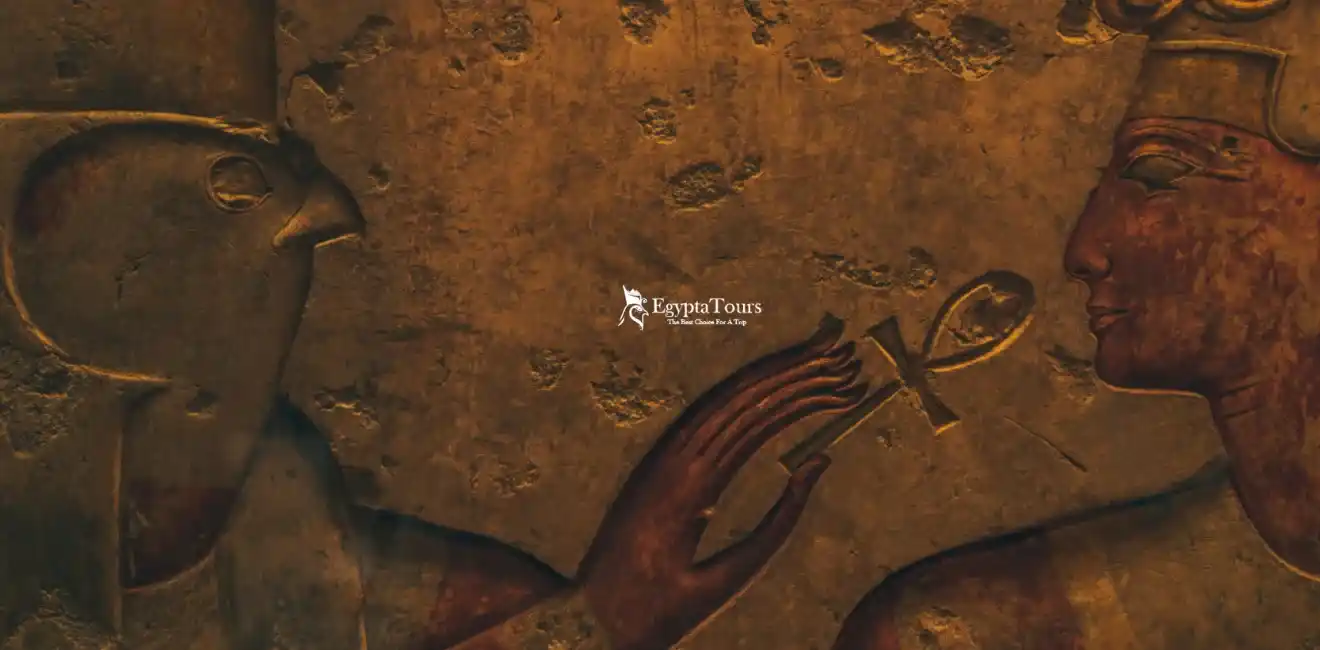
Isis, pregnant with Horus, hides from Seth who sees the unborn child as a threat, in a thicket of papyrus in the Nile Delta. This place is called Akhet meaning “Papyrus Thicket” in Egyptian and is referred to by Greek writers as Khemis, said to be near the city of Buto. However, in the myth the physical location is less important than its nature as a symbol of seclusion and safety.
The special status of the thicket is emphasized by its frequent depiction in Egyptian art. However, in most events in Egyptian mythology, the background is often described or hinted at with discretion. In this thicket, Isis gives birth to Horus and raises him earning it the name “Nest of Horus”. The image of Isis nursing Horus is also frequently depicted in Egyptian art.
Some texts describe Isis traveling in the wider world, moving among ordinary people unaware of her identity, and even begging them for help. These actions are unusual as in Egyptian mythology, gods typically remain separate from humans.
As in the first part of the myth, Isis relies on other gods to protect her son during her absence. According to a magical spell, seven gods in the form of small scorpions accompany Isis and protect her when she seeks help for Horus. They even take revenge on a wealthy woman who refuses to help Isis by stinging her son forcing Isis to heal the innocent child.
Isis and the Magical Protection of the Child Horus
This story conveys a moral message that the poor can be more virtuous than the rich and highlights Isis’ compassionate nature. At this stage of the myth, Horus becomes a vulnerable child surrounded by dangers.
Magical spells using Horus’ childhood as a basis for magical incantations, diagnose Horus’ illnesses in various ways, from scorpion stings to simple stomach pains with the choice of illness depending on the spell’s purpose.
However, it is common for the divine child to be bitten by a snake reflecting the ancient Egyptians’ fear of snake bites and their venom. Some texts suggest these aggressive creatures are agents of Seth. Isis can then use her magical powers to save her son or call upon gods like Ra and Geb or threaten them to heal him.
As she represents the archetype of mourning in the first part of the story during Horus’ childhood, she plays the role of the perfect, selfless mother. Through healing magical spells, her efforts to heal her son extend to treating any patient.
The Conflict between Horus and Seth
The -Conflict -between -Horus -and -Seth
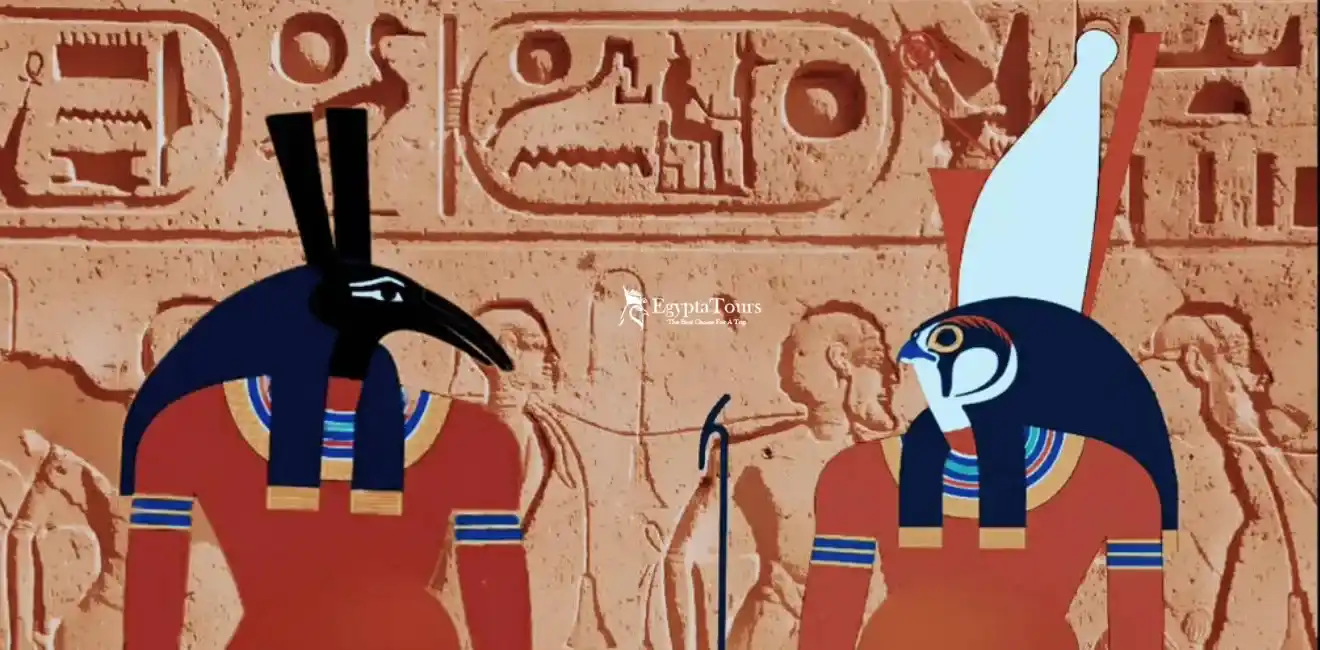
The next part of the myth begins with the adult Horus challenging Seth for the throne of Egypt. The competition between them is typically violent but can also be described as a legal trial before Ennead, a group of Egyptian gods deciding who has the right to inherit the throne.
The judge in this trial is likely Geb as the father of Osiris and Seth who had held the throne before them or possibly one of the creator gods, Ra or Atum, founders of the royal system. Other gods also play important roles, Thoth acts as a mediator in the conflict or an assistant to the divine judge. In the Contendings, Isis uses her intelligence and magical powers to help her son.
The competition between Horus and Seth is depicted in two contrasting ways, both present in the Pyramid Texts, the earliest source of the myth. In some spells, Horus is considered the son of Osiris and nephew of Seth with Osiris’ murder being the primary motivation for the conflict. Other stories describe Horus and Seth as brothers. This contradiction appears in later sources where the two gods can be called brothers or uncle and nephew in different parts of the same document.
Horus Strikes Seth in the Form of a Hippopotamus
This conflict involves several parts. The “Contendings” describes the gods appealing to other deities to settle the dispute competing in various contests like boat racing or wrestling as hippopotami to determine the winner.
In this version, Horus repeatedly defeats Seth, aided by most of the other gods. However, the conflict lasts eighty years, primarily because the divine judge, the creator god, favors Seth.
In modern ritual texts, the conflict is described as a great battle involving all followers of the two gods. The strife in the divine world extends beyond the two rivals. At one point, Isis tries to stab Seth with a harpoon while he is fighting her son but she accidentally stabs Horus, causing him to cut off her head in a fit of rage. Thoth replaces Isis’ head with that of a cow explaining why Isis is often depicted wearing a headdress with cow horns.
Seth justifies his continued aggression against Horus as punishment for the young god’s violence towards his mother. In a key episode, Seth sexually assaults Horus aiming to humiliate his opponent and also reflecting Seth’s violent and indiscriminate nature.
the oldest story about horus and seth
In the oldest story of this part, an incomplete papyrus from the New Kingdom, the sexual encounter begins when Seth asks to have sex with Horus who agrees on the condition that Seth returns some of his strength. This encounter puts Horus at risk as semen in Egyptian mythology is a powerful and dangerous substance akin to poison.
According to some texts, Seth’s semen causes Horus to become ill but in the “Contendings”, Horus thwarts Seth’s plot by catching Seth’s semen in his hand. Isis retaliates by placing Horus’ semen on lettuce that Seth eats. Seth’s defeat is marked when this semen appears on his forehead as a golden disk indicating he has been fertilized by his opponent and has “given birth” to the disk.
In the Contendings, Thoth takes the disk and places it on his own head. In older versions of the story, Thoth himself is the product of this anomalous birth. Another important episode involves the injuries inflicted by the rivals on each other: Horus injures or steals Seth’s testicles while Seth damages or removes one or both of Horus’ eyes, sometimes said to be torn apart.
The Symbolism of Horus’ Eye and Seth’s Injury
Seth’s injury symbolizes loss of virility and strength but the removal of Horus’ eye is more significant representing various concepts in ancient Egyptian religion. As a sky god, Horus’ right eye is the sun and his left eye is the moon so the theft or damage of his eyes represents the moon’s phases or eclipses.
Horus can recover his lost eye or other gods including Isis, Thoth and Hathor, can return or heal it. Egyptologist Herman te Velde suggests the story of the lost testicles is a late distortion of Seth losing his semen to Horus and the lunar-shaped disk on Seth’s forehead after fertilization is actually Horus’ eye.
If true, the episode of injuries and sexual assault forms a separate story where Seth attacks Horus and loses his semen then Horus retaliates and fertilizes Seth with Seth gaining Horus’ eye when it appears on his forehead. Since Thoth is a moon god among his other roles, it is plausible according to the Velde, that Thoth produces the eye and tries to mediate the conflict between the rival gods.
In any case, restoring Horus’ eye represents the moon’s return to full brightness, Horus’ restoration to the throne, and many aspects of Ma’at. Sometimes, Horus’ recovery of his eye is accompanied by Seth’s recovery of his testicles so both gods are restored to completeness by the end of the conflict.
Sources of the Myth of Isis and Osiris
The myth of Isis and Osiris was of great importance in ancient Egyptian religion and was popular among the general population. One reason for its popularity is its basis in a religious meaning which is that any deceased person can enjoy the afterlife. Another reason for its popularity is that the characters and emotions in it are closer to people’s real lives than any other Egyptian myth making the story more appealing to the general public.
As Egyptologist J. Gwyn Griffiths says, the myth conveys a strong sense of loyalty and devotion within the family. With this great appeal, this myth appears more than any other myth in ancient texts and exceptionally in a wide range of ancient Egyptian literature.
In the Ancient Texts
The myth is first mentioned in the Pyramid Texts which are the oldest ancient Egyptian funerary texts that appeared on the walls of the burial chambers of the pyramids at the end of the Fifth Dynasty during the 24th century BC. These texts, composed of spells or “utterances” of varying lengths, contain ideas that are supposed to date back to earlier eras.
These texts deal with the afterlife of the kings buried in the pyramids so they often refer to the myth of Isis and Osiris which is deeply rooted in the system of kingship and the afterlife. Many elements of the story such as the death and resurrection of Osiris and the strife between Horus and Seth, appear in the utterances found in the Pyramid Texts.
Representations and Rituals
Information about Osirian rituals comes from the walls of Egyptian temples dating back to the New Kingdom and up to the Ptolemaic Kingdom which extended from 323 to 30 BC. These ritual texts are another major source of information about the myth.
Magical Spells
Healing magical spells, used by Egyptians of all classes, contribute as a source for an important part of the myth in which Horus is poisoned or sick and Isis heals him. The spells connect a sick person with Horus spiritually so that the person can benefit from the gods’ efforts.
Greek and Roman Sources
Many ancient Greek and Roman writers who described Egyptian religion in its later period, recorded much about the myth of Isis and Osiris. Herodotus, in the 5th century BC, mentioned parts of the myth in his description of Egypt in his work known as The Histories and four centuries later, Diodorus Siculus appended a summary of the myth to his work known as The Library of History.
In the early 2nd century AD, Plutarch wrote the most complete and ancient version of the myth in his book On Isis and Osiris which is an analysis of ancient Egyptian beliefs. The story that Plutarch presents is the one that is often told in modern popular writings.
The End of the Myth
As with many parts of the myth, the ending is complex and varied. In most stories, Horus and Seth divide the kingdom between them which can equate to any of the many dualities the Egyptians saw in their world.
Horus’ portion may include the fertile Nile land, the heart of Egyptian civilization while Seth’s portion is the desert or foreign lands. Horus rules the earth while Seth inhabits the sky. Alternatively, the gods may divide the traditional halves of the country, Upper and Lower Egypt allowing either god to associate with either half.
However, in the Memphite Theology, the judge Geb divides the kingdom between the claimants, then reverses his decision leaving Horus in absolute control. In this peaceful union, Horus and Seth are reconciled and their duality becomes a unified whole restoring order after the violent conflict.
Another version focuses solely on Horus’ victory where Seth is not reconciled but is thoroughly defeated, sometimes exiled from Egypt or even destroyed. Details of his defeat and humiliation appear in later Egyptian texts where he is increasingly seen as a symbol of chaos and evil, no longer viewed by Egyptians as a necessary complement to the natural order.
In a great celebration among the gods, Horus takes the throne and finally rules Egypt as a legitimate king. The divine verdict that Seth is guilty compensates for the injustice of Osiris’ murder and completes his resurrection. Sometimes, Seth is forced to carry Osiris’ body to his tomb as part of his punishment.
The new king performs his father’s funeral rites and offers food sacrifices to support him, often including Horus’ eye symbolizing life and the flood. According to these sources, only through these acts can Osiris live in the afterlife and assume his role as king of the dead mirroring his son’s role as king of the living.
From then on, Osiris is concerned with the natural cycles of death and rebirth, like the annual growth of crops which mirrors his resurrection.
The Death and Resurrection of Osiris
At the beginning of the story, Osiris rules Egypt, inheriting the throne from his ancestors who trace their lineage back to the creator god, Ra or Atum. Isis is Osiris’ wife and along with Osiris and his killer Seth, she is one of the children of the earth god Geb and the sky goddess Nut.
There is little information about Osiris’ reign in the Egyptian texts, the focus is on his death and the events that follow. Osiris is associated with the life giving force, the just kingship and the rule of Ma’at which is based on the ideal natural order that remained a primary goal in ancient Egyptian culture.
In contrast, Seth represents violence and chaos. Therefore, the murder of Osiris symbolizes the conflict between order and chaos and the disruption of life caused by death.
Some versions of the myth tell of Seth’s motive for killing Osiris. According to a magical spell in the Pyramid Texts, Seth takes revenge on Osiris because Osiris kicked him but in a text from the Late Period, Seth’s grievance is that Osiris had a sexual relationship with Nephthys, Seth’s wife and the fourth child of Geb and Nut.
As for the murder itself, it is hinted at without explicit description. The Egyptians believed in the power of writing to influence reality so they avoided direct writing about highly negative events like Osiris’ death. Sometimes, they even denied Osiris’ death altogether, although the accumulated tradition about him makes his murder a clear fact.
Sometimes, the texts suggest that Seth took the form of a wild animal, like a crocodile or a bull to kill Osiris. Other stories indicate that Osiris’ body was thrown into the water or that he died by drowning which is why the Egyptians believed that those who drowned in the Nile were saints.
Even the identity of the victim varies across texts, sometimes, the murdered god is Haroeris, the elder form of Horus, who was killed by Seth and avenged by another form of Horus, the son of Haroeris and Isis.
By the end of the New Kingdom, the tradition developed that Seth cut Osiris’ body into pieces and scattered them throughout Egypt and the centers loyal to Osiris in the country claimed that the body or certain parts of it, were found near these centers. It was said that these body parts could number up to forty two, each corresponding to one of Egypt’s forty two nomes. Thus, the god king became an embodiment of his kingdom.
Isis Searching for Osiris
Isis tracks down Osiris’ body with the help of Nephthys. During the search for Osiris or the mourning for him, the two goddesses are often symbolized by kites or falcons, perhaps because kites travel long distances in search of carrion or because the Egyptians associated the birds’ cries with human lamentation or due to the connection between the goddess and Horus who is symbolized by the falcon.
In the New Kingdom when Osiris’ death and resurrection were linked to the annual Nile flood that made Egypt fertile, it was said that the Nile’s waters were equivalent to Isis’ tears of mourning or the fluids in Osiris’ body. Thus, Osiris came to represent the divine life giving force present in the river’s waters and the plants that grew after the flood.
The Resurrection of Osiris
The goddess finds Osiris’ body and restores it to life, often with the help of other gods including Thoth, the god with great powers of magic and healing and Anubis, the god of embalming and funerary rites. The efforts of these gods contributed to the establishment of the Egyptian mythology of embalming which aimed to protect and preserve bodies from decay after death through the mummification of corpses.
This part often extends to episodes where Seth or his followers try to destroy the body while Isis and her allies must protect it. Once Isis gathers Osiris’ body parts and restores him to wholeness, she, still in the form of a bird, breathes the spirit into his body with her wings and then mates with him. Apparently, Osiris’ resurrection was temporary and after this point in the story, Osiris is only mentioned as the ruler of Duat, the distant and mysterious realm of the dead.
Despite this, Osiris’ brief contact with Isis enabled him to make her pregnant with his son and rightful heir, Horus. Although Osiris himself lives only in Duat, he and his right to the throne will be reborn, in some form, in his son.
Plutarch’s Story
Plutarch’s cohesive story of this part of the myth differs significantly from that found in the known Egyptian sources in several ways. Seth, whom Plutarch refers to by the Greek name “Typhon” conspired with seventy two others against Osiris. Seth had a chest made to fit Osiris’ measurements then announced at a feast that he would give the chest as a gift to whoever fit into it. The guests, one by one, lay down in the chest but no one fit it except Osiris. When Osiris lay in the chest, Seth and his accomplices closed the lid on Osiris, sealed it and threw it into the Nile.
The chest containing Osiris’ body floated on the sea and reached the city of Byblos where a tree grew around it. The king of Byblos had the tree cut down to make a pillar for his palace with the chest still inside the tree. Isis then had to remove the chest from the tree to recover her husband’s body.
After taking the chest, she left the tree in Byblos where it became an object of worship for the people of the town. This episode of the myth, which is not taken from Egyptian sources, provides an explanation for the presence of cults of Isis and Osiris in Byblos in Plutarch’s time which may date back to the New Kingdom.
Plutarch states that Seth stole the body and dismembered it only after Isis had restored it to life. Afterwards, Isis found all the parts of her husband’s body and buried them, except for his gengenital member which had been eaten by fish in the river so she had to recreate it using magical spells. According to Plutarch, this is why eating fish was forbidden to ancient Egyptians. However, in Egyptian stories about the myth, Isis finds the genitals intact and the only similarity with Plutarch’s story is in “The Tale of Two Brothers” a popular story from the New Kingdom that shares some similarities with the myth of Isis and Osiris.
Another difference in Plutarch’s story is the birth of Horus. The image of Horus avenging his father was already present and born before Osiris’ death. This image is a second child, born prematurely, Harpokrates who was conceived by Osiris after his death and Isis. Here, there are two separate images of Horus in Egyptian tradition, each with a different place in Plutarch’s version of the myth.
The Statues Of Osiris
The -Statues -Of -Osiris
The Double Statue of Isis and Osiris
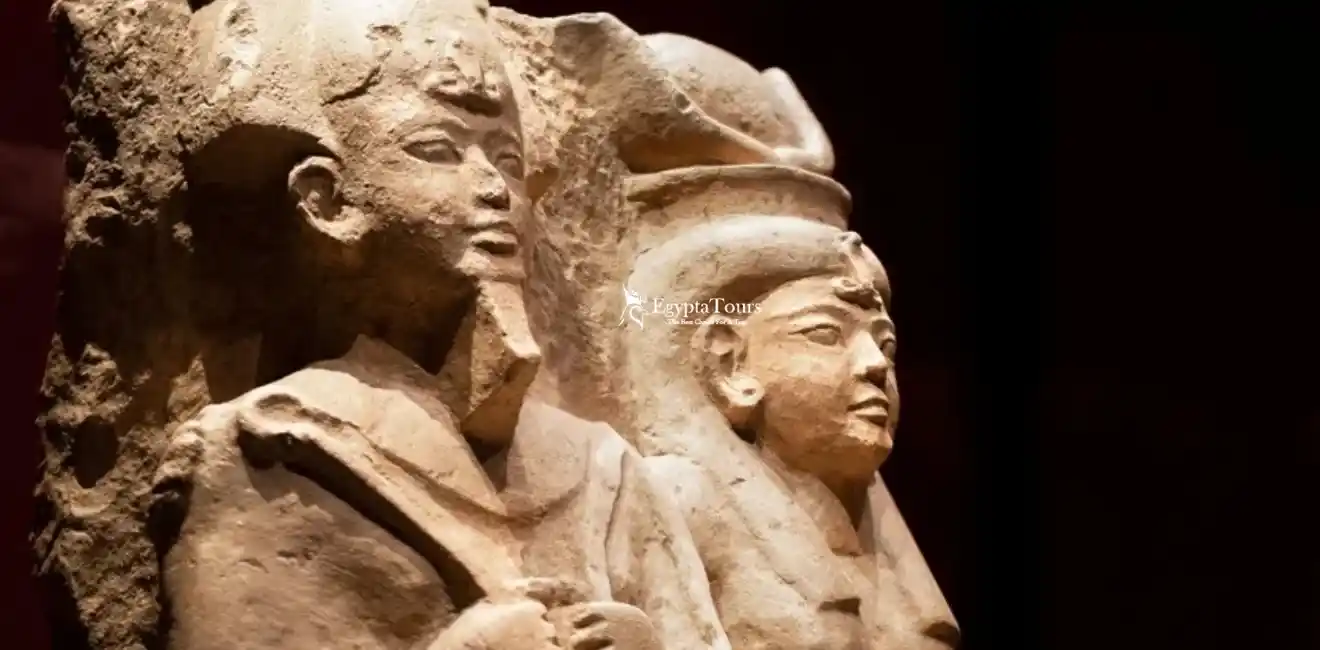
The Hurghada Museum of Antiquities is home to a remarkable double statue of Isis and Osiris, crafted from limestone and dating back to the Third Intermediate Period, approximately between 1069 and 664 BC. This exquisite piece showcases the exceptional skill and artistry of ancient Egyptian craftsmen reflecting the opulence and refinement of the era.
The statue depicts Osiris seated on his throne, adorned with the Atef crown and the uraeus symbolizing his royal authority. He is shown with a regal beard grasping the crook and flail, emblems of his power. Isis, his devoted wife, stands beside him wearing a long and flowing robe and the Hathoric crown with the solar disc and uraeus on her head. Her right arm is wrapped around Osiris conveying her unwavering loyalty and love.
According to Mena Makram, Deputy Director of the Hurghada Museum of Antiquities, this statue is a testament to the deep bond between Isis and Osiris as well as the Egyptians’ reverence for their gods. Isis’ legendary quest to reunite with her slain husband and restore him to life is a powerful symbol of the eternal nature of love and devotion.
The Statue of Osiris, Isis and Hathor
A companion statue featuring Osiris, Isis and Hathor is a remarkable example of ancient Egyptian sculpture. Commissioned by Psamtek, a high ranking official, it showcases the artistic excellence of the time. The three deities are depicted in a harmonious ensemble exuding serenity and majesty.
Osiris, the god of the dead and the afterlife was revered as the ruler of the underworld and the embodiment of eternal life. According to Heliopolitan cosmology, he was the son of Geb, the earth god and Nut, the sky goddess. Osiris was also the brother and husband of Isis, the goddess of motherhood, magic and fertility.
The statue portrays Osiris in his mummified form, seated on his throne with the Atef crown and uraeus on his head. He holds the crook and flail and his arms are crossed over his chest. The hieroglyphic inscription on the base of the statue is a testament to the enduring legacy of ancient Egyptian culture.
FAQs
Who Was Osiris?
Osiris was one of the most important and famous gods in ancient Egyptian beliefs. He was considered the god of fertility, agriculture, resurrection, life and death. He was usually shown as a green skinned god with a pharaonic beard partially wrapped in a mummy from below his chest wearing a distinctive Atef crown and holding a flail and a crook.
Osiris was also a god of the moon and it was believed that he controlled the cycles of the moon. He was also considered a god of floods and was called upon to ensure the flooding of the Nile and bring water to the agricultural lands.
What was Plutarch’s story?
Plutarch’s story of the myth differs from known Egyptian sources in several ways. Seth, whom Plutarch refers to as “Typhon”, conspired with 72 others against Osiris. Seth had a chest made to fit Osiris’ measurements and announced at a feast that he would give the chest as a gift to whoever fit into it. When Osiris lay in the chest, Seth closed the lid on him and threw it into the Nile.
The chest floated on the sea and reached the city of Byblos, where a tree grew around it. The king of Byblos cut the tree down to make a pillar for his palace with the chest still inside. Isis then took the chest and recovered her husband’s body. She left the tree in Byblos, where it became an object of worship for the people.
Plutarch says that Seth stole the body and dismembered it only after Isis had restored it to life. Isis found all the parts of her husband’s body and buried them, except for his genitals, which had been eaten by fish in the river, so she recreated it using magical spells. This is why eating fish was forbidden to ancient Egyptians.
In Plutarch’s story, Horus was already born and present before Osiris’ death, unlike the Egyptian tradition where Horus is born after his father’s death.
What were the Greek and Roman Sources of isis and osiris story?
Many ancient Greek and Roman writers who described Egyptian religion in its later period, recorded much about the myth of Isis and Osiris. Herodotus, in the 5th century BC, mentioned parts of the myth in his description of Egypt in his work known as The Histories and four centuries later, Diodorus Siculus appended a summary of the myth to his work known as The Library of History.
In the early 2nd century AD, Plutarch wrote the most complete and ancient version of the myth in his book On Isis and Osiris which is an analysis of ancient Egyptian beliefs. The story that Plutarch presents is the one that is often told in modern popular writings.
How was the Death and Resurrection of Osiris?
Osiris rules Egypt, inheriting the throne from his ancestors. He’s associated with life, just kingship, and Ma’at (natural order). Seth, his brother, represents violence and chaos. Seth kills Osiris, symbolizing conflict between order and chaos. The murder’s details are unclear, with various texts giving different motives and methods.
Isis, Osiris’ wife, searches for his body with Nephthys’ help. They find it, and with Thoth and Anubis, restore Osiris to life temporarily. Isis breathes life into him and conceives Horus. Osiris then becomes ruler of Duat, the realm of the dead, and his right to the throne is passed to Horus.
Egyptians believed Osiris’ resurrection was temporary, and his story influenced their funerary practices, like mummification, to preserve bodies for the afterlife.
What was the Symbolism of Horus’ Eye and Seth’s Injury?
Seth’s injury symbolizes loss of virility and strength but the removal of Horus’ eye is more significant representing various concepts in ancient Egyptian religion. As a sky god, Horus’ right eye is the sun and his left eye is the moon so the theft or damage of his eyes represents the moon’s phases or eclipses.
Horus can recover his lost eye or other gods including Isis, Thoth and Hathor, can return or heal it. Egyptologist Herman te Velde suggests the story of the lost testicles is a late distortion of Seth losing his semen to Horus and the lunar shaped disk on Seth’s forehead after fertilization is actually Horus’ eye.
What was the Origin of the Name “osiris”
The name Osiris comes from the Greek Ὄσιρις, adapted from the Egyptian name wsjr (Asar, Usar, Usir, Wesir or Osir). Its origin and meaning are unclear with proposals including:
– Derived from wsr (powerful)
– Compound of st jrt (seat of the eye)
– Referring to “the producer, something made” (Osiris as a product of embalming)
– Alternative readings: sjr (Muchiki), jsjrj (Allen meaning “male generative principle”)
How was the Appearance of Osiris?
Osiris is depicted wearing the Atef crown, holding a crook (symbolizing a shepherd god) and flailing (symbolism unclear). He’s shown as a pharaoh with green (rebirth) or black (Nile fertility) skin, often as a mummy.
How was the Judgment Scene of Osiris?
In the Book of the Dead, Osiris judges the dead (like Hunefer) in the Hall of Judgment. Anubis leads, heart is weighed against Maat’s feather, Ammit waits, Thoth records. If the heart is light (life lived by Maat), Horus presents the deceased to Osiris, if not, Ammit devours them. This judgment idea arose in the Old Kingdom involving 42 judges and the negative confessions.