





Ancient Egyptian Astronomy
Ancient Egyptian astronomy is one of the greatest testaments to the ability of humans in pre-modern scientific eras to explore the secrets of the heavens and understand the movement of celestial bodies. For the Egyptians, astronomy was not merely a means of entertainment or theoretical knowledge; it was a science closely linked to daily life, religion, agriculture, and politics.
The ancient Egyptians viewed the sky as a living divine stage where the gods moved and stories of creation and resurrection were told. By observing the stars, planets, the sun, and the moon, they were able to lay the foundations of an integrated civilization built in harmony with the universe.
Studying this science reveals how the ancient Egyptians were able to establish a sophisticated calendar and build pyramids and temples that aligned with celestial phenomena with astonishing precision making astronomy one of the pillars of their great civilization.
When we examine the details of ancient Egyptian astronomy we find that it was not a separate science from other aspects of life. Rather, it was integrated into architecture, the arts, religious rituals, and even agriculture.
The Egyptians viewed the sky as the language of the gods and through the stars and planets they sought to understand divine will. The Egyptians also relied on observing the movement of the stars to determine directions and build temples and pyramids.
They also created one of the oldest solar calendars known to history, This ancient science gave them the ability to regulate agricultural seasons and link religious holidays to astronomical cycles reflecting their early awareness of the importance of the sky to the continuation of life on Earth.
Through ancient texts and drawings on the walls of temples and tombs we can discern the depth of the relationship between ancient Egyptians and ancient Egyptian astronomy as this science represented a tool for approaching the gods and organizing society.
Ancient Egyptian Astronomy in Architecture and Temples

Ancient-Egyptian-Astronomy-in-and-Temples-EgyptaTours
Ancient Egyptian astronomy was surprisingly linked to architecture. Pyramids and temples were not built haphazardly, but were designed with extreme precision to align with the positions of the stars and the sun.
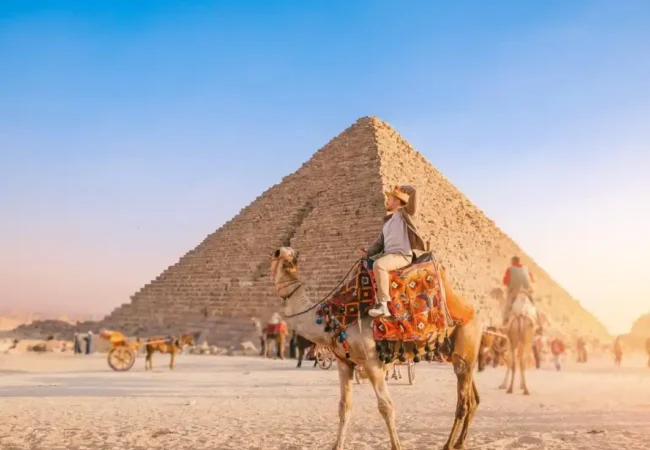
For example, the Great Pyramid of Giza is oriented to true north with astonishing accuracy demonstrating the builders’ reliance on observing the stars to determine directions.
Large temples such as the Temple of Abu Simbel were designed so that the sun’s rays would enter the Holy of Holies on specific dates associated with religious and political events confirming that astronomy was the cornerstone of the planning of these structures.
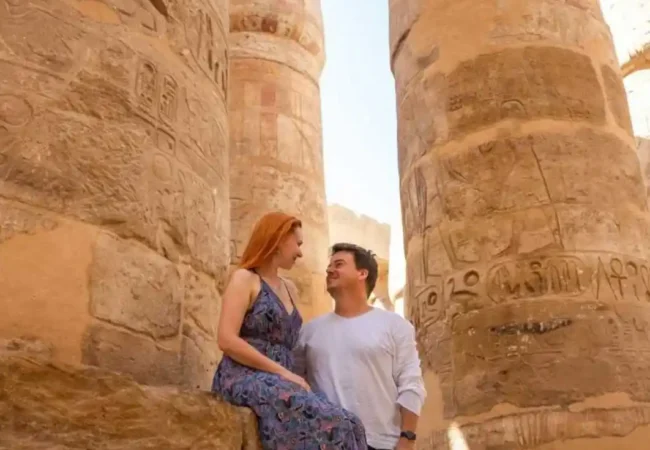
It was not merely a matter of decoration for the temples it was part of the belief that the king sat on a throne in harmony with the universe, and that his authority was directly linked to the heavens. This is also evident in the Karnak temples which were built on specific axes aligned with the sunrise on the winter solstice.
Ancient Egyptian Astronomy and the Construction of the Great Pyramid
The Great Pyramid of Khufu is a significant example of the use of ancient Egyptian astronomy in construction. The builders relied on the star “Serpent” in the Draco constellation to determine north. The pyramid’s internal openings were oriented toward specific stars such as Orion’s Belt associated with the god Osiris, and the polar stars which were considered eternal stars.
This orientation was not merely a matter of engineering precision it also reflected a religious belief that the pharaoh, after his death, ascended to heaven to join the gods and eternal stars.
The pyramid’s design also embodied the ancient Egyptian philosophy of immortality linking the king’s life on earth with his journey through the heavens. This harmony between religion, astronomy, and engineering reflects an unprecedented level of cosmic awareness among the Egyptians.
Ancient Egyptian Astronomy and Solar Temples

Ancient-Egyptian-Astronomy-and-Solar-Temples-EgyptaTours
Ancient Egyptian temples clearly embody the relationship between astronomy and religion. At the Abu Simbel Temple astronomical creativity is evident when the sun’s rays shine directly onto the statues of the gods and Ramses II twice a year in a scene that embodies the king’s connection to the gods.
At the Karnak Temple we notice that its design follows the direction of sunrise at the winter solstice reflecting the connection of religious rituals to the movement of celestial bodies.
These phenomena were not merely natural displays; they were carefully considered rituals aimed at affirming the idea of comic order and connecting the king to the gods. Through these astronomical phenomena the Egyptians sought to emphasize that earth and heaven function in perfect harmony, and that the king is the guarantor of this cosmic order.
Ancient Egyptian Astronomy and the Calendar
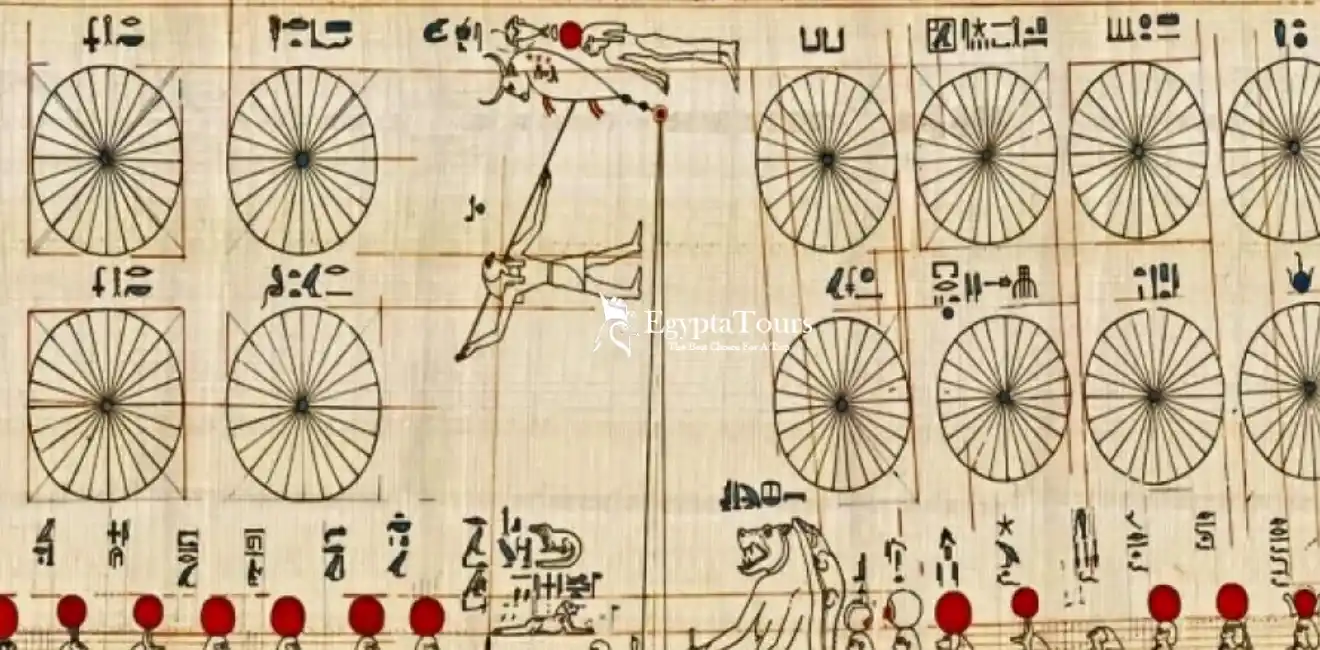
Ancient-Egyptian-Astronomy-and-the-Calendar-EgyptaTours
The Egyptians created one of the first solar calendars an achievement that reflects the sophistication of ancient Egyptian astronomy. They relied on the solar cycle dividing it into 365 days spread over 12 months, each of 30 days with five additional days called intercalary days.
The appearance of the star Sirius also signaled the beginning of the annual flooding of the Nile River making this star the cornerstone of timekeeping. This precise system enabled the Egyptians to accurately record agricultural seasons and religious celebrations. This calendar also became the basis for later timekeeping systems in other civilizations such as Greece and Rome.
Ancient Egyptian Astronomy and Agriculture

Ancient-Egyptian-Astronomy-and-Agriculture-EgyptaTours
The Egyptian farmer relied on ancient Egyptian astronomy to organize his agricultural life as the agricultural seasons were linked to the cycles of the Nile and the stars. The year was divided into three main seasons the flood season, the growing season, and the harvest season.
These seasons coincided with specific astronomical phenomena such as the rising of the star Sirius. Thus, the daily life of the Egyptians was directly linked to the sky with astrology becoming an essential tool for securing food and life. Through this connection the Egyptians lived in harmony with the universe, planting and harvesting according to a sacred celestial rhythm that ensured stability and prosperity.
Tools of Ancient Egyptian Astronomy
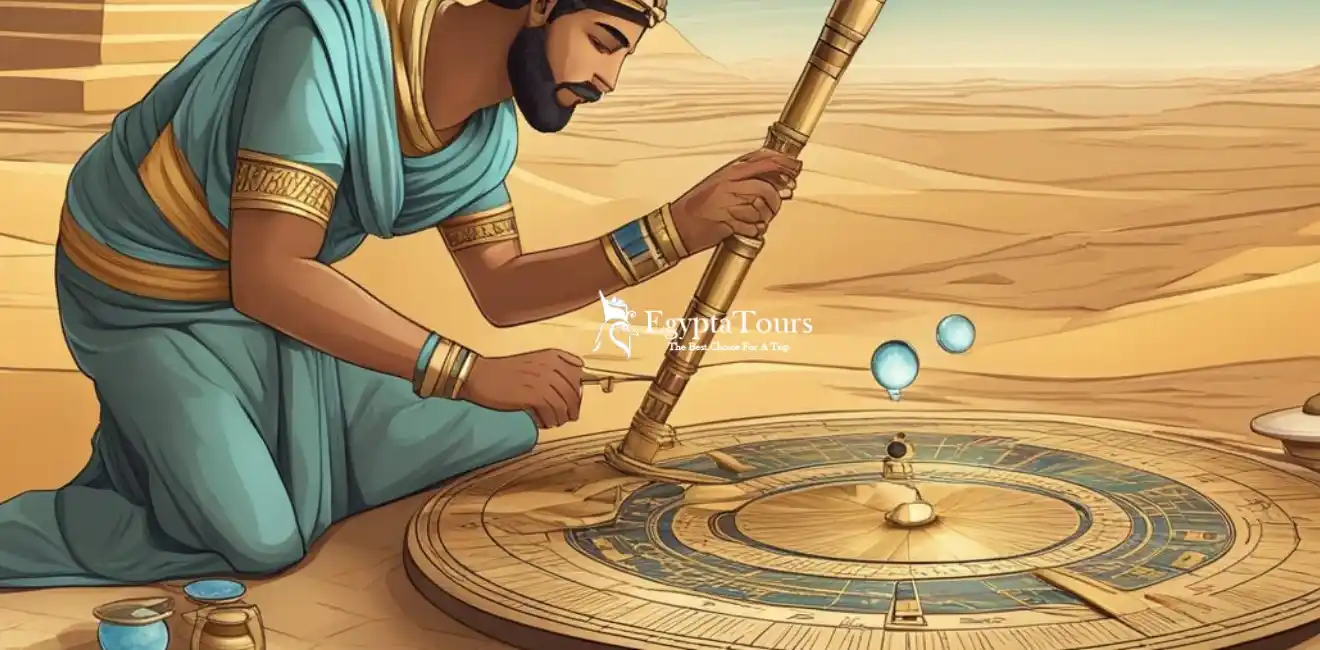
Despite the simplicity of the tools used by the Egyptians Egyptian astronomy demonstrated great skill in observation. Among the most important of these tools were the “merkhet,” a tool that relied on a vertical string to accurately determine directions, and the “pi,” which helped observe the stars.
They also used ropes and simple measurements accurately determined locations, enabling them to build pyramids and temples that were in stunning harmony with celestial phenomena. Despite their lack of telescopes or advanced instruments, their precision in astronomical calculations proved they were natural scientists.
Stellar Division and Time in Ancient Egyptian Astronomy
The Egyptians divided the sky into 36 constellations known as “Decans.” Each Deccan appeared on the horizon approximately every ten days. Thus, they were able to divide the night into precisely calculated night hours which were used to organize religious rituals and celebrations.
These star tables appeared on tomb walls and ceilings as celestial maps that guided souls on their journey after death. This knowledge was not born of chance, but rather the result of long-term and careful observation of the movement of the stars over centuries.
Conclusion
Ancient Egyptian astronomy was an integrated lifestyle that combined religion, agriculture, politics, and the arts. Through it, the ancient Egyptians embodied their cosmic vision that connected the earth and the heavens.
They were truly pioneers in understanding the secrets of the universe leaving behind an enduring legacy that continues to amaze and inspire admiration to this day. Perhaps the most important benefit we can learn from them today is their understanding that humans cannot be separated from the universe, but rather are part of a greater system operating in harmony and eternal rhythm.
FAQS
How did the ancient Egyptians use astronomy in their daily lives?
The ancient Egyptians relied on ancient Egyptian astronomy to regulate agricultural seasons by tracking the movement of the star Sirius. They also used it to determine the dates of religious holidays and rituals associated with the gods. Astronomical observations also helped them build accurate calendars and align their daily activities with the cosmic order.
What tools did the Egyptians use in astronomy?
The ancient Egyptians did not rely on sophisticated instruments. Instead, they developed simple and effective methods such as the merkhet for determining directions and the pi for observing the stars. They also used ropes and simple measuring instruments.
These tools enabled them to build pyramids and temples with astonishing astronomical accuracy that continues to impress scholars to this day.
What is the relationship between ancient Egyptian astronomy and religion and the gods?
The religious beliefs of the ancient Egyptians were closely linked to astronomy. They considered the sun, moon, and stars to be embodiments of the gods. The god Ra represented the sun, and the goddess Nut represented the sky. The polar stars were associated with immortality and eternity, and astronomy served as a bridge between the earthly world and the heavenly world.
How did ancient Egyptian astronomy influence other civilizations?
The influence of ancient Egyptian astronomy was transmitted to Greek civilization through the Library of Alexandria where Egyptian and Greek knowledge blended to form the basis of Hellenistic astronomy. Through this knowledge astronomical ideas were transmitted to Europe helping to inform the writings of astronomical sciences that later developed in the Middle Ages and the modern era.
About EgyptaTours

EgyptaTours is a name synonymous with trust, excellence, and unforgettable travel experiences, proudly standing as one of the leading travel agencies in Egypt. Renowned for its deep expertise, personalized service, and carefully crafted itineraries, EgyptaTours serves as the ultimate gateway to discovering Egypt in its most authentic and inspiring form.