The Screaming Mummy
Ancient Egyptian civilization and its Pharaonic treasures are an endless source of...



In most modern works the ancient Egyptian army appears to be a fully professional highly trained army equipped with an array of advanced ancient Egyptian weapons and highly organized in combat.
This image only applies to the period of the New Kingdom’s prosperity between 1550 and 1077 BC, and to some extent to the Middle Kingdom from 2055 to 1650 BC when Egypt began establishing its first professional standing army during the reign of King Amenemhat I around 1991 BC.

Ancient-Egyptian-Weapons-EgyptaTours
Ancient Egyptian weapons witnessed significant development over time. This was not a luxury, but rather a necessity imposed by reality. In the early days specifically from the pre-unification era until the Old Kingdom combat tools such as the bow, axe, and knife served their purpose.
They were used to repel internal disturbances or to control surrounding tribes who possessed similar weapons.
There were no significant differences in effectiveness. However with the expansion of the Egyptian state and its interaction with more equipped external forces it became important to develop and upgrade weapons to meet new challenges.
This is when clear changes began to emerge in the quality of weapons and their manufacturing methods to meet the needs of armies in major battles outside Egypt’s borders.
Early-Ancient-Egyptian-Weapons-EgyptaTours
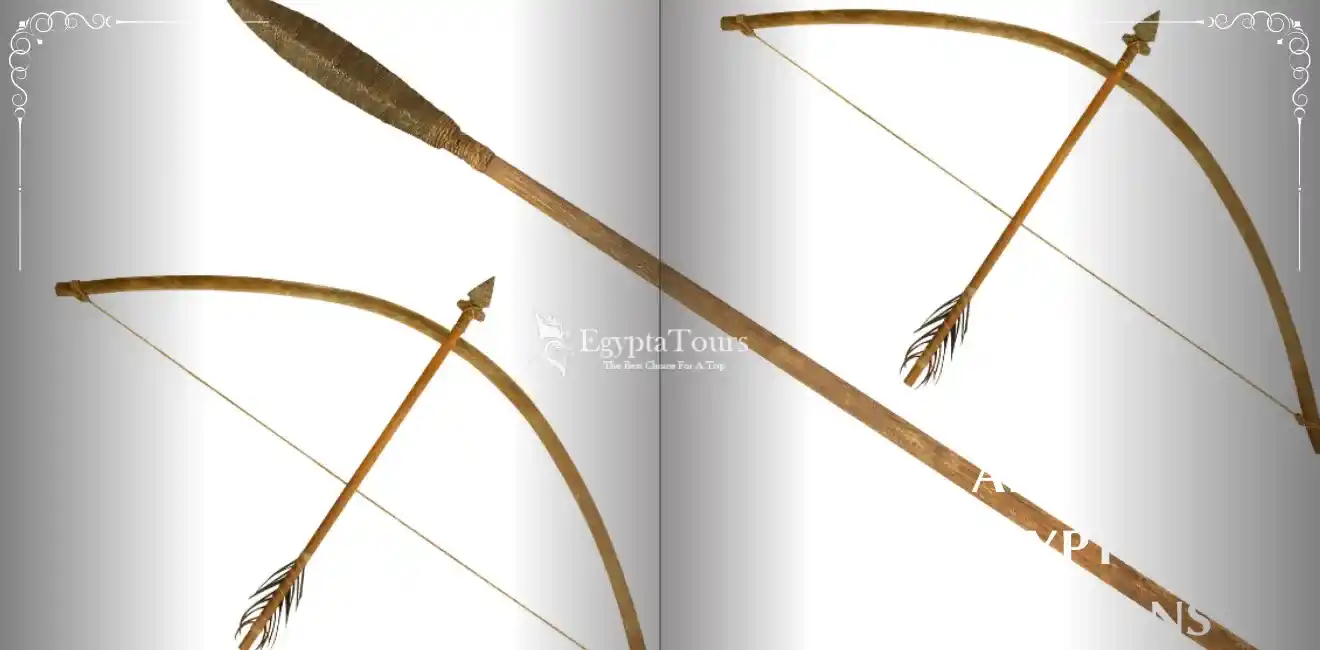
In the early days of Egyptian rule, specifically during the Early Dynastic Period (3150–2686 BC), ancient Egyptian weapons reflected the pre-war environment. Soldiers relied on maces, daggers, and spears.
These tools were sufficient at that time, as the spear itself was not a new invention. Rather it evolved from hunting tools used before the establishment of the state with some minor changes such as the shift from flint to copper for daggers. However flint remained used for spearheads and arrowheads for a long time especially during the Old Kingdom.
The fighter at that time carried a spear and dagger and used a traditional shield often made of animal skin or compressed plants such as papyrus.
Later archers appeared alongside the foot soldiers using primitive single-arch bows firing arrows made of reeds tipped with flint or copper.
These bows were relatively weak hitting accurately only at close ranges. Their use required considerable effort, as archers in this era were not professionals, but rather peasants called upon to fight without any real training or combat background, and often had no hunting experience.
The actual developments in the structure of the army and the quality of ancient Egyptian weapons did not begin until the beginning of the Middle Kingdom.
In the period following the collapse of the Old Kingdom known as the First Intermediate Period (2181–2055 BC), the central government lost complete control, and power became distributed among provincial princes who freely exercised their influence sometimes extending beyond their own regions.
From this turmoil emerged Mentuhotep II ruler of Thebes who was able to transform his city from a marginal position into a center of power through sheer force of arms and organization. He defeated the rulers in the north specifically at Herakleopolis around 2055 BC, reuniting Egypt under Theban rule and establishing a new more organized era that served as the nucleus for a stronger and more sophisticated army.
The-Middle-Kingdom-Army-Ancient-Egyptian-Weapons-EgyptaTours
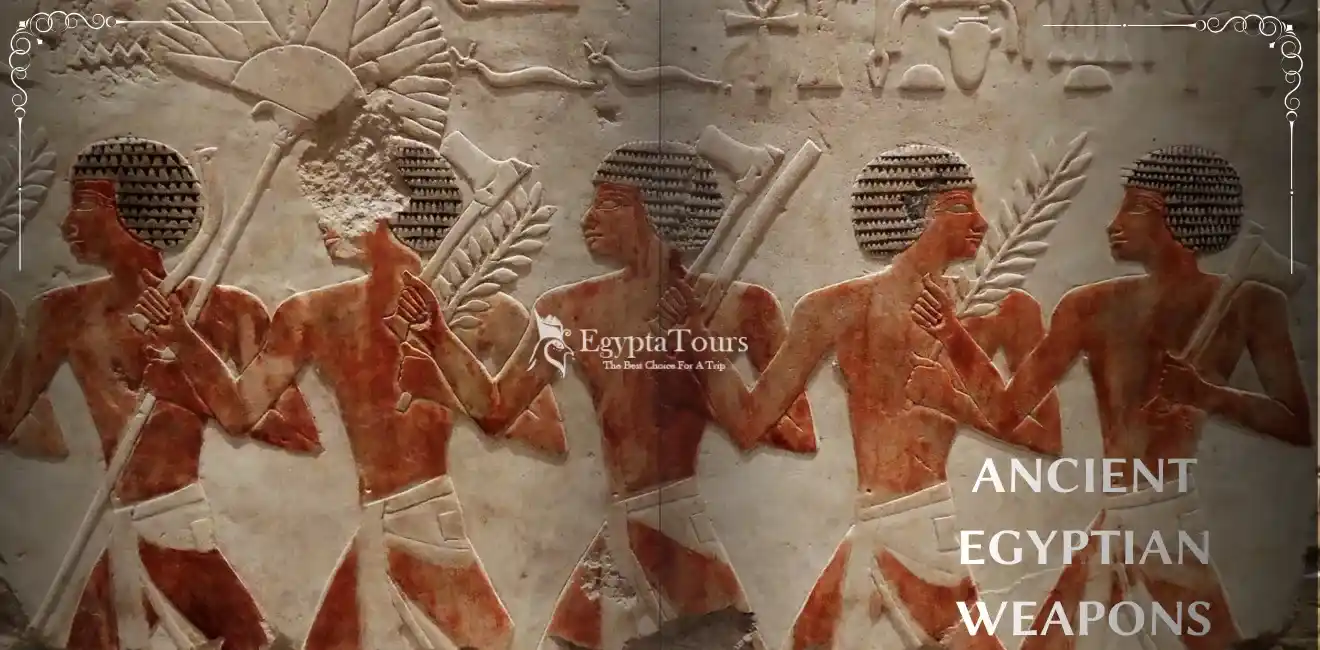
Although Mentuhotep II was the real initiator of the Middle Kingdom through his reliance on military force it was Amenemhat I who laid the true foundation for the establishment of a professional army for the first time in Egyptian history.
Although ancient Egyptian weapons were suitable for use and acceptable in performance they still lacked the significant advancements seen in later periods.
At that stage archers still used the same simple bow relying on a single string with arrows made of reeds and copper or flint tips.
These arrows were carried in a long quiver and slung over the shoulder using a belt.
The sword was not as we know it today, but rather a long dagger with its copper blade weakly attached to the hilt making it vulnerable to disintegration if struck hard reducing its effectiveness in close combat.

The-most-important-weapons-used-in-the-army -EgyptaTours
The war axe and the spear. The axe in particular was more like an agricultural tool than a combat weapon. It consisted of a long wooden shaft with a half-moon-shaped copper blade attached to its end.
It required both hands to use in a sideways motion similar to a sickle requiring skill and strength, but it was effective in close combat.
In terms of protection soldiers did not have metal armor as in later eras. Instead they were content with simple leather clothing in the form of breastplates or short leather skirts.
This protection was very weak against arrows or axe blows, but in the end it was better than nothing.
An Egyptian soldier in the field was often equipped with a light sword, a spear a simple shield, and perhaps a spare dagger for hand-to-hand combat.
Archers on the other hand were armed only with a bow and arrows and perhaps a small dagger if necessary.
In the early New Kingdom shields were made of wooden planks covered with animal hide to provide a simple form of protection on the battlefield. Soldiers continued to use swords made of bronze composed of copper and tin even after the famous Battle of Kadesh in 1274 BC.
This battle pitted the armies of Ramesses II, one of the greatest kings of Egypt against the Hittite forces led by King Muwatalli II. Details of the battle are recorded in inscriptions and monuments along with the Pentawer Poem and the official text known as the “Bullet.”
All of these depict Ramses II as a victorious hero, but recent studies indicate that what happened was not an outright victory for either side but rather a draw with each side claiming victory.
Despite the later advent of iron Egypt was unable to manufacture sufficient quantities of ancient Egyptian iron weapons. This was because the manufacturing process required charcoal from burning wood, and Egypt due to its geography was not rich in trees.
As the country entered what is known as the Second Iron Age around 1000 BC reliance on bronze weapons continued because iron was not sufficient to meet the army’s needs.

The-Bravery-of-Ramses-II’s-Son-in-Defending-Egypt-EgyptaTours
Merenptah son of Ramses II was able to repel the attack of the Libyans and the Sea Peoples using the same ancient bronze weapons. Ramses III repeated the same scenario in his great battle against the Sea Peoples achieving the last major victory for ancient Egypt, Ramses III is considered the last powerful ruler of the New Kingdom.
He possessed an organized army equipped with war chariots iron weapons, and trained manpower but all these factors were insufficient in the absence of strong leadership.
With the decline of the New Kingdom the army also began to lose its influence. Although other kings emerged in later periods during the Third Intermediate Period and the Late Period most of them lacked the resources or expertise necessary to build a strong army capable of waging wars as had been the case in the past.
In conclusion, ancient Egyptian weapons were an essential part of the state’s strength and its ability to defend and expand. Soldiers used them in wars to protect the land and implement the kings’ plans.
These weapons evolved over the ages in a practical manner that suited the challenges and military circumstances of each period reflecting the ancient Egyptians’ awareness of the importance of weapons to the survival and stability of civilization.
The ancient Egyptians used swords bows, spears, axes, and daggers, in addition to chariots, which were a strategic tool in warfare.
Yes, most weapons were manufactured in special workshops in Egypt using copper then bronze. Over time iron was used in some later periods.
Weapons were the primary factor in the strength of the army helping to protect the state from invaders and expand its borders. They were also linked to soldier training and organized battle plans.




Explore our top-rated Egypt travel packages and embark on an unforgettable journey. From the Pyramids of Cairo to the magical temples of Luxor, Aswan, and Abu Simbel, discover expertly curated tours designed for your perfect Egyptian adventure