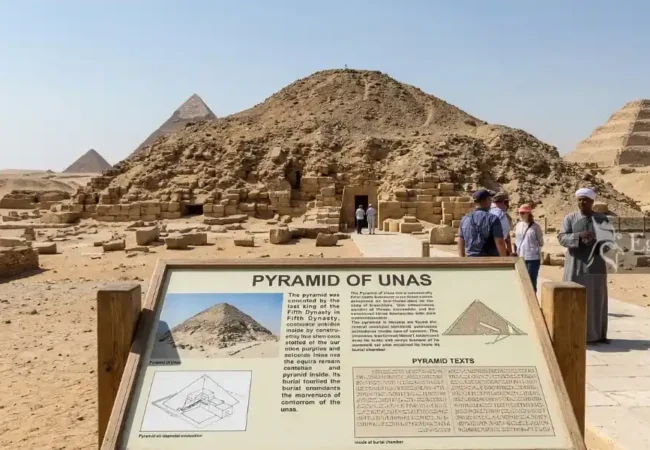
Explore the Pyramid of Unas in Saqqara
The Pyramid of Unas, an ancient Egyptian marvel, holds the secrets of...



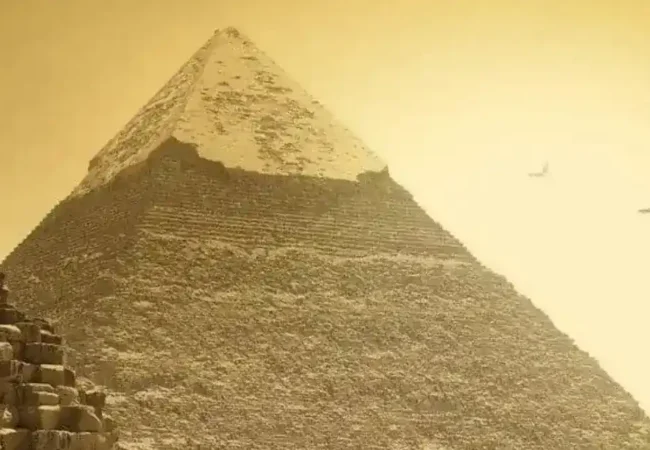
The Black Pyramid is one of the most important and interesting monuments in the history of ancient Egyptian civilization and is distinguished by its unique design It is an important stage in the development of the construction of the Giza Pyramids.
This pyramid is considered a symbol of the engineering and architectural progress in Pharaonic Egypt It also reflects some of the religious and cultural beliefs prevailing in that period The Black Pyramid carries stories that indicate its prominent position in history.
We will learn together about some of the details of the pyramid, so follow us.

History-of-the-Black-Pyramid-EgyptaTours
The construction of this pyramid dates back to the Middle Kingdom It was built by King Amenemhat III and is considered one of the remaining pyramids built by the pharaohs The name of this pyramid from the beginning was Amenemhat the Mighty, then it was named the Black Pyramid as a result of the darkness surrounding it and the deterioration of its appearance so it looked like a pile of ash.
The Black Pyramid was discovered for the first time in history in the early nineteenth century by some researchers, and then many archaeologists from the General Authority for Antiquities in Egypt investigated and discovered the pyramid from the inside This pyramid contained many inscriptions that scientists found about their interpretation that are information about how the pyramid was built and the purpose of its construction.
This pyramid has now been transferred to the Cairo Museum For many visitors from inside and outside Egypt to enjoy it, and during a certain period the pyramid became attracting a very large number of archaeologists and lovers of creativity art and ancient Egyptian culture to study the pyramid and learn about its historical importance.
Despite this there is still a mystery about how this pyramid was built how it was carved in this way, and how it was built with these simple components.
One of the pyramids built in Dahshur it is about 75 meters high and tilted at an angle of 57 degrees.
Its base is about 105 meters This pyramid was made of mud bricks and consists of an entrance opening through which one enters the funerary temple surrounded by walls on all sides.
It contains 10 graves These graves together form the shape of a cross and are covered with many religious symbols and ancient Pharaonic inscriptions This pyramid was not used to bury the dead as it was distorted during the reign of Akhenaten.
This pyramid is divided underground into many corridors with a room containing the entrails and a coffin.
There were four other rooms underground that were also used to bury the dead There are many studies that have been done to find out the identity of those buried in these rooms, but they have not been reached Many people believed that they were relatives of King Amenemhat III.

Location-of-the-black-pyramid-EgyptaTours
This pyramid was built in Dahshur towards the east of the width and the Black Pyramid has two entrances one located in the southeastern corner and the other located in the southwestern corner.
Due to its location and the lack of sufficient engineering progress to ensure the sea level measurement and the construction of the pyramid using clay this pyramid sank more than once.
As a result of the sinking of the pyramid some parts of it were removed, and a lot of dust accumulated on it making its color black There are some parts of the Black Pyramid that are now displayed in the Egyptian Museum.
This pyramid is considered the third largest pyramid in Egypt, and before it comes the Pyramid of Khufu and the Pyramid of Khafre The ancient Egyptians took about 20 years to build this pyramid and it contains complex ventilation systems and there are many artifacts around it.
Although the Black Pyramid was considered one of the architectural miracles at that time, it later faced many problems the most important of which is the lack of a strong structure for the pyramid as it was built entirely of mud bricks, and it is also lower than sea level which led to the discharge of groundwater into it with the accumulation of some clay materials coming with the Nile waters which led to the deposition of some black materials on the pyramid which is why it was named the Black Pyramid.
The Black Pyramid was of great importance to the ancient Egyptians, as it was built as one of the memorials in which King Amenemhat III.
The last king of the Twelfth Dynasty, was honored This pyramid is considered one of the most important buildings that were built during the Middle Kingdom, and it expressed the ingenuity of the ancient Egyptians in architecture and arts Although it was made of mud bricks and was exposed to flooding more than once it still exists until now.

The-Pyramids-in-Egypt-EgyptaTours
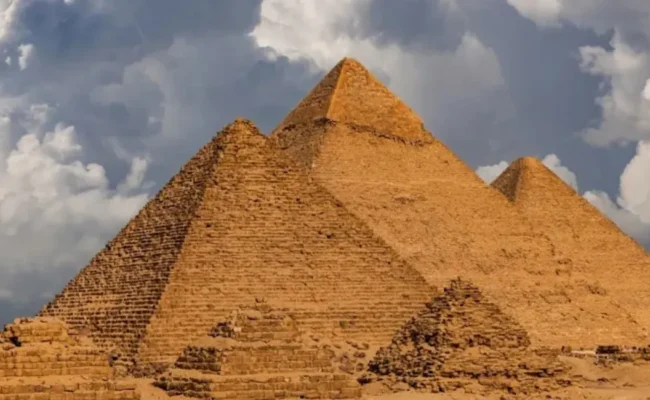
The Pyramids of Giza in Egypt have won the admiration of all people as they considered them one of the wonders of the world Although these three pyramids are considered among the most famous pyramids not only in Egypt but all over the world, there are 11 other smaller pyramids than these pyramids that demonstrated the ingenuity of the ancient Egyptians in architecture.
These pyramids were built to be a place for burying kings and tombs for them because of their belief in resurrection after death The tombs began with a small hole and then developed to be a stone and then developed to be a pyramid.
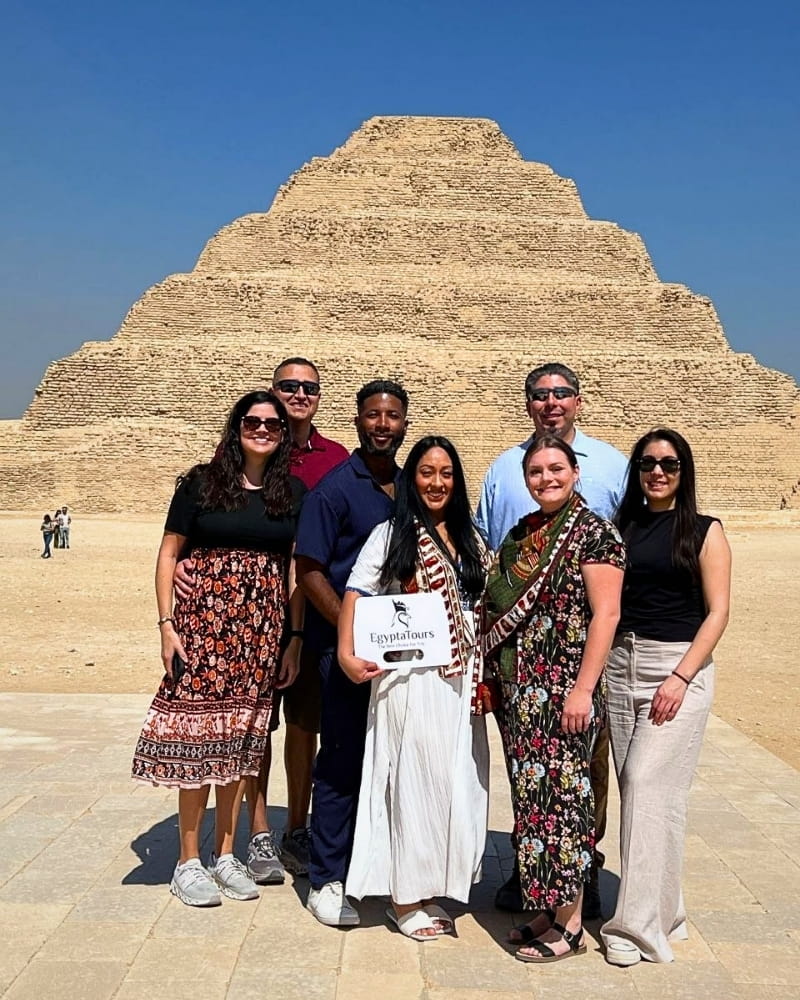
The ancient Egyptians tried more than one attempt during the reign of many kings until the familiar shape of the pyramid appeared These pyramids were initially built from mud bricks and then developed to be the shape of the stepped pyramid like the Saqqara pyramid and then developed and was made of stone like the Giza pyramids.
At the end of this article we have learned about the Black Pyramid and how it was built with skill relying on some simple materials such as mud bricks, and how the ancient Egyptians excelled in building the pyramids which were tombs for them.
The Black Pyramid, located at Dahshur, was built during the reign of Pharaoh Amenemhat II and is known for its unique, steep angle, which resembles the earlier Bent Pyramid.
Excavated by Jacques de Morgan in the late 19th century, the pyramid’s dark, weathered appearance comes from the limestone casing that has eroded over time.
It is part of a larger mortuary temple complex, which was once a grand site dedicated to the king’s afterlife rituals. Despite its damaged state, the Black Pyramid remains an important example of Middle Kingdom pyramid construction.
The Pyramid of Amenemhat III is called the Black Pyramid because its dark mudbrick core became visible after the outer limestone covering was removed. The core was made of mud bricks from clay soil which has a dark color.
Over time, most of the outer casing stones which were made of smooth white Tura limestone, were taken away or worn down. People reused these stones in other buildings in old Cairo.
Because the white outer stones disappeared, the dark mudbrick core could be clearly seen. This made the pyramid look dark and damaged which is why it became known as the Black Pyramid.
The Black Pyramid was part of a funerary complex that included a mortuary temple, a causeway and other buildings. These parts were used to perform burial rituals and give offerings to the dead pharaoh.
There are four burial chambers underground, but the kings buried there are not known. Many people believe that two of these chambers belonged to Amenemhat IV and Queen Neferusobek.
The king’s section had a burial chamber with a large stone sarcophagus. Its design was similar to the outer wall of Djoser’s Step Pyramid in Saqqara.
Two of his queens were buried under the pyramid. The first chamber in the queens’ area was on the southwest side of the pyramid. It belonged to Queen Aat, while the owner of the second chamber is unknown.
Even though both chambers were robbed and most of the objects were stolen, archaeologists still found some items that the thieves left behind including a canopic jar that belonged to Queen Aat.
The inside of the upper part of the pyramid was made of mud bricks and did not have internal walls. Many people believe it was designed this way to make it lighter because the pyramid was built close to the Nile.
The pyramid was built on mudstone which was not strong enough to hold its heavy weight. Because of this, the pyramid slowly started to sink, similar to what happened to the Bent Pyramid of Sneferu in Dahshur many centuries earlier. The two pyramids are only about one and a half kilometers apart.
The outside layer was made of limestone, known as the shiny layer. Builders tried to keep it stable using evenly placed pegs. However, the pyramid later began to damage the chambers below. Workers tried to fix the problem by adding support beams and mud bricks to stop the sinking, but these solutions did not work well, so the pyramid was eventually abandoned.
The Black Pyramid had many structural problems. It was built in a very low area of Egypt, only about 10 meters above sea level. Because of this, groundwater from the Nile could seep into the pyramid.
There were many passages and chambers underground, but the pyramid did not have enough support above these spaces to carry the heavy weight. Builders also used mud bricks under the outer stones instead of strong stone blocks.
In the end, the pyramid started to sink and partly collapse. This happened because the underground chambers were not well supported, the building materials were not strong enough and the site was too low.
The construction of the Black Pyramid probably began early in the reign of Amenemhat III, around 1860 BCE. Building the whole complex may have taken about 10–15 years. This was a shorter time compared to the pyramids of the Old Kingdom. The reason is that builders used mud bricks instead of solid limestone blocks, which made construction faster and cheaper.
Excavations at Dahshur were carried out by the German Archaeological Institute. Their work showed examples of the large mud-brick structures used in the pyramid. These findings helped archaeologists understand how the layers of the pyramid were built.
The Black Pyramid of Amenemhat III stands tall at about 75 meters high, making it a huge and impressive ancient structure. The base of the pyramid is about 105 meters wide and its sides rise at a steep angle of 57 degrees which is different from many other pyramids.
It was built during the Middle Kingdom of Egypt and is mostly made from mudbrick and clay. The pyramid gets its dark black color from the limestone outer covering that surrounds the mudbrick inside.
At ground level, there is an entrance that leads to a large courtyard. In this area, there was a mortuary temple surrounded by strong protective walls.
Inside the temple area, there were ten deep shaft tombs carefully cut into the natural rock. These tombs were located between two strong walls.
The pyramid is built from east to west and it has two entrances placed on the southeast and southwest corners. The center of the pyramid was built as a large solid tower of mudbrick without inner walls, probably because the pyramid was built close to the Nile River and the builders wanted it to stay stable.
The design of the Black Pyramid shows the advanced engineering skills of ancient Egyptians. Today, visitors can explore this amazing pyramid in the Dahshur area of Egypt.
Despite being badly damaged, the Black Pyramid once contained the burial rooms of King Amenemhat III, his queen and several princesses. The mortuary temple, although mostly ruined, has an open courtyard with 18 granite columns shaped like sacred papyrus plants. Behind the courtyard there is a room used for offerings.
Inside the pyramid walls there are many small spaces (niches) that may have held statues of the king. A wide pathway with low brick walls on both sides connected the Black Pyramid and its mortuary temple to the valley temple. The valley temple had two open courtyards, with one terrace built higher than the other. The walls of the lower courtyard formed a gateway that looked like a tower.
In the courtyard, archaeologists found a limestone model of a 13th-dynasty pyramid with an underground chamber. To the west of the pyramid there are several tombs belonging to members of the royal family, including daughters of Amenemhat III. These tombs contained personal belongings and jewelry of the princesses.
The Black Pyramid also contained artifacts such as canopic jars and sarcophagi which help us understand the burial traditions and show how grand the pyramid was meant to be.
The beautiful Pyramidion of Pharaoh Amenemhat III is a special piece of art made around 1850 BC. It was the top stone that finished the Black Pyramid of Dashur. This important object, now in the Egyptian Museum, shows the skill of ancient builders.
The Pyramidion was found again in 1900 during a check in the Dashur area after thieves attacked the guards at the Saqqara necropolis. The basalt capstone is 1.85 meters wide at the base, 1.40 meters tall and weighs about 4.5 tonnes.
The east side shows a sun disk with magical uraei (cobra symbols) and wadjat (eye symbols) which represent the king’s eyes. The sun disk represents the god Ra and the word “Nefer” means beauty. The writing says, “Amenemhat sees the perfection of Ra.”
The north side shows the king’s high and honored status while the east side also wishes for the king to be ruler of the horizon and to travel across the magical sky.
The south side has the image of Imiut or Anubis, showing the king’s link to the western desert and his golden inheritance.
The west side shows Sokar-Osiris and Ptah, giving the king strength and life.
The name of the god Amun in Amenemhat’s cartouches was erased, probably during the rule of Akhenaten in the 18th Dynasty. This may mean the pyramidion had been lying on the ground since about 1350 BC. Some people think it was so well preserved that it might never have been placed on top of the pyramid.
The Black Pyramid is notable for its mudbrick core, a rare choice for royal pyramids. Unlike the mostly limestone-built pyramids, this one used a mix of mudbrick and limestone, which has caused its structure to deteriorate more than others.
The name comes from the dark appearance of the mudbrick core remaining after much of the outer casing has worn away. Originally, it was covered in smooth white limestone, but erosion exposed the darker inner layers.
Amenemhat III was a pharaoh of the 12th Dynasty, ruling during Egypt’s Middle Kingdom period. He’s known for stability and large building projects, including two pyramids, The Black Pyramid in Dahshur and another at Hawara.
It stands in the Dahshur royal necropolis, south of Cairo. This area was a popular burial site for Middle Kingdom pharaohs, with several pyramids nearby.
The pyramid’s mudbrick core was vulnerable to water damage and weathering. Over time, floods and erosion weakened the structure, leading to collapse and its current ruined state.
Yes, like many pyramids, it was looted in ancient times. Tomb robbers targeted the burial chambers and removed valuable artifacts, which is common for most Egyptian pyramids.
The Black Pyramid had sophisticated chambers and corridors. It included a network of tunnels, false passages, and traps to deter robbers. The main burial chamber lay deep inside, with a complex ventilation system.
Archaeologists found fragments of funerary equipment, stone sarcophagi, and some jewelry pieces. However, much was missing due to looting and decay.
Yes, his other pyramid is at Hawara, sometimes called the Labyrinth Pyramid. It’s better preserved and famous for its complex maze-like structure and underground chambers.
It shows the period’s architectural experimentation and shift from Old Kingdom styles. The use of mudbrick reveals adaptation to resource availability and construction challenges of the time.
Yes, Egypt’s antiquities authorities regularly work on stabilizing the site, preventing further erosion, and making it accessible for researchers and visitors.
Visitors can see the site but entry inside the pyramid is usually restricted due to safety concerns and preservation efforts.
Experts still debate why Amenemhat III chose mudbrick so heavily and whether the pyramid was truly finished or altered during construction.
It’s smaller and less durable due to materials and design. While Giza’s pyramids used mostly stone and lasted millennia, the Black Pyramid’s mudbrick core didn’t hold up as well.
The site offers insight into Middle Kingdom building techniques and the challenges of pyramid construction beyond the Old Kingdom era. It also highlights the risks of using mudbrick for large monuments.


Explore our top-rated Egypt travel packages and embark on an unforgettable journey. From the Pyramids of Cairo to the magical temples of Luxor, Aswan, and Abu Simbel, discover expertly curated tours designed for your perfect Egyptian adventure