


Church of St Sergius Bacchus: History & Visitor Guide
The Church of St Sergius Bacchus is one of the oldest and most ancient churches in Egypt also known as the ancient Church of Saint Abu Serga. It has great significance for Copts especially because of its long history since its construction until today.
It is also an ideal destination for tourists and visitors from all over the world to learn about ancient Coptic history and see the unique architectural style of that time, which is unlike any other architectural style.
It is also of great historical and religious importance. Let us take you with us on a historical journey full of fun and knowledge at the same time.
History of the Church’s Construction

Church-of-St-Sergius-Bacchus-Construction-History-EgyptaTours
The Church of St Sergius and Bacchus was built in the Byzantine era and is considered an unprecedented model of early Coptic architecture. It includes a structure with three aisles, marble columns and ancient icons.
The Church of St Sergius and Bacchus is located in the Old Cairo area of Cairo. The church was built in the place where the Holy Family stayed during their journey to Egypt.
The church is located inside the Babylon Fortress specifically inside the religious complex near the Bene Ezra Jewish Temple and the Church of Saint Barbara.
It is worth noting that Saints Sergius and Bacchus are two soldiers in the Roman army, and the church was named after them. The church was built in the fourth century AD and was completed in the fifth century AD.
It is of great historical and religious importance. The Holy Family is referred to in these stories as the Virgin Mary and Jesus Christ peace be upon him, who sought refuge in Egypt in search of safety and escape from the brutality of King Herod.
The Religious Complex
It is the largest and oldest religious complex in Egypt and includes the Church of St Sergius and Bacchus. It was named so because it includes Islamic mosques Christian churches, and ancient historical Jewish temples. The religious complex is located in the Old Cairo area and entry is free. It is located near Mar Girgis Station.
It was named the Religious Complex because it combines the three heavenly religions in its ancient historical monuments. It includes Islamic monuments such as the Mosque of Amr Ibn Al-Aas, Christian monuments such as the Church of St Sergius and Bacchus the Church of St. George the Church of St. Tadros El-Shatby the Church of the Archangel Michael the famous Hanging Church which dates back 500 years, and the Ben Ezra Synagogue which represents Jewish monuments.
It is considered one of the landmarks of religious values in Egypt and a very unique place for different cultures in different eras.It also has many bazaars and shops.
The complex is frequented by many tourists and visitors. The Religious Complex opens its doors to visitors from ten in the morning for those who intend to see the Church of St Sergius and Bacchus, and the rest of the complex which also contains many ancient Christian monuments.
There are also small libraries lined with various historical brochures that tell that ancient history.
Architectural style of the church

Church-of-St-Sergius-Bacchus-Architectural-style-EgyptaTours
The Church of St Sergius and Bacchus was built in the Byzantine era. Technically the church was built in the basilica style in a rectangular shape. The height of the church is about 15 meters. It contains the most valuable and oldest icons in the southern part.
It has a large central hall divided into three parts of columns.
During the Fustat fire the church was exposed to fire and then restored and rebuilt again during the eighth century AD. It was renovated and restored several times during the Islamic eras, especially the Fatimid and Mamluk eras.
The date of construction of the church is in doubt, as some scholars believe that it dates back to the late fourth and early fifth centuries AD while others believe that it dates back to the seventeenth century AD.
Abu Serga Church
The Abu Serga Church was built on the ruins of an ancient Roman castle. The name “Abu Serga” goes back to a change in the pronunciation of the original name of Saint Sergius in Arab culture.
The saint was originally known as “Sergius”, and when this name was transferred to the Arab environment its pronunciation gradually changed until it became “Serga”.
According to the common custom and veneration in the Coptic heritage the adjective “Abi” was added to him to indicate respect and love, so he was referred to as “Abu Serga”. This change in language and custom is what established the popular name of the church among members of the Coptic community.
Church landmarks
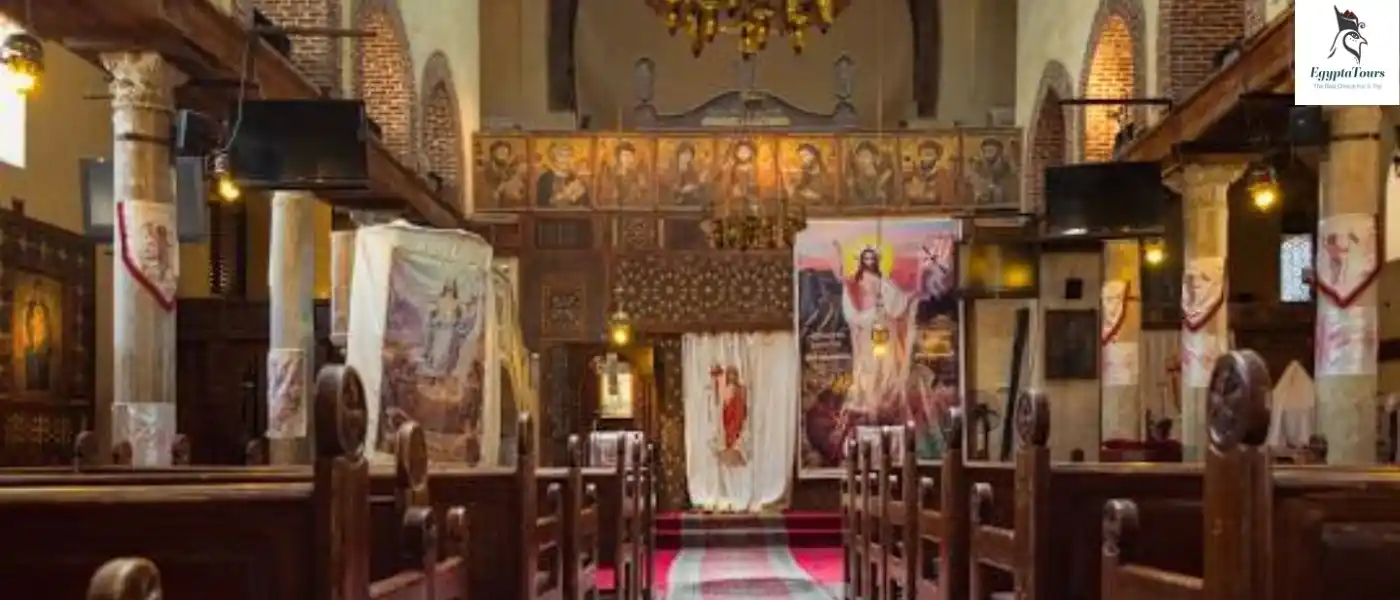
Church-of-St-Sergius-Bacchus-landmarks-EgyptaTours
The Abu Serga Church is considered one of the oldest churches in the world. The archaeological importance of the Church of St Sergius and Bacchus is due to the presence of the cave in which the Holy Family settled for three months, and the Holy Church was built over it in the Apostolic era according to what was narrated by ancient Coptic accounts.
Visitors descend to see this cave through a stone staircase designated for it, and it is in the form of a room interspersed with medium-thick columns with beautiful decorations engraved at the top of the column.
The cave has an ancient architectural style, and its walls are covered with colorful paintings and other paintings engraved with this ancient history, and there is a painting hung on its wall from the inside engraved with (the cave where the Holy Family stayed for three months and became a church in the Apostolic era).
In the cave there is a designated place where Jesus Christ our Lord Jesus peace be upon him slept when he was a child according to Coptic narratives.
Paintings and pictures were hung on the walls of the cave in addition to the presence of some ancient relics that have been preserved throughout history, and at the top of the cave there is an ancient well from which it is believed that the Holy Family drank.
The Church of St Sergius and Bacchus is a stage in the Holy Family’s passage at one time, as the Holy Family passed through many monasteries in Egypt on their holy journey such as Matariya and Assiut as well.
Egypt’s Role in preserving the Church
- Including it among the historical monuments, and classifying it as an important historical site.
- Renovations and restorations during different eras Especially the Islamic era.
- Supervised by the Egyptian Ministry of Antiquities and the Ministry of Culture with support provided to preserve the site spiritually and architecturally.
- Religious interest as the church enjoys great respect in Christian circles, and is a place of worship and visitation for many Copts.
Given the historical and religious importance of the church it has local and international appreciation, which contributes to attracting technical and financial support from international and local heritage institutions which had an impact on the Church of Abu Serga remaining a witness to Christian history in Egypt, and preserved its artistic archaeological and architectural features that reflect a civilization spanning centuries.
What happened to the Church?
The church was burned during the fire in Fustat which happened around 750, when Marwan II was the ruler. It was rebuilt and fixed as early as the 8th century.
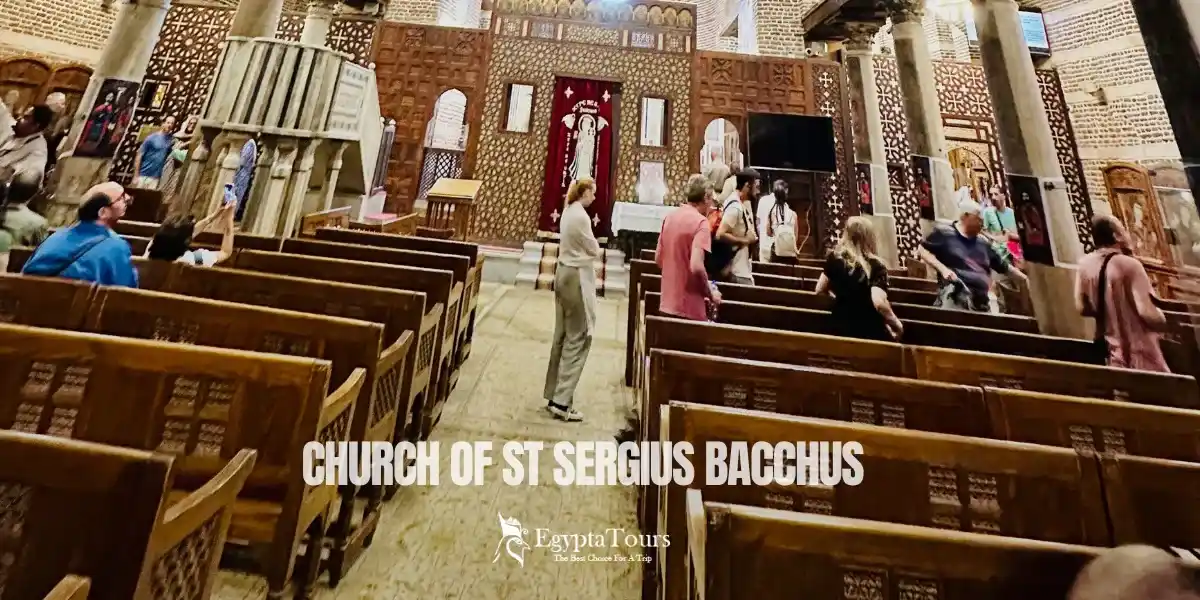
Inside, the church has three sections separated by two rows of pillars. Each row has six columns that divide the side areas from the main middle area. The pulpit has been replaced with a copy of the one from St. Barbara’s Church, one of the oldest. The original wooden pulpit is now kept in the Coptic Museum in Cairo, in the Mar Girgis area of Old Cairo.
People believe that the Holy Family Joseph, Mary and baby Jesus rested here at the end of their journey in Egypt. They may have stayed here while Joseph worked near the Babylonian fortress.
The Historical value of the Church of St Sergius & Bacchus
The church is very important historically because it is very old. It is seen as a model of the first Coptic churches. Over the years, it was also chosen as the place where many Coptic Church leaders (patriarchs) were elected.
The first patriarch elected here was Isaac (681–692). It is the main church of Cairo and was the main church of the Old Cairo area, replacing the old seat in Babylon. Many bishops were also ordained here until the time of Patriarch Christodulus (1047–1077).
One of the most interesting parts of the church is the crypt where it is believed that Mary, Joseph and baby Jesus rested. The crypt is 10 meters deep and sometimes floods when the Nile rises. The oldest and most valuable icons are on the southern wall.
In the 11th century, the main seat of the Coptic Orthodox Pope of Alexandria moved to Cairo, because the ruling powers moved from Alexandria to Cairo after the Arab invasion of Egypt.
During the time of Pope Christodolus, Cairo became the official home of the Coptic pope. The main church is the Hanging Church (Kanisa el Muwallaqa).
There is a small rivalry between the Church of Saints Sergius and Bacchus and the Hanging Church. This happened because Patriarch Christodolus wanted to be consecrated in the Hanging Church while the ceremony traditionally took place in the Church of Saints Sergius and Bacchus.
The Crypt: A Sacred Refuge of the Holy Family
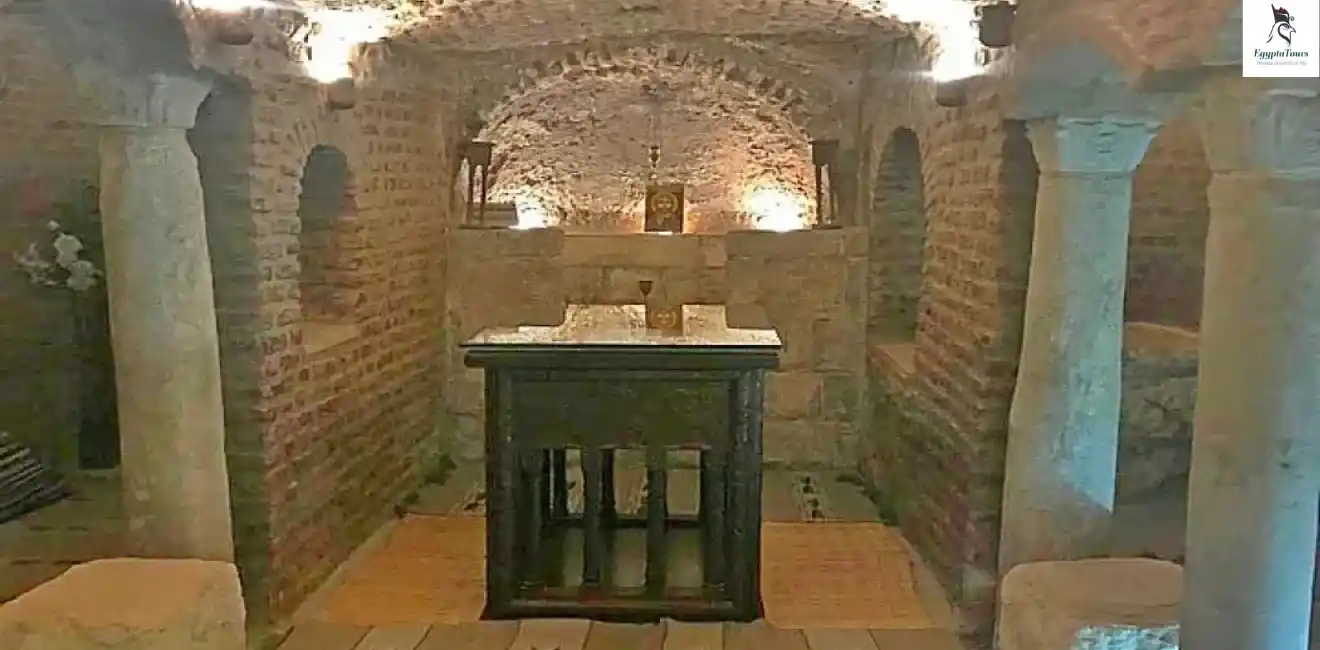
The-Crypt-A-Sacred-Refuge-of-the-Holy-Family-EgyptaTours
One special and spiritual part of the Church of Saints Sergius and Bacchus is its underground crypt. It is believed to be the place where the Holy Family stayed while in Egypt. The crypt is about 10 meters deep and is an important spot for many visitors.
Entering the crypt can feel a little intimidating because the passage is low, narrow and dark, but it is also full of history. The crypt is small and has only an altar where the Holy Family is believed to have rested. Many people bow here and pray for help; this place is called the Thanksgiving for the Holy Family.
The crypt also adds to the mystery and holiness of the church. Sometimes it floods when the Nile water is high. For Christians visiting Egypt, standing in the place where baby Jesus may have stayed is an unforgettable experience.
Religious Significance and Pilgrimage
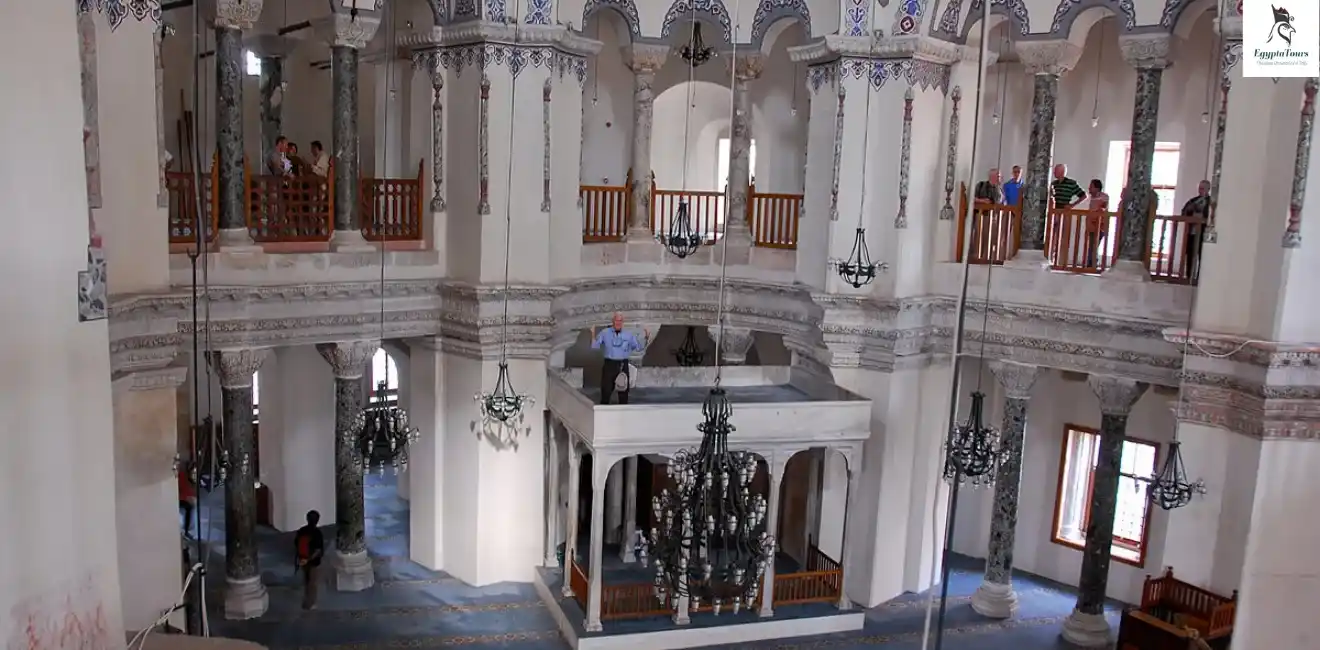
Church-of-St-Sergius-Bacchus-Religious-Significance-and-Pilgrimage-EgyptaTours
The Church of Saints Sergius and Bacchus is very important, not only to Coptic Christians but to all Christians. It is one of the main places on the Holy Family Trail, a pilgrimage path that marks the places in Egypt where the Holy Family is believed to have visited.
People from all over Egypt and the world visit Abu Serga Church to honor the Holy Family, pray at the shrine and join religious services. The church is especially busy during the Feast of the Holy Family on June 1st, when many people come to remember the Holy Family’s journey to Egypt.
The church also works as a regular place of worship for the Coptic community in Cairo. Here, people attend services, masses and other religious celebrations, coming together to show their faith and connect with the early Christian saints and the family of Christ.
The Church’s Role in Coptic Cairo
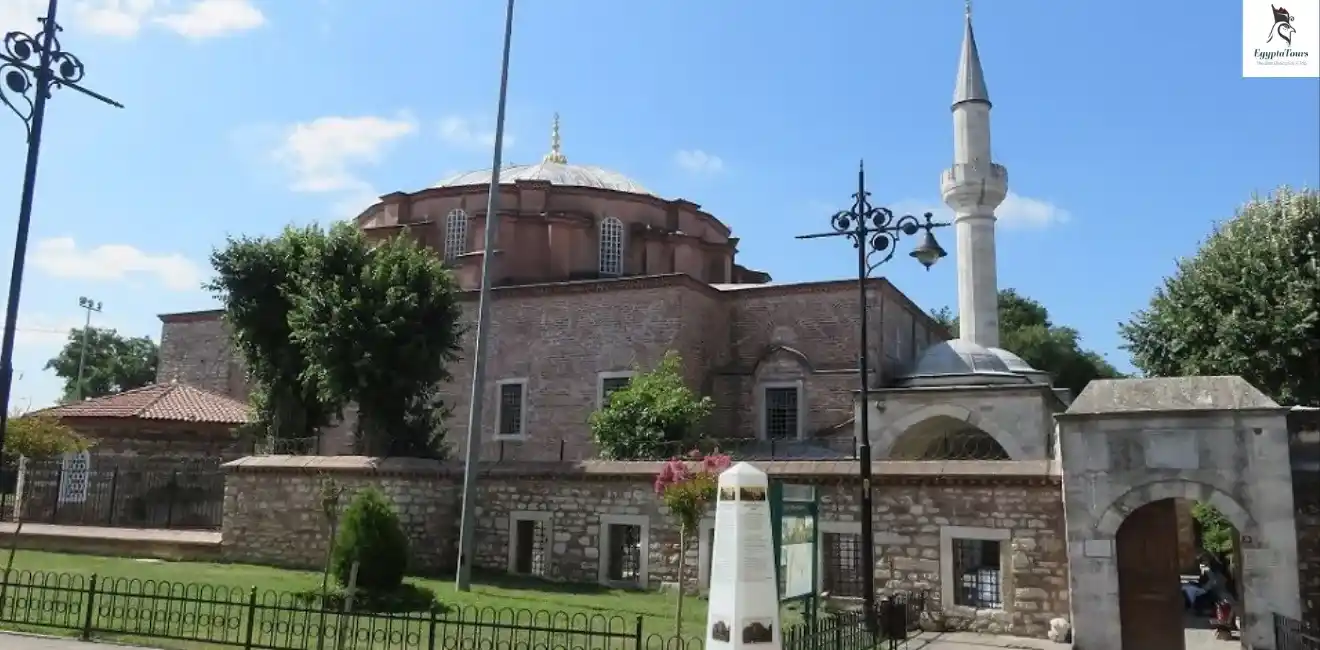
Church-of-St-Sergius-Bacchus-Role-in-Coptic-Cairo-EgyptaTours
One important place in Coptic Cairo is the Church of Saints Sergius and Bacchus. It is in a neighborhood that has many important Christian and Jewish sites. Coptic culture is an important part of Egypt’s history which existed long before Islam and it is still respected today.
Abu Serga is close to other famous sites in Coptic Cairo, like the Hanging Church, known for its beautiful “hanging” main hall and the Coptic Museum, which holds many Christian relics, old books and artworks. Visitors often go to these places too which helps them learn more about the Coptic Orthodox religion and its history in Egypt.
The church also shows how different religions lived together in Egypt. The Ben Ezra Synagogue, one of the oldest synagogues in Egypt, is right next to it. This shows that Egyptians have been tolerant of different religions for a long time.
Holy Family Cave
When you enter the Church of Saints Sergius and Bacchus which is built above the cave of the Holy Family, you will see a front area (narthex), a main hall (nave) and two side sections (aisles). These side sections are separated from the main hall by 12 columns with decorated tops. Ten of these columns are made of stone, one is marble and one is granite.
Like the Hanging Church, on the eastern side you will find three sanctuaries. Each one has a wooden dome supported by four marble columns. When you look up at each altar, you will see religious images of Christ, angels and the four evangelists painted on the wooden domes.
On the northeast side of the main hall, you will see a pulpit made of marble and wood, decorated with ebony and ivory which easily catches your attention. In the central sanctuary, there is a wooden screen from the 13th century, also decorated with ebony and ivory panels. As you walk around the church, you can enjoy the beautiful carvings and the icons that date back to the 15th and 16th centuries.
When you walk into the cave of the Holy Family, you may feel very happy and touched by this holy place. Scholars from the French campaign wrote about it, saying that in one of the Coptic churches there is a cave where the Virgin Mary stayed with baby Jesus when they came to Egypt to escape from King Herod.
Inside the cave, you will find a small main area and two side areas, with a domed ceiling. At the southern end of the cave, there is also a place used for baptism.
FAQs
Where is the Church of Saints Sergius and Bacchus located?
It is in Old Cairo, near the Hanging Church and the Coptic Museum, often called Abu Serga.
Who were Saints Sergius and Bacchus?
They were 4th-century Roman soldiers and Christian martyrs venerated in the Coptic and Catholic traditions.
Why is the church called Abu Serga?
“Abu Serga” is Arabic for “Father Sergius,” the popular name for the church in Cairo.
What is the history of the church?
The site dates to Late Antiquity (traditionally late 3rd–4th century) and is one of Cairo’s oldest Coptic churches, rebuilt and renovated over the centuries.
Is this the place where the Holy Family stayed in Egypt?
Yes, tradition holds that the Holy Family rested here during their flight into Egypt.
What are notable architectural features?
small, ancient church with a simple nave, a crypt, and traditional Coptic icons and murals; it is also connected to the crypt where the Holy Family is believed to have lodged.
Are there relics or icons I can see?
The church preserves ancient icons and liturgical objects typical of Coptic churches, and a sacred crypt associated with Sergius and Bacchus.
Can visitors attend services, and when?
Visitors can often attend Coptic liturgies and vespers when services are held; check current schedules with the church or local parish.
Is photography allowed inside?
Photography policies vary; ask at the entrance or the guard to avoid disturbing worshippers.
What about dress code or modesty?
As a religious site, modest dress is appreciated; remove hats and keep shoulders and knees covered.
Is the church open to tourists?
Yes, it’s a common stop for visitors to Old Cairo, though hours may be limited by services and local holidays.
How do I get there from central Cairo?
You can reach Old Cairo by taxi or rideshare; it’s near the historic district with walkable access to other sites such as the Hanging Church.
Are there guided tours available?
Many tours of Old Cairo include Abu Serga; local guides can provide on-site explanations during visits.
What is the significance of this church in Coptic tradition?
It is revered as one of the earliest Christian worship sites in Egypt and as a site connected to the Holy Family’s sojourn in Egypt.
What nearby sites should I also visit?
The Hanging Church (Saint Virgin Mary), the Coptic Museum, and the Ben Ezra Synagogue are all in the same historic area.
What are the archaeological features of the Church of St Sergius and Bacchus?
The Holy Cave in which the Holy Family resided the Blessed Well.
Why was the Church of St Sergius Bacchus named this name?
In reference to the name of two soldiers in the ancient Roman army
And here our talk is about to end, and we flew in the sky of the ancient Cairo of Al-Muizz, and that was nothing but a talk that tells about the magnificence of the great history and all that remains is for us to visit that place, and let our hands touch those beautiful doors walls, and holy places and how those who did it preserved them until this day for hundreds of years and you will see it with your own eyes soon, God willing.
About EgyptaTours

EgyptaTours is a name synonymous with trust, excellence, and unforgettable travel experiences, proudly standing as one of the leading travel agencies in Egypt. Renowned for its deep expertise, personalized service, and carefully crafted itineraries, EgyptaTours serves as the ultimate gateway to discovering Egypt in its most authentic and inspiring form.