





Egyptian God Aten
The god Aten was special in ancient Egypt. He was the sun itself and was treated as the only god during the Amarna Period. This guide looks at Aten’s short but powerful rise under Pharaoh Akhenaten (who used to be called Amenhotep IV).
Akhenaten stopped people from worshiping the old gods like Amun and made Aten the only creator and giver of life. You will learn about Atenism, its simple symbol the sun disk with rays that give life and how it changed Egyptian art, politics and religion. The worship of Aten ended quickly after Akhenaten died.
The god Aten was the sun itself and had a special, unusual place in ancient Egypt. Unlike other gods, who looked like animals or were ideas, Aten was just the sun disk that everyone could see.
Pharaoh Akhenaten (first called Amenhotep IV) made Aten the main and only god. During this time, called the Amarna Period, Egypt had a new kind of one god religion for a short time, instead of the usual many gods.
Meaning of Egyptian God Aten
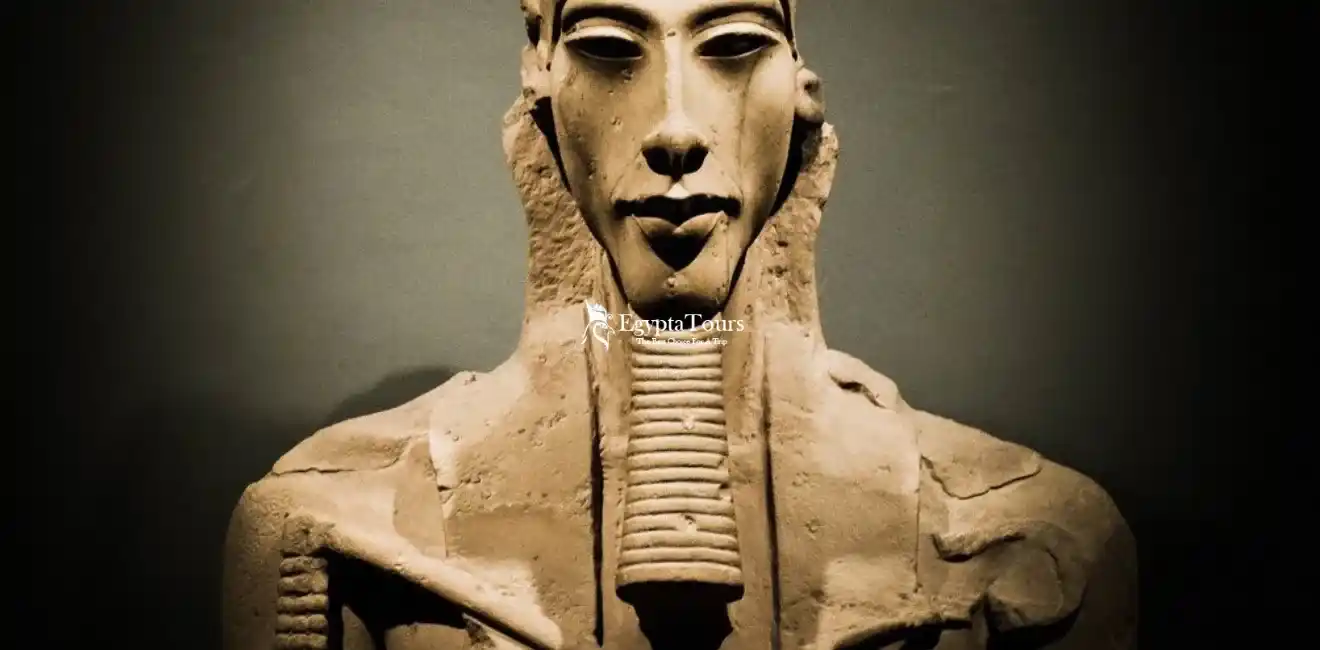
Meaning -of- Egyptian- God- Aten
Archaeologists say that the word Aten means disc. It goes back to the Old Kingdom and appears in ancient artwork.
The Egyptians believed the sun was the disc of the day. The sun god Ra lived in that disc. Every day, Ra sailed across the sky in his sun boat, giving light to the people of Egypt. At night, Ra went into the underworld with his sun boat and came back up the next morning.
The word Aten was used for anything shaped like a disc. Egyptians also called the moon the “silver Aten.” Some authors say that “sphere” or “globe” might be a better translation of the word Aten.
Origins and Early Worship
Aten was not a completely new god. Egyptians had worshiped the sun in different forms for many years. The god Ra was also connected to the sun. Before Akhenaten, Aten was just one part of the sun and a minor god. In older times, artists usually showed Aten as a small part of bigger pictures. Aten did not have its own temples or followers. Its main role was to help other, more important sun gods.
Akhenaten and the Worship of Egyptian God Aten
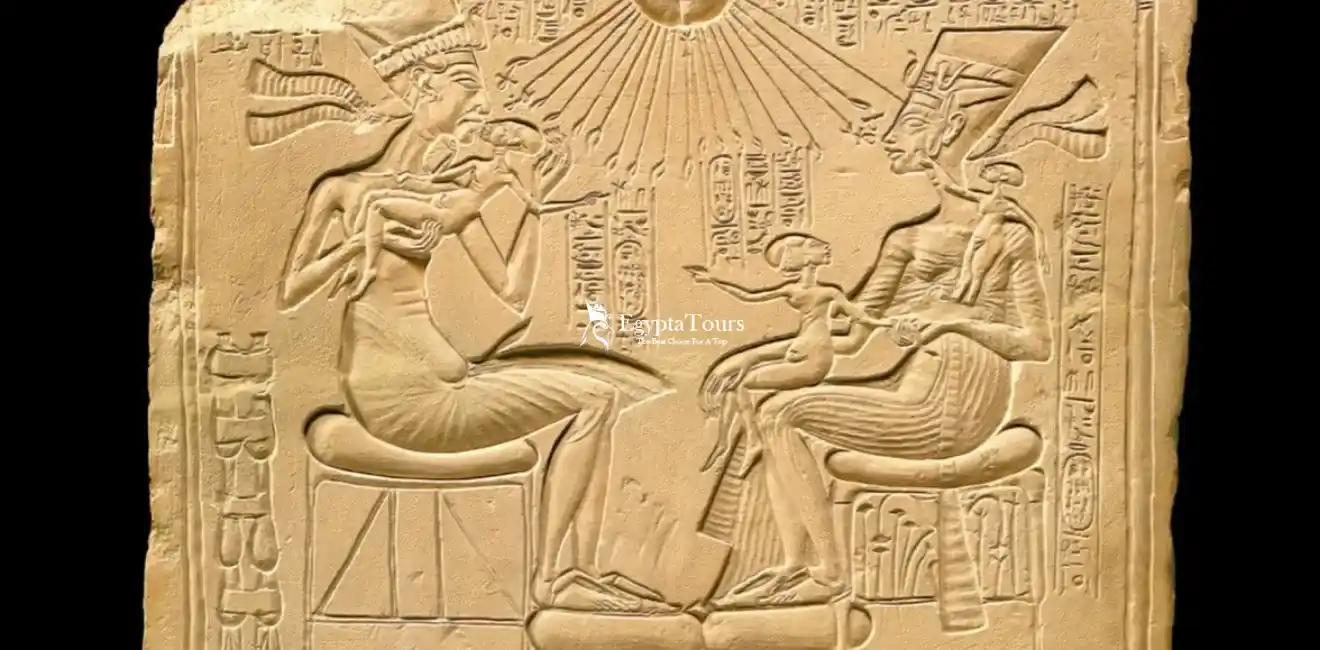
Akhenaten -and- the- Worship- of- Egyptian- God- Aten
Pharaoh Akhenaten made big changes in religion and made Aten the most important god. He stopped the usual worship of many gods and goddesses and only focused on Aten. This big change can be seen in the buildings of his new capital, Akhetaten (now called Amarna) which was built to follow the sun’s path.
Akhenaten loved Aten more than any other god and worked hard to share this belief across Egypt. He ordered many artworks, like statues and paintings, showing Aten as a strong and kind god. The most famous one is the statue of Aten from Tutankhamun’s tomb, which shows Aten with rays reaching out to touch his family.
Aten’s meteoric rise during the reign of Amenhotep IV
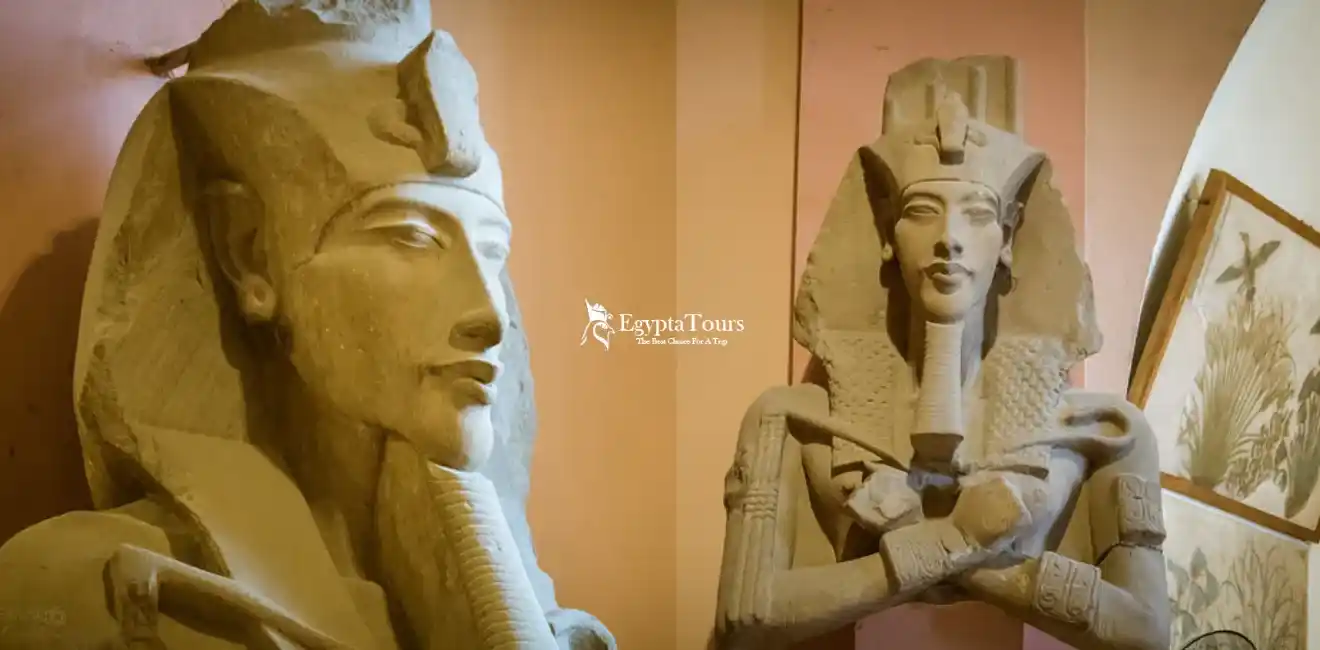
Aten’s- meteoric -rise -during -the -reign- of -Amenhotep -IV
The worship of Aten became very strong around the tenth year of Amenhotep IV’s rule. The young pharaoh who became king only because his older brother Prince Thutmose died early, inherited a rich and powerful Egypt.
Akhenaten, his main wife Nefertiti, and all their children changed their names to honor Aten. This was one of the first steps he took to change the religion in Egypt. For example, Akhenaten means Effective spirit of Aten and his oldest daughter Meritaten means She who is loved by Aten.
In this new religion, Akhenaten did not say he was Aten himself. Instead, he showed himself as a kind of son of Aten.
The Rise of Atenism
When Akhenaten became king, he greatly changed Aten’s importance. Around his fifth year as ruler, he started a big religious change. Akhenaten said that Aten was the only real god.
He stopped people from worshiping all other gods, especially Amun-Ra, the main god. He even changed his own name from Amenhotep to Akhenaten which means “Works for Aten.”
Akhenaten moved the capital from Thebes to a new city he built. He named it Akhetaten which means “Horizon of Aten.”
Today, this city is called Amarna. The new city showed his new religion. It was made only for worshiping Aten. The temples were open to the sky so sunlight could shine inside. This was very different from the dark, closed temples of the other gods.
Iconography and Philosophy of Egyptian God Aten
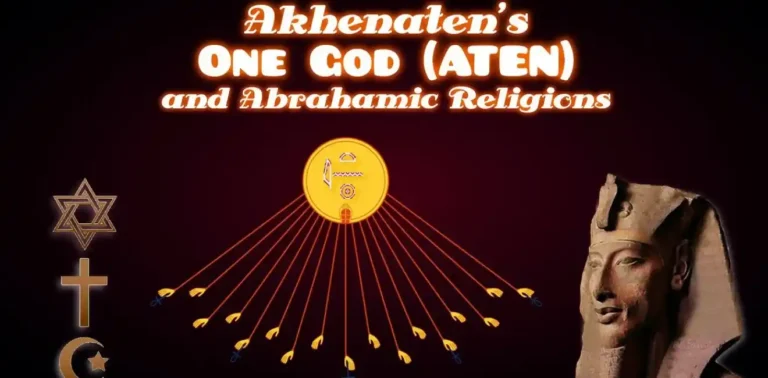
Artists showed Aten in special ways. It was a sun disk with rays coming down. The rays often had small hands holding the ankh, the symbol of life. This showed that Aten gave not only light and warmth but also life and food to all living things.
Atenism had a new and different idea about religion. It believed in only one god. This was very different from the usual Egyptian belief in many gods. Aten was seen as a god for everyone, not just one city or region. Akhenaten encouraged people to have a direct, personal connection with Aten. This meant people did not need many other gods to act as helpers.
The Decline and Legacy of Atenism
Akhenaten’s religious changes did not last after he died. His son, Tutankhaten (Living Image of Aten), quickly stopped the new religion. He changed his name to Tutankhamun (“Living Image of Amun”). The old priests got their power back and brought back the old gods, especially Amun-Ra.
Akhenaten’s name was removed from monuments, his temples were destroyed and his new city was abandoned. The Egyptians wanted to forget Atenism and its founder. They saw it as a wrong or forbidden religion.
Even though Atenism did not last, it had an important impact. It was one of the first known attempts to worship only one god. The art from the Amarna Period which looked more natural and realistic, also left a mark. Atenism is still an interesting part of religious history. It shows how one person can change the basic beliefs of a whole civilization.
Characteristics of Egyptian God Aten
Pharaoh Akhenaten also set up rules for the new kind of religion he wanted. One rule said that working during the day was the best way to honor Aten, because Aten worked during the day. People believed that Aten created the Nile River. Akhenaten thought that all people were created by Aten.
Aten was praised for loving and caring for humans. He always watched over the world and shone brightly in the sky to guide everyone. People who worshiped Aten believed he did all this following the principle of Ma’at, the goddess of truth and order.
Akhenaten said that only he and his royal family could connect people to Aten. People could receive Aten’s light by being loyal to the king and queen.
Aten was seen as a life giving force that was everywhere and all-powerful. Because of this, worshipers thought it was not right to make images of him. Showing Aten in a physical form could not show how powerful he was. Akhenaten started banning pictures of Aten as a human. Eventually, even showing Aten as a sun disk was discouraged by the king.
Temples of Egyptian God Aten in Amarna
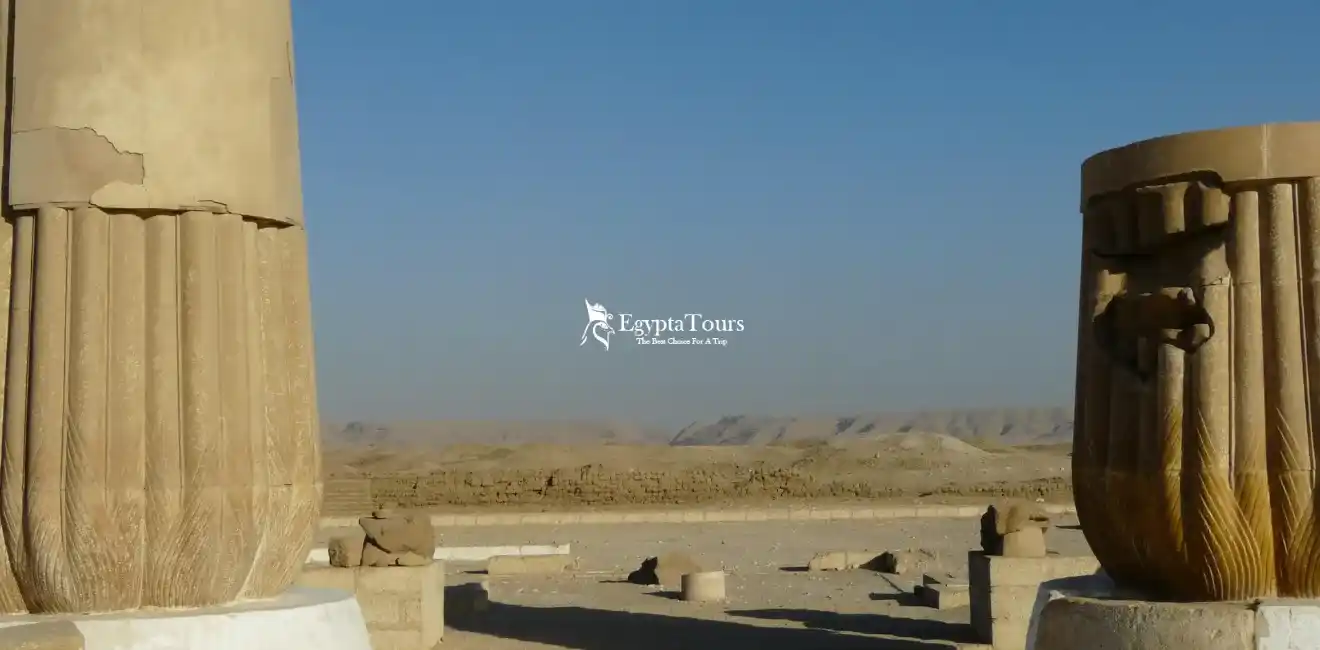
Temples -of- Egyptian- God- Aten- in -Amarna
People who worshiped Aten kept the temple roofs open so sunlight could shine on them. Most importantly, they did not use statues to worship the god. This was very different from the usual religion at the time. Pharaoh Akhenaten thought that using statues was wrong because it did not fit with Aten’s power.
Instead of statues of Aten, Akhenaten put up statues of himself and his family receiving Aten’s life-giving rays. This showed that the king was the connection through which Aten’s power reached the people of Egypt. In other words, he acted like a prophet of Aten.
People who worshiped Aten also sang songs and played the harp. Compared to older religious traditions, Aten worship involved fewer rituals. Akhenaten started a religion that made temple priests less important in ceremonies.
We don’t have much evidence to know if Akhenaten showed himself as the living form of Aten or if Aten was shown as the highest ruler, above the king.
FAQs
Who was the Egyptian god Aten, and what made him different from other Egyptian gods?
Aten was the sun itself and was worshiped as the only god during the Amarna Period in ancient Egypt. Unlike other Egyptian gods, who were often depicted with animal heads or as human figures representing ideas, Aten was shown simply as a sun disk with rays extending downward. These rays sometimes held small hands carrying the ankh, the symbol of life. This simplicity and direct representation of the sun set Aten apart from the traditional, more anthropomorphic gods.
How did Akhenaten promote Aten’s worship?
Akhenaten made Aten the only god, stopped worshiping other gods, changed his name, moved the capital to Akhetaten, and showed Aten in art with himself and his family.
What were some unique features of Atenism and its temples?
Atenism was unique because it emphasized one universal god instead of many. Temples dedicated to Aten had open roofs to allow sunlight to enter, symbolizing Aten’s life-giving power. Statues of other gods were not used; instead, statues of Akhenaten and his family were depicted receiving Aten’s rays. Rituals were simpler compared to older religious traditions, and priests held less authority.
Why did Atenism decline after Akhenaten’s death?
Atenism declined quickly because Akhenaten’s reforms were not widely accepted by the priests or the public. After his death, his son Tutankhaten restored the old religion, changing his name to Tutankhamun to honor Amun. The old gods, especially Amun-Ra, regained their temples and influence. Akhenaten’s monuments and temples were destroyed, and the city of Akhetaten was abandoned. Egyptians wanted to erase the memory of Atenism, considering it a forbidden or mistaken religion.
About EgyptaTours

EgyptaTours is a name synonymous with trust, excellence, and unforgettable travel experiences, proudly standing as one of the leading travel agencies in Egypt. Renowned for its deep expertise, personalized service, and carefully crafted itineraries, EgyptaTours serves as the ultimate gateway to discovering Egypt in its most authentic and inspiring form.