Wadjet, Egyptian Goddess
In ancient Egyptian mythology, gods and goddesses played an important role in...



Egyptian God Ra was the supreme god and the creator of all things. He was the god of the sun, the sky, kingship, power, and light. Not only did he control the sun’s movements, but he also was the sun itself, as well as the day.
Ra took on many different forms, and when combined with other gods, he took on new roles. When linked with Amun, another mysterious creator god, he became Amun-Ra, symbolizing the sun’s vast, universal power.
When joined with Horus, Ra became Ra-Horakhty, meaning Ra-Horus in the horizon. In this form, Horus represented Ra in the form of the Pharaoh of Egypt. Ra could also take on the forms of his fierce daughter, Sekhmet, or his loving daughter, Hathor. He moved the sun across the sky as the beetle Khepri and brought it back through the underworld on a magical boat.
For the ancient Egyptians, who lived in a desert and were primarily farmers, the sun and thus Ra was essential to their world, guiding everything they did.

Egyptian -God -Ra-Etymology
In ancient Egyptian, Ra’s name simply meant sun. Like many gods in different mythologies, Ra had many names. He was sometimes called Re, Amun-Re, Khepri, Ra-Horakhty and Atum.
Each of these names was linked to a different aspect of Ra’s nature. These names often came about as the Egyptians incorporated new gods and beliefs into their own culture.
Ra’s worship likely began in a town called Iunu by the Egyptians, which the Greeks called Heliopolis, meaning city of the sun god. This ancient city was located in what is now a northern suburb of Cairo.

Egyptian -God -Ra-Attributes
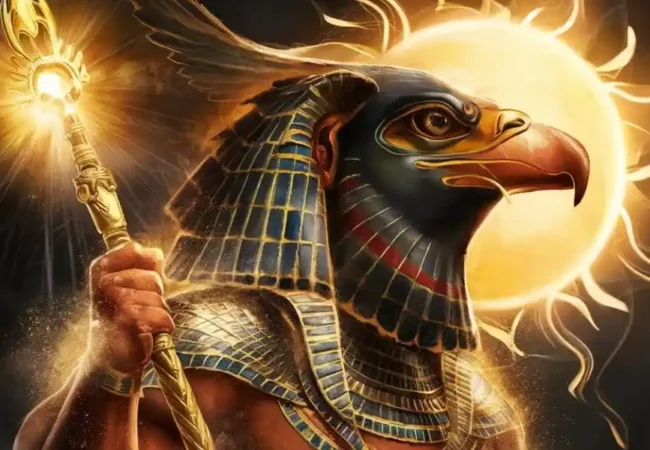
While Ra was best known as the Egyptian creator god, he had other important roles too. His titles included god of the sun, god of kings, and god of order. Ra was shown in different ways. Most commonly, he appeared as a solar disk, a circle placed above the heads of various sun gods. He was also often shown as a man with the head of a falcon. Ra’s images usually showed him holding both a scepter and an ankh.
Ra, especially in his morning form as Khepri, was sometimes shown as a scarab beetle. The Egyptians watched the beetle roll a ball of dung across the sand and bury it, from which new beetles would emerge. This process was seen as a reflection of the sun’s journey across the sky, being reborn each day. Ra was believed to travel across the sky in his solar boat, called Atet.

Egyptian -God -Ra-Family
In an act of self creation, Ra gave birth to his children Shu and Tefnut. Shu was the god of air and Tefnut was the goddess of mist.
As the god of kings and order, Ra was closely connected to maat, a key idea in Egyptian mythology. Maat represented truth, justice, righteousness, order, balance and cosmic law and was also personified by a goddess. The goddess Maat was believed to be Ra’s favorite daughter. Egyptian rulers were expected to uphold maat (both the concept and the goddess) and after death, they were judged based on how well they had followed it.
Although some stories say that Ra created himself (or was created by Amun and Ptah), he did have a mother. Neith, whose name means the terrifying one, was a creator goddess and also the goddess of weaving.

Egyptian -God -Ra-History
Ra was an ancient god, but not the oldest; the first mentions of him go back to the Second Dynasty. However, by the Fifth Dynasty, he had become a powerful god closely linked to the pharaoh.
The pharaoh was already seen as the earthly form of Horus, so the two gods became connected, sometimes as the combined god Ra-Horakhty (Ra is Horus of the Horizon). Ra was also linked with Atum (the creator god of the Ennead in Heliopolis), forming the god Atum-Ra.
By the Fifth Dynasty, pharaohs were called the sons of Ra and Ra’s name became part of the throne name of every king from then on. Many Old Kingdom pharaohs built sun temples to honor Ra.
In the Middle Kingdom, Amun of Thebes became more important. While Ra remained linked to the pharaoh, he was partly absorbed by Amun, forming the combined god Amun-Ra. However, the priests of Amun grew very rich and powerful, so some pharaohs of the New Kingdom chose to focus more on Ra, possibly because he was already closely connected with the pharaoh.
For example, Thutmose promoted Ra-Horakhty as his main god, while Amenhotep III called himself the dazzling sun and named his wife’s pleasure boat the Aten Gleams. His successor (and likely son) Akhenaten took this further by rejecting Amun and many other gods, instead worshipping the Aten (a sun god).
The worship of the Egyptian god Ra reached its peak during the New Kingdom. Many tombs in the Valley of the Kings from this period show images of Ra’s journey through the underworld in twelve stages, or hours. In the fifth hour, Ra dies and reunites with Osiris in the underworld, but in the twelfth hour, he is reborn as the scarab (Khepri).Sun temples were built again during the New Kingdom, although those from the Amarna Period were dedicated to the Aten instead.
Amun-Ra was also widely worshipped in Nubia and was the main god of the Nubian Kingdom of Napata during the Twenty-fifth Dynasty. The Greeks linked Ra with Zeus, so he remained important during the Ptolemaic Period. However, after this time, Egypt was ruled by foreign leaders who had no connection to the god of the pharaohs, leading to a decline in his popularity.

Ra -in -the- Heavens
Ra is linked with the sky in the Pyramid Texts and is already associated with the sun and life giving energy. However, a later text called the Book of the Heavenly Cow provides more details about how Ra left the Earth, which he once ruled directly, and ascended to the sky.
The Book of the Heavenly Cow is believed to have existed in some form during the First Intermediate Period (2181-2040 BCE) and was written during the Middle Kingdom (2040-1782 BCE). All surviving copies of the text, though, come from the New Kingdom period (around 1570 – 1069 BCE).
The story describes how Ra grows old and his human followers begin to plot against him. Feeling betrayed, Ra calls a meeting with the other gods, who advise him to punish the humans for their ingratitude. Ra then calls upon the Eye of Ra, typically seen as a goddess. The Eye is a powerful force that either carries out Ra’s commands or breaks free to cause destruction. Regardless of what happens, the Eye of Ra always brings some kind of transformation, which is a common theme in stories involving the Eye.
In this story, Hathor takes the form of the Eye of Ra and is sent to destroy humanity. She kills thousands before Ra realizes the mistake and regrets his decision, pleading with her to stop. However, Hathor, consumed by her rage, has transformed into the wild and uncontrollable Sekhmet and cannot hear his pleas. In desperation, Ra orders 7,000 jugs of beer to be dyed red to look like blood and poured out onto the plains of Dendera.
Hathor-Sekhmet drinks the blood-like beer, falls unconscious, and when she wakes, she returns to her form as Hathor. She then promises to be a protector and friend to humanity from that point on.
Ra grows weary of ruling over humans and asks the goddess Nut to carry him to the heavens. Nut transforms into a celestial cow and takes Ra up to the sky on her back. During their journey, Ra creates the Field of Reeds and organizes the management of the world, leaving it in the hands of the other gods. From then on, humans will be responsible for maintaining order according to the will of the gods. Ra, having stepped down, will focus only on guiding his great barge across the sky.

Ra -on -the -Earth
Before he left, Ra ruled over his creation directly from Earth. He created the laws which were later passed on to humanity by Osiris and Isis during the golden age of their reign. This period ended when Osiris was murdered by his brother Set, who took control until he was defeated by Horus the Younger, the son of Osiris and Isis, who restored order. Ra’s presence on Earth was marked by the sunlight, the growth of crops and the changing of the seasons.
Ra was honored in the Houses of Life which were scriptoria connected to temples. These were places where scribes’ works were stored under the protection of Thoth, the god of writing and his consort (and sometimes daughter) Seshat. While Thoth gave humanity the written word to record the past and keep balance and order in the present, it was ultimately Ra, the Creator of All, who was the source of this knowledge. The Houses of Life were seen as extensions of Ra who also inspired the correct understanding of written works.

Ra- in -the- Netherworld
During the day, Ra traveled across the sky in his solar barge but at night, he descended into the underworld. His sun barge then transformed into the evening barge, called the Ship of a Million Souls. This ship carried the newly arrived, justified souls of the dead to the paradise known as the Field of Reeds.
At this time, Ra merged with Osiris, the god of the dead and the judge of the afterlife. In this form, Osiris is seen as the body while Ra represents the soul of the combined deity, Ra-Osiris.
As Ra-Osiris, the god communicates with Osiris on a deep level, possibly confirming which souls are truly justified before carrying them on their journey. Together they travel through the darkness of the underworld toward the dawn of paradise. During this journey, the barge is attacked by the serpent Apophis who tries to stop Ra and prevent the sunrise.
The gods aboard the barge fight off the serpent with the help of the justified souls. On earth, the living people perform rituals to channel positive energy and support the defenders. Each night, Apophis attacks but every night he is defeated. Ra and his crew continue their journey, delivering the justified souls to their destination, and the sunrise marks Ra’s victory, signaling that the Egyptians would live to see another day.
In one version of the soul’s journey to paradise, as described in the Book of the Dead from the New Kingdom, the soul must face judgment before Osiris. The soul’s heart is weighed against the white feather of truth which belongs to Ma’at, the goddess of balance and order. If the scales are balanced, the soul is allowed to continue its journey after Osiris consults with the Forty-Two Judges and other gods.
However, if the heart is heavier than the feather, the soul is destroyed. Ra is present at this judgment either in his Ra-Osiris form or invisibly, inspiring Osiris to make a just decision. Ma’at, one of Ra’s daughters, also represents his presence during the judgment and is part of the defense team aboard the barge which transforms into the solar boat once dawn arrives.

Ra -as -Creator
In Ancient Egyptian mythology, several gods are credited with creating the world and establishing order including Ra, Atum, Ptah, and the goddess Neith. Regardless of which god is mentioned, they all share the same qualities and powers as Ra. It is believed that Ra was present and alone, at the beginning of creation, regardless of the name he took later on. So, even though priests of Ptah might claim their god created everything, the Ptah they refer to would actually be Ra. Similarly, Atum was essentially just Ra by another name and the same applies to Neith in her role as a creator.
In the most popular version of the story, in the beginning, there was only water everywhere. Then, the first piece of dry land, called the ben-ben, appeared, and Ra, the Self Created, stood on it. He cut himself and from his blood, created Hu (the power of authority) and Sia (the power of understanding).
Afterward, Ra realized he was alone and decided to create his children by mating with his shadow. This resulted in Shu (the god of air) and Tefnut (the goddess of moisture), who went off to form the world. They were gone for a long time, so Ra sent the Eye of Ra to find them. When the Eye returned with his children, Ra was so happy that he shed tears, which fell on the fertile land of the ben-ben and turned into human beings.
Realizing the new people had no place to live, Shu and Tefnut had children: Geb (the earth) and Nut (the sky). Geb and Nut then gave birth to Osiris, Isis, Set, Nephthys and Horus the Elder and from these gods, all the others came. Heka, one of the oldest gods, was thought to have been present from the very beginning of creation.
Each god was given a special role to make sure everything stayed in order, so that there would be no overlap in what they did. The gods would take care of the people, and in return, the people would worship and follow the gods’ wishes. This relationship created balance and harmony between the people, the gods, the earth and the afterlife, all of which came from Ra.
Balance was a key value in ancient Egyptian culture, and the king played a central role in maintaining it. The ruler was believed to be chosen by the gods to keep order, which was seen as balance or harmony. Userkaf, the first king of the 5th Dynasty (around the late 26th century BCE), represented this ideal by promoting the worship of the sun god Ra and encouraging people to follow Ra’s principles. He built the Sun Temple of Ra, known as Nekhenre, near Abusir and started a tradition of honoring Ra that continued throughout his dynasty.
Userkaf was the first king to build a temple for Ra, but all the kings who came after him followed his example, starting a tradition of building temples to honor Ra that lasted throughout Egypt’s history. The 5th Dynasty is most famous for these sun temples and for strongly connecting the king with the gods.
Userkaf and his successors called themselves sons of Ra and were seen as the actual children of the god. At this time, Ra was already known as the king of the gods, but he was now also seen as King and Father of the King, maintaining order through the fair rule of his sons.
This idea made the king (who was called pharaoh only in the New Kingdom) the representative of the god on earth and a demigod himself. By the time of the New Kingdom, Horus had taken over as the god who protected the king while he was alive and ruled and Osiris became the god of the king after his death. However, since Ra was believed to be the Self Created god from whom everything else came, it was still considered Ra’s power behind both Horus and Osiris.

Ra- Mythology
The ancient Egyptians believed that Ra, the sun god, traveled across the sky each day in his boat called the Barque of Millions of Years. In the morning, when Ra rose in the east, his boat was called Madjet, meaning becoming strong. By evening, it was called Semektet, meaning becoming weak.
At the end of the day, it was thought that Ra died (swallowed by the sky goddess Nut) and sailed to the underworld, with the moon taking his place to light the world. Ra was reborn at dawn the next day. During his journey across the sky, he fought his main enemy, an evil serpent called Apep, or The Lord of Chaos. In some stories, Ra, in the form of a cat named Mau, defeats Apep. This is one reason why cats were so highly respected in Egypt.
Ra created himself from the chaos that existed before everything. He is also called Re and Atum. His children are Shu, the god of dry air and father of the sky, and his twin sister Tefnut, the goddess of moisture and water. Tefnut, often shown with the head of a lion, is in charge of dew and freshness. Humans were said to have been created from Ra’s tears.
Even though Ra was deeply respected and worshipped by the ancient Egyptians, there’s a story that suggests he eventually became weak. In the Legend of Ra, Isis and the Snake, Ra grew old and started to drool. Isis knew that Ra’s power was hidden in his secret name.
She collected Ra’s saliva and made a snake out of it. She placed the snake in his path, and it bit him. Isis wanted the power Ra had, but she knew she needed to learn his secret name. Eventually, because of the pain from the bite, Ra let Isis search through him, which allowed her to heal him, and in the process, Ra’s power was transferred to her.
The Tree of Life was an important religious symbol for the Egyptians. It was found in Ra’s sun temple in Heliopolis and was considered sacred. The fruit from this tree was not for humans, but was used in special rituals for pharaohs. The Tree of Life is also called the mythical, sacred Ished tree. Anyone who ate its fruit was believed to gain eternal life.
Another important symbol linked to Ra in ancient Egypt is the Bennu. The Bennu is the name of the bird that represented Ra’s soul. It is a phoenix and was believed to rest at the Tree of Life in Ra’s Sun Temple in Heliopolis. Inside the temple, on top of an obelisk, was the Benben Stone. This pyramid shaped stone acted as a guide for the Bennu and is also a significant religious symbol in ancient Egypt.
Solar temples were built for Ra, but they didn’t have a statue of the god. Instead, they were designed to be open to the sunlight that Ra symbolized. The earliest known temple built in honor of Ra is in Heliopolis (now a suburb of Cairo). This solar temple, called Benu Phoenix, is thought to have been built at the exact place where Ra first emerged into creation.
Although Ra goes back to the Second Dynasty, he is not the oldest of the Egyptian gods. It wasn’t until the Fifth Dynasty that Ra became closely linked with the pharaoh. As the king and ruler of Egypt, the pharaoh was seen as the earthly form of Horus, so the two gods became connected. This new combination of gods was called Ra-Horakhty, meaning Ra is Horus of the Horizon. Ra’s connections with other gods didn’t stop there. As the powerful creator of humanity and the sun god, he also merged with Atum to become Atum-Ra.
From the Fifth Dynasty onward, all pharaohs were known as The son of Ra, and Ra became part of every pharaoh’s name. During the Middle Kingdom, a new god called Amun-Ra was created. Amun was one of the gods in the Ogdoad, a group of eight gods who represented different aspects of creation.
The New Kingdom saw an increase in the worship of Ra. Many tombs in the Valley of the Kings show images of Ra and his journey through the underworld. During this period, many solar temples were also built.
Ra was often called the father of the gods. He was sometimes said to be married to Hesat or Hathor, though Hathor is usually considered his daughter.Since his worship came after that of some of his children (like Hathor and Horus), it’s likely that Ra took on this fatherly role when he became connected with the creator god Atum.
According to the Pyramid Texts, Ra (as Atum) rose from the waters of Nun as a benben stone (a pillar like an obelisk). He then spat out Shu (air) and Tefnut (moisture) and Tefnut later gave birth to Geb (earth) and Nut (sky).
Ra tried to separate Geb and Nut by placing Shu between them and declared that Nut could not give birth on any day of the year. However, Thoth managed to get five extra days from the moon, allowing Nut to give birth to Osiris, Set, Isis, Nephthys and Horus the Elder.
It was believed that Ra died or was swallowed by Nut every evening as the sun set. He would travel through the underworld at night and be reborn in the morning (which made Nut both his granddaughter and his mother). At sunset, Ra was connected with Horakhty (Horus on the Horizon) and Atum, while at dawn he was linked to the scarab beetle, Khepri (the Emerging One), and Nefertum.
Ra-Horakhty-Atum was connected to Osiris as the form of the sun during the night. When Osiris was killed by his brother Set, he became the God of the Underworld. Therefore, the Pharaoh was considered the son of Ra, ruling as the living Horus and becoming Osiris after his death.
According to another myth, Ra ruled as Pharaoh until he grew old and tired. The people no longer respected him or followed his laws, so Ra decided they should be punished. He sent his Eye (a powerful force) to teach them a lesson, but then had to get her drunk to stop her from killing everyone. Once the danger was gone, Ra decided it was time to leave the world to Horus (who took his place as king) and travel across the sky on Nut’s back.
Ra’s children, Shu and Tefnut, had two children of their own: Geb and Nut. Unlike most mythologies, Geb, the male, ruled the earth, while Nut, the female, ruled the sky.
Ra wanted Nut to be his wife, but she fell in love with Geb and rejected Ra. Angry about this, Ra cursed her, saying she could not give birth in any month or year. At the same time, the god Thoth had been playing games of checkers with the moon and won several times. He took his winnings as the moon’s light, gaining 1/72nd of her glow. In total, he collected an extra five days.
The Egyptian calendar year had only 360 days, and the extra five days were added at the end of the year to align the Egyptian calendar with the solar calendar. Because of this, the five additional days, which were won by Thoth, were not affected by Ra’s curse. When these extra days came, Nut gave birth to Osiris, Horus, Set, Isis and Nephthys.
The Egyptians believed that names were very powerful, so much so that gods used fake names to protect their strength. Because of this, the goddess Isis set out to find Ra’s true name.
By this time, Ra was old and weak; he slept and drooled while sitting on his throne. Quietly, Isis gathered some of his drool and mixed it with some earth. With her magic, she formed this mixture into a poisonous snake.
Ra was a creature of routine, always walking the same path every day to check on his creation. Isis released the snake at a crossroads and waited. The snake attacked as soon as Ra reached the crossroads. Normally, Ra was immune to such bites, but because this poison came from his own body, he had no protection against it and was overwhelmed with intense pain.
In immense pain, Ra called his followers and told them he had been seriously hurt. He asked if anyone could help heal him, but none of them could provide the cure he needed.
After everyone else had tried and failed, Isis told Ra she could help him, but only if he revealed his true name. Suspecting a trick, Ra responded:I am the creator of the sky and the earth, the one who shaped the mountains, the maker of the waters, and the keeper of the secrets of the horizons. I am both light and darkness, the creator of time and the one who made the days. I open the festivals, I create flowing streams, and I give life to fire. I am Khepri in the morning, Ra at midday, and Atum in the evening.
Not impressed by his evasions, Isis insisted that she couldn’t heal him without knowing his true name.
In great pain, Ra finally gave in and told Isis his true name. Chanting a magical spell, Isis removed the poison from Ra’s body. As payment for her help, she demanded that Ra give his unborn son Horus both of his eyes: the sun and the moon.
When Horus grew up, he took over Ra’s role as the sun god, giving the old god a chance to retire from his exhausting daily duties.
This story was written down on a papyrus scroll from the 20th Dynasty (around 1200-1085 BCE) and it was believed to be a spell for curing snake bites. Egyptian priests thought the spell Isis used to heal Ra could also be used to heal humans.
The Egyptian religion lasted for thousands of years, and over time, it changed as different groups came to power or lost it. Since the beginning, Ra had always been a key god, and his central role made him a common choice to merge with other rising deities.
Ra was combined with so many other gods that references to a single, separate Ra have become quite rare.
Horus and Ra were combined early in the development of the Egyptian religion. The name Ra-Horakhty meant Ra-Horus of the Double Horizon and symbolized the sun defeating its enemies at night so it could rise again.
Horus was a complex god, with at least 15 different forms linked to him. The most common and popular of these forms was the falcon. Ra-Horakhty combined the images of both Ra and Horus, often depicted as a falcon with a solar disk on its head, or sometimes as a winged solar disk.
Around 2020 BCE, the Theban king Mentuhotep II defeated the Heracleopolitan dynasty and brought Egypt back together under his control. This event marked the start of what we now call the Middle Kingdom (2066-1780 BCE).
Amun was one of the most important gods of Thebes and during this time of Theban rule, Amun went from being a lesser known local god to a major deity. By the 18th Dynasty (1550-1292 BCE), Amun had become a national figure and fully merged with Ra.
When the two gods combined, many of the myths linked to Ra were rebranded as the myths of Amun-Ra.
Atum was a creator god similar to Amun. In fact, the stories about Amun and Atum often overlapped, and the two gods were essentially reflections of each other.
Like Ra, Atum was a solar god, but his role was more specific. Atum represented the older aspect of Ra and symbolized the setting sun. As the setting sun, he was often paired with Khepri, the god of the rising sun.
Atum-Ra was seen as the god of Lower Egypt, while his counterpart Montu-Ra was considered the god of Upper Egypt.
When King Amenhotep IV came to power (around 1351 or 1353 BCE), Amun, or Amun-Ra, was the main god of Egypt. This was reflected in Amenhotep’s name, which meant Amun is Satisfied. However, five years into his reign, Amenhotep changed his name to Akhenaten, meaning One effective on behalf of Aten. This change reflected his efforts to promote the god Aten over Amun.
Before Akhenaten’s push to make Aten Egypt’s main god, Aten was mostly worshipped as the god of the solar disk. Under Akhenaten’s rule, Aten was combined with Ra-Horakhty. At the same time, Akhenaten banned the worship of Amun-Ra and discouraged the worship of other gods in the Egyptian pantheon.
The changes Akhenaten made were not widely accepted and they were slowly undone after his death. Aten returned to being seen as a part of the sun god and Amun was restored to his role as the main god of the state religion.
Another sun god, Khepri, was specifically linked to the morning sun. In the story of Ra’s hidden name, Ra stated that he was Khepri in the morning.
Khepri was sometimes associated with Atum, and in the form of Atum-Khepri, he was seen as the god of personal transformations. These transformations, called kheperu, included changes such as moving from childhood to adulthood and from life to death.
The god Khnum was linked to the regular flooding of the Nile River and the First Cataract of the Nile. He was also associated with pottery wheels, which is why he was called lord of the wheel.
Although Khnum’s origins are not clear, it is known that he was recognized as a creator god only later in Egyptian history. Still, his worship continued until the second or third century CE. Once he was seen as a creator deity, Khnum became connected with Ra.
Montu was another god from Thebes who was eventually combined with Ra. A falcon headed god associated with the stars, Montu was the main god of Thebes and was seen as an aspect of Ra from the 20th century BCE onwards.
Montu-Ra was considered the god of Upper Egypt, while his counterpart, Atum-Ra, was regarded as the god of Lower Egypt.
As one of the first gods, Ra is incredibly powerful, taking on the endless task of fighting Apophis every night for eternity. He is the oldest and most powerful god in the story, with only the demonic Apophis as his rival.
Far Sight: Being the god of the sun, Ra likely has the ability to see everything beneath the sun. Even though he wasn’t present, he somehow witnessed the murder of his son Osiris.
Immortality: As the first god, Ra may be immortal, surviving injuries that would have killed other gods.
Increased Durability: While all gods have greater durability, Ra is much stronger. He survived a sword to the heart, though he was knocked out by a blast from his own spear, but he still recovered from the wound.
Increased Healing Factor: As a god, Ra heals faster. Since he is one of the first gods, his healing might be much faster when the sword was removed, he seemed to already be healing and by the time Horus gave him his spear, he was fully healed.
Pyrokinesis: As the god of the sun, Ra has complete control over fire. His known abilities include:
Resurrection: While the exact details of this power are unclear, Ra seems to have the ability to bring people back from the Land of the Dead, but not from the afterlife itself.
Teleportation: Ra can move quickly by transforming into a fire like energy sphere, allowing him to travel from one place to another.
Transformation: Unlike other gods who become armored beasts, Ra can change his size, growing much taller than any of the other gods, even his sons.
Ra was the supreme god and the creator of all things. He was the god of the sun, the sky, kingship, power, and light. Not only did he control the sun’s movements, but he also was the sun itself, as well as the day.
Ra grows weary of ruling over humans and asks the goddess Nut to carry him to the heavens. Nut transforms into a celestial cow and takes Ra up to the sky on her back. During their journey, Ra creates the Field of Reeds and organizes the management of the world, leaving it in the hands of the other gods. From then on, humans will be responsible for maintaining order according to the will of the gods. Ra, having stepped down, will focus only on guiding his great barge across the sky.
By the time of the New Kingdom, Horus had taken over as the god who protected the king while he was alive and ruled and Osiris became the god of the king after his death. However, since Ra was believed to be the Self Created god from whom everything else came, it was still considered Ra’s power behind both Horus and Osiris.

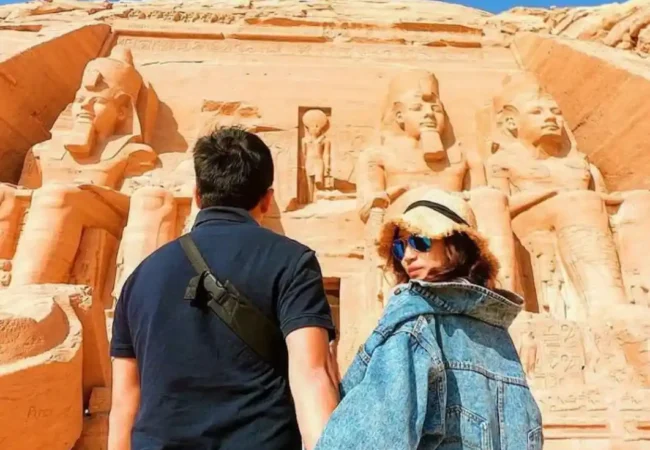
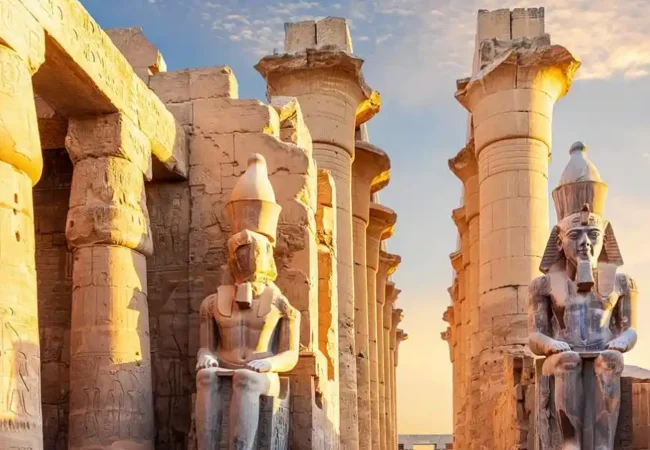
Explore our top-rated Egypt travel packages and embark on an unforgettable journey. From the Pyramids of Cairo to the magical temples of Luxor, Aswan, and Abu Simbel, discover expertly curated tours designed for your perfect Egyptian adventure