




Madinet Habu: Explore The Magical Secrets of Luxor
If you’re planning a trip to Luxor, be sure to add Madinet Habu to your list of places to visit. This ancient temple is home to some of the most extraordinary architecture and carvings in all of Egypt.
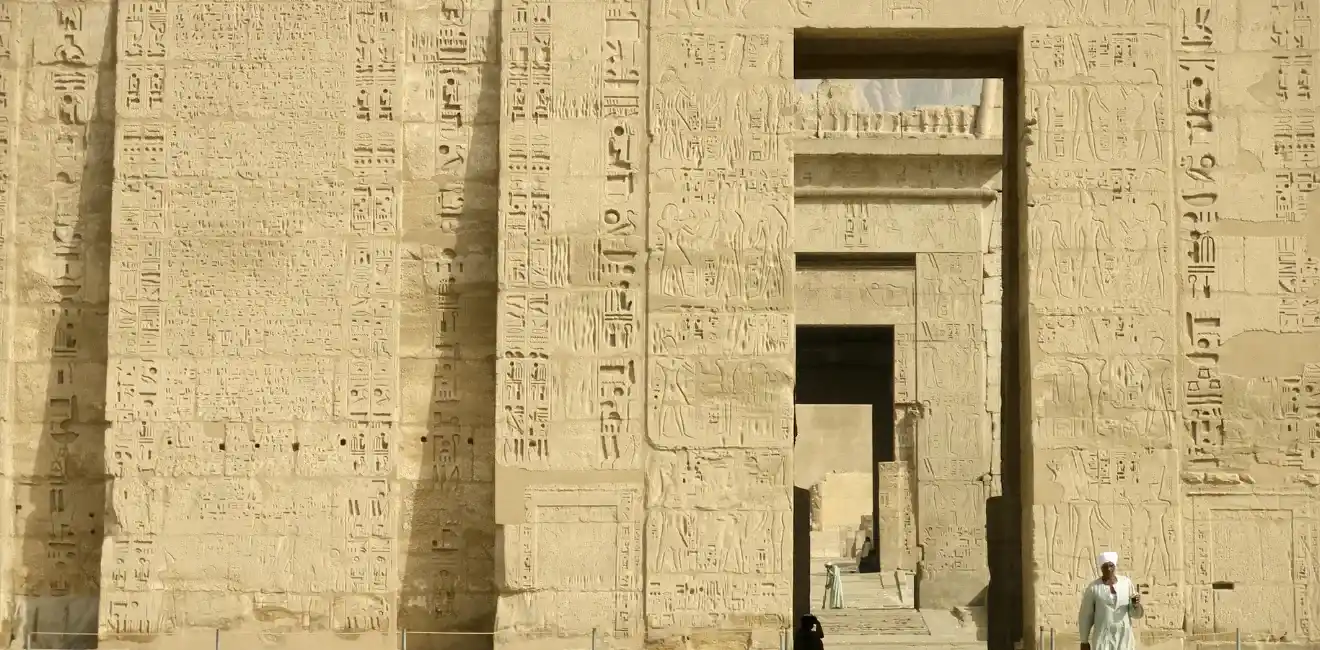
While you’re there, be sure to explore all the temple has to offer. The main courtyard is a masterpiece in its own right, with carvings of various gods and goddesses adorning the walls. Don’t miss the inside of the temple, either, where you’ll find more stunning carvings as well as some of the best-preserved hieroglyphs in all of Egypt.
This temple complex feels bold and physical, like it was built to last through noise, crowds, and centuries of wind. You’ll see a quick history of Ramses III, some of the best preserved wall reliefs in Luxor, and practical tips to make your visit smooth. It’s also often less crowded than nearby sites, which means you can actually stand still, look close, and read the walls like a story.
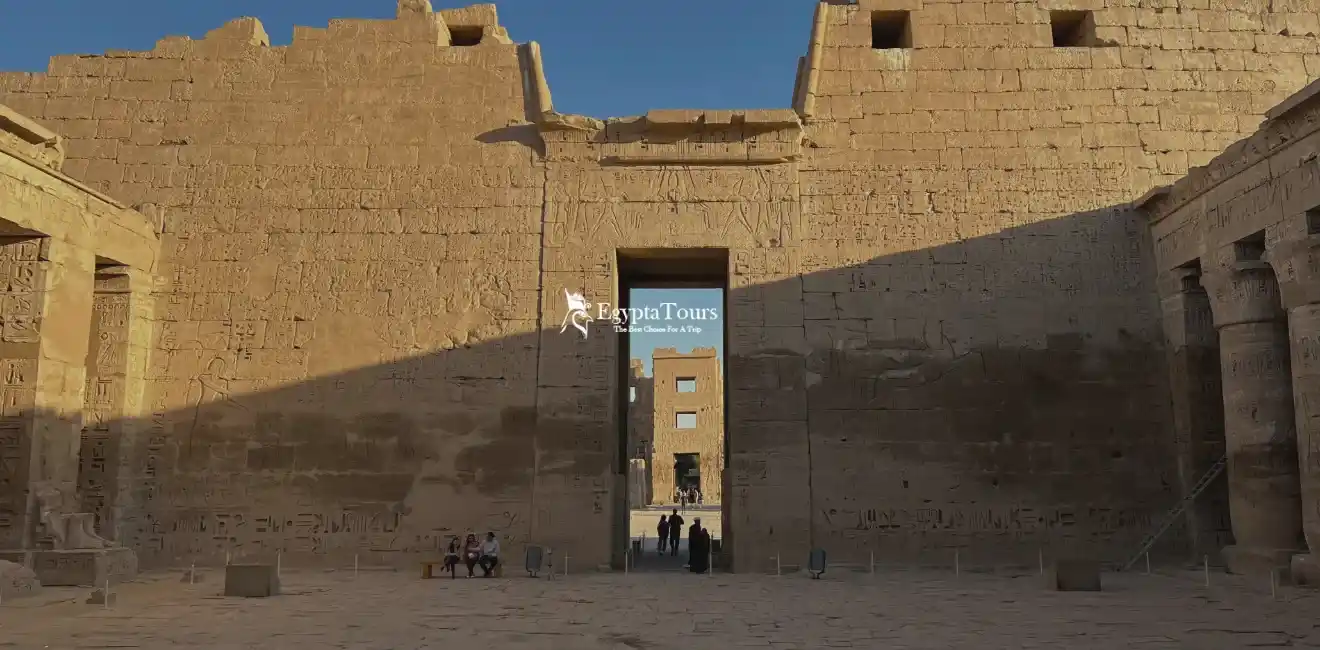
Madinet-Habu-Explained-What-It-Is-Where-It-Is-And-Why-It-Matters-In-Luxor-EgyptaTours
Madinet Habu (also spelled Medinet Habu) sits on the Luxor West Bank, not far from other major tombs and temples. When people say “Madinet Habu temple,” they usually mean the Mortuary Temple of Ramses III, the main monument inside a larger walled complex.
At first glance, it doesn’t look delicate. The outer walls are thick, the entrance is tall, and the first approach can feel more like a fortress than a quiet shrine. That’s part of its power. Ramses III wanted visitors, priests, and officials to feel his authority before they even stepped into the courtyards.
For travelers, the big reason Madinet Habu matters is simple: the reliefs are often sharp and readable, with deep carving and long runs of hieroglyphs. Many scenes still hold a sense of motion, crowded with figures, weapons, boats, animals, and gods. It’s one of the best places in Luxor to understand how ancient Egyptians used walls like public memory, recording victories and ritual in permanent stone.
Another reason it stands out is its layout. You move through clear stages: massive gateway, open courts, then darker halls and smaller rooms. It creates a natural rhythm. Loud spaces first, quiet spaces later, like walking from a stadium into a chapel.
Who built Madinet Habu and what was it used for?
Madinet Habu is tied to Ramses III, a New Kingdom pharaoh of Egypt’s 20th Dynasty. His mortuary temple wasn’t just a “tomb temple” in the modern sense. It was built for worship, ritual, and the ongoing idea of kingship, where the pharaoh stayed present through offerings and ceremonies.
The complex also worked like a protected estate. Think of it as a temple wrapped inside a working center with storage areas, offices, and rooms used by staff and priests. In daily life, it could feel like a small town built around sacred space.
A quick timeline: from New Kingdom glory to later reuse
The temple’s high point was in the New Kingdom, when Ramses III’s reign shaped most of what you see today. Later eras brought change. Different rulers, new needs, and shifting power meant parts of the complex were reused and reworked.
That’s why visitors may notice layers: older core scenes that feel grand and official, then later additions and repairs. The site you walk through now is not a single moment frozen in time, it’s a place that kept being used, adapted, and lived around.
History of Madinet Habu and Habu Temple
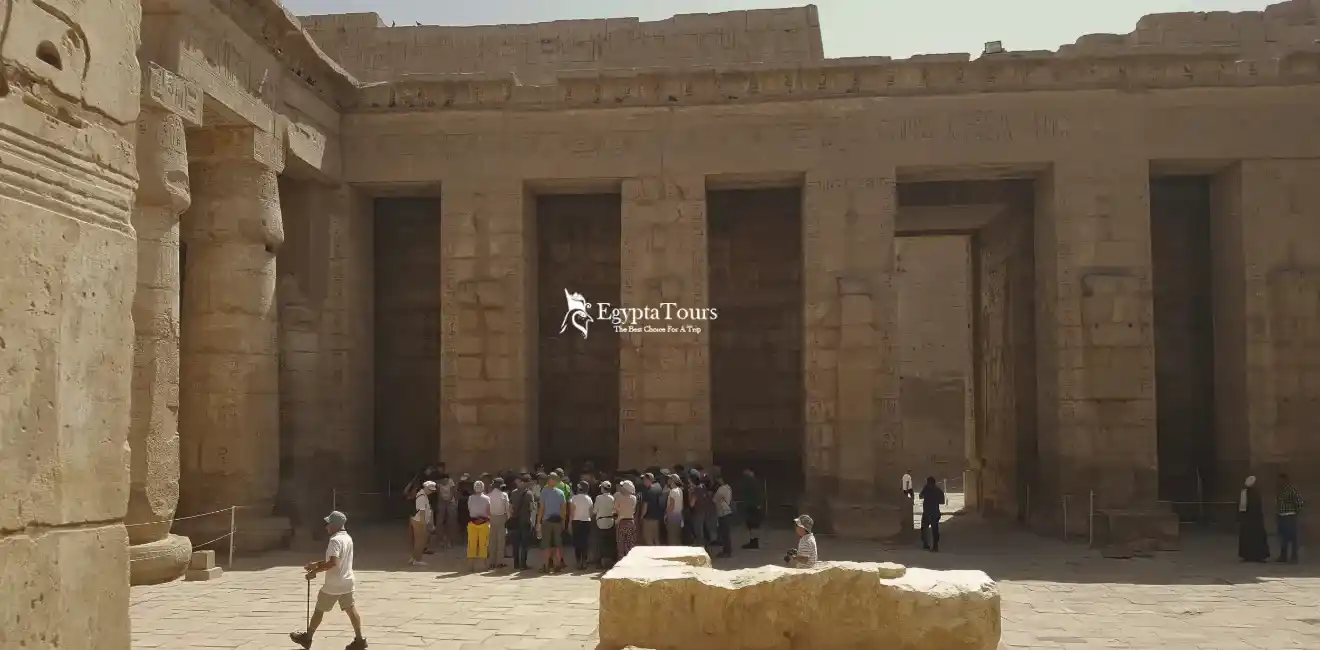
History-Of-Madinet-Habu-And-Habu-Temple-Temple-Of-Ramesses-III-In-Luxor-EgyptaTours
Madinet Habu was founded in the 19th Dynasty by Ramesses III, who is also buried there. The temple complex is dedicated to the god Amun-Re, who was the head of the Egyptian pantheon during the New Kingdom period. The construction of Habu Temple began under Ramesses III and continued until the end of the Ramesside period.
The temple complex is quite large and features a number of different buildings and courtyards. The most famous structure in the complex is the Mortuary Temple of Ramesses III, which is decorated with scenes from the king’s life and battles. Other notable features include the Temple of Amun, which has some of the best-preserved carvings in all of Egypt, and the Sacred Lake.
Medinet Habu is an enclosure primarily centered around the funerary temple of Ramesses III, one of the most significant pharaohs of the 20th Dynasty. It is largely inspired by the nearby Ramesseum, the funerary temple of Ramesses II.
However, Medinet Habu was walled and within its walls, there were additional spaces, making it not only a religious site but also an administrative and even residential center or at least a place for the pharaoh himself, as it included its own royal palace. Furthermore, in times of danger, it could offer shelter to the surrounding population. In fact by the early centuries of our era it seems to have been used as a Coptic settlement with a church.
Although it may not be one of the most visited sites on the West Bank, Medinat Habu is regarded by many travelers as one of the most impressive attractions they encounter in Luxor. This temple complex is notably well preserved especially when compared to the Ramesseum, which serves as the model for its design.
Although the Ramesseum was constructed by the more renowned Pharaoh Ramesses II, Medinat Habu, commissioned by Ramesses III, is a far more striking sight. Its pylon and many of its walls remain largely intact, with much of the original paint still visible on its carved surfaces.
Ramesses III (reigned 1184–1153 BC) was the final of Egypt’s great pharaohs. Following his rule, Egypt entered a period of long decline, eventually being governed by foreign powers for much of its history after the New Kingdom. After the empire reached its greatest extent under Ramesses II, the constant threats of invasion from various borders ultimately became too overwhelming.
Ramesses III is the last pharaoh credited with major building projects and this temple complex was the largest of them all.
During his reign, Medinat Habu served as a fortified city, with the temple and an administrative center enclosed within walls that offered protection to the area’s inhabitants during difficult times. Later, the complex became a walled town for Coptic Christians living in the region.
The first impression of the temple is striking as you pass through a massive stone gate that seems unusual for Egypt. This Ptolemaic addition to the complex conceals the main feature behind it the Temple of Ramesses III, with its towering pylon still adorned with well preserved relief carvings. These carvings depict the king’s victories over Egypt’s rivals including the Libyans and the Sea Peoples.
From there, the temple extends into several courtyards featuring well preserved reliefs and columns, many of which still retain their original coloring. This path leads into the final hypostyle hall.
Habu Temple Location
Habu Temple is located in the West Bank of Luxor, on the opposite side of the Nile River from the city of Luxor. It’s dedicated to the god Amun and located in the ancient city of Thebes.
Interesting Facts About Madinet Habu and the Habu Temple
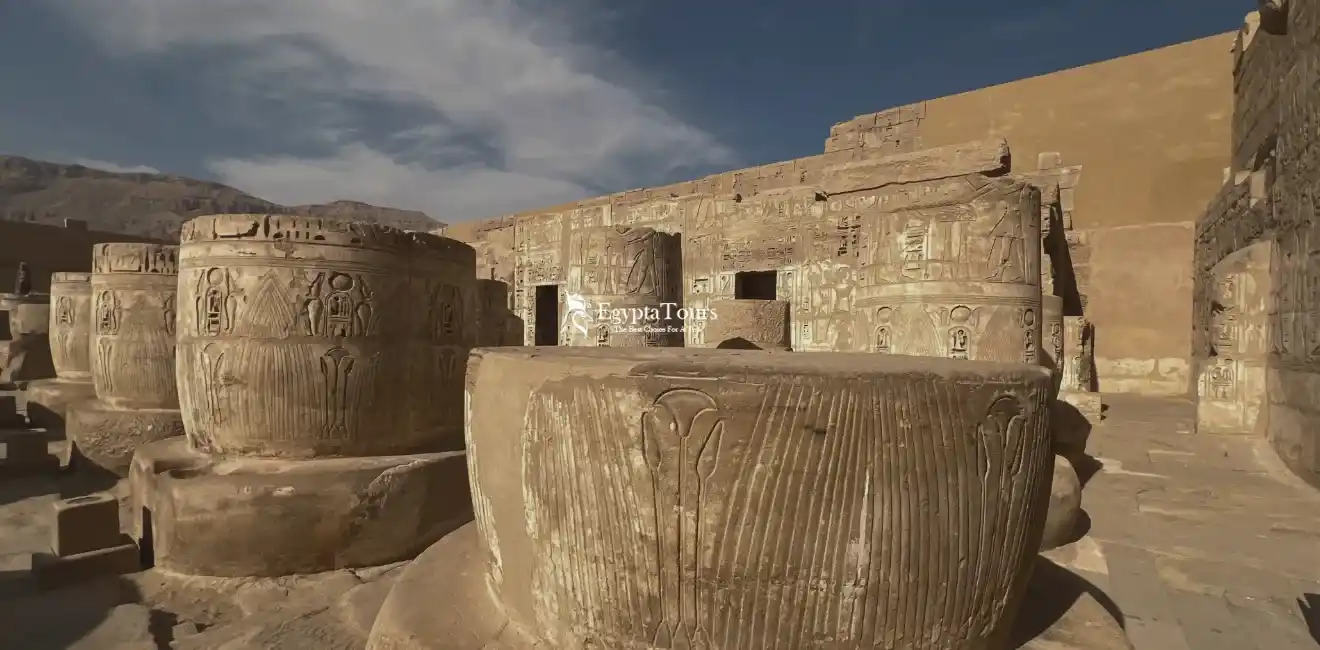
Interesting-Facts-About-Madinet-Habu-And-The-Habu-Temple-Ancient-Egyptian-History-EgyptaTours
Medinet Habu is an ancient temple located in Luxor, Egypt. It was dedicated to the god Amun, who was the chief deity of Thebes. The temple was constructed By <strong>Pharaoh Ramesses III</strong>, who ruled from 1186-1155 BC.
The temple is famous for its impressive facade, which is decorated with carvings of animals and hieroglyphs. One of the most interesting features of Madinet Habu is the Habu Temple, which is located within the complex. The Habu Temple is a small, unassuming building that is dedicated to the god HPNDS (Habu).
Despite its small size, the Habu Temple is one of the most important temples at Madinet Habu. It contains a number of interesting features, including an altar and a chapel dedicated to the god Amun. The temple is also home to a number of carvings and paintings that depict religious scenes and myths.
During your visit to Medinet Habu, you will encounter several distinct areas, each with its own unique features although some are nearly in ruins:
Temple of Ramesses III: Undoubtedly the best preserved structure, this temple will capture the visitor’s attention. Several pylons with spectacular reliefs depicting the pharaoh are still standing, along with the courtyard, several hypostyle halls and chapels. It’s worth noting that some of the columns and roofs still display traces of polychromy, providing a glimpse into the vibrant colors that must have adorned the structure.
Other temples and chapels, such as those of Nectanebo I and Amenardis.
Wharf and canal, as this enclosure was once connected to the Nile for religious boat processions.
Pavilion or Royal Palace, from where the pharaoh would have watched and led the processions.
Wall which gives insight into the scale of the entire enclosure.
As with many archaeological sites, it can be challenging to fully grasp the significance of these spaces with the naked eye. For this reason, it is highly recommended to visit with an expert guide. If you book your trip with Egipto Exclusivo, we will provide you with a top professional who can share all the fascinating details of your visit to Medinet Habu.
What to see inside Madinet Habu: highlights you should not miss
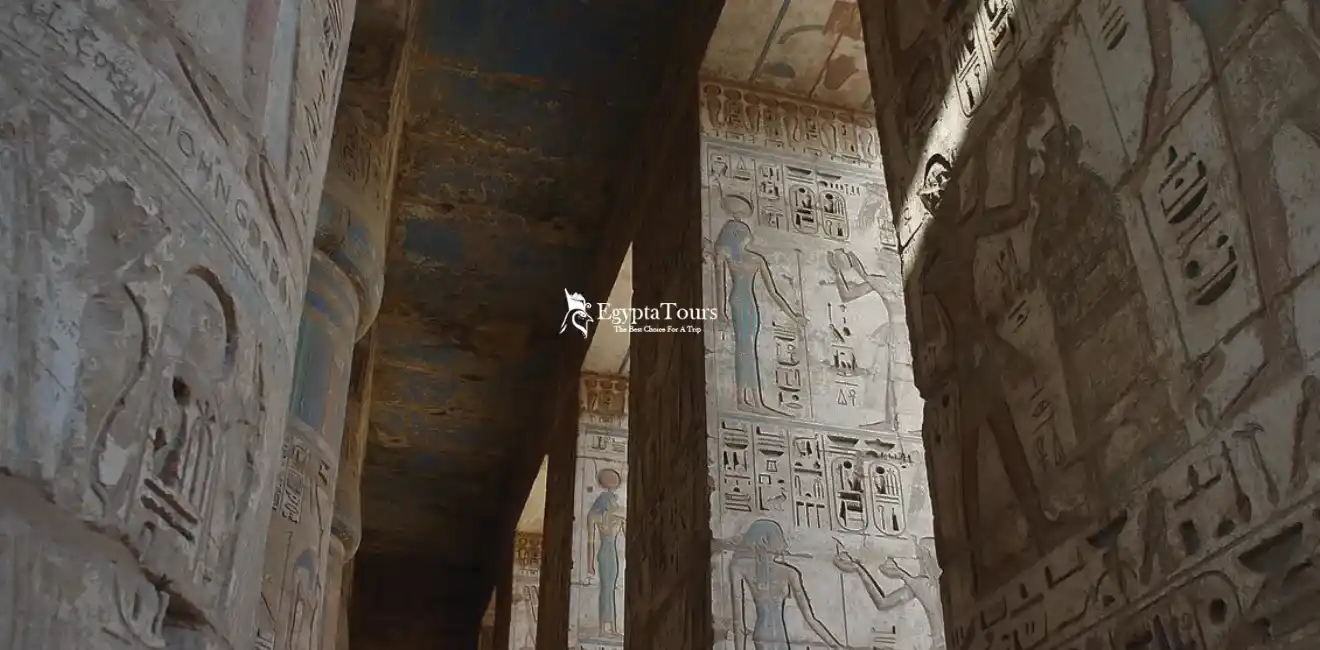
What-To-See-Inside-Madinet-Habu-Temple-Reliefs-Courtyards-And-Sacred-Highlights-EgyptaTours
Madinet Habu rewards slow looking. The carvings aren’t just decoration; they’re messages. Give yourself a simple plan: enter through the main gateway, spend time in the first courtyard, follow the major battle walls, then head inward to the halls and side rooms where the details get quieter.
One tip that helps: look at the walls from a distance first. Then step in close to read the texture. This temple is famous because so much of the carving is still crisp, even after centuries outdoors.
Explore Medinet Habu By Category
| Category Name |
|---|
| Alexandria Tour Packages |
| Cairo Short Breaks |
| Giza Pyramids Day Tours |
| Egypt Honeymoon Packages |
| Egypt Travel Packages |
| Luxor Short Breaks |
| Nile Cruises |
| Egypt Sahara Tour Packages |
Tours of Medinet Habu and the Habu Temple in Luxor, Egypt
Ready to explore Madinet Habu and the Habu Temple? You have a few options. The most common and preferred option is to join a guided tour with a certified Egyptologist. This way, you’ll be able to get the full story behind the ancient site and hear about the mythological characters and their role in Ancient Egyptian history.
| Tour Name | Duration |
|---|---|
| Day Tour to Valley of Queens, Habu and Ramsseum-Luxor Short Breaks | 1 Day – 10 Hours |
| 3 Days Luxor Tour – Luxor short Breaks | 3 Days – 2 Nights |
| 4 Days Luxor Tour – Luxor Short breaks | 4 Days – 3 Nights |
You can also book a private, bespoke tour if you’re looking for something more personalized. With this option, you’ll have access to all of the exciting sites that make up Madinet Habu, as well as exclusive insights from your guide.
If you prefer to explore independently, you can also take advantage of self-guided audio tours. These are available in most tourist spots around Luxor and provide an interesting overview of Madinet Habu and the Habu Temple during your visit.
On site tips: guides, photos, and what to bring
A licensed guide can help you spot key scenes fast, especially the long battle walls. If you prefer to explore solo, a simple map and a patient eye go a long way.
Bring a few basics:
- Water and a hat for sun
- Comfortable shoes for uneven stone
- A small cloth or tissues, dust is common
For photos, be polite and aware of other visitors. Step back before you frame wide shots, and avoid blocking narrow passages. And again, keep hands off the carvings, even for a quick pose.
Conclusion
Madinet Habu is worth the trip because it combines scale, history, and well preserved reliefs that still feel alive. It’s easier to take your time here, and that changes the whole experience. You don’t just walk through a monument, you read it.
Add Madinet Habu to a West Bank day plan, then give yourself permission to slow down. Stand close to the wall stories, trace the carved lines with your eyes, and let the temple do what it was built to do: speak.
Uncovering Madinet Habu: FAQ
What is Madinet Habu?
Madinet Habu is an ancient temple complex in Luxor, Egypt. It’s renowned for its historical significance, particularly during the reign of Pharaoh Ramses III.
Who built the Habu Temple?
Pharaoh Ramses III commissioned the construction of the Habu Temple. It served as both a mortuary temple and a place for significant ceremonies.
Why is Madinet Habu important?
Madinet Habu is a key site for understanding the New Kingdom era in Egypt. Its inscriptions provide insights into the political, cultural, and religious life of the time.
What architectural features stand out in the Habu Temple?
The temple is famous for its massive pylons, detailed reliefs, and well-preserved murals. These elements display some of the finest examples of New Kingdom art.
What events are depicted on the temple walls?
The reliefs at Habu Temple vividly portray Ramses III’s military victories, religious rituals, and royal processions. These serve as historical records of his reign.
How has Madinet Habu contributed to our understanding of ancient Egyptian society?
The temple’s inscriptions and reliefs offer critical information on ancient Egyptian governance, warfare, and daily life, adding depth to our historical knowledge.
Is the Habu Temple still intact?
While the temple has endured some damage over the centuries, much of its structure and artwork remains remarkably intact, providing valuable insight for historians and archaeologists.
Can visitors access Madinet Habu today?
Yes, Madinet Habu is accessible to tourists. It’s a popular site for those interested in ancient history and Egyptian architecture.
What conservation efforts are in place at Madinet Habu?
Efforts include site maintenance, restoration projects, and measures to preserve the temple’s carvings and paintings for future generations.
Are there any myths or legends associated with Madinet Habu?
While not steeped in myth, the temple is notable for its historical narratives and the legends surrounding Ramses III and his accomplishments.
How does Madinet Habu compare to other temple complexes in Egypt?
Though not as famous as Karnak or Luxor temples, Madinet Habu is unique for its detailed historical records and artistic achievements, distinguishing it as a vital archaeological site.
What is the best time to visit Madinet Habu?
Visiting during the cooler months, from November to March, offers a more comfortable experience when exploring this expansive historical site.
About EgyptaTours

EgyptaTours is a name synonymous with trust, excellence, and unforgettable travel experiences, proudly standing as one of the leading travel agencies in Egypt. Renowned for its deep expertise, personalized service, and carefully crafted itineraries, EgyptaTours serves as the ultimate gateway to discovering Egypt in its most authentic and inspiring form.