Discover the Mysteries of Ancient Egyptian Sarcophagus: History, Significance, and Facts
The ancient Egyptian civilization is one of the most important civilizations in...



Khnum, also written Khnemu and pronounced /kəˈnuːm/, whose name in Ancient Egyptian is 𓎸𓅱𓀭 (ẖnmw) and in Greek Χνοῦβις (Chnoûbis), is considered one of the oldest known gods in Upper Egypt. In the beginning, he was associated with the cataracts of the Nile.
Khnum was responsible for regulating the annual flooding of the Nile River, which was believed to come from the caverns of the god Hapi, the god of the inundation. Since the Nile flood brought silt and clay and its waters were the source of life for everything around, Khnum later became known as the creator of human bodies and the life force called “ka.”
He was depicted forming humans from clay on a potter’s wheel, then placing them into their mothers’ wombs. His acts of creation were often carried out under the supervision of another god. Later, it was said that he also formed the other gods and was worshiped as the creator of the animal world. The god Banebdjedet was his counterpart in Lower Egypt.
The worship of Khnum extended from the time of the First Dynasty and continued through the Greek and Roman periods after the end of native Egyptian rule. His first main cult center was in the city of Herwer in Middle Egypt. Although his presence on Elephantine Island dates back to the Early Dynastic Period, he did not become the chief god of the island until the New Kingdom when he received the title “Overseer of the First Cataract of the Nile.”
At Elephantine, Khnum formed a sacred triad with the goddesses Satis and Anuket. His religious importance also extended to the city of Esna, south of Thebes.
Khnum’s Form and Symbolism
Khnum’s main role in the creation of humans was usually shown with the head of a ram. The ram was a sacred animal in ancient Egypt and symbolized fertility, rebirth, regeneration, and resurrection. At first, he was depicted with horizontally twisted horns, based on an ancient Egyptian breed of spiral-horned sheep that is now extinct. In the New Kingdom, his appearance changed and he was shown with the downward-curving horns of Amun.
Sometimes he was depicted with the head of a crocodile, symbolizing his power over the Nile. He could also be shown wearing the atef crown with two feathers or the white crown of Upper Egypt.

The- Name -and -Titles- of-The God- Khnum
The hieroglyphic sign hnm (𓎸) which appears in Khnum’s name, is connected to the word hnmt, meaning “well” or “spring.” His name can also be linked to a Semitic root meaning “sheep.” Another interpretation of his name is “the beloved divine being.”
Khnum is also described with the phrase iw m hapy, meaning “the coming of the Nile.” He is sometimes called Khnum-Ra, referring to his role at the Nile cataracts as the soul of the sun god Ra.
His importance is reflected in his many titles, such as:
Creator God, Potter God, Lord of Life, Lord of the Fields, Lord of Esna, the Good Protector, and Lord of the Crocodiles.
Over time, the Egyptian word khn.m came to mean “to shape” or “to build,” influenced by Khnum’s creative powers.
Because of his importance, personal names were formed using his name, such as Khnum-Khufwy, meaning “Khnum is my Protector” which was the full name of King Khufu, the builder of the Great Pyramid.
The worship of Khnum was centered mainly in two sacred river sites: Elephantine and Esna. At Elephantine, he was worshiped with Satis and Anuket. At Esna, he was worshiped with Menhit, Nebtu, Neith, and Heka. Banebdjedet was his counterpart in Lower Egypt and Khnum was also associated with the god Min.
In the temples of Elephantine and Esna, religious rituals and festivals were held. One of these was a fertility ritual attended only by women who wished to conceive, while male priests were forbidden to participate. It was held at night in the Temple of Esna where women presented a potter’s wheel and recited hymns before a hidden statue of Khnum.
The festival of the “Installation of the Potter’s Wheel” ended with a great feast on the first day of the month of Paremhat.

The -Temple- of-The -God- Khnum -at -Elephantine
The original cult center of Khnum was in the city of Elephantine and the temple dates back to the Middle Kingdom. Khnum, his consort Satis, and their daughter Anuket are recorded there from the Eleventh Dynasty.
During the New Kingdom, rulers expanded the temples and built new structures including the temples of Khnum and Satis under Hatshepsut and Thutmose III, as well as a way station for Khnum’s sacred festival boat. Later, the Ptolemaic and Roman rulers added their own modifications.
Sacred rams dedicated to Khnum were found on Elephantine Island. They were mummified, decorated with golden headgear and placed in stone coffins.
Evidence was also found of tensions between the priests of the Temple of Elephantine and a nearby Jewish temple, caused by the desire of Khnum’s priests to enlarge their temple at the expense of the Jewish community.
Remains from the Thirteenth Dynasty show architectural features such as an entrance, a decorated hall, and a shrine for the sacred boat. Parts of the later Greco-Roman temple were probably reused from the older Temple of Satet.
Today, only a large monumental gateway of the Temple of Khnum remains.
At Esna, a temple was dedicated to Khnum, Neith and Heka, among other gods. Construction began in the Ptolemaic period but most of the surviving parts date to Roman times.
The temple stood in an agricultural area, and Khnum was regarded as the lord of the fields and the one responsible for the fertility of the land and the continuation of life. The inscriptions emphasize his role as a divine potter and credit him with creating gods, humans, plants and animals.

The -God-Khnum -in -Art- and -Literature
Khnum is usually shown seated beside a potter’s wheel forming humans. He is often accompanied by the frog-headed goddess Heqet, who assists him in creation.
In the Pyramid Texts, he is described as the maker of Ra’s boats. In the Coffin Texts, he is named as the creator of humans. In the Ipuwer Papyrus, he is described as a god who stopped creating because of the corruption of the land. In the Tale of Two Brothers, he creates Bata’s wife. He also appears in the Book of the Dead in spells protecting the heart.
Khnum’s importance is shown on the Famine Stela on Sehel Island, which tells of seven years of famine during the reign of King Djoser, until Khnum promised to end it in return for offerings to his temple.
He also appears on the stelae of Seti I and Tutankhamun, where incense and offerings are presented to him as “Lord of the Cataract.”
Khnum appears in hymns from the temples of Elephantine and Esna. The Morning Hymn praises him as “Lord of Life” and creator of humanity. The Great Hymn praises him as the creator of humans, gods, and animals, and as the one who distributes languages among peoples.
The role of the god Khnum was not limited to forming the physical body of the child only; rather, he was also responsible for creating the child’s “ka,” or vital spirit, and then granting him divine blessing. The Westcar Papyrus from the Second Intermediate Period recounts the story of Khufu and the Magician, in which the birth of three future pharaohs took place in the presence of the goddesses Isis, Nephthys, Meskhenet and Heqet with Khnum among them. After the birth of each child, Khnum bestowed upon him the gift of health and well-being.
Similarly, Queen Hatshepsut claimed that the god Khnum himself had fashioned her “ka” and granted her the blessing of health and strength, in response to the request of her “father,” the god Amun-Ra.
Khnum was not only a god of creation and life, but was also regarded as a protective deity of the dead. Spells invoking his assistance appear in the Book of the Dead, and his name has been found inscribed on many heart scarabs buried with the deceased. The ancient Egyptians believed that Khnum would help the dead obtain a fair and just judgment in the Hall of Ma’at during the afterlife.
The ram was considered an extremely powerful and fertile animal, and for this reason Khnum became associated with fertility, growth, and abundance. He appears on the famous Famine Stele discovered on Sehel Island, which states that the pharaoh, during the reign of Djoser, saw in a dream that the country would be saved from a severe famine if a temple were built in honor of Khnum. The pharaoh immediately consecrated a temple to him, and according to the stele, the famine indeed came to an end as the god had promised.
Khnum was among the gods who helped protect the god Ra during his dangerous nightly journey through the underworld. It is believed that he constructed the boat that carried Ra on this journey and also assisted in defending him against the serpent Apophis, the eternal enemy of the sun.
Khnum was sometimes regarded as the “ba of Ra,” meaning the spirit of Ra, because the word for “ram” in the ancient Egyptian language was also pronounced “ba.” When he merged with Ra in the composite form Khnum-Ra, he became associated with the god Nun, the embodiment of the primeval waters, and was given the epithet “Hap-ur,” meaning “the Great Nile” or “the Nile of Heaven.”

The- Relationship -of -khnum -with -Other -Deities
Khnum was associated with the goddesses Menhet and Neith at the temple of Esna, where he formed part of a local religious system.
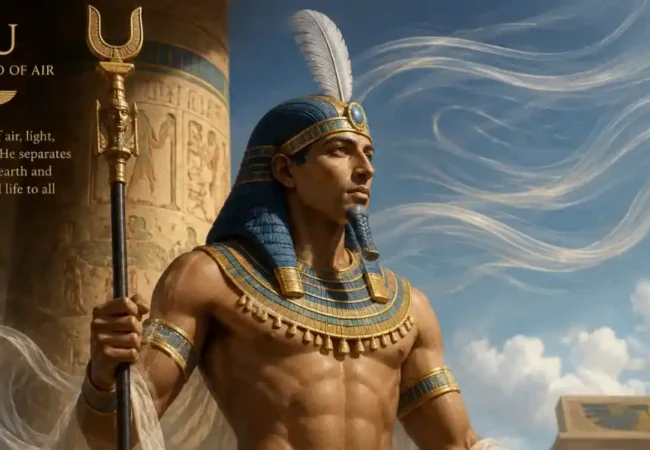
On Elephantine Island, he formed, together with the goddesses Satet and Anuket, the so-called First Cataract Triad. He was also united there with the gods Shu and Horus. The Greeks identified him with the god Amun at Thebes, perhaps because both were linked with the ram.
It was believed that Elephantine Island and the region surrounding the Aswan Cataracts were under Khnum’s protection and for this reason he was given the title “Lord of the Cataracts” in the Old Kingdom. In the New Kingdom, he formed with his wife Satet and his daughter Anuket, what became known as the Elephantine Triad.
Khnum was worshipped in many regions of Upper Egypt and Nubia, but his cult declined in northern Egypt and the Delta. Among his most important cult centers were Elephantine, Philae, Esna, Edfu, Asyut, Kom Ombo and Mendes. Since the earliest dynasties, the belief in the sacredness of rams had been well established in Egyptian religion.
Khnum appears in the manga and anime JoJo’s Bizarre Adventure, where the ability to change appearance is inspired by his role as the creator of humans.
Khnum, also written Khnemu and pronounced /kəˈnuːm/, whose name in Ancient Egyptian is 𓎸𓅱𓀭 (ẖnmw) and in Greek Χνοῦβις (Chnoûbis), is considered one of the oldest known gods in Upper Egypt. In the beginning, he was associated with the cataracts of the Nile.
Khnum was responsible for regulating the annual flooding of the Nile River, which was believed to come from the caverns of the god Hapi, the god of the inundation.
Since the Nile flood brought silt and clay and its waters were the source of life for everything around, Khnum later became known as the creator of human bodies and the life force called “ka.”
He was depicted forming humans from clay on a potter’s wheel, then placing them into their mothers’ wombs. His acts of creation were often carried out under the supervision of another god.
Later, it was said that he also formed the other gods and was worshiped as the creator of the animal world. The god Banebdjedet was his counterpart in Lower Egypt.
The worship of Khnum extended from the time of the First Dynasty and continued through the Greek and Roman periods after the end of native Egyptian rule.
His first main cult center was in the city of Herwer in Middle Egypt.
Although his presence on Elephantine Island dates back to the Early Dynastic Period, he did not become the chief god of the island until the New Kingdom, when he received the title “Overseer of the First Cataract of the Nile.”
At Elephantine, Khnum formed a sacred triad with the goddesses Satis and Anuket.
His religious importance also extended to the city of Esna, south of Thebes.


Explore our top-rated Egypt travel packages and embark on an unforgettable journey. From the Pyramids of Cairo to the magical temples of Luxor, Aswan, and Abu Simbel, discover expertly curated tours designed for your perfect Egyptian adventure