Abu Simbel Temple Relocation: See the Amazing Change
The Abu Simbel Temple stands tall as one of the greatest buildings....



The location of Abu Simbel is in Aswan, Egypt, in the southern part of the country near the Nubian region. The site includes two main temples: the Great Abu Simbel Temple, dedicated to the gods Ra-Horakhty, Amun-Ra, Ptah and the king himself, and the Small Abu Simbel Temple, located about 100 meters from the Great Temple, dedicated to the goddess Hathor and Queen Nefertari, the main wife of the king.
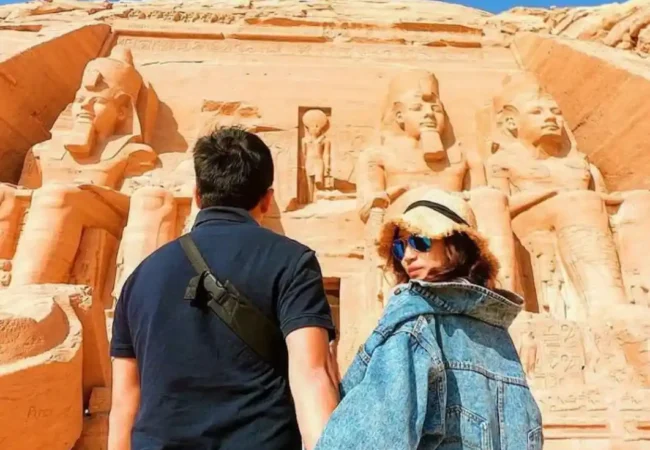
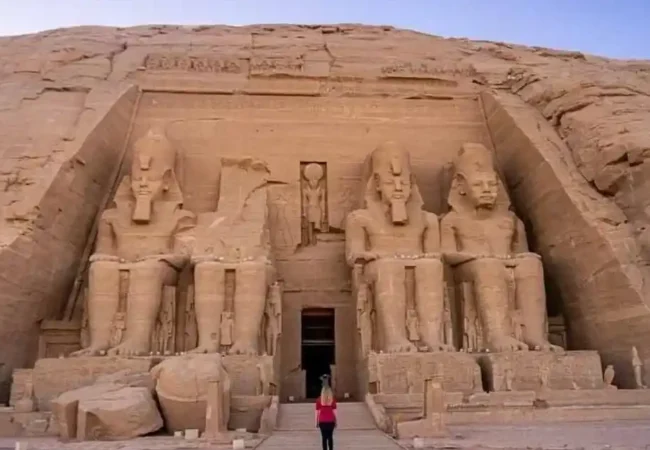
The temples are carved from six massive rocks in the Nubian region. At the entrance of the Great Temple, there are four statues of King Ramses and four statues of Nefertari.
The name “Abu Simbel” was given by the Swiss traveler Johann Ludwig Burckhardt, known as “Ibrahim Burckhardt” who discovered the site in 1813, guided by a young boy named Abu Simbel.
Construction of the Abu Simbel temples began in 1244 BCE and lasted about 21 years. The Great Temple, originally called the Temple of Ramses, celebrated Ramses’ victory in the Battle of Kadesh, strengthened Egypt’s power and the king’s authority and promoted Egyptian religion in the region.
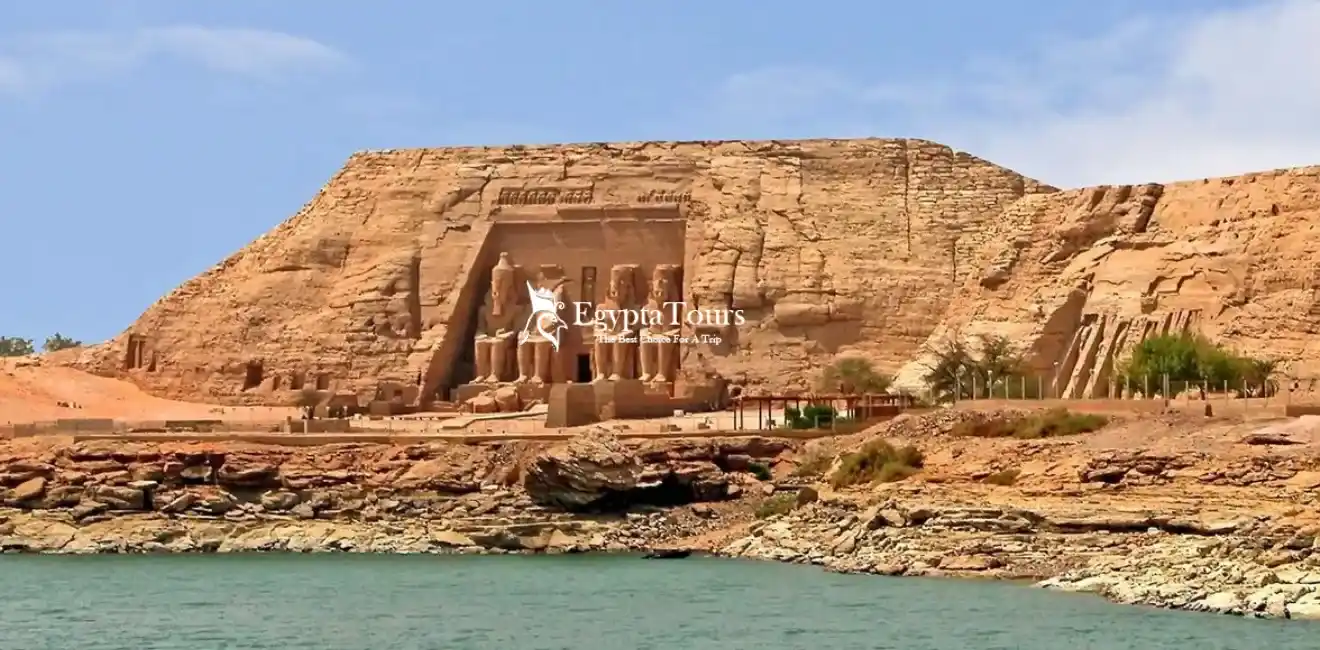
The -Discovery -of -the- Location- Of -Abu -Simbel-EgyptaTours
Over centuries, the temples were abandoned and almost completely covered by sand. In 1813, Swiss explorer J. L. Burckhardt discovered the cornice of the Great Temple and informed Italian explorer Giovanni Belzoni. They visited the site together but could not open the entrance. In 1817, Belzoni returned alone, successfully opened the temple and collected valuable items.
Tour guides today tell a legend of a young boy living at the site, who guided explorers to the temples. He was sometimes seen buried under moving sand. Because of this story, the site became known as Abu Simbel, though it was originally called the Temple of Ramses and Nefertari. The location of Abu Simbel today remains one of the most famous archaeological and tourist sites in Egypt.
The location of Abu Simbel includes two temples originally built by the famous King Ramses II. The main temple, known as the Great Temple, was dedicated to Ramses II himself and the gods Ra-Horakhty, Ptah and Amun. It also celebrated his victory in the Battle of Kadesh against the Hittite Kingdom.
The Small Temple was dedicated to his principal wife, Queen Nefertari, and represented the goddess Hathor.
Construction of the temple complex began around 1264 BCE and continued for about 20 years, completing around 1244 BCE. The main purpose of building the temples in Nubia was to display Egypt’s political power and religious influence during its golden age. Ramses II carried out a large-scale building program across Egypt and Nubia which was under Egyptian control at the time.
Nubia was economically and strategically important because it was a source of gold and many other valuable trade goods. Therefore, Ramses II built many large temples there to impress the Nubians with Egypt’s power and to reinforce Egyptian influence in the region.
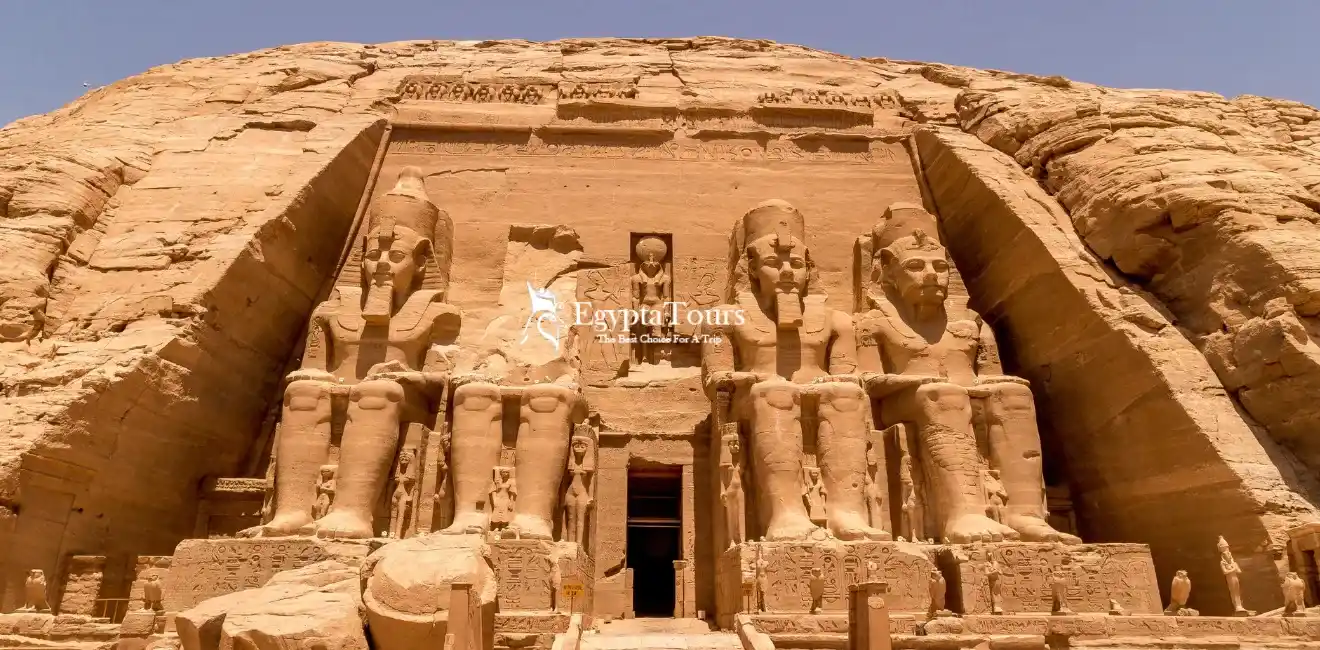
What- Makes -This -Temple- Unique -in- Egypt-EgyptaTours
The most striking feature of the Great Temple is its massive façade, which shows a unique artistic harmony and balance between its parts and the surrounding environment.
The façade is decorated with four huge statues of King Ramses II seated and wearing the double crown. His titles are carved on his shoulders and chest. Each statue is 20 meters tall and carved from a single block of sandstone, designed to fit the overall structure of the façade and show his grandeur as he overlooks the Nile.
Above the façade, there are carved statues of monkeys raising their hands in praise to the morning sun, totaling 22 monkeys. They represent the 24 hours of day and night, but due to limited space, the Egyptian sculptor reduced the number to 22.
The location of Abu Simbel and its artistic and religious design make it one of the most remarkable temples in Egypt and a symbol of Ramses II’s power and vision.
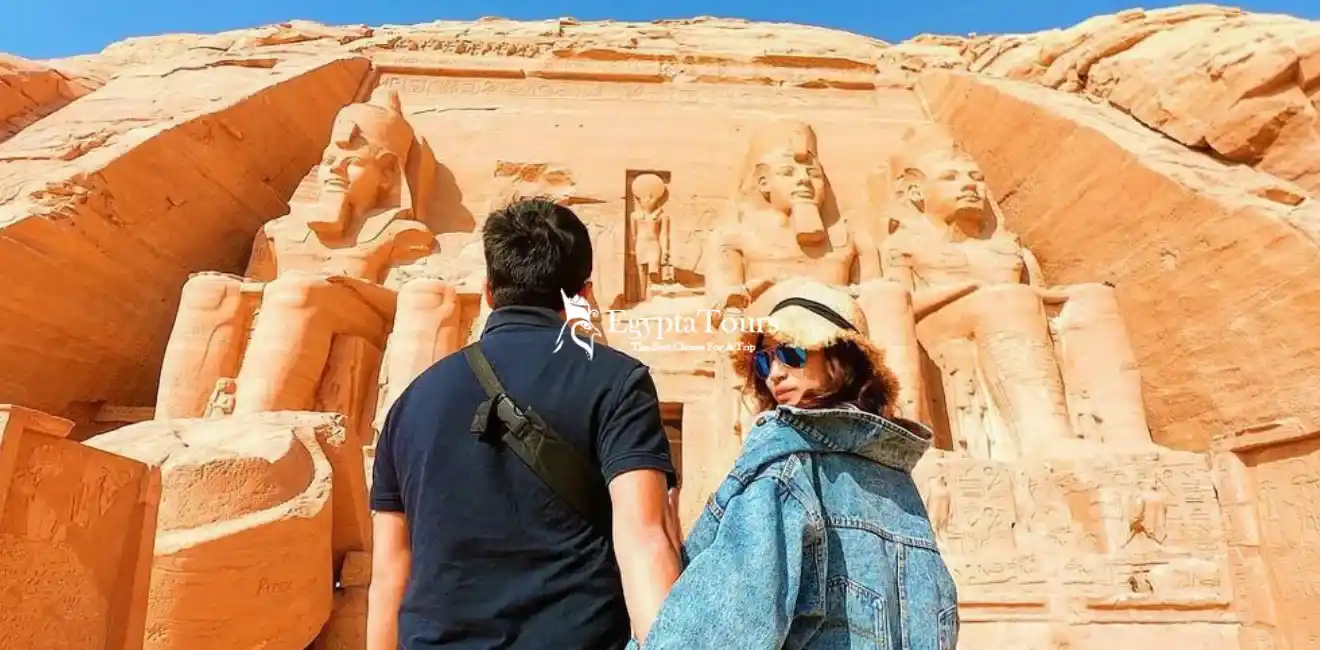
The -Importance -of -the -Location- Of -Abu- Simbel-EgyptaTours
The location of Abu Simbel is especially important because of the solar phenomenon that occurs twice a year when the sun aligns perfectly with the face of the Ramses II statue. The first alignment happens on October 22, marking the king’s birthday and the second on February 22, marking his coronation day.
The Great Abu Simbel Temple was carved from the mountains during the reign of Pharaoh Ramses II as a permanent monument to himself and Queen Nefertari. It celebrated his victory in the Battle of Kadesh and was also meant to intimidate the neighboring Nubians. Construction of the temple complex began around 1244 BCE and lasted about 20 years, completing around 1224 BCE.
Over time, sand covered the main statues up to the knees, and the temple was forgotten until 1813 when Swiss explorer Johann Ludwig Burckhardt discovered the cornice of the Great Temple. He informed Italian explorer Giovanni Belzoni and they visited the site together but could not dig an entrance. Belzoni returned in 1817 and successfully entered the complex, taking with him what he could from inside.
Abu Simbel Temple is considered one of the most important, famous and beautiful temples in Egypt. It is a masterpiece of ancient Egyptian architecture, carved into the mountains during the reign of Ramses II, one of Egypt’s greatest kings in the 13th century BCE. The construction of the two temples began around 1264 BCE and lasted 20 years, creating a permanent monument to Ramses II and Queen Nefertari, celebrating his victory in the Battle of Kadesh.
The story began in 1953, when Egypt, under President Gamal Abdel Nasser, decided to build a new dam on the Nile River near Aswan, about 900 kilometers south of Cairo.
The construction of the High Dam was essential for Egypt’s economic growth. However, it also created a serious problem: the dam required a reservoir, Lake Nasser, which would raise the water level up to 80 meters above the river. This meant that the Nubian temples, including the location of Abu Simbel, were at risk of being submerged. Once the dam was completed, the Abu Simbel complex would have disappeared under the water forever if no action had been taken.
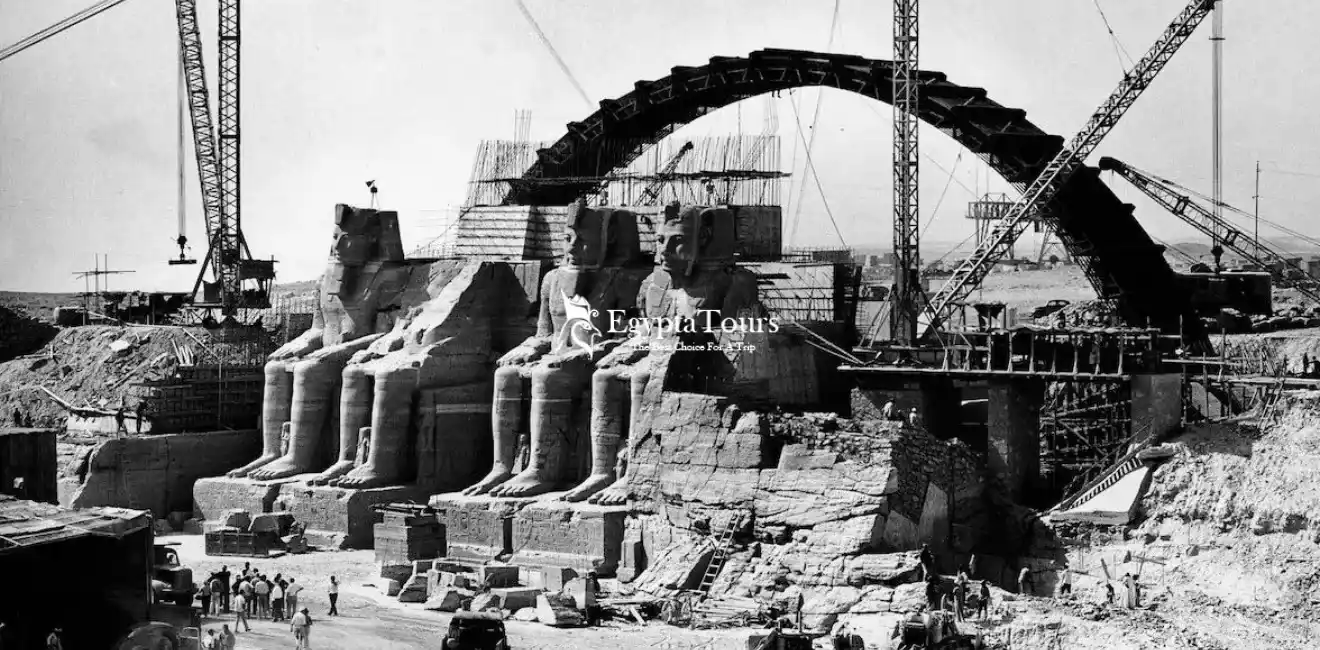
The -Relocation -Of- Abu -Simbel-EgyptaTours
In 1960 AD, the Abu Simbel temple was completely moved to an artificial hill in Aswan on top of the High Dam and above its reservoir. This relocation was necessary to prevent the temple from being submerged due to the formation of Lake Nasser which resulted from the construction of the dam and created an artificial reservoir to store the Nile waters.
The site was named “Location Of Abu Simbel” and became a UNESCO World Heritage Site under the title “Nubian Monuments.”
The construction of the High Dam was essential to achieve economic development and prosperity for the Egyptian people. However, building the dam required a lake to store the Nile’s water which is Lake Nasser, where the water level rises up to 80 meters above the river surface. As a result, all the Nubian monuments including the Abu Simbel temples, would have been submerged forever.
Here, the Egyptian government showed its commitment to development alongside preserving the heritage of the ancestors. They worked on saving the Nubian monuments while continuing the construction of the High Dam. Accordingly, in April 1959, the Egyptian government sent an official letter to UNESCO requesting technical, scientific and financial assistance to relocate and protect the temples from the High Dam waters as well as to conduct excavations in all archaeological areas in Nubia and fully document all Nubian monuments.
In March 1960, UNESCO launched a historic international appeal from its headquarters in Paris to save the Abu Simbel temples in particular and the Nubian monuments in general. A multinational team of archaeologists, engineers and geologists began working together to study the best solutions to save the temples.
After several studies, experts proposed two projects: the first, a French project, involved building a rock and concrete dam around the temples; the second, by Italian engineer Gazzola, aimed to lift the temples as a single block.
The technical committee refused the rock dam project due to the risk of water leakage into the temples. Additionally, the temples were located in a low area surrounded by water which could increase humidity inside and affect the carvings and statues. Moreover, the construction cost was high and the dam would require continuous maintenance.
In June 1961, the UNESCO committee decided to adopt the second project, which involved isolating the temples from the mountain, constructing a concrete box over them, and lifting the temples using giant hydraulic jacks, at a cost of 80 million dollars. However, this project was not implemented due to insufficient funding from the contributing countries which led to a search for a more cost-effective solution.
The Egyptian government then proposed an alternative project, approved by UNESCO, which involved dismantling the temples into rock blocks, moving them to the Abu Simbel hill and reconstructing the temples on the hill in the same original orientation. This solution cost less than previous projects, about 36 million dollars. The financing agreement was signed in November 1963 between Dr. Abdel Qader Hatem, Egypt’s Minister of Information and Culture and UNESCO. After signing the agreement, the dream became a reality to save the most important Nubian monuments, the Abu Simbel temples, following Egypt’s extensive efforts to overcome all obstacles.
The actual execution began according to the project consultant’s report with several precise steps:
First, a protective dam and metal barriers were built in front of the temples to safeguard the structures in case of rising water. Then, metal scaffolding was erected inside each temple to protect walls, columns and ceilings during the removal of rocks above the temples. The temple façades were then covered with sand to prevent damage from falling stones.
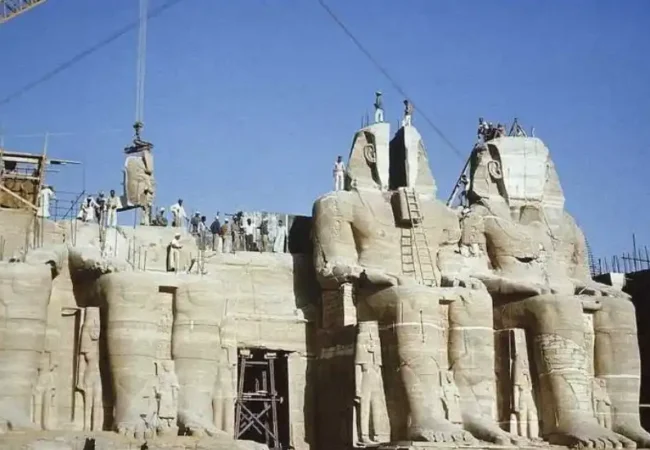
Next, a tunnel was constructed to allow entry into each temple. The rocks were strengthened and the carvings were stabilized. Fabrics were applied over the cutting lines to prevent edge breakage. The rocks above the temples were then removed, spread according to the pre-determined reinforced lines, either manually or using machinery.
The rock blocks, which had been carefully numbered, were transported to the new location on the hill for reconstruction in the same original orientation. After completing all cutting and transport operations, the temples were reassembled according to the numbering system. Rock mounds were built over each temple to preserve the original shape with concrete roofs topped by rubble stones. All gaps and joints between the assembled rocks were sealed carefully so that no difference could be noticed, restoring the temples to their original appearance without change.
Before dismantling, the restoration department at the Egyptian Antiquities Authority worked for seven months in 1962 to strengthen the weak sandstone and inject the cracks and rocks with chemicals to protect them during cutting and transport.
The large and small temples were then moved to a higher location on the Abu Simbel hill to keep them safe from the Nile waters, at a height of 65 meters above the river and 200 meters inward on the hill. The rocks were cut into square blocks, each 4 meters long and weighing about 30 tons, then numbered, transported to the hill and stored in order until reassembly.
The temples were reconstructed with extreme precision to preserve the solar alignment phenomenon, where sunlight illuminates the face of the statue of Ramses II inside the inner hall twice a year: on his birthday, October 21 and on his coronation day, February 21. After relocation, these dates shifted to October 22 and February 22. The most challenging part was maintaining the precise pharaonic geometric angles for the sun alignment as sunlight passes through a narrow opening to reach the statue deep inside the temple.
Around 2,000 engineers and workers, most of them Egyptians, participated in relocating the temples. The temples were dismantled into 1,036 rock blocks, totaling 31,000 tons. Work began in April 1964 and took four years, finishing on September 22, 1968. The total cost of relocating the temples was 36 million dollars, of which Egypt contributed 12 million and 51 countries covered the remaining costs.
On September 22, 1968, Egypt and the world celebrated the completion of the international mission to save the Abu Simbel temples, the largest cultural and civilizational project in Egypt and the world. The ceremony was attended by 500 cultural enthusiasts from around the world, alongside the UNESCO Director-General, ministers and ambassadors of the contributing countries and representatives from international news agencies, television channels and newspapers.
The location of Abu Simbel is in Aswan, Egypt, in the southern part of the country near the Nubian region.
The site includes two main temples: the Great Abu Simbel Temple, dedicated to the gods Ra-Horakhty, Amun-Ra, Ptah and the king himself and the Small Abu Simbel Temple, located about 100 meters from the Great Temple, dedicated to the goddess Hathor and Queen Nefertari.
The Swiss traveler Johann Ludwig Burckhardt, known as “Ibrahim Burckhardt,” discovered the site in 1813, guided by a young boy named Abu Simbel.
Construction of the Abu Simbel temples began around 1264 BCE and lasted about 20 years, completing around 1244 BCE.
The temples were built to display Egypt’s political power and religious influence during Ramses II’s reign, celebrate his victory in the Battle of Kadesh, strengthen Egypt’s power and promote Egyptian religion in the Nubian region.
The Great Temple has a massive façade decorated with four huge statues of King Ramses II seated and wearing the double crown. Above the façade, 22 carved monkeys represent hours of the day, and the temple’s design aligns with the sun twice a year, illuminating Ramses II’s statue.
Sunlight illuminates the face of Ramses II’s statue inside the inner hall twice a year: on October 22, marking the king’s birthday and on February 22, marking his coronation day.
In 1960 AD, the Abu Simbel temple was moved to an artificial hill in Aswan on top of the High Dam to prevent it from being submerged due to the formation of Lake Nasser.
The temples were dismantled into 1,036 rock blocks, transported to a higher location on the Abu Simbel hill and reconstructed with extreme precision, preserving the original orientation and solar alignment.
The temples were relocated 65 meters above the river and 200 meters inward on the hill.
The project began in April 1964 and was completed on September 22, 1968, taking four years.
Around 2,000 engineers and workers, most of them Egyptians, participated in the relocation.
The total cost was 36 million dollars with Egypt contributing 12 million dollars and 51 countries covering the remaining costs.
On September 22, 1968, Egypt and the world celebrated the completion of the relocation project.
The ceremony was attended by 500 cultural enthusiasts from around the world, the UNESCO Director-General, ministers and ambassadors of contributing countries and representatives from international news agencies, television channels and newspapers.
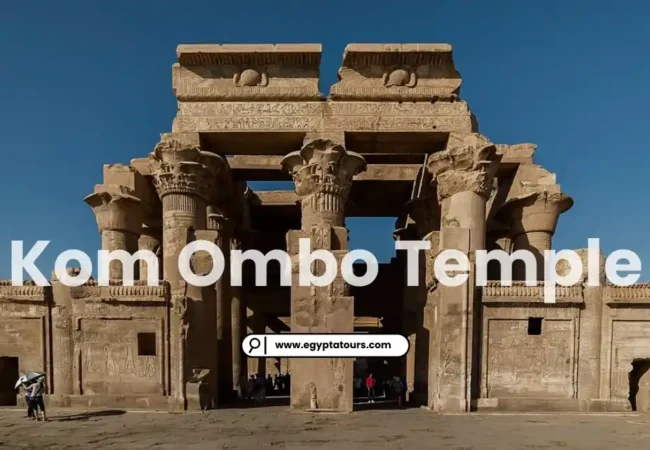
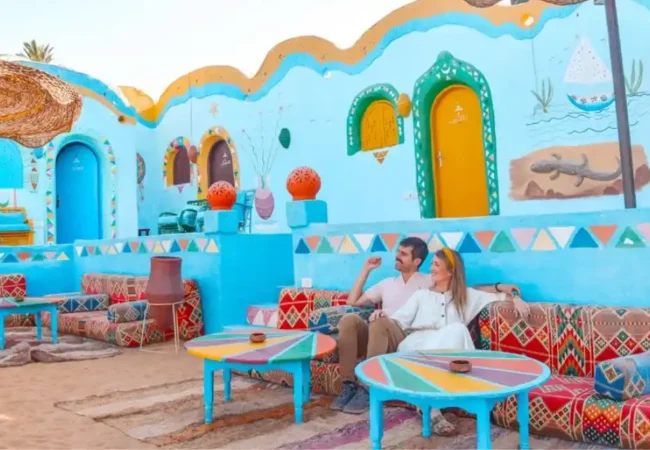


Explore our top-rated Egypt travel packages and embark on an unforgettable journey. From the Pyramids of Cairo to the magical temples of Luxor, Aswan, and Abu Simbel, discover expertly curated tours designed for your perfect Egyptian adventure