Alexander the Great’s Birth: Date, Place & Historical Background
The birth of Alexander the Great is considered a very important event...



Lake Nasser is considered one of the largest lakes in the world to store the waters of the Nile River, which led to providing a significant amount of water and improving agriculture in this vast region.
This lake is home to many diverse types of fish and plays an essential role in generating hydroelectric power, which leads to an increase in electricity production and significantly boosts the Egyptian economy.
In this article, we will learn about Lake Nasser and the most prominent tourist attractions located near it, making it a unique and distinctive tourist destination.

What-is-Lake-Nasser-EgyptaTours
Lake Nasser is one of the most important and largest artificial lakes in the world, containing fresh water that is continuously fed from the Nile River after the construction of the Aswan High Dam.
The lake is located on the border between Egypt and Sudan, but the largest part of it lies within Egyptian territory.
This lake has also been named Lake Nubia, and it is about 550 kilometers long, capable of storing approximately 162 billion cubic meters of water, making it a vital strategic reserve for Egypt.
Lake Nasser is named after the former Egyptian president Gamal Abdel Nasser who ordered the construction of the Aswan High Dam. The dam was finished in 1970 and its construction led to the flooding that formed Lake Nasser. The lake reaches the northern end near the dam.
Although the dam greatly increased Egypt’s production of hydroelectric power and helped the government control the yearly flooding of the Nile River, allowing farmland north of the dam to be protected, the project caused a lot of debate and criticism.
Building Lake Nasser forced about 90,000 Egyptian and Sudanese nomadic people to move to other places. In addition, several ancient sites had to be moved to higher land which cost a lot of money.
One famous example is the Abu Simbel Temples. Other places, like the ancient city of Buhen, were studied by archaeologists and then left to be covered by water.
Today, the benefits of the dam may face new challenges because of the construction of the Grand Ethiopian Renaissance Dam on the border between Ethiopia and Sudan. Some experts worry that this new dam could reduce the amount of water flowing into Lake Nasser which might lower the amount of electricity produced by the Aswan High Dam.

What-activities-can-be-done-in-Lake-Nasser-EgyptaTours
There are many activities that can be done in Lake Nasser, one of the most important of which is fishing, as the lake is rich in many delicious species. There are also some ancient Egyptian sites, the most important of which is the Buhen Fortress and some other ancient Egyptian fortresses located in the Nubia region.
In addition, there are some temples, parts of which are located under the waters of Lake Nasser, giving them a special mystery and attractiveness. Swimming is also considered one of the most important activities that can be done in this lake, as you can explore some areas and enjoy exercising while seeing the beautiful natural scenery that surrounds the lake.
You can also watch many types of birds that live around the lake and make it their home, in addition to the possibility of riding boats and enjoying the magical view of the water that soothes the soul and pleases the eye.
While the famous cruise on the Nile River between Luxor and Aswan is very popular, a cruise on Lake Nasser is a different and quieter experience.
Comfort and Privacy: Cruise ships on Lake Nasser are usually smaller and more private, giving visitors a comfortable and peaceful trip.
Fewer Tourists: Unlike the busy routes on the Nile River, the temples around Lake Nasser are visited by much fewer people.
Interesting Travel Programs: Most cruises stop at famous places like Abu Simbel Temples, Temple of Amada and Wadi El Sebua and other historic sites.
Wildlife Watching: Visitors may see Nile crocodile, migrating birds and other animals living in the area.
Popular cruise boats such as Steigenberger Omar El Khayam, Prince Abbas and Nubian Sea offer excellent service, delicious food and expert guides who help visitors learn more about the history of the region.
When Lake Nasser was made, people around the world worked to save important Nubian monuments. UNESCO moved some famous sites, especially Abu Simbel which was cut into more than a thousand pieces and rebuilt 64 meters higher and 180 meters further from the river. Other temples like Kalabsha, Wadi es-Sebua, Amada and the Philae monuments were also carefully moved, showing a new way to protect historical places.

The-most-prominent-tourist-attractions-around-Lake-Nasser-EgyptaTours
There are many tourist attractions that can be seen and enjoyed, all of which are located near Lake Nasser.
When visiting Lake Nasser, you can see many ancient monuments and temples that reflect the greatness of Egyptian civilization.
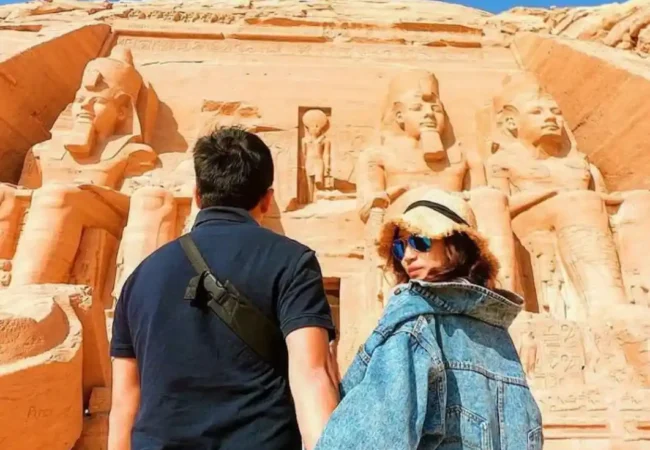
The Abu Simbel Temple is one of the most important ancient Pharaonic monuments located around Lake Nasser, and this temple was built during the reign of King Ramses II.
The temple is characterized by the four huge statues that adorn the facade of the temple and are located at the entrance representing the god Amun-Ra, the god Ptah, the god Ra-Horakhty, in addition to Ramses II himself.
It is worth mentioning that the sun’s rays are perpendicular to the temple on two specific days of the year, which are February 22 and October 22, and there is a part of the temple dedicated to the goddess Hathor and Queen Nefertari, which indicates the importance of women in ancient Egyptian civilization.
This temple is located near Lake Nasser and is considered one of the most important ancient Egyptian monuments.
It was built by King Amenhotep III and consists of three huge, interconnected temples.
The outer part of it was constructed of stone, while the inner part was carved from rock.
This temple has been restored more than once; it was restored during the reign of King Ramses II, and some believe that this temple was designed specifically for the god Horus, the god of the sun and protection.
This temple is considered one of the best temples located in the Nubia region, and it was built in the Roman era.
It consists of a large edifice leading to an open courtyard, and it has two rooms that were considered offerings to the gods, then the temple was later dedicated to some Nubian gods, reflecting the cultural and religious diversity in this region.
There are some crocodiles that have lived in the waters of the Nile River since ancient times, but after the construction of the Aswan High Dam, these crocodiles gathered behind the High Dam inside Lake Nasser.
A nature reserve was established that includes a large number of crocodiles, and strict penalties were imposed on hunting these crocodiles to preserve them and protect them from extinction.
It is a rocky island in the middle of Lake Nasser. This is the only monument in the lake that stayed in its original place. Qasr Ibrim used to protect a busy city, but most of the ruins were covered by the lake. In the middle ages, this place became important and the most visible ruins on the island are from a big cathedral that used to be there. People lived here until the mid-1800s and then it was abandoned.
The Temple of Amada goes back to the time of the Eighteenth Dynasty of Egypt and is the oldest temple in Nubia. Its wall paintings are still bright and well preserved, showing orders from the kings and stories about their battles and victories.
These temples are smaller but still very interesting. They were also moved to another place because the water of Lake Nasser rose. They help us understand the daily life and religious beliefs of the ancient people of Nubia and Egypt.
The Temple of Beit El-Wali is in Aswan, near the Temple of Kalabsha, south of the High Dam. It is one of the monuments built by Ramesses II in Nubian style and it was made for the god Amon and other gods. Beit El-Wali was saved from the flooding of Lake Nasser by a team of Polish archaeologists, supported by the Oriental Institute of Chicago and the Swiss Institute of Cairo Project.
The usual way to enjoy Lake Nasser is by taking a cruise. Most boats start from Aswan or Abu Simbel and the trip between the two places usually takes a few days. There are different choices of cruises, from very luxurious ones like the 5-star Steigenberger Omar El Khayam to other cruise activities included in many Egypt Nile tour programs.
If you do not want to stay on a boat, there are a few hotels near the lake, mostly around Abu Simbel. The Seti Abu Simbel Lake Resort and the Nefertari Abu Simbel Hotel are two 4-star hotels. Both offer views of the lake, a restaurant, a swimming pool and rooms with Wi-Fi and air conditioning.
There are some tips that must be followed when traveling to Lake Nasser, and the most important of these tips are the following:
Lake Nasser, one of the largest man-made lakes in the world, was created when the Aswan High Dam was built across the Nile in the 1960s.
Extending into northern Sudan, where it is called Lake Nubia, the lake was named after Gamal Abdel Nasser, the president of Egypt at the time.
The rising water levels of the newly created lake required the relocation of several ancient monuments, including the Temple of Abu Simbel, the Temples of Kalabsha, and the Temple of Dakka.
Lake Nasser, one of the largest man-made lakes in the world, stretches across Egypt and northern Sudan, formed by the construction of the Aswan High Dam in the 1960s.
This vast reservoir plays a crucial role in water storage and irrigation for the region.
In addition to its agricultural importance, Lake Nasser supports a growing fishing industry, providing livelihoods for local communities and contributing to the local economy with species such as Nile perch and tilapia.
Today, a Lake Nasser cruise offers a unique way to explore these relocated temples and the vast waterscape.
Lake Nasser is considered one of the most important artificial lakes in Egypt, and it is used to store excess river water until it is needed. It is also an important source of fish wealth and receives water coming during the flood of the state of Ethiopia, which leads to not flooding Egyptian lands with water.
This water is used in agriculture, irrigation, and drinking, and hydroelectric power is produced through this lake, which is one of the most important sources of electricity in Egypt.
This lake is located in southern Egypt, and it can be reached by land or by the Nile River through Nile cruises that depart from Aswan.
One of the best times to visit Lake Nasser is to visit it in the winter, because it is located in southern Egypt and the weather in the winter is warm and pleasant, and therefore visits to it increase in the winter.
It can also be visited during the spring and autumn seasons, when the weather is mild and suitable for doing various tourist activities.
Lake Nasser is considered one of the most important tourist destinations where many tourists go to enjoy the beautiful natural scenery, see some of the ancient monuments and temples located around the lake, and learn about the history and civilization of ancient Egypt.
Construction of the Aswan High Dam was completed in the 1960s, and the reservoir began filling in 1964, reaching full capacity in the late 1960s.
It covers about 5,250 square kilometers (2,030 square miles) when full, holding roughly 132 cubic kilometers (34 trillion gallons) of water.
It was built primarily for hydroelectric power, flood control, irrigation, and to regulate the Nile’s flow for downstream stability.
It lies mostly in southern Egypt and extends a portion into northern Sudan, though the Egyptian side is the larger shoreline.
The dam’s construction flooded ancient sites; large portions were moved or safeguarded before inundation, and the UNESCO-led efforts saved many artifacts, including the famous temples of Abu Simbel.
Yes. Tourism is possible via cruises and safaris along the lake and in nearby sites like Abu Simbel and Philae, depending on political and safety conditions.
The region hosts African fish species, Nile perch, various waterbirds, and reptiles. The surrounding habitats also support desert wildlife and migratory birds.
Yes. It supports commercial and artisanal fishing, with species such as Nile perch and tilapia being commonly harvested.
The dam enables controlled irrigation of vast tracts of land, improving crop reliability and enabling year-round farming in the Nile Valley.
Issues include sedimentation, evaporation losses, ecological changes, and impacts on downstream flows and natural flood regimes.
Management involves water release scheduling, hydropower operations, sediment management, and cooperation between Egypt and Sudan, under national authorities and international guidelines.
The creation of the lake displaced communities and altered traditional livelihoods, which is reflected in local histories and memories; the Abu Simbel temple relocation is a key cultural milestone.
Swimming is generally discouraged in certain areas due to currents, wildlife, and boat traffic; follow local guidance and safety advisories.
Depth varies seasonally and by location, with typical depths ranging from tens to over 90 meters in some channels, depending on water level.




Explore our top-rated Egypt travel packages and embark on an unforgettable journey. From the Pyramids of Cairo to the magical temples of Luxor, Aswan, and Abu Simbel, discover expertly curated tours designed for your perfect Egyptian adventure