




The Valley of the Golden Mummies
The Valley of the Golden Mummies is considered one of the most beautiful archaeological sites dating back to the Roman era in Egypt. According to their beliefs at the time, it was dedicated to the art of mummification and all funerary practices.
It has a distinguished location in the Bahariya Oasis, west of the Giza governorate. It contains many mummies covered with golden masks and the finest funerary garments. It is one of the discoveries that came to light in 1996, expressing the richness of the Roman era in Egypt. In this article, we will discuss the Valley of the Golden Mummies in detail.

Explore the Valley of the Golden Mummies, where history shines beneath Egypt’s sands.
The discovery of the Valley of the Golden Mummies took place in the late 20th century. It is located in the Bahariya Oasis area, southwest of Cairo. During routine excavations near the temple of Alexander the Great, the excavation team discovered a secret entrance to a tomb containing dozens of well-preserved mummies.
The most distinctive feature is the faces painted in an artistic style called “Fayum portraits,” known for its ability to realistically paint facial features on top of the mummy’s shroud.
Number of Mummies Found in the Valley of the Golden Mummies
The number of mummies found in the Valley of the Golden Mummies exceeds 250 mummies, and it is likely that the valley contains approximately 10,000 mummies under the sandy layers. Some mummies represent individuals from the upper classes, which expresses their social status and wealth, as evident through the amulets, jewelry, and decorations they wear.
Features of Mummification in the Golden Mummies

Experience where archaeology meets legend in the heart of the Western Desert.
Mummification in the Golden Mummies collection represents the best forms of mummification in the Roman era.
Its most important features are:
- Expressing the status of the mummies while preserving the deceased’s body in preparation for the other world according to their beliefs. The mummification in myths also expressed spiritual protection for the bodies By <strong>placing amulets</strong>.
- Reliance on highly advanced mummification materials, most notably resin, anti-decomposition substances, and aromatic oils.
- Adornment with funerary portraits, which is one of the oldest arts in the world, blending Egyptian symbolism with Roman realism.
- The golden mummies expressed the art and skill of mummification processes at that time, which highlights the skill and professionalism of the ancient Egyptians.
- Preservation of personal belongings and jewelry, such as necklaces or bracelets, for the journey to the other world.
- Class distribution in the quality of mummification, as the quality of the mummified bodies varies based on the social status of the deceased.
Ornaments and Decorations Discovered with the Mummies
With the discovery of the Valley of the Golden Mummies, a large number of decorated artifacts were found, including the following:
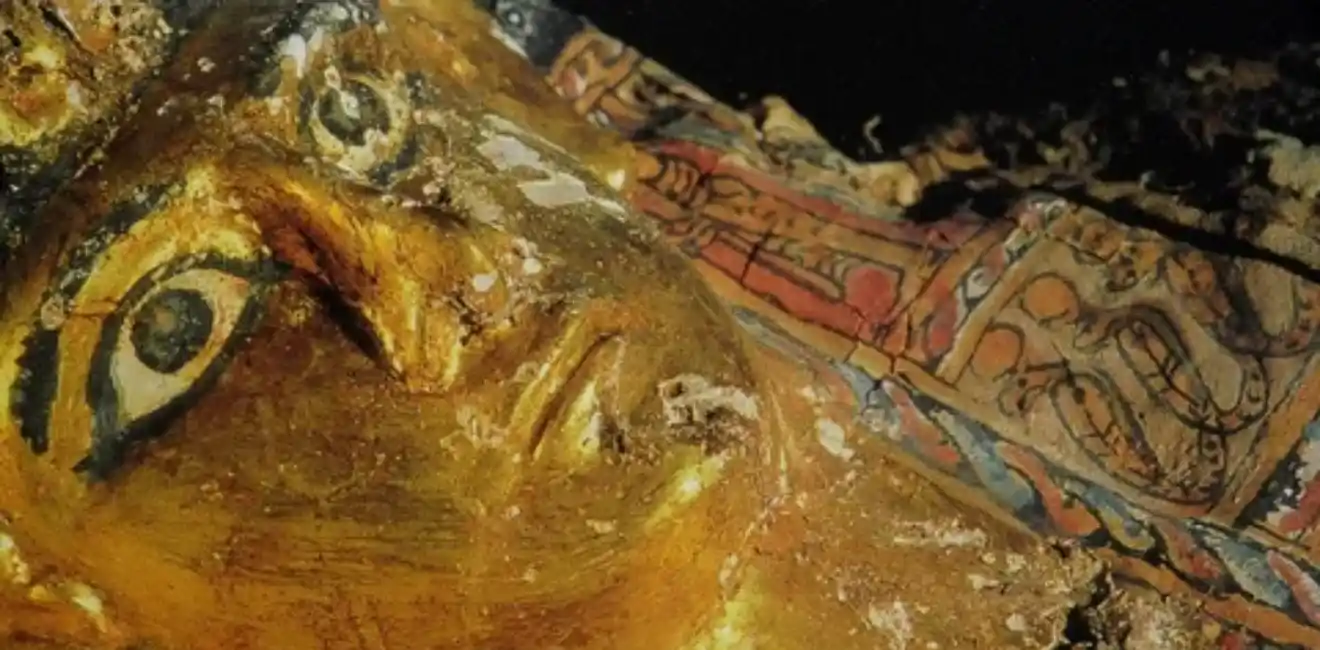
- Golden masks that completely cover the face and are finely decorated, such as with raised eyebrows and kohl-lined eyes, which reflected the status and sophistication of the mummy’s owner.
- Personal jewelry of gold rings with inscriptions. Some wore silver rings and bracelets decorated with carnelian and turquoise stones.
- Amulets, according to their beliefs, were used to protect the souls and grant them safety in the other life. They came in the form of the djed pillar symbol, the Udjat eye, and others; these are myths.
The Role of the Romans in this Huge Necropolis
The Romans played a prominent role in shaping the cultural and religious aspect of the Valley of the Golden Mummies, as was evident from the decorations and burial methods. Although they integrated Roman elements with Egyptian art, they preserved Egyptian rituals, which reflected the intermingling of the two civilizations in that era.
Different Burial Styles in the Valley
The Valley of the Golden Mummies was known for its variety of burial styles, which highlight the class diversity of that era.
The most important of them are:
- Burial inside a decorated sarcophagus: Some were placed in wooden sarcophagi with religious inscriptions, decorations, and symbols on top. This was used for the upper classes.
- Burial in linen wrappings: Many mummies were found wrapped in linen decorated with portraits or golden masks. This was applied to the middle classes.
- Mass burial: Some were placed in mass burial chambers to accommodate a group or members of the same family, which was applied to economically interconnected families.
- Simple burial: Some people were buried without masks or decorations and relied on simple wrappings for burial, which was applied to individuals of modest economic means.
The Difference Between Mummies of Rulers and Mummies of the Common People
In the Valley of the Golden Mummies, the clear difference between the mummies of rulers and the common people is evident in the quality of mummification, adornment with decorations and golden masks, and the burial method. In addition, there were religious and social significances for rulers that differed from the common people.
The mummies of rulers are associated with integrated rituals, while the mummies of the common people highlight simple and limited beliefs and may be limited to the basics only, according to their beliefs.
Most Famous Archaeological Discoveries in the Valley

Each mummy tells a story of Egypt’s golden past—come see them for yourself.
Among the most famous discoveries in the Valley of the Golden Mummies is the presence of thousands of mummies dating back to the Greco-Roman period. Dr. Zahi Hawass’s excavation team discovered many mummies covered with golden masks and valuable possessions, which is considered the largest archaeological discovery after the tomb of Tutankhamun.
How did the Discoveries Help in Understanding Daily Life?
The discoveries of the Valley of the Golden Mummies helped in understanding the course of life in the Roman period in Egypt. They contributed to a detailed study of the mummies, their beliefs, their religious rituals, their preferences in decoration, and the funerary rituals they followed. All this contributed to understanding ancient Egyptian life.
The Valley of the Golden Mummies as a Global Tourist Attraction

The Valley of the Golden Mummies awaits—where the past still shines bright.
The Valley of the Golden Mummies is considered one of the best modern archaeological destinations. Tourists and researchers from all over the world flock to it, as it contains unique archaeological treasures that express the fusion of Egyptian and Roman civilizations.
Its distinction with a large number of mummified bodies places it at the forefront of the most attractive archaeological sites, and its historical value makes a visit unmissable.
Conclusion
The Valley of the Golden Mummies is a major archaeological discovery. Through it, various mummies equipped with golden masks and buried in multiple ways were uncovered. This greatly contributed to understanding life at that time. Thus, it is a tourist attraction with increasing popularity.
FAQs
What are 5 facts about mummies?
They are mummified bodies from the Roman era, distinguished by elaborate mummification adorned with golden masks and other decorations. They are also known for the variation in burial method and mummification based on the class diversity of that era.
How many bodies were found in the Valley of the Kings?
63 tombs have been found to date, and each tomb contains dozens of bodies, most of them of princes, kings, and queens. The most famous kings are Tutankhamun, Ramesses II, and Thutmose III.
Where is the valley of the pharaohs?
The Valley of the Pharaohs (commonly known as the Valley of the Kings) is located on the west bank of the Nile River in Luxor governorate. It was designed for the burial of the kingdom’s nobles and kings. The valley also includes many tombs within the mountain.
Who found the golden mummy?
They were discovered by the Egyptian archaeological mission’s excavation team in 1996, marking the beginning of the discovery of hundreds of mummies with golden masks.
What female is buried in the Valley of the Kings?
The most famous mummy in Egypt is that of Tutankhamun, which is considered among the great treasures with its golden mask, ranking as a global art masterpiece.
How old are mummies in Egypt?
The ages of mummies in Egypt range for a few thousand years. The age of the oldest mummies discovered in Egypt is estimated to be around 3000 BC, which coincided with the pre-dynastic era. In general, the age of mummies varies based on the civilization they belong to and their time period.
About EgyptaTours

EgyptaTours is a name synonymous with trust, excellence, and unforgettable travel experiences, proudly standing as one of the leading travel agencies in Egypt. Renowned for its deep expertise, personalized service, and carefully crafted itineraries, EgyptaTours serves as the ultimate gateway to discovering Egypt in its most authentic and inspiring form.