
AL-Rifai Mosque: amazing Islamic Landmark
Consider it a story of his loneliness? Islamic architecture is like a...



Today’s story is about Al-Aqmar Mosque, one of the mosques of Fatimid Cairo and an architectural gem that steals the spotlight. Al-Aqmar Mosque is located on Al-Muizz Li-Din Allah Al-Fatimi Street, one of the oldest and most prestigious streets of Islamic Cairo.
It was founded in 1125 AD. It is worth noting that it was built by Minister Al-Ma’mun bin Al-Bata’ihi after being commissioned by Al-Amir bi-Ahkam Allah bin Ali Al-Mansur, the Fatimid Caliph.
The ancient mosques in Egypt bear witness to the antiquity of Islamic history and cultural values throughout the ages and times.
The ancient mosques in Cairo are considered among the most prominent historical landmarks that show the development of Islamic architecture throughout the different ages.
We notice that the unique Islamic arts intertwine harmoniously with the cultural and political influences of each time period. These mosques are also famous for their unique designs, exquisite decorations, and their pivotal role in religious and scientific life since their establishment until today.
Cairo is adorned with dozens of mosques that were built in the era of the Fatimid state.
No one who steps foot in Al-Muizz’s Cairo can do without feeling the spirituality and tranquility they seek. Each of these mosques has an origin and a story told with the fragrance of history and tells the authenticity of that time.
In addition to being an architectural gem in the heart of Cairo, it is also considered one of the most prestigious and beautiful Fatimid mosques in Egypt.
Al-Aqmar Mosque is known for its unique architectural design, which, if it indicates anything, indicates the brilliance and magnificence of Islamic architecture in the Fatimid era.
It is considered evidence of a historical antiquity that is manifested in a sophisticated image of Islamic art and architecture.
The Mosque of Al-Aqmar is in the middle of Al Muizz Street which was the center of Cairo during the Fatimid period. Many important Islamic monuments are nearby on the same street including the large Qalaun complex, the Al-Hakim Mosque and Beit El Sehemy, one of the best-preserved historic houses in Cairo.
Tourists visiting Egypt can easily reach Al Muizz Street because it runs next to the famous Khan El Khalili market. Visitors can take a taxi, stop at the well-known Al-Azhar Mosque, cross to the other side of the road, and enter Al Muizz Street. After walking about 10 minutes, they will reach the Mosque of Al-Aqmar, passing some of the most interesting Islamic monuments in Egypt along the way.
The-History-of-Al-Aqmar-Mosque-EgyptaTours
The Fatimids were part of the Shiite branch of Islam. They believed that Muslim leadership should pass from the Prophet Muhammad to his son-in-law, Ali and then to his sons Hassan and Hussein.
After the death of the sixth Shiite Imam, Jaafar El Sadeq, in 765 AD, the Shiites split again. Some followed his oldest son, Ismail and they were called the Ismailis. Others followed a younger son, Mousa and they were called the Twelvers.
The history of the Fatimids had times of great success and also times of decline. The Mosque of Al-Aqmar was built during a time of political and religious problems.
The mosque was built between 1121 and 1125 AD. The builder was Mamoun El Bataihi, the vizier of the Fatimid Caliph Al-Amir.
The Mosque of Al-Aqmar (the Moonlit Mosque) got its name because its grey stone used to shine in the light. Today, covered in Cairo’s dust and dirt, it doesn’t shine, but it is still considered an important piece of architecture.
The mosque was built in 1125 by one of the last Fatimid caliphs and is the oldest mosque in Egypt made of stone (earlier mosques were made of brick and covered with plaster).
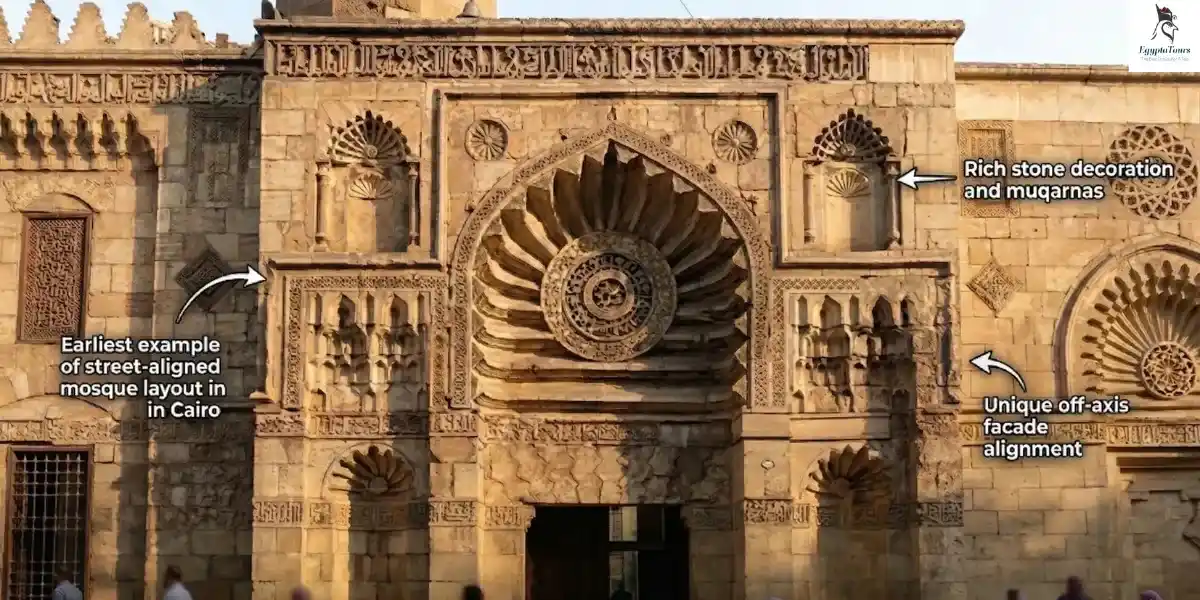
The mosque has an interesting design. Its outer wall has different thicknesses to adjust the inside space, making it fit both the street layout and the direction of Mecca.
The front of the mosque also shows the first use of decorative features that became popular later with the Mamluks, like carved stone “stalactites” (muqarnas) and ribbed designs in the arches.
The mosque got the name “Moonlit Mosque” because its light-colored stone front looks like it glows in the evening. This name shows how beautiful it looked in the streets of old Cairo.
As the first mosque in Islamic Cairo with rich façade decoration, the Aqmar Mosque influenced many buildings that came after it. It showed that a mosque could be both meaningful in religion and beautiful in design. Many later mosques in Egypt and other places used similar decoration styles.
The mosque is smaller than older large mosques which introduced a new idea for neighborhood mosques. Instead of being a large main mosque, it served as a local place for prayer but with special artistic beauty.
Inside, the mosque follows the traditional design with many columns, but it also includes the new entrance alignment idea. This mix of old and new helped people accept the design while allowing new architectural ideas to develop.
Scholars see the Aqmar Mosque as an important link between early Islamic architecture and later Mamluk styles. The decorative techniques used here appeared in many later buildings in Islamic Cairo and helped shape the area’s unique architectural style.

The-Facade-of-Al-Aqmar-Mosque-EgyptaTours
It was also the first mosque in Cairo to have a decorated stone front. The beauty of Fatimid stone carving is shown at its best on this mosque’s façade which is an architectural masterpiece. One side of the façade was hidden by nearby buildings until recently, but it has now been rebuilt, restoring the mosque’s original balance.
The main feature of the façade is its strong vertical design, divided into three sections by three keel-shaped arches. The taller middle arch has a carved hood with a medallion at the center. The carved lines start at the bottom as strong horizontal ribs, then rise and spread outward like the sun around the medallion. They end at the scalloped edge of the arch, framed by carefully carved interlacing circles.
The medallion itself is one of the finest and most balanced designs in Fatimid art. It has several rings with alternating bands of calligraphy and scroll patterns. In the center, the name of Ali is repeated in Kufic script, surrounded by a circle of scrollwork. The next ring repeats the name of Muhammad which is framed by a wide band of detailed carved leaves and scrolls.
The same design of the medallion and carved hood is repeated in a simpler way in the side sections of the façade. This style later appeared in other Fatimid buildings, such as the shrine of Sayyida Ruqayya (1133) and the mosque of al-Salih Tala’i (1160). Another new feature can be seen above the tall square panels on both sides of the entrance where muqarnas (decorative stone shapes) were used for the first time in Egypt on a flat surface.
Above these panels, the entrance is further decorated with shallow blind niches that have scalloped arches supported by small columns. A band of leafy Kufic writing runs along the top of the façade and another thinner band crosses it at the level of the arches. Round medallions have been restored above the side arches and the façade also includes smaller decorative shapes and panels with designs like vases and interwoven patterns.
Overall, the façade is beautifully designed and well balanced. The different layers of carving are carefully shaped and detailed to create a strong effect of light and shadow from the sun.
To understand the Aqmar Mosque, it is important to see its role in the development of architecture. The building connects traditional Islamic design with the needs of city planning, creating ideas that later became common in the Islamic world.
The decoration on the façade set an example for combining calligraphy, geometric patterns and muqarnas into one balanced design. Later architects used these ideas in many types of buildings, from small local mosques to large royal complexes. The style first seen at the Aqmar Mosque spread across North Africa, the Middle East and other regions.
The building methods used in the mosque also influenced later construction. Using brick for the structure and stone for decoration became a popular way to create buildings that were both strong and beautiful.
The mosque also solved the problem of aligning the building for prayer while fitting into the city’s layout. This solution became a model for many later projects and architects in different Islamic cities used similar ideas in their designs.
Valuable-Collections-of-Al-Aqmar-Mosque-EgyptaTours
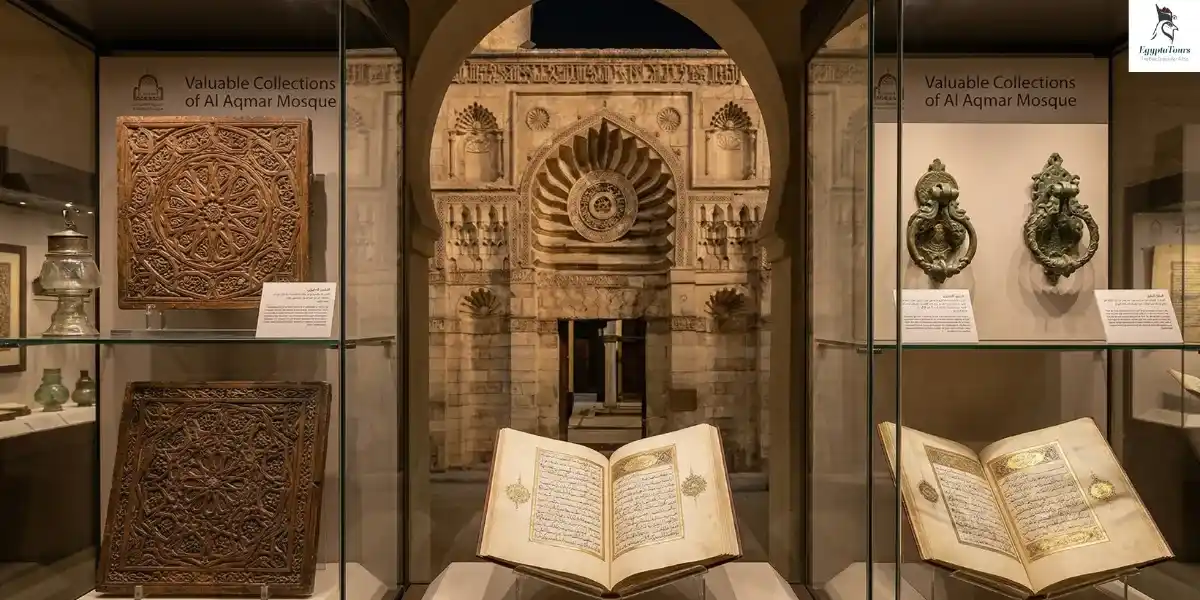
The Al-Aqmar Mosque has an important collection of Islamic art and objects that show the richness and variety of the Islamic world. This collection includes calligraphy, pottery, metal items, textiles and jewelry, all carefully preserved and displayed in the mosque’s gallery.
The calligraphy collection is especially important, with rare examples from the 9th and 10th centuries. The ceramic collection includes bowls, plates and jars decorated with detailed patterns, each with its own story.
The Al-Aqmar Mosque has always been an important center for religious and social activities in Egypt. It has hosted many exhibitions, events and talks about Islamic art and architecture, making it a place for learning and cultural exchange. Its creative design has influenced other buildings in Egypt and the region.
Despite challenges from urban growth and development, many efforts have been made to protect and promote the mosque’s heritage. Restoration work, archaeological excavations and improvements have helped preserve and celebrate its history.

Reasons-for-naming-Al-Aqmar-Mosque-EgyptaTours
There is an inherited story about the reason for naming Al-Aqmar Mosque with this name; This is due to the beauty of its architectural style and decorations inspired by the unique Islamic art, especially at nightfall.
it appears with a luster resembling moonlight, and in the Fatimid era, where the mosque was built with precision and delicacy of details, and the distinctive decorations suggest an expression of magnificence and beauty, and therefore the name “Al-Aqmar” was associated with its meaning of works and is the most brilliant and radiant.
This indicates the splendor of the unique mosque that matches the moonlight in its clarity and light, and in another narration, the Al-Aqmar Mosque attributes its name to Al-Aqmar; because it contains white stones on its sides that resemble the color of the moon.

Al-Aqmar-Mosque-EgyptaTours-Construction-history
The Al-Aqmar Mosque was built in the year 519 AH / 1125 AD by order of the Fatimid Caliph called Al-Amir bi-Hakim Allah, and the order to build it at that time was assigned to the minister Al-Ma’mun Al-Bata’ihi.
The mosque is considered one of the architectural masterpieces that reflect the unique Fatimid character. It is the smallest of the Fatimid mosques in Cairo, but it is distinguished by its rich architectural and decorative details.
It was built on the site of one of the Coptic monasteries that was called Bir al-Azma because it contained the bones of some Coptic martyrs, according to the account of the historical historian Al-Maqrizi.
The Al-Aqmar Mosque is considered one of the famous historical landmarks in Cairo, as it was established to be a symbol of the distinctive Islamic architecture.
The mosque was built during the era of the prosperity of the Fatimid state, and was known for its precise design and unique geometric decorations that indicate the spirit of that wonderful era.
Since its establishment, this mosque has been called “Al-Aqmar” in reference to the sparkle that rises above its decorated facade, which was similar to the light of the moon on moonlit nights, which made it especially famous among the many Islamic landmarks of Cairo.
The Al Aqmar Mosque was designed to suit the layout of the street it passes through, as it tends to deviate slightly to keep up with the direction of the street and was based on the idea that the facade of the mosque should be parallel to the Qibla wall, as its walls from the inside form a regular rectangle with sides 28 meters long and 17.5 meters wide.
This deviation created a void, which was utilized and exploited to create three small rooms inside, one on the right and two on the left.
The walls of the mosque, its beautiful, delicate decorations and the architectural style show the flavor of the Fatimid civilization and the extent of its influence on the diversity and distinction of Islamic architectural arts.

Interior-design-of-Al-Aqmar-Mosque-EgyptaTours
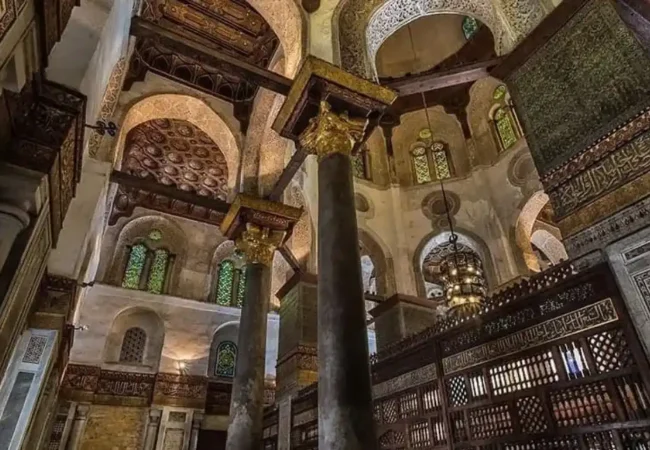
The interior of Al-Aqmar Mosque consists of a small square courtyard, containing a decorated mihrab and a wooden pulpit made of the finest wood, dating back to the Ottoman era. The courtyard is surrounded by a single arcade on three sides, and three arcades in the Qibla Iwan.
The arcades are decorated with Kufic decorative inscriptions, carried on ancient marble columns.
At its entrance is the interlocking arch, which spread in Mamluk architecture in the fifteenth century AD, and above it is the Persian arch, which was created in the shape of a fan with a circle in the middle.
These decorations became widespread in most Islamic architecture after the construction of this mosque.
The ceiling of Al-Aqmar Mosque is also distinguished by its arches and exquisite decorations that reflect the precision of Islamic craftsmanship in that era.
Al-Aqmar Mosque has witnessed many restoration and renovation operations throughout history, including the renovation of the pulpit and minaret during the reign of Sultan Al-Zahir Barquq in 1396 AD, and the last of these was part of the restoration projects of historic Cairo to preserve its architectural beauty.
These restorations helped highlight the magnificence of its engravings and decorations that embody the spirit of the Fatimid era.
The mosque still retains some of the ancient Fatimid decorations. Despite its modest size compared to the rest of the mosques around it, Al-Aqmar Mosque remains unique and has a unique design that attracts attention.
Over the ages, the mosque has witnessed several renovations and restorations that preserved its authenticity and historical beauty, to remain a living witness to the genius of Islamic architecture and the ancient legacy of the Fatimid state.
During the construction period of Al-Aqmar Mosque in the Fatimid era (12th century AD), Egyptian society was distinguished by its diversity and cultural and social richness.
The rule was in the authority of the Fatimid state, which adopted the Ismaili Shiite doctrine, where the class of caliphs, ministers, scholars and thinkers supported urban, artistic and cultural projects, which made Cairo a pivotal center for intellectual and artistic activity.
Skilled craftsmen also played a fundamental role in reviving the landmarks of architecture, engineering and arts.
We must mention the sculptors, potters, carpenters and other artists who contributed to the fine details and architectural decorations that distinguished the mosque, reflecting a high level of creativity and craftsmanship in that era.
The diversity expanded to include economic and social aspects, and also extended to the religious and cultural aspect.
At that time, Muslims from different trends and intellectual currents lived side by side, in addition to the presence of minorities of Christians and Jews who played a role in urban and economic life.
It was constructed in the early 12th century, around 1125–1126 CE.
The exact patron is not definitively recorded; it was built in the Fatimid period by a local patron, typical of the era.
Unlike most mosques, its façade is a prominent, richly decorated exterior wall facing the street, with marble and stucco inscriptions and arabesque motifs.
Fatimid Islamic architecture with a unique exterior, a horizontal façade, carved marble, stucco ornament, and a simple prayer hall behind the façade.
Inside, the layout reflects traditional Fatimid mosque design, with a prayer space aligned toward Mecca and notable decorative details.
Yes. It has undergone restorations and renovations across centuries and survived earthquakes and urban changes.
Over the years it has functioned as a mosque and, at times, has been part of the area’s educational and religious life; today it remains a place of worship and a historic site.
t is accessible to worshippers; visitors can often view exterior architecture and, with appropriate timings and permissions, may enter.
“Al-Aqmar” translates roughly to “The Moonlit” or “The Moon,” reflecting its poetic name.
It is one of Cairo’s notable Fatimid-era monuments, reflecting the architectural and cultural character of Fatimid rule in the city.
Its striking, street-facing exterior façade is unusual and iconic, setting it apart from mosques with interior-focused façades.
Plan a trip to central Cairo; ask for directions to al-Muizz Street and Al-Aqmar Mosque, and check current visiting hours and modesty requirements.
It is recognized as part of Cairo’s rich Islamic architectural heritage and has undergone restoration by Egyptian authorities
If you have not visited Al-Aqmar Mosque before, do not hesitate to do so so that you do not miss out on a lot of goodness and take with you those you love from your family and children so that you can learn about the history of the Fatimid state and the antiquity of history and enjoy seeing the movable decorations and architectural civilization at that time.
The mosque is located on Al-Muizz Li-Din Allah Street, one of the oldest streets in Islamic Cairo that tells the history of the Fatimids.
No matter how long we talk about one of the most important Islamic and archaeological landmarks in Cairo, words fail to describe the effect of seeing it on the soul thirsty to see those glorious Islamic monuments.
Al-Aqmar Mosque is part of everything that embodies the fragrance of history and the splendor of architecture.


Confidently choose your perfect Egyptian adventure from our selection of trusted, expert-curated tours.





Unlock the true wonders of Egypt with confidence. We combine expert local knowledge, seamless logistics, and round-the-clock support to deliver flawless, responsible, and unforgettable travel experiences.