




Giza Pyramids Complex
Giza Pyramids Complex, one of the Seven Wonders of the World are extraordinary architectural feats, consisting of the Great Pyramid of Khufu, the Pyramid of Khafre and the Pyramid of Menkaure, These pyramids were built as tombs for the ancient Egyptian pharaohs, symbolizing their belief in an afterlife and serving to preserve their legacy.
If you think about the state of Egypt, it is possible that the Giza Complex will come to your mind first. there are no other countries in the world in any of these wonderful structures as there is in Egypt.
Egypt has wonders of the seven wonders of the world to which delegations from all over the world come and gather around it like a beehive to see what our ancient Egyptian ancestors did.
The Giza pyramids complex is a symbol of the innovation reached for humans, the ancient Egyptians held the pyramids as a magical stair that leads to the heavens to take their rightful place next to the gods.
Construction and architecture the Giza pyramids Complex in general is a site of the Giza hills on the outskirts of Cairo, including the three great pyramids (Khufu- Khafre and Manures) the sphinx. several tombs .an international labor village and a large industrial complex.
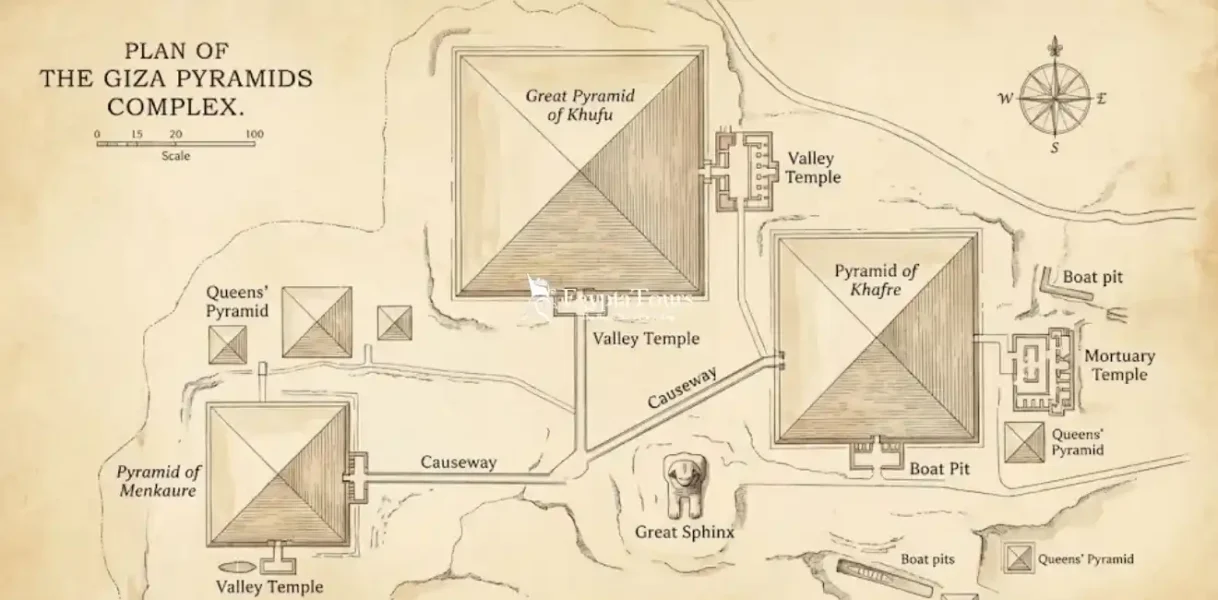
Covering an extensive area, the Giza Pyramids Complex is a monumental necropolis, home to the three iconic pyramids of Giza. Each pyramid is paired with a smaller complex, serving as the burial site for the queens and heirs of the pharaohs, a distinctive feature of this ancient site.
The complex is also famous for the Great Sphinx, Egypt’s celestial protector, which majestically stands to the east.
In addition to the main pyramids, the complex features smaller satellite structures including the queen’s pyramids, valley pyramids and causeways. Unfortunately, these impressive monuments have fallen victim to theft and tomb raiding resulting in irreparable damage to both their interiors and exteriors, as well as the tragic loss of treasures and mummies.
Encircling the Giza Pyramids is a large stone wall that once provided shelter for the workers who constructed these remarkable structures. This area known as the workers’ village dates back to the middle of the 4th Dynasty.
Construction of the Giza Pyramids
Giza Pyramids complex is one of the landmarks that captivates many hearts and spirits. the world was beautiful and was built between 2480:2550. it is a royal tomb each bearing the name of the king he built and was buried in.
it contains three huge pyramids of Khufu, Khafre and Menkaure. Who wanted to stand the test of time and perpetuate their names and heritage through the ages?
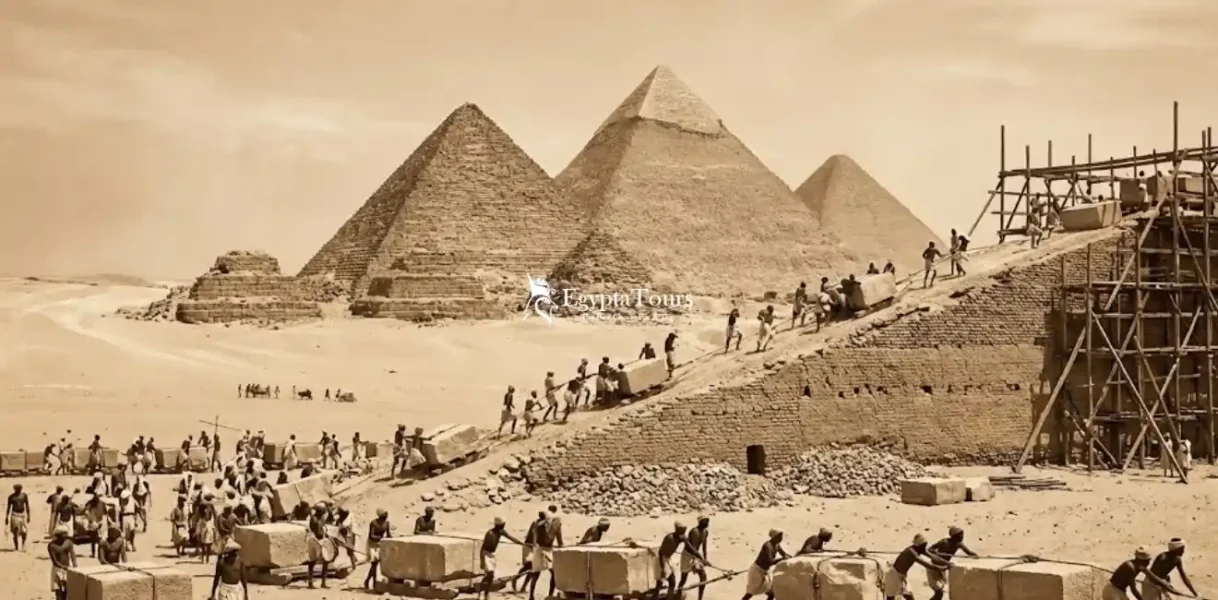
The prevailing theory proposes that these architectural wonders were built by transporting massive stones from quarries and carefully positioning them within the Giza complex.
The innovative architects used advanced techniques to survey the site, strategically placing the first layer of stones and constructing the pyramids on horizontal levels. Each limestone block weighing around 2.5 tons was meticulously stacked to create a symmetrical and balanced structure.
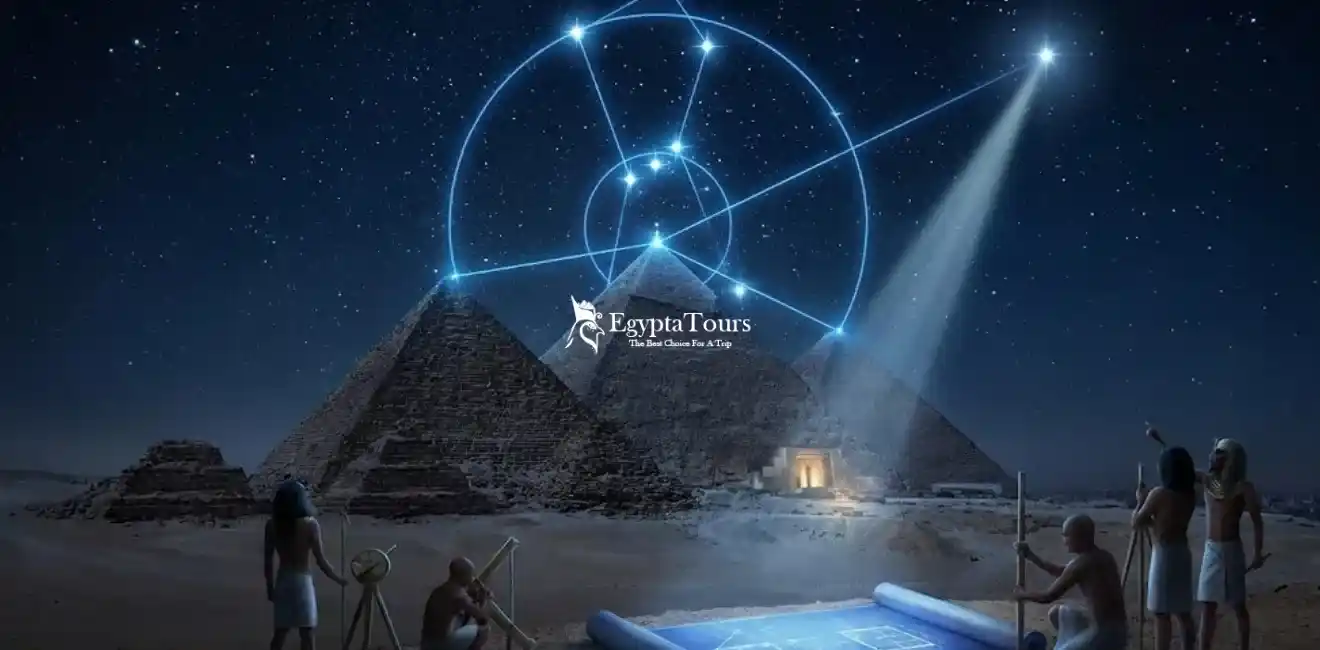
Remarkably, all sides of the three Giza pyramids align almost perfectly with the east west and north south axes deviating by only a tiny fraction of a degree. This precise alignment supports the theory connecting the pyramids’ layout to the Orion constellation, suggesting that the ancient Egyptians had an advanced understanding of astronomy.
After more than 4,500 years the Giza Pyramids complex still stands as a towering symbol of human creativity and resilience, continuing to captivate and inspire visitors from around the world. It remains a timeless testament to our shared heritage and a symbol of our lasting legacy.
Giza Pyramids Complex Site
The ancient Egyptians chose west Nile as the site for their pyramid construction because they believed that the west represented the world of the living. they also built their cities near the Nile River. the complex was located in the western desert 9km west of the Nile and 13km southwest of downtown Cairo.
Tours To Giza Pyramids Complex By Category
| Category Name |
|---|
| Alexandria Tour Packages |
| Cairo Short Breaks |
| Giza Pyramids Day Tours |
| Egypt Honeymoon Packages |
| Egypt Travel Packages |
| Luxor Short Breaks |
| Nile Cruises |
| Egypt Sahara Tour Packages |
The purpose of the Giza pyramids complex
The ancient Egyptians were very interested in building tombs and believed in the idea of life and rebirth after death. they built pyramids to bury kings and put objects next to them. which helped us to get to know food.
clothing and work which made us one of the stars in the sky that lit up our civilization among the civilization among the civilization of the world.
How It Was Built
There is a hidden secret in how to build .in terms of how did he arrive at the final form that would be a map or a painting? How were the large stones used for construction moved? Why are the pyramids still intact?
The reason for the existence of the Giza pyramids Complex was due to skill of the ancient Egyptians in the art of architecture.as well as the use of some of the engineers and brilliant chemists.
here the ancient ingenuity emerged: it was built of intense limestone and red granite was used on the floors as for the walls. basalt and alabaster were made. according to the scientists. a single mass weighs up to 16tons .and it took more than 45 workers to move it.
And it would take 20:30 years for a single pyramid. And this is what scientists came up with in scientific research. after so many minds were helpless in the face of something that amazed the world.
The Pyramid of Khufu
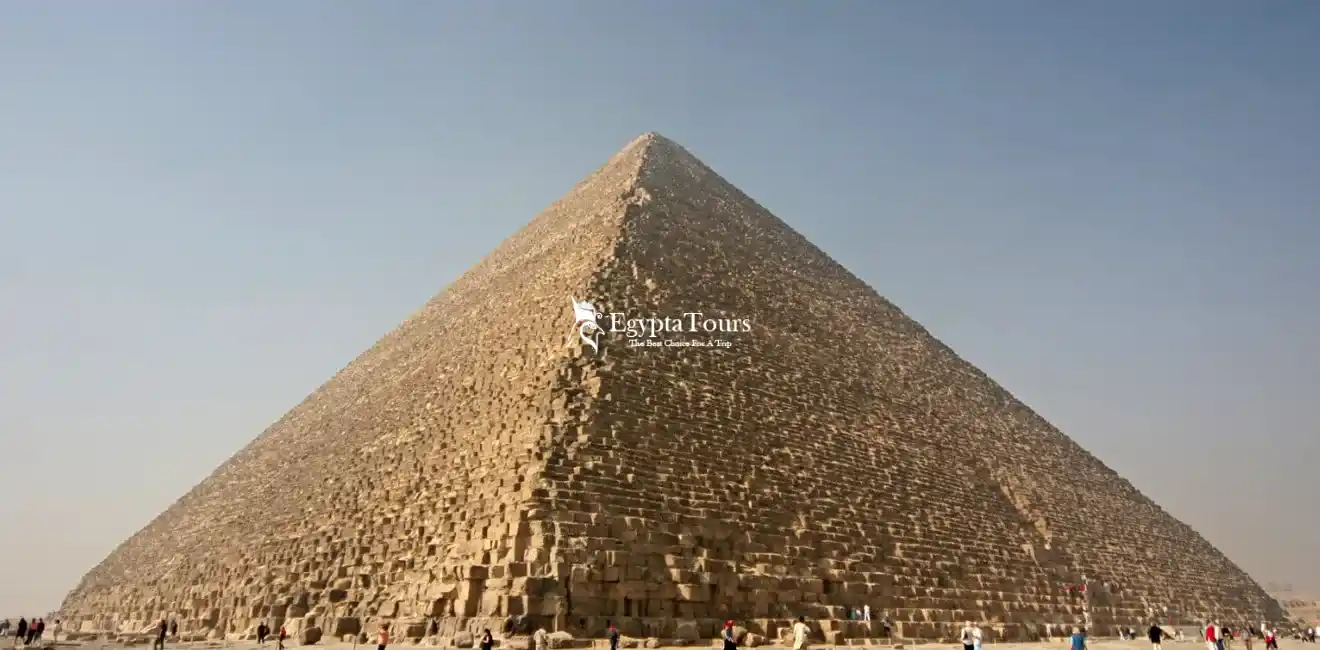
Pyramid-of-Khufu-Great-Pyramid-of-Giza-exterior-view-and-massive-limestone-blocks-EgyptaTours
The miraculous pyramid. which still puzzles scholars and archeologists around the world. stands as a witness to the greatness of the ancient man. here I will take about the loftiness of king Khufu .as he is the second king of the fourth dynasty who followed pharaoh sneferu on the throne.
Khufu found one statue in Abydos now in the Egyptian museum. the largest man-made building ever built .it took 20years to build.
workers lifted two and a half million pieces of stone. each weighing about two tons Built in granite and splendidly covered in chalk.
The pyramid is one of the most consistent Giza pyramids Complex.
Unlike the pyramid .and consists of three elements: the king granite chamber the queen chamber .and the grand gallery. the entire structure was designed by king Khufu hemione. the king minister. who created an unparalleled architectural masterpiece of all time?
The Pyramid of Khafre
Pyramid-of-Khafre-with-intact-casing-stones-and-Great-Sphinx-in-background-EgyptaTours
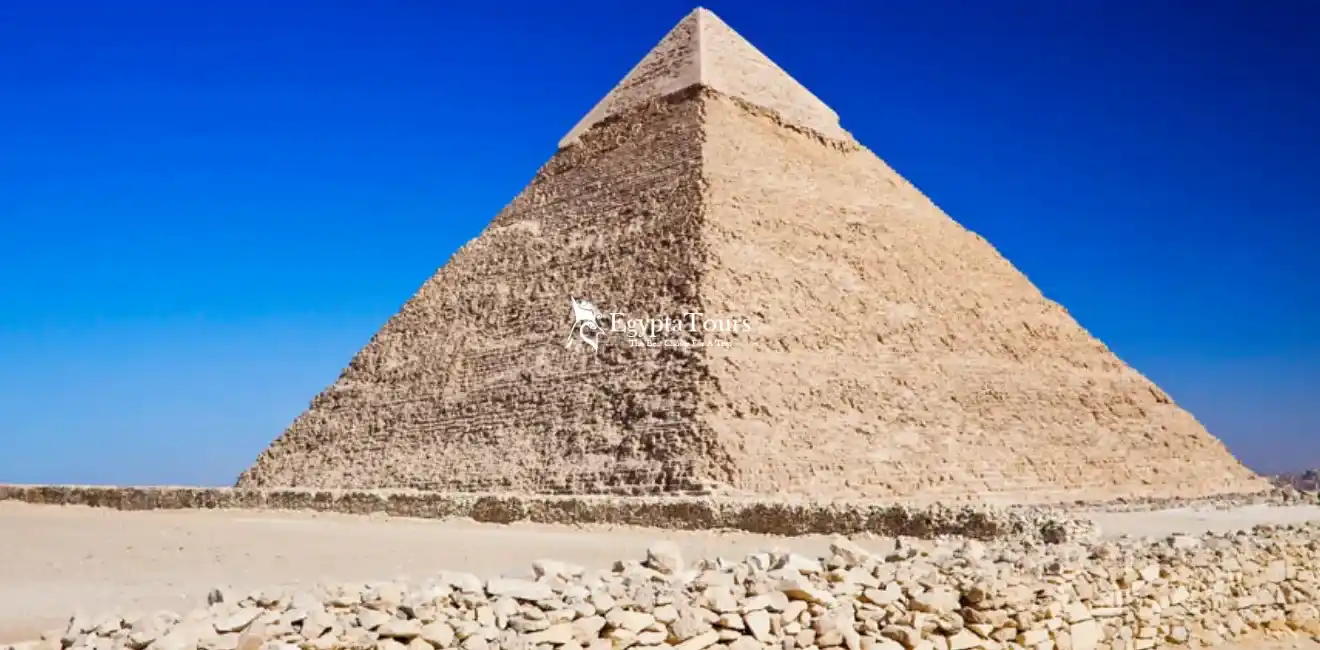
Khafre wanted to create a structure similar to that of his father which became the second largest pyramid in Egypt and in Giza Pyramids complex.
king Khafre was the fourth king of the fourth dynasty and married princess mera ankh. who reigned for twenty –six years? the pyramid is lower than that of his father about 142 meters now 136meters Historians disagree on when the pyramid was built. but it was built in 2559:2535BC.
Arab historian Ibn Abd al-salaam recorded that the pyramid was opened in 1372 AD. the presence of the sphinx next to it gave the pyramid a grand look to be seen from a distance.
The pyramid of Menkaure
Pyramid-of-Menkaure-the-smallest-pyramid-at-the-Giza-plateau-EgyptaTours
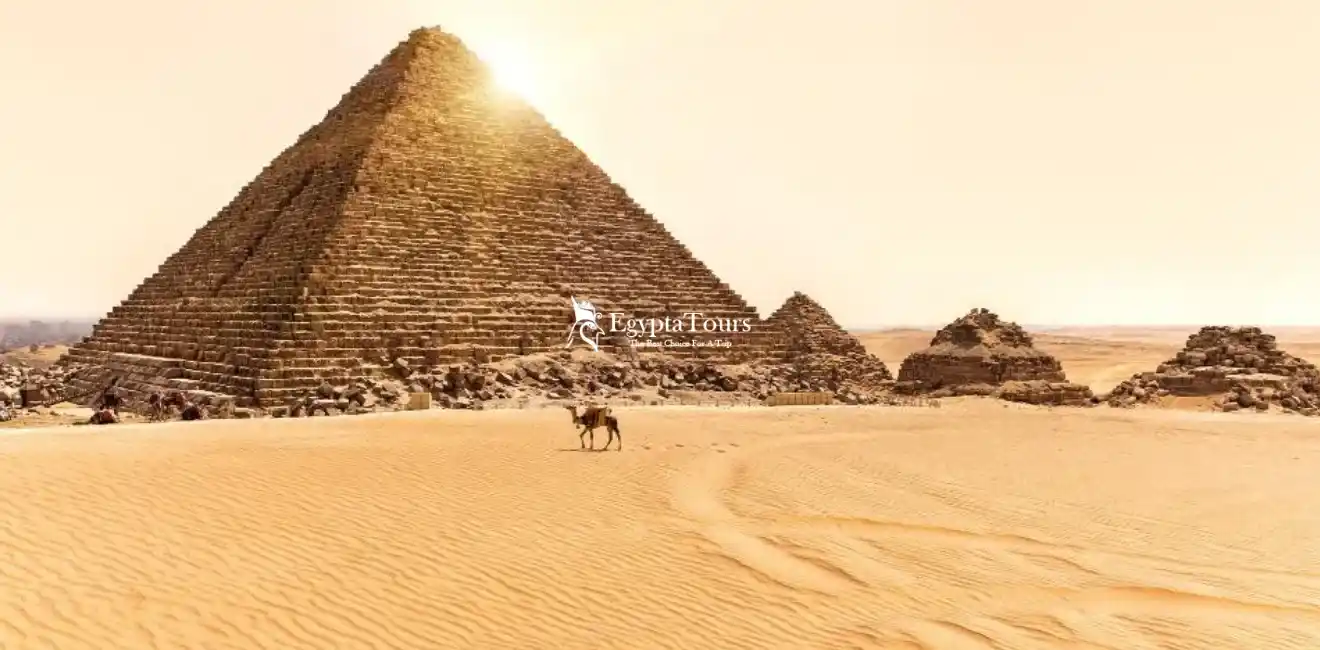
It is the smallest of the three Giza pyramids Complex, so they became three stars that illuminate the Giza area.
It was built by King Menkaure, son of King Khafre of the Fourth Dynasty.
The length of each of its ribs is 108.5 m, and its height is 65.5 m. But its outer covering fell, and its length became 62 m.
It was built of limestone, but the lower part was built of granite that It was brought from Aswan. At the end of the corridor there is a stone vestibule that leads to a horizontal corridor in which there are three barricades, and then the burial chamber.
The Great Sphinx
The-Great-Sphinx-of-Giza-carved-from-limestone-guarding-the-pyramids-EgyptaTours
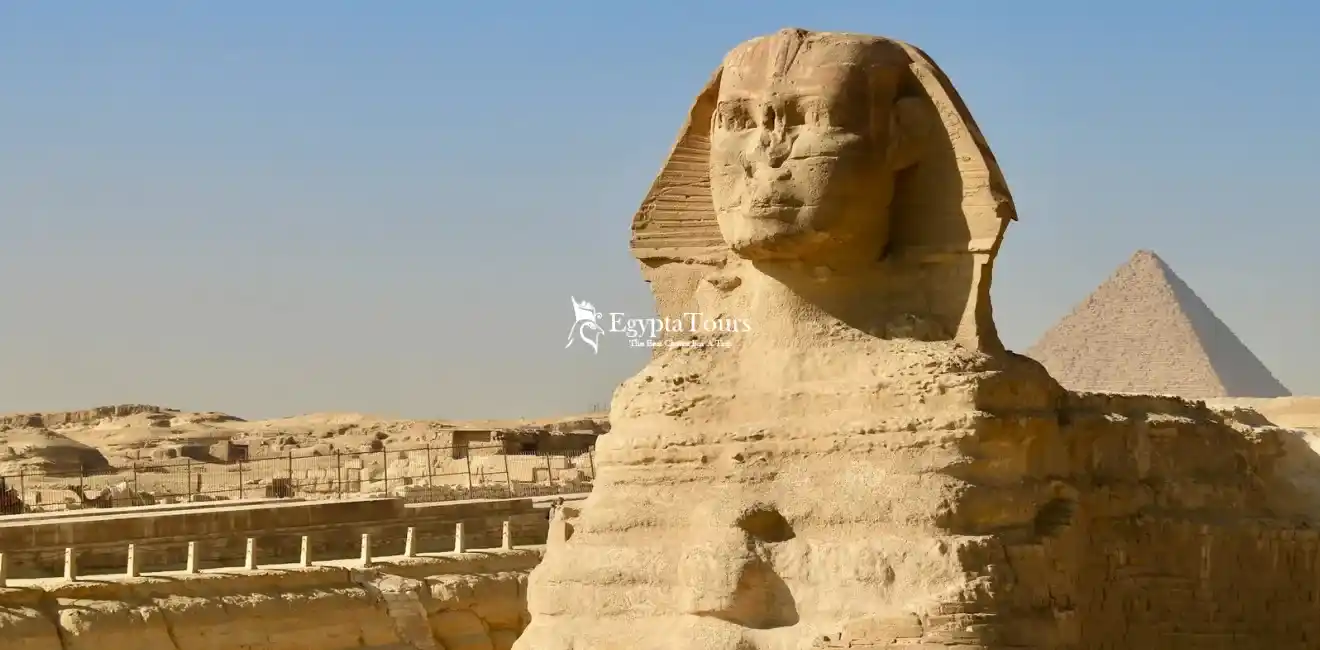
The Great Sphinx is a truly staggering piece of history that feels even more imposing when you’re standing right at its feet. It wasn’t built block by block like the pyramids but was actually carved from a single massive outcropping of limestone that happened to be on the plateau. Most experts believe it was commissioned by Pharaoh Khafre, which makes sense because it seems to guard his specific funerary complex.
There is something haunting about the way it gazes toward the rising sun every morning. Even though it has lost its nose and its original bright paint over the millennia, the sheer scale of the sculpture still manages to stop people in their tracks. It serves as an incredible bridge between the physical world of ancient engineering and the spiritual beliefs of the Egyptians who saw the lion as a symbol of solar protection.
The Valley Temple
The-Valley-Temple-at-Giza-used-for-pharaoh-mummification-rituals-EgyptaTours
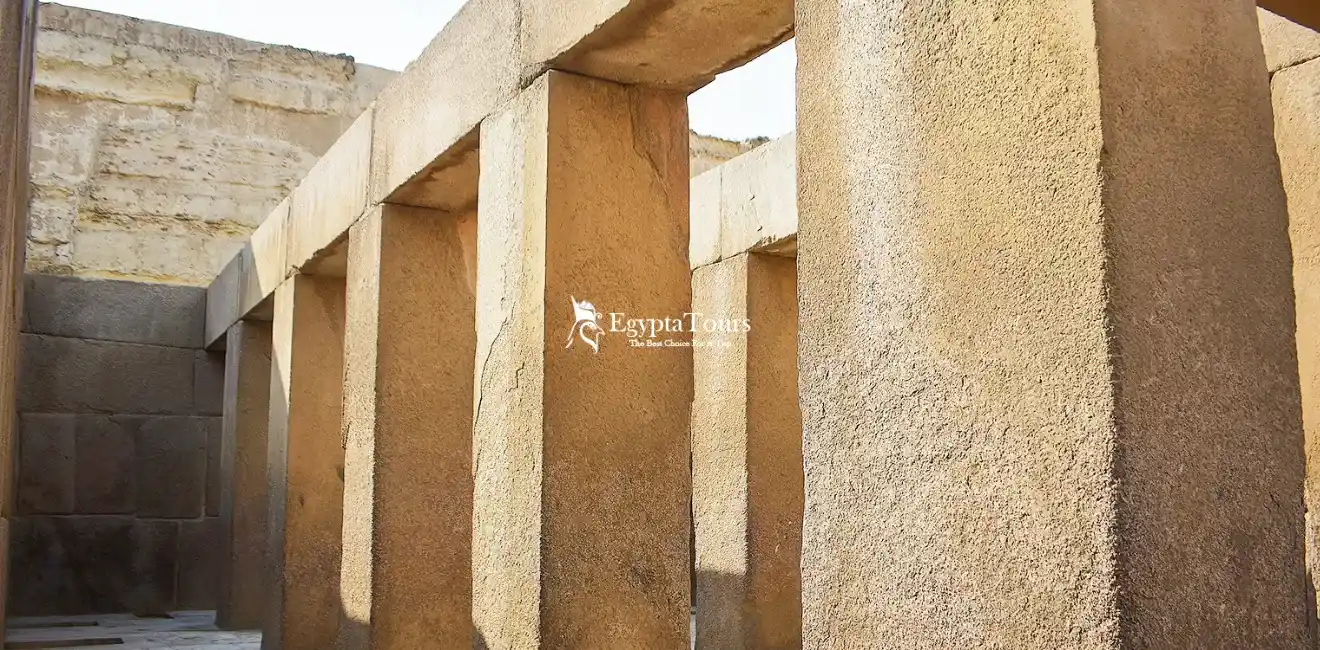
The Valley Temple of King Khafre is one of the best-preserved monuments of the Giza Plateau and offers a fascinating glimpse into ancient Egyptian funerary rituals. Built during the 4th Dynasty, this temple once served as the ceremonial entrance to Khafre’s pyramid complex.
Here, the king’s body was purified and prepared for burial before being taken along the causeway to the pyramid itself.
Constructed from massive limestone and granite blocks, the temple reflects the Egyptians’ advanced architectural skills and their deep belief in the afterlife. Inside, statues of King Khafre were discovered, including the famous diorite statue now housed in the Egyptian Museum. Standing beside the Great Sphinx, the Valley Temple remains a powerful reminder of royal authority, religious devotion, and the enduring legacy of ancient Egypt.
The Worker’s Village
The-Workers-Village-at-Giza-revealing-homes-and-bakeries-of-pyramid-builders-EgyptaTours
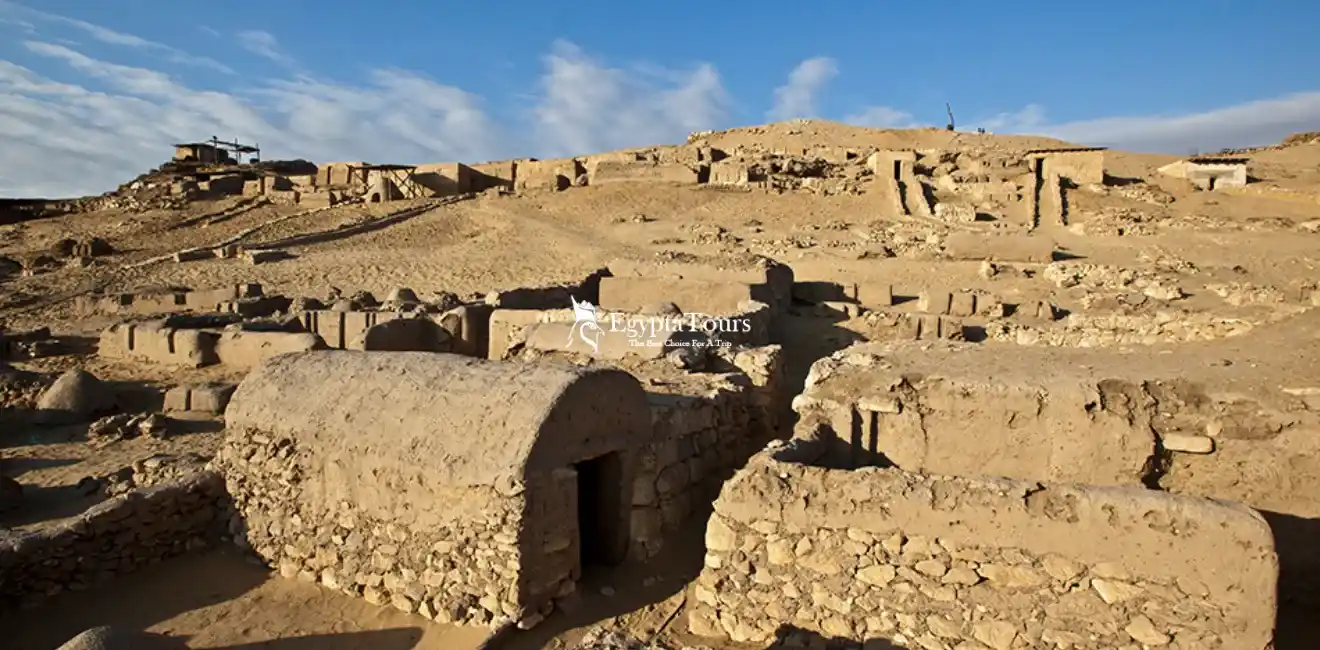
The Worker’s Village is an important archaeological site from the middle of the 4th Dynasty, it was more than just a busy center for over 10,000 workers. It stands as a testament to their relentless dedication and hard work. These workers, including quarrymen, metalworkers, architects, carpenters, haulers and masons devoted more than thirty years of their lives to building the magnificent Giza Pyramids.
It is located in the west of Giza and was considered more than just a place of operation, it was a reflection of the workers’ status and well being. The numerous tombs of the pyramid builders serve as proof of their position as well paid, well fed laborers as well as a tribute to their accomplishments and the respect they earned.
Its location on the southeast of the Khafre and Menkaure complexes was more than just a workplace, it was a thriving community. It featured communal sleeping quarters, breweries, bakeries and kitchens. The remains of these structures along with discoveries of bread, beef and fish provide insight into the workers’ diet. The village also had a hospital and a cemetery emphasizing the importance of workers’ welfare.
The Worker’s Village and the Giza Pyramids are not only amazing architectural sites but also rich sources of ancient Egyptian art. The art of the tombs are filled with intricate details, symbolism and portrays scenes from everyday life during this era. These include farming, livestock tending, fishing, fowling, carpentry, metalworking, religious ceremonies and burial practices. Each scene offers a fascinating window into the past shedding light on the customs, beliefs and activities of the ancient Egyptians.
Giza Settlement
The Giza Settlement is situated to the southeast of the Khafre and Menkaure complexes. Among the finds in the workers’ village are communal sleeping areas, bakeries, breweries, kitchens, a hospital and a cemetery. The settlement is believed to be built in the middle of the 4th Dynasty after the reign of Khufu.
The extensive tasks of quarrying, transporting, positioning and carving the massive stones used to build the pyramids likely involved thousands of skilled workers, unskilled laborers and support staff. In addition, bakers, carpenters, water carriers and other specialists were essential to the project.
Mastaba of seshemnefer
The Mastaba of Seshemnefer is one of the most significant tombs in the GIS cemetery of the Giza Necropolis in Egypt dating back to the early Sixth Dynasty. The tomb was fully uncovered during Junker’s excavations. It dates to around 2340 BCE and was built for the official Seshemnefer. Five reliefs from the mastaba of Seshemnefer are currently displayed in the Egyptian collection of the Roemer und Pelizaeus Museum in Hildesheim.
Mastaba of Hemiunu
The Hemiunu Mastaba which is located in the Giza Western Field near Khufu’s pyramid, contains reliefs depicting his image. Some stones from his severely damaged mastaba are inscribed with dates referring to Khufu’s reign. A statue of Hemiunu is displayed at the Pelizaeus Museum in Hildesheim, Germany. The mastaba had been looted by ancient thieves searching for valuable items and the wall leading to the serdab had a child sized hole cut into it.
Tomb Complex of Senedjemib
The Senedjemib Tomb Complex belongs to two high ranking officials from the 5th and 6th dynasties, Senedjemib Inti and Senedjemib Mehi. Located in the Western Cemetery of the Giza Plateau, the complex consists of several mastabas belonging to Senedjemib Inti and his family who served as high officials during the reigns of Djedkare Isesi and Unas in Egypt’s Fifth Dynasty .
The primary tomb of Senedjemib Inti features an inscribed false door, an offering chamber and detailed autobiographical texts. These inscriptions recount his service as vizier overseer of works and chief architect and document royal commissions including construction projects at royal pyramid complexes and other administrative duties. The tomb complex also includes subsidiary chapels and burial shafts for family members offering valuable insights into the roles of elite officials and funerary practices during the end of the Old Kingdom.
Astronomy’s Relationship to How Giza Pyramids complex was built
Astronomy-and-alignment-of-the-Giza-Pyramids-complex-with-stars-and-cardinal-directions-EgyptaTours
Astronomy is often recognized as the oldest science, and ancient monuments such as the Pyramids of Giza align precisely with the positions of the moon and sun on the horizon.
There are many fantasies about how the ancients built and orientated these structures, which has led to many assumptions being put forward as some suggest that prehistoric humans had some knowledge of mathematics and science to implement it, while others went too far in their imaginations and reached the point of speculating that visitors Potential aliens, teach them how to build the ancient pyramids.
The pyramids of Egypt are among the most impressive ancient monuments, and Egyptologist, Flinder Petrie, conducted the first highly accurate survey of the Giza Pyramids Complex in the nineteenth century. He discovered that each of the four edges of the Giza Pyramids Complex indicate a cardinal direction within a quarter of a degree.
The Giza Complex, located on the Giza Plateau, is one of the most iconic and enduring symbols of ancient Egypt.
Constructed during the 4th Dynasty, this remarkable site is home to the Great Pyramid of Giza, built for Pharaoh Khufu, along with the smaller pyramids of his successors, including the Queens’ Pyramids.
The pyramids were originally covered with smooth limestone casing stones, giving them a polished, gleaming appearance that has mostly worn away over time.
The complex also includes the Valley Temple, a structure that was used for religious ceremonies and mummification processes associated with the burial practices of the pharaohs.
FAQs
What pyramids are in the Giza Pyramids complex?
The Giza pyramids complex is one of the oldest and most famous examples of ancient Egyptian architecture, It was built during the Fourth Dynasty of ancient Egypt (2494-2345 BC). The Giza pyramids complex consists of the ruins of three pyramids, a mortuary temple, and a large valley.
The three pyramids are the Great Pyramid of Giza (Also known as Khufu and the Pyramid of Cheops), the Middle one is known as the Pyramid of Khafre or Chephren, and the Small one is known as the Pyramid of Menkaure or Mykerinus.
How many pyramids are in the Giza Pyramids complex?
Giza is the largest of several sites in Egypt where large pyramids have been built. There are three main pyramid complexes at Giza: the Great Pyramid, the Pyramid of Khufu, and the Pyramid of Menkaure.
What do Giza Pyramids complex represent?
The Giza Pyramids Complex are among the oldest and most recognizable structures on Earth. They have been a source of fascination for thousands of years, with debate still ongoing regarding their true purpose.
Some believe they were built as tombs for Pharaohs, while others believe they may have been used as observatories or storage facilities. No one can say for certain what the pyramids were originally used for, but their iconic appearance remains unchanged and continues to intrigue people to this day.
What are the 3 small pyramids of Giza called?
Giza Pyramids Complex are among the oldest and most recognizable structures on Earth. The largest pyramid is the Great Pyramid of Giza, which was built for the pharaoh Khufu. It is over 480 feet tall and made from millions of blocks of stone. The other two pyramids are the Pyramid of Khafre and the Pyramid of Menkaure.
Why did the pyramids start to crack?
The great pyramids of Giza were built over 4,500 years ago and are some of the oldest structures on Earth and is the greatest one of Giza Pyramids Complex. But over the last few decades, they have started to crack and crumble.
Archaeologists aren’t sure why this is happening, but they speculate that it may be due to a combination of factors including climate change, water erosion, and the use of modern construction techniques.
The Egyptian government has announced plans to preserve and rebuild some of the pyramids if necessary, but for now they remain a mystery – and a source of fascination for historians and tourists alike.
Which of the 3 pyramids is the Great Pyramid?
The Great Pyramid of Giza is the oldest and largest of the three pyramids in the Giza pyramids complex. It is the only one of the Seven Wonders of the Ancient World that remains largely intact. The Great Pyramid was built over a period of 20 years, c. 2560-2540 BC, for the pharaoh Khufu (Cheops) subsequently, it is named after him.
What is under the pyramids?
According to some theorists, the ancient Egyptians may have excavated a series of chambers and tunnels that lead down to underground caverns containing valuable treasures—including lost treasures from ancient empires. The theory is that the chambers and tunnels have been hidden for centuries, but are now being explored by a small group of treasure hunters. The chamber full of gold and jewels, as well as other riches, was discovered by an ancient Egyptian who had studied at the University of London.
Can you go inside the Giza pyramids Complex?
Yes, you can go inside the Giza Pyramids Complex. But the ticket is not included in your trip to the Pyramids. Nevertheless, It is around 6$ only.
Who really built the Giza Pyramids complex?
This is a question that has puzzled archaeologists and historians for centuries. The answer is that nobody knows for sure. Scholars have proposed any number of theories, but none of them has been proven. The Pyramid of Khufu (also known as the Great Pyramid) was built by Menkaure, Khafre and Menkaure.
Who is the Queen of Giza?
The Queen of Giza is an ancient Egyptian queen who ruled during the Second Dynasty. She is believed to have been the daughter of King Sneferu and Queen Khamerernebty II and was the sister of King Khufu. Her burial site has not been found yet, but she may have been buried in a pyramid at Giza.
Is the Sphinx a pyramid?
The ancient Egyptians built the Sphinx as a towering symbol of their power and strength. Generations of historians have debated whether or not the Sphinx is actually a pyramid, but there is little evidence to support either theory. If it is a pyramid, then it would be one of the oldest known examples in existence and one of the most mysterious structures on Earth.
Who is the face of the Sphinx?
The Sphinx is one of the oldest and most iconic symbols in history. The face on the monument has been carved into limestone for over 4,500 years, and it remains a mystery who is behind it. Some believe that the Sphinx is the head of a lioness, while others believe that it was once the body of an Egyptian pharaoh. Regardless of its origins, the Sphinx is an important part of ancient Egyptian culture and remains one of Egypt’s most popular tourist destinations.
Why didn’t Egyptians build pyramids?
The Pyramids were built by the grand ancestors of the Egyptians, the Pharaohs.
What religion built the Giza Pyramids complex?
The Egyptians believed in a pantheon of gods and goddesses who were responsible for the natural world, human life, and the afterlife. The pharaohs were considered to be the incarnations of these gods and were believed to have had a direct relationship with the divine. The religion of the pharaohs was a complex and powerful force in ancient Egypt, and it played an important role in shaping society and culture.
How were the pyramids built so perfect?
The ancient Egyptians were some of the most accomplished builders in history, and their pyramids are some of the most mysterious structures ever built. How were they able to construct such perfect pyramids without modern tools or construction methods? Theories abound, but no one knows for sure how the ancient Egyptians were able to build such amazing pyramids.
The Great Pyramid was built using a technique called “pyramid building.” This term was used by the ancient Egyptians to describe any structure that had a triangular shape, a base, and an internal core. The method of pyramid building is called a “step pyramid”. This means that it is built in layers.
Does the Bible mention the Giza Pyramids complex?
The pyramids are one of the most famous structures in the world, and they have been a source of fascination for centuries. Many people believe that the pyramids were built by ancient Egyptians, but the Bible doesn’t mention them at all. Some people believe that the pyramids were built as tombs for Pharaohs, but there is no proof that this is true. Theories about what the pyramids were used for continue to be proposed, but no one knows for sure.
Which is oldest religion in world?
The world’s oldest religion is probably shamanism. It likely predates any other organized religion, and its origins are still unknown. Some believe it may have started with early humans trying to understand their environment better, and others suggest that it may represent an earlier form of shamanism. Regardless of its origins, shamanism has been practiced by people all over the world for centuries, and there are still many tribes and cultures that practice it today.
The world’s oldest religion is probably shamanism. It likely predates any other organized religion, and its origins are still unknown. Some believe it may have started with early humans trying to understand their environment better, and others suggest that it may represent an earlier form of shamanism. Regardless of its origins, shamanism has been practiced by people all over the world for centuries, and there are still many tribes and cultures that practice it today.
What does the Bible say about Egypt?
The ancient Egyptians were among the most influential and advanced civilizations of their time.
They built some of the most impressive pyramids ever constructed and developed many ingenious ways of life. However, there is much that the Bible has to say about Egypt. For example, the Bible records that Egypt enslaved Israel (Exod. 12:37-38), that Israel made a treaty with Pharaoh (Exod. 12:40), and that Moses led the Israelites out of Egypt (Exod. 14:4-15).
The Bible also mentions that Pharaoh’s daughter found Moses hiding in a basket (Exod. 2 24-25), and that after being rescued from the Nile, Moses and the Israelites travelled through the desert for 40 years (Exod. 5 7-12).
The oldest writings about Egypt date to about 3,400 years ago, and concern the periods of Egyptian history before the birth of Moses.
Live Your Dream Tour With Egyptatours Throughout Our Egypt Classic Tours Packages , Nile Cruises , Day Tours Or At Least You Can send us a request To Build Your Tour
About EgyptaTours

EgyptaTours is a name synonymous with trust, excellence, and unforgettable travel experiences, proudly standing as one of the leading travel agencies in Egypt. Renowned for its deep expertise, personalized service, and carefully crafted itineraries, EgyptaTours serves as the ultimate gateway to discovering Egypt in its most authentic and inspiring form.